Verb Patterns: Want to Eat or Like Eating?

 This article explains verb patterns, focusing on when to use verbs with to-infinitives or -ing forms. It covers verbs that take both patterns, how their meanings change, common mistakes, and includes exercises for practice.
English learners often find it challenging to choose between phrases like "wish to try" and "enjoy trying" because some verbs are followed by the infinitive form while others require the -ing form. For example, "wish" is typically followed by the infinitive, as in "wish to try," whereas "enjoy" is followed by the -ing form, as in "enjoy trying." Learning these verb patterns is important, since using the correct form will help you communicate more naturally and confidently in both spoken and written English.
What Are Verb Patterns?
Understanding how verbs connect with other words is crucial in English. Certain verbs are followed by specific structures, such as another verb in the infinitive form or the gerund (-ing form). These predictable combinations are known as verb patterns, and mastering them helps you build natural, accurate sentences.
Why Verb Patterns Matter
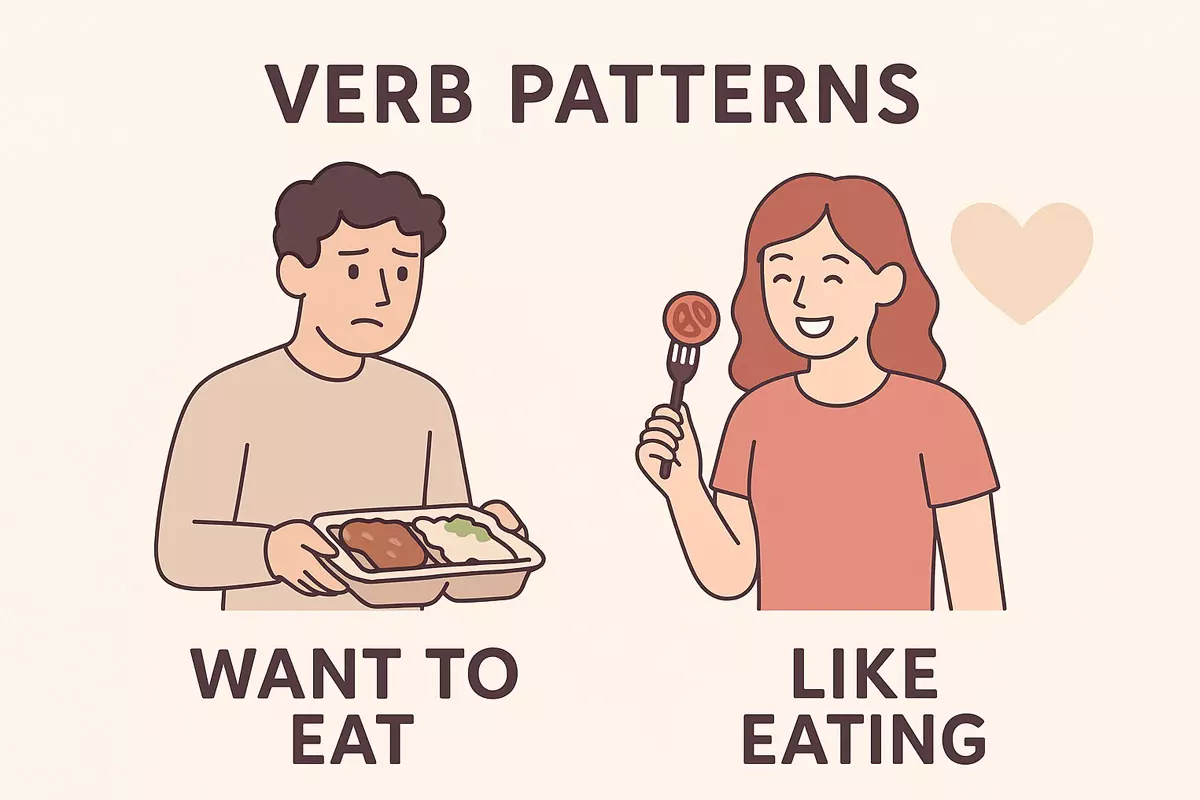
Verb patterns determine what kind of word or phrase can logically and grammatically follow a verb. Using the wrong pattern can confuse your listener or even change your meaning. For example, “I want to eat” and “I like eating” use different structures after the main verb, and switching them can sound odd or incorrect.
Common Types of Verb Patterns
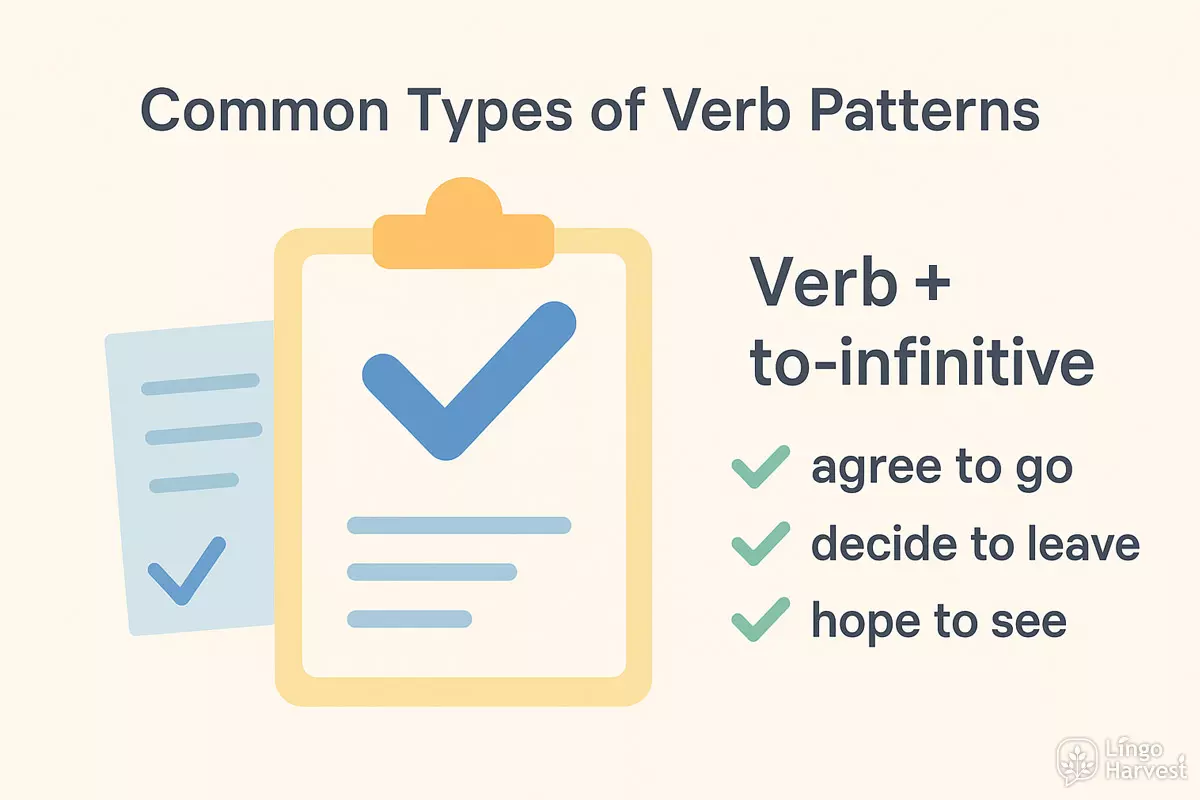
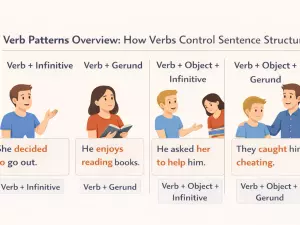
English verbs tend to fall into several main categories based on what follows them. Here are some key patterns:
- Verb + to-infinitive: agree to go, decide to leave, hope to see
- Verb + -ing (gerund): enjoy reading, suggest going, avoid talking
- Verb + object + to-infinitive: want him to stay, ask her to help, tell them to wait
- Verb + object + bare infinitive: make me laugh, let him go, help her finish
- Verb + that-clause: think that it’s true, know that he left, believe that she can
These patterns are not interchangeable; each verb “prefers” a certain structure. Sometimes, a verb can use more than one pattern, but the meaning may change.
Examples of Verbs and Their Preferred Patterns
Below is a comparison of some common verbs and the forms they are typically followed by:
| Verb | Usual Pattern | Example |
|---|---|---|
| want | to + infinitive | I want to eat. |
| enjoy | verb + -ing | She enjoys swimming. |
| ask | object + to + infinitive | They asked him to help. |
| let | object + base verb | Let me explain. |
| suggest | verb + -ing | I suggest leaving now. |
| help | object + base verb / to + infinitive | She helped me (to) carry the bags. |
| decide | to + infinitive | We decided to stay. |
| make | object + base verb | He made me cry. |
| avoid | verb + -ing | They avoid eating late. |
| expect | object + to + infinitive | I expect you to understand. |
Learning Patterns Efficiently
It’s helpful to learn verbs in groups according to their typical structure. Practice with real sentences and pay attention to which forms follow each verb. Over time, these combinations will become familiar and automatic in your speech and writing.
Verb + To-Infinitive Pattern
When learning English, you’ll notice that certain verbs are usually followed by the base form of another verb, introduced by “to.” This construction is common with verbs expressing desires, plans, intentions, or preferences. For example, in “want to eat,” the verb “want” is followed by “to” and the infinitive “eat.” This pattern helps clarify what action is being considered, intended, or preferred.
Common Verbs That Use “To” + Infinitive
Some verbs almost always take the infinitive form of the next verb. Here are some of the most frequent ones:
- want to (I want to leave.)
- hope to (She hopes to travel.)
- decide to (They decided to join us.)
- plan to (We plan to move.)
- agree to (He agreed to help.)
- offer to (She offered to drive.)
- promise to (You promised to call.)
- refuse to (He refused to answer.)
- learn to (She’s learning to swim.)
- forget to (Don’t forget to lock the door.)
- need to (I need to study.)
- manage to (He managed to finish on time.)
- fail to (They failed to notice.)
- choose to (We chose to wait.)
- prepare to (She prepared to present.)
- seem to (He seems to understand.)
- expect to (I expect to see you.)
- ask to (He asked to join.)
How the “To”-Infinitive Works in Sentences
This construction is used when the first verb refers to a mental process, intention, or willingness. For example:
- “I hope to visit Paris someday.” (intention)
- “She refused to answer the question.” (willingness)
- “We plan to organize a meeting.” (plan)
Notice that the meaning often changes if you switch to a different verb form; for example, “like eating” (habit or enjoyment) vs. “want to eat” (desire).
Comparison: “To”-Infinitive vs. Gerund Patterns
The choice between using “to” + infinitive or the -ing form (-ing/gerund) after certain verbs can completely change the meaning or just reflect standard usage. For instance, “remember to call” (don’t forget to do it) vs. “remember calling” (recall having done it). Some verbs accept both forms, but many do not.
| Verb | Example with “To” + Infinitive |
|---|---|
| want | I want to learn English. |
| decide | They decided to leave early. |
| offer | She offered to help us. |
| promise | You promised to finish the project. |
| refuse | He refused to answer. |
| hope | We hope to see you again. |
| need | I need to rest. |
| plan | They plan to visit soon. |
Understanding which verbs require this pattern is essential for natural-sounding English. When in doubt, consult a reliable grammar source or pay attention to how these verbs are used in authentic English contexts. Using the right structure will help you express intentions, preferences, and actions more clearly.
Verb + -ing Pattern
Some English verbs are naturally followed by another verb in its -ing form (the gerund). This structure is common when talking about activities, preferences, and habits. Using the gerund after such verbs is essential—changing it to the infinitive often makes the sentence sound odd or incorrect.
Common Verbs That Take the -ing Form
Many everyday verbs require a following verb to end in -ing. Here are some of the most frequently used:
- enjoy
- like
- love
- dislike
- hate
- prefer
- avoid
- recommend
- suggest
- consider
- admit
- deny
- imagine
- miss
- finish
- keep (on)
- practice
- risk
- mind
- postpone
Examples in Context
These sentences show how the pattern works:
- I enjoy reading before bed.
- She suggested going for a walk.
- He admitted making a mistake.
- They avoided talking about the problem.
- Do you mind opening the window?
How This Pattern Differs from the Infinitive
Some verbs are only followed by the -ing form, while others take the infinitive (to + verb), and a few can use both but with different meanings. For example, "like" can be followed by either, but "enjoy" always needs -ing. Choosing the correct structure changes the meaning or keeps the sentence natural.
| Verb | Example with -ing |
|---|---|
| enjoy | I enjoy swimming. |
| suggest | She suggested meeting earlier. |
| avoid | They avoid eating late. |
| finish | He finished writing the report. |
| mind | Do you mind closing the door? |
| recommend | I recommend trying this dish. |
Tips for Mastery
Learning which verbs need -ing comes down to practice and exposure. When unsure, check a dictionary or reliable grammar source. Over time, you’ll recognize the pattern and use it naturally in speech and writing. Remember: forcing an infinitive after these verbs usually sounds wrong to native speakers.
Verbs That Can Take Both Forms
Some English verbs allow you to use either the infinitive (to + verb) or the gerund (verb + -ing) after them, with little or no change in meaning. These flexible verbs are useful for learners because they give more options and can make sentences sound more natural. However, in some cases, the meaning might change slightly depending on which form you choose, so it’s important to be aware of context.
Common Examples of Flexible Verbs
Here are several verbs that accept both patterns. For most, the difference is subtle or nonexistent, but for a few, the choice can affect the meaning:
- begin: She began to sing. / She began singing.
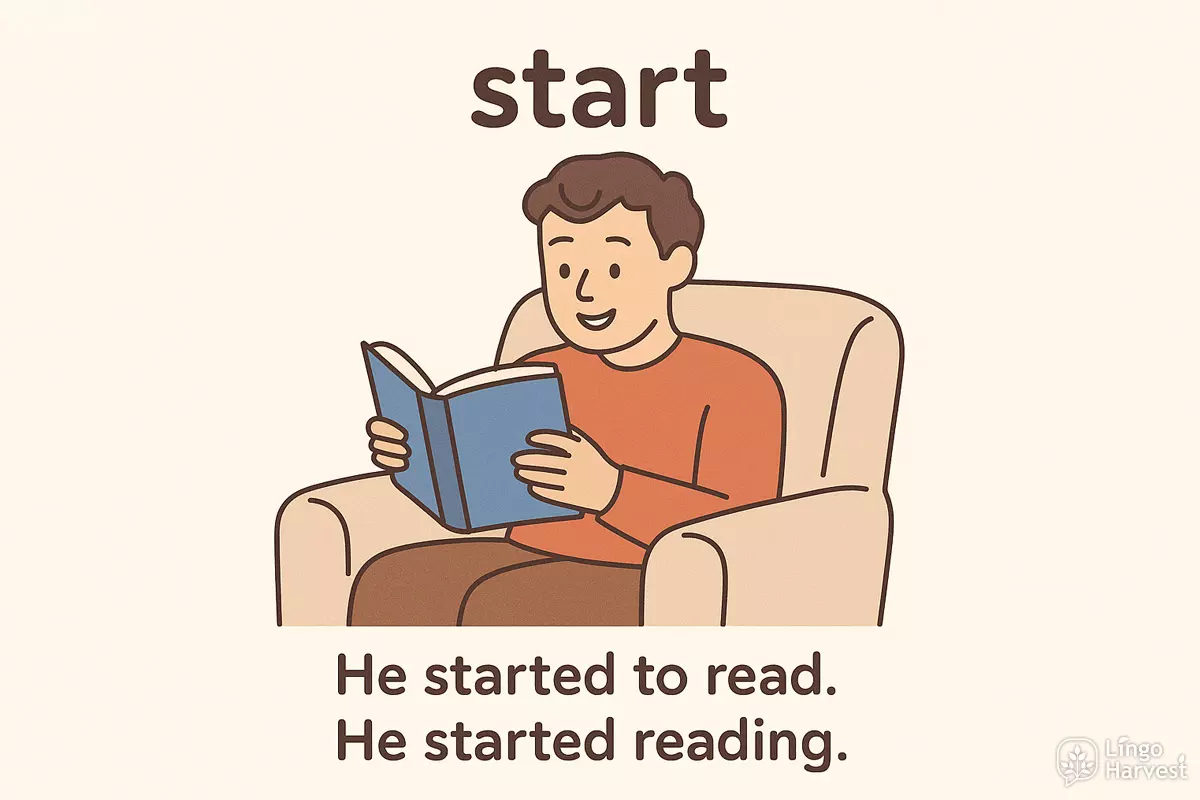
- start: He started to read. / He started reading.
- continue: They continued to talk. / They continued talking.
- like: I like to swim. / I like swimming.
- love: She loves to dance. / She loves dancing.
- hate: He hates to wait. / He hates waiting.
- prefer: We prefer to walk. / We prefer walking.
- attempt: They attempted to escape. / They attempted escaping.
- intend: I intend to leave. / I intend leaving.
- can’t bear: She can’t bear to lose. / She can’t bear losing.
- can't stand: I can’t stand to wait. / I can’t stand waiting.
- propose: He proposed to increase taxes. / He proposed increasing taxes.
- neglect: They neglected to lock the door. / They neglected locking the door.
- intend: We intend to visit. / We intend visiting.
Subtle Differences in Meaning
For many verbs such as begin and start, there is no real difference in meaning between the infinitive and the gerund. However, verbs like remember, forget, and regret do change meaning depending on the form that follows:
- Remember to do: Don’t forget to do something.
Remember doing: Recall a past action. - Forget to do: Not remember to complete something.
Forget doing: Not recall a past experience. - Regret to do: Regret what you are about to say.
Regret doing: Regret something in the past.
Summary Table: Verbs Accepting Both Infinitive and Gerund
| Verb | Example Sentences |
|---|---|
| start | He started to laugh. / He started laughing. |
| continue | They continued to argue. / They continued arguing. |
| like | I like to read. / I like reading. |
| hate | She hates to clean. / She hates cleaning. |
| remember | Remember to lock the door. / I remember locking the door. |
| regret | I regret to inform you… / I regret telling you. |
| prefer | We prefer to drive. / We prefer driving. |
| love | He loves to travel. / He loves traveling. |
| can’t bear | I can’t bear to lose. / I can’t bear losing. |
| intend | She intends to resign. / She intends resigning. |
In summary, knowing which verbs allow both forms gives you more expressive power in English. Always check whether the meaning changes with each form, especially with verbs like remember or regret, and enjoy experimenting with different sentence structures.
Meaning Changes with Patterns
How you use verbs like want or like with different patterns in English can actually change the meaning of what you say, sometimes in subtle but important ways. Some verbs allow both the to + infinitive and the –ing form, but the choice isn’t always just about style—it often signals a shift in meaning, focus, or even intention.
Common Verbs with Different Patterns
Let’s look at some common verbs where the grammatical structure you choose affects the interpretation:
- Remember: "I remembered to lock the door" (I didn’t forget to do it) vs. "I remember locking the door" (I have a memory of doing it).
- Stop: "She stopped to talk" (paused in order to talk) vs. "She stopped talking" (no longer talked).
- Try: "Try to open the window" (make an attempt) vs. "Try opening the window" (experiment to see if it helps).
- Forget: "He forgot to call" (didn’t remember to call) vs. "He forgot calling" (doesn’t recall the action).
- Mean: "I meant to tell you" (intended to) vs. "This means starting over" (entails).
- Regret: "I regret to inform you" (I’m sorry to tell you now) vs. "I regret telling her" (I wish I hadn’t told her).
- Go on: "He went on to say..." (did something new) vs. "He went on saying..." (kept doing the same thing).
- Like: "I like to swim" (prefer as a habit) vs. "I like swimming" (enjoy the activity).
- Dread: "I dread to think" (don’t want to imagine) vs. "I dread going to the dentist" (fear the experience).
- Need: "The car needs to be washed" (someone should wash it) vs. "The car needs washing" (passive meaning, needs the action).
Comparison Table: Pattern Choice and Meaning
| Verb + Pattern | Meaning |
|---|---|
| Remember + to + verb | Do not forget to do something (future/obligation) |
| Remember + verb-ing | Recall a memory of doing something (past event) |
| Stop + to + verb | Pause one action to start another |
| Stop + verb-ing | Cease the action completely |
| Try + to + verb | Make an effort or attempt |
| Try + verb-ing | Experiment to see if something works |
| Forget + to + verb | Not remember to do something (didn’t happen) |
| Forget + verb-ing | Not remember an event that happened |
Why Do Patterns Affect Meaning?
The core difference often comes down to time or perspective: to + infinitive usually looks forward (actions yet to happen or intentions), while –ing forms refer to experiences, memories, or ongoing actions. Understanding these distinctions helps you communicate more precisely and avoid misunderstandings in English.
So, when you choose between forms like want to eat or like eating, you’re not just picking a random structure; you’re shaping what you actually mean. Pay attention to these patterns, especially with verbs that can take both, to make sure your message is clear.
Common Mistakes
Learners often mix up which verb form follows "want" and "like," leading to sentences that sound unnatural or are grammatically incorrect. The confusion usually comes from the different structures these verbs require. For example, "want" is typically followed by the infinitive ("to eat"), while "like" is usually followed by the gerund ("eating"). These patterns are not interchangeable, and using the wrong form can make your English sound awkward.
Confusing Verb Forms
A major source of errors is treating "want" and "like" as if they follow the same rule. Here are some typical mix-ups to watch out for:
- Using a gerund after "want": She wants eating ice cream. ❌ (Incorrect)
- Using an infinitive after "like": I like to swim. ✅ (Correct, but less common in everyday English; "I like swimming" is preferred.)
- Forgetting to use "to" after "want": They want go home. ❌ (Incorrect)
- Mixing up subject structures: He likes eat chocolate. ❌
Exceptions and Flexibility
While "like" can sometimes be followed by the infinitive, especially in American English ("I like to read"), using the gerund ("I like reading") is generally more natural and frequent. However, "want" almost always requires the infinitive. Avoid switching these patterns.
Comparison Table: Correct & Incorrect Patterns
| Incorrect Form | Correct Form |
|---|---|
| He wants eating pizza. | He wants to eat pizza. |
| We like eat outside. | We like eating outside. |
| She wants go shopping. | She wants to go shopping. |
| They like to play football. (✅ Acceptable, but "like playing" is more common) | They like playing football. |
| I want going home. | I want to go home. |
| He likes to swim. (✅ Acceptable, but less natural than "likes swimming") | He likes swimming. |
Other Typical Problems
Watch for these additional pitfalls:
- Adding "to" before a gerund: I like to eating. ❌
- Using the bare verb after "want" or "like": She want eat. ❌
- Confusing tense and aspect: He wanted to eating breakfast. ❌
- Overusing the infinitive after "like": In casual conversation, "like eating" sounds more fluent than "like to eat."
- Trying to use both forms together: I want to eating. ❌
Tips for Avoiding Errors
- Remember: "want" + to + base verb (to eat, to go, to read).
- "like" + verb-ing (eating, going, reading) is most natural.
- Check example sentences if unsure which form sounds right.
- Practice with both verbs to reinforce the correct structure.
By being mindful of these patterns and practicing with real examples, you'll make fewer mistakes and sound more fluent in everyday English.
Practice: Choose the Correct Pattern
Understanding when to use the infinitive or the -ing form after certain verbs can be tricky. Let's put your skills to the test with some practical exercises. Read each sentence and select the correct verb form to complete it. This will help reinforce your knowledge of common verb patterns in English.
Fill in the Blank
Choose the right form (to + verb or verb + -ing) for each sentence below. Write your answer as either the infinitive (e.g., to go) or the gerund (e.g., going).
- She enjoys ______ (swim) in the ocean every morning.
- I want ______ (visit) the new museum this weekend.
- They decided ______ (not/attend) the conference.
- He can't stand ______ (wait) in long lines.
- We hope ______ (see) you soon.
- My brother suggested ______ (try) the new restaurant.
- Do you mind ______ (open) the window?
- The children promised ______ (help) with the cleanup.
- I prefer ______ (read) at home rather than go out.
- She needs ______ (finish) the report by tomorrow.
Show answers
- swimming
- to visit
- not to attend
- waiting
- to see
- trying
- opening
- to help
- reading
- to finish
Common Verb Patterns
Here are some frequently used verbs and their typical verb patterns. Use this as a reference when practicing or reviewing.
| Verb | Pattern Example |
|---|---|
| enjoy | enjoy doing something (e.g., enjoy swimming) |
| want | want to do something (e.g., want to go) |
| suggest | suggest doing something (e.g., suggest trying) |
| hope | hope to do something (e.g., hope to see) |
| decide | decide to do something (e.g., decide to leave) |
| prefer | prefer doing or to do (e.g., prefer reading / prefer to read) |
| need | need to do something (e.g., need to finish) |
| can't stand | can't stand doing (e.g., can't stand waiting) |
| promise | promise to do (e.g., promise to help) |
| mind | mind doing (e.g., mind opening) |
Quick Choice Quiz
Choose the correct form for each verb. Write to + verb or verb + -ing.
- He agreed ______ (join) the team.
- We finished ______ (clean) the kitchen.
- She refused ______ (answer) the question.
- They enjoy ______ (travel) together.
Show answers
- to join
- cleaning
- to answer
- traveling
Reviewing these patterns and practicing with real examples is the best way to master which form to use after each verb. Keep practicing, and soon choosing the right structure will become second nature!