Intensifiers with Adjectives: Very, Really, Quite

 This article defines intensifiers, compares very, really, and quite, and explains the difference between strong and weak adjectives. It also covers when intensifiers are inappropriate, common mistakes, and includes practice rewriting sentences.
Using words such as very, really, or quite before adjectives can intensify or slightly adjust the meaning of your descriptions, but it is important to apply them thoughtfully. Overusing these modifiers can weaken your writing or make it sound repetitive, while choosing the right one can add emphasis or subtlety. Understanding the impact each word has allows you to communicate more effectively and create more vivid or nuanced descriptions in your writing or speech.
What Are Intensifiers?
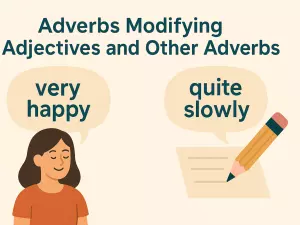
Intensifiers are special words that modify adjectives or adverbs to make their meaning stronger or weaker. Rather than simply describing a quality, these words add emphasis, showing just how much or how little something possesses a particular characteristic. For example, in “very cold” or “really exciting,” the intensifiers “very” and “really” amplify the adjectives “cold” and “exciting.” This helps speakers convey precise feelings, attitudes, or degrees of intensity in a sentence.
How Intensifiers Work with Adjectives
When attached to an adjective, intensifiers can either strengthen or, less commonly, soften the quality being described. They are most often placed directly before the adjective. Using them helps speakers and writers add nuance and expressiveness to their language, making descriptions more vivid and accurate.
Common Intensifiers in English
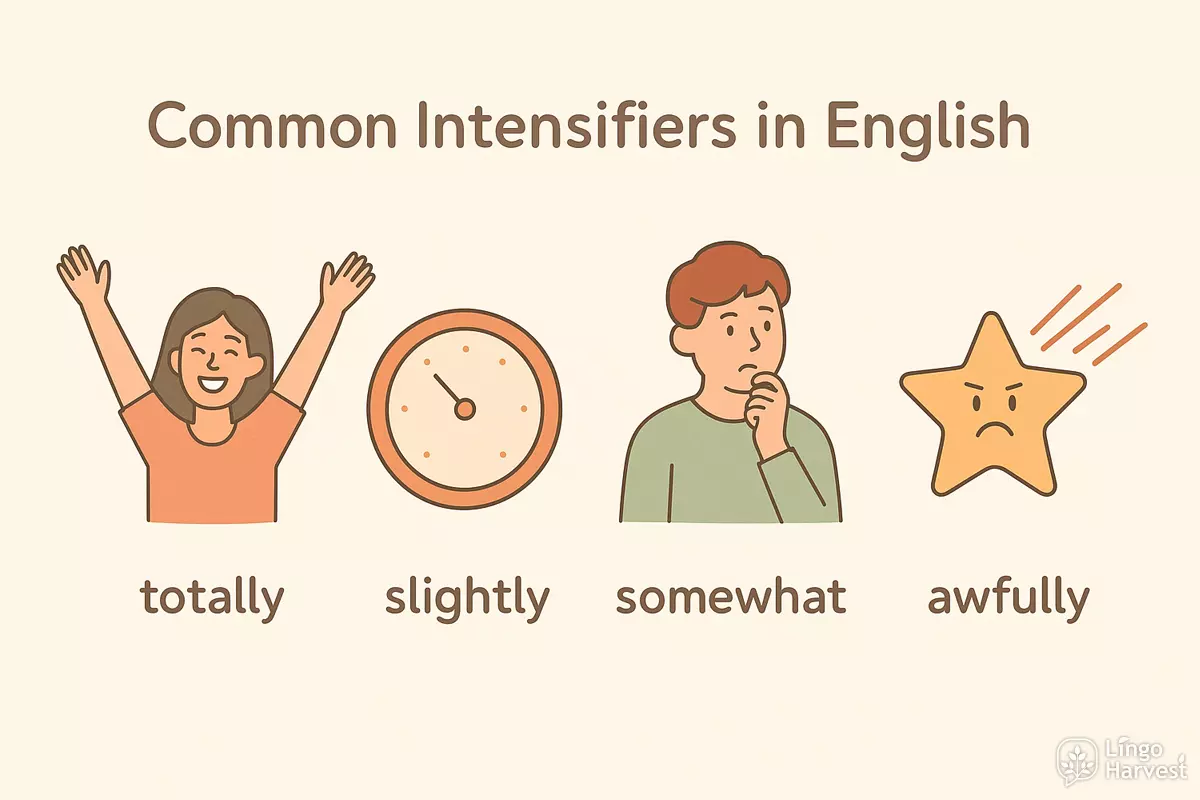
Some intensifiers are used much more frequently than others. Here are several commonly used ones:
- very
- really
- quite
- extremely
- so
- too
- absolutely
- incredibly
- fairly
- rather
- completely
- totally
- slightly
- somewhat
- awfully
- pretty
- highly
- strongly
- particularly
- utterly
Degrees of Emphasis
Not all intensifiers have the same effect. Some express maximum strength (“absolutely amazing”), while others are milder (“fairly interesting”). Choosing the right one depends on the level of intensity you want to communicate.
| Intensifier | Example Phrase | Degree of Emphasis |
|---|---|---|
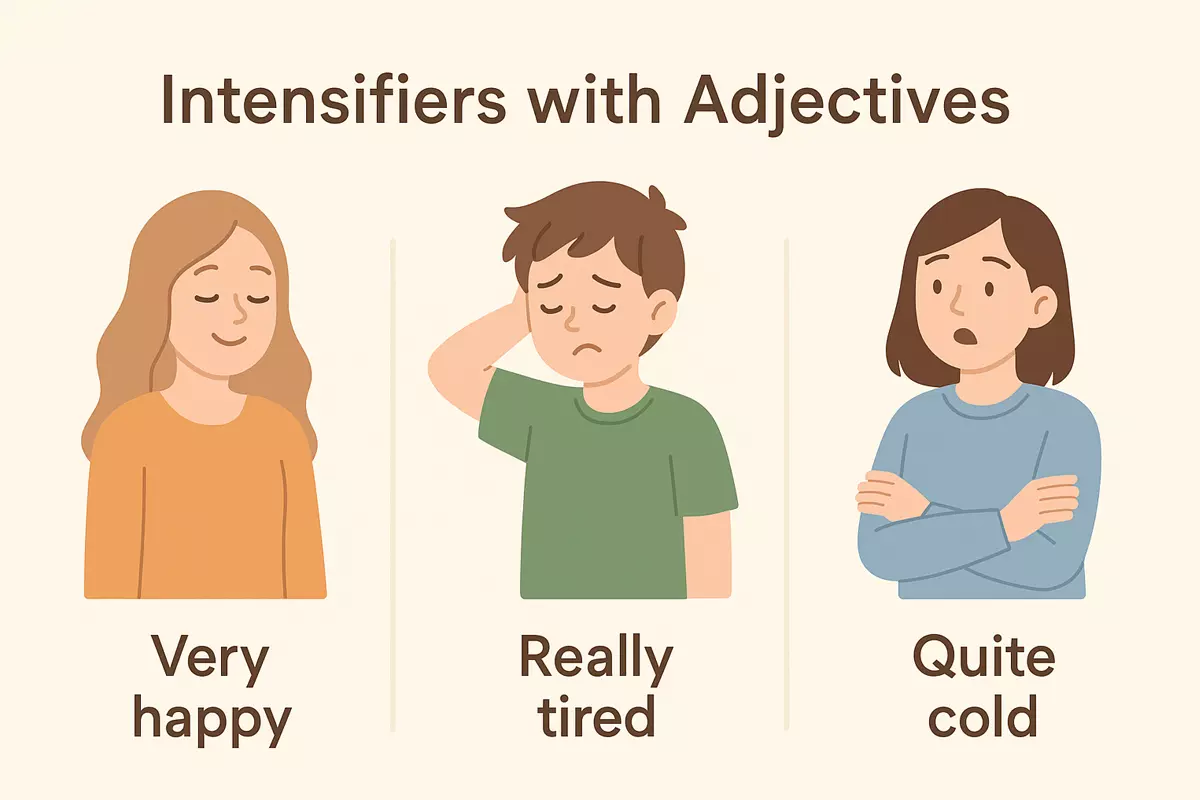
| very | very happy | strong |
| really | really tired | strong |
| quite | quite simple | moderate |
| absolutely | absolutely perfect | maximum |
| slightly | slightly annoyed | weak |
| too | too loud | strong (often negative) |
| fairly | fairly easy | mild |
| completely | completely wrong | maximum |
Why Use Intensifiers?
Using these modifiers allows for greater clarity and variety in communication. They help specify exactly how someone feels or how much an object or situation meets a description. Without intensifiers, language can sound flat or imprecise, lacking the details that make it engaging and clear.
Very vs Really vs Quite
English speakers use intensifiers to strengthen or soften adjectives, but each word can change the feeling or degree of intensity. While all three are common, they aren’t always interchangeable and can subtly affect what you’re expressing. Understanding how they differ helps you sound more natural and precise.
How Each Intensifier Works
- Very is used to boost the strength of an adjective in a neutral way. It’s straightforward, often making statements factual or objective. Example: very cold means the temperature is notably low.
- Really adds emphasis and often sounds a bit more conversational or subjective. It shows personal feeling or conviction, as in really cold, which might suggest the speaker is surprised or emotionally affected.
- Quite can either intensify or soften an adjective, depending on context or dialect. In British English, it sometimes means “fairly” (less than ‘very’), while in American English, it often means “completely” or “very.” For example: quite cold might mean moderately cold or very cold, depending on the speaker.
Comparing Usage and Meaning
| Intensifier | Typical Meaning | Example Sentence |
|---|---|---|
| Very | Strong, neutral emphasis | The soup is very hot. |
| Really | Strong, informal, personal | This movie is really interesting! |
| Quite (UK) | Moderate or partial emphasis | That’s quite good. (fairly good) |
| Quite (US) | Strong or complete emphasis | The answer is quite clear. (very clear) |
Examples of Intensifiers with Adjectives
Here are common adjective combinations that show how these intensifiers are used in real sentences:
- very tired
- really happy
- quite difficult
- very important
- really funny
- quite old
- very expensive
- really dangerous
- quite nice
- very interesting
- really easy
- quite small
- very busy
- really big
- quite strange
- very clean
- really loud
- quite pretty
Tips for Choosing the Right Intensifier
Pick very for formal or neutral writing. Use really in casual speech or when you want to sound enthusiastic or personal. Quite is best for softer or more nuanced statements, or if you want to reflect British English style. Always consider your audience and the exact meaning you want to communicate.
Strong and Weak Adjectives
When we talk about intensifiers, it’s important to know which adjectives are already powerful and which ones are more neutral. Some describing words, like "good" or "big," are considered mild or basic. Others, such as "excellent" or "enormous," have a much higher intensity. This difference affects which intensifiers sound natural or correct.
Understanding the Difference
Mild adjectives (sometimes called "gradable") can be strengthened or softened with many intensifiers. For example, you can say "very cold," "really small," or "quite interesting." In contrast, extreme or "strong" adjectives already express a high degree, so they don't usually combine with common intensifiers like "very." For instance, "freezing" is already more intense than "cold," so "very freezing" is generally avoided.
Examples of Gradable and Extreme Adjectives
Here are some common pairs showing a basic adjective alongside a stronger alternative:
- cold → freezing
- angry → furious
- small → tiny
- big → enormous
- tired → exhausted
- hungry → starving
- bad → terrible
- good → excellent
- hot → boiling
- happy → delighted
- scared → terrified
- funny → hilarious
- dirty → filthy
- clean → spotless
- old → ancient
- pretty → gorgeous
- sad → devastated
- sure → certain
- surprised → astonished
- interesting → fascinating
Which Intensifiers Work?
With mild adjectives, words like "very," "really," and "quite" are common. For example:
- very cold
- really tired
- quite small
With extreme adjectives, these intensifiers are unusual or incorrect. Instead, use adverbs like "absolutely," "completely," or "utterly":
- absolutely freezing
- completely exhausted
- utterly filthy
Summary Table: Intensifiers and Adjective Types
| Adjective Type | Common Intensifiers | Example |
|---|---|---|
| Gradable (mild) | very, really, quite | very cold, quite big |
| Extreme (strong) | absolutely, completely, utterly | absolutely freezing, completely exhausted |
Choosing the right intensifier depends on how strong the adjective already is. This helps your English sound more natural and accurate.
When Not to Use Intensifiers
Overusing words like "very," "really," or "quite" can actually weaken your message or make your writing sound unnatural. In some contexts, intensifiers add little or no value, and sometimes they can even cause confusion. It’s important to know when adjectives are strong enough on their own, or when the situation calls for a different approach.
Strong Adjectives Don’t Need Intensifiers
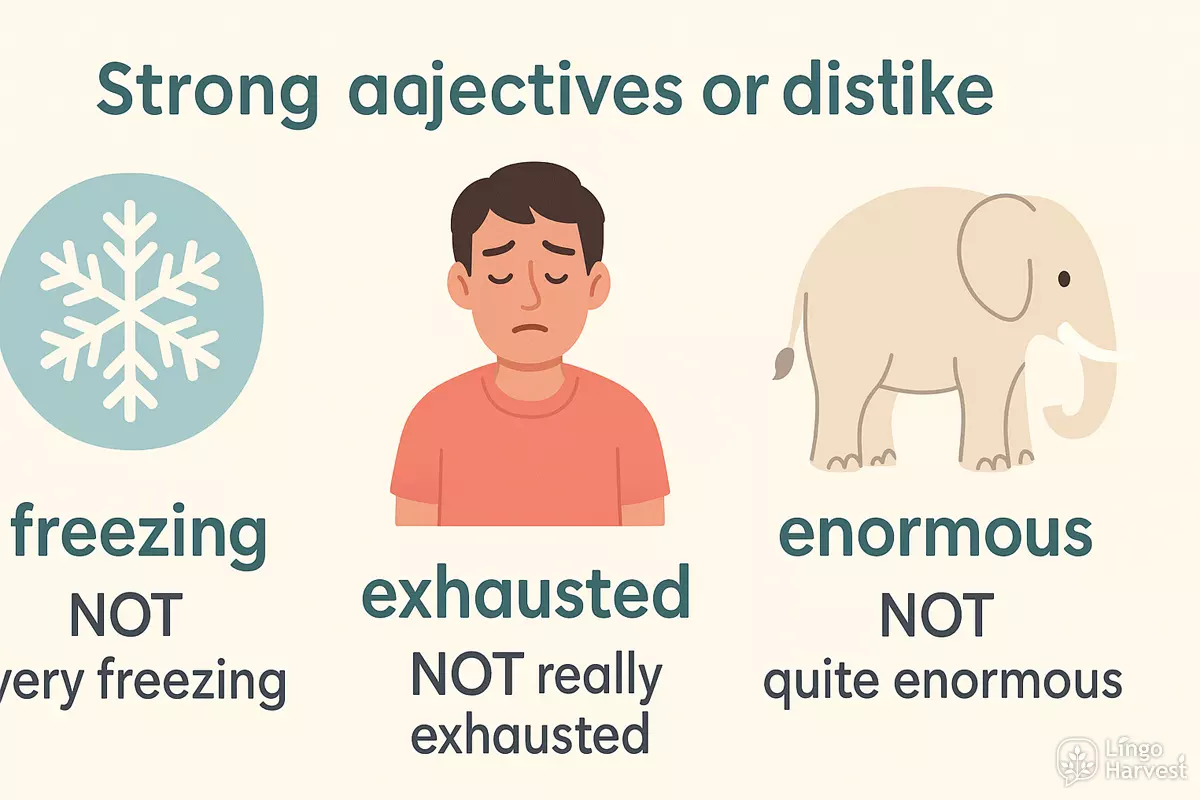
Some adjectives already express a high degree or an extreme quality, so adding an intensifier is redundant. For example, "freezing" already means "very cold," and "delicious" is stronger than "tasty." Using "very freezing" or "really delicious" can sound awkward or unnecessary.
- freezing (NOT very freezing)
- exhausted (NOT really exhausted)
- enormous (NOT quite enormous)
- tiny (NOT very tiny)
- perfect (NOT really perfect)
- terrible (NOT very terrible)
- impossible (NOT quite impossible)
- delicious (NOT very delicious)
- boiling (NOT really boiling)
- unique (NOT very unique)
When Precision or Formality Is Needed
In formal writing or professional contexts, it’s usually better to choose a more precise adjective instead of relying on intensifiers. For instance, instead of saying "really good," select "excellent" or "outstanding." This makes your language clearer and more impactful.
Comparing with Other Adjectives
Sometimes, using intensifiers can create confusion if the adjective already compares two things. For example, "more better" or "very best" is incorrect, because "better" and "best" are already comparative and superlative forms.
| Incorrect Usage | Correct Form |
|---|---|
| very freezing | freezing |
| quite impossible | impossible |
| really perfect | perfect |
| very unique | unique |
| more better | better |
| very best | best |
Avoiding Repetition and Wordiness
Packing sentences with intensifiers can make your writing feel repetitive or overly casual. If every sentence uses "very" or "really," readers may lose interest or doubt the strength of your statements. Try to reserve these words for moments when you truly want to highlight an adjective. Careful use of intensifiers helps your language stay clear, precise, and engaging. Choose your adjectives thoughtfully, and remember that sometimes less is more.
Common Mistakes
Misusing intensifiers with adjectives is a frequent issue for learners. People often choose the wrong word, combine intensifiers in unnatural ways, or apply them to adjectives where they don’t fit. Understanding the subtle differences and usage rules helps avoid awkward sentences and makes your English sound more natural.
Mixing Up Degrees of Intensity
Some intensifiers are stronger than others, and using them interchangeably can change the meaning of your sentence or make it sound odd. For example, "really" usually adds more emphasis than "quite," and "very" is often more neutral. Using "very" with an adjective that is already strong (like "excellent") can sound strange.
Incorrect Collocations
Certain adjectives naturally pair with specific intensifiers. Native speakers rarely say "very amazing" or "really impossible." Instead, they might say "absolutely amazing" or "completely impossible." Choosing the wrong combination often signals non-native usage.
| Incorrect Usage | Preferred Usage |
|---|---|
| very amazing | absolutely amazing |
| really impossible | completely impossible |
| quite best | by far the best |
| very unique | truly unique |
| really perfect | absolutely perfect |
| very excellent | simply excellent |
| quite delicious | absolutely delicious |
| really dead | completely dead |
Overusing Intensifiers
It’s tempting to use intensifying words too often, especially in spoken English. This can make your speech sound exaggerated or less credible. For example, saying "really, really good" or "very, very tired" is usually unnecessary unless you want to add strong emphasis for effect.
- Try to vary your language: use "extremely," "incredibly," or "particularly" for variety.
- Use intensifiers sparingly for more impact.
- Remember that some adjectives do not need any intensifier (e.g., "dead," "perfect," "unique").
Using Intensifiers with Absolute Adjectives
Absolute adjectives describe qualities that are either present or not, such as "perfect," "dead," or "unique." Pairing these with words like "very" or "quite" is generally incorrect. Instead, use intensifiers that express totality, such as "absolutely" or "completely," or avoid intensifiers altogether.
Summary List: Frequent Pitfalls
- Using "very" with extreme adjectives: very exhausted ❌ → completely exhausted ✅
- Pairing "quite" with superlatives: quite best ❌
- Repeating intensifiers: very really happy ❌
- Doubling up: very very cold ❌
- Forgetting nuance: "quite" in British English often means "fairly," but in American English, it can mean "very."
- Applying intensifiers to ungradable adjectives: very dead ❌
- Not matching tone: Using "really" in formal writing is often too casual.
- Relying only on a few words: Expand your vocabulary beyond "very" and "really."
- Misplacing intensifiers: She is a very beautiful singer (should be "She is a very good singer" or "She sings beautifully").
- Literal translations: Some mistakes come from directly translating phrases from your native language.
Being careful with these points will help you sound more fluent and natural in English conversations and writing.
Practice: Rewrite Sentences with Intensifiers
When learning to use words like "very," "really," and "quite" with adjectives, practicing with real examples helps deepen understanding. Below, you’ll find exercises to help you improve your skill at rewriting sentences using different intensifiers. Try to make the meaning stronger or softer by choosing the most suitable word.
Rewrite the Sentences Using Intensifiers
Read each sentence and rewrite it by adding an appropriate intensifier ("very," "really," or "quite"). Think about which word best fits the meaning you want to express.
- The movie was interesting.
- This soup is hot.
- Her answer was surprising.
- The garden is beautiful.
- My backpack is heavy.
- The weather today is cold.
- He is smart.
- The instructions were confusing.
- Her house is big.
- The exam was easy.
Show answers
- The movie was very interesting.
- This soup is really hot.
- Her answer was quite surprising.
- The garden is really beautiful.
- My backpack is very heavy.
- The weather today is quite cold.
- He is really smart.
- The instructions were very confusing.
- Her house is quite big.
- The exam was really easy.
Compare the Effect of Different Intensifiers
Each intensifier can subtly change the strength or feeling of a sentence. Let’s see how the meaning shifts by using different words with the same adjective.
| Adjective | With "very" | With "quite" | With "really" |
|---|---|---|---|
| tired | very tired | quite tired | really tired |
| expensive | very expensive | quite expensive | really expensive |
| funny | very funny | quite funny | really funny |
| difficult | very difficult | quite difficult | really difficult |
| clean | very clean | quite clean | really clean |
Challenge: Make Sentences Less Strong
Sometimes, you may want to make an adjective less strong. Rewrite the following using "quite" to soften the meaning:
- She is very confident.
- The street is really noisy.
- This test is very simple.
- It is really late.
Show answers
- She is quite confident.
- The street is quite noisy.
- This test is quite simple.
- It is quite late.
These activities help you see how intensifiers adjust the strength and nuance of your sentences. Practicing with different adjectives and intensifying words will make your speech and writing more precise and natural.