Making Adverbs from Adjectives: Quick Grammar Guide

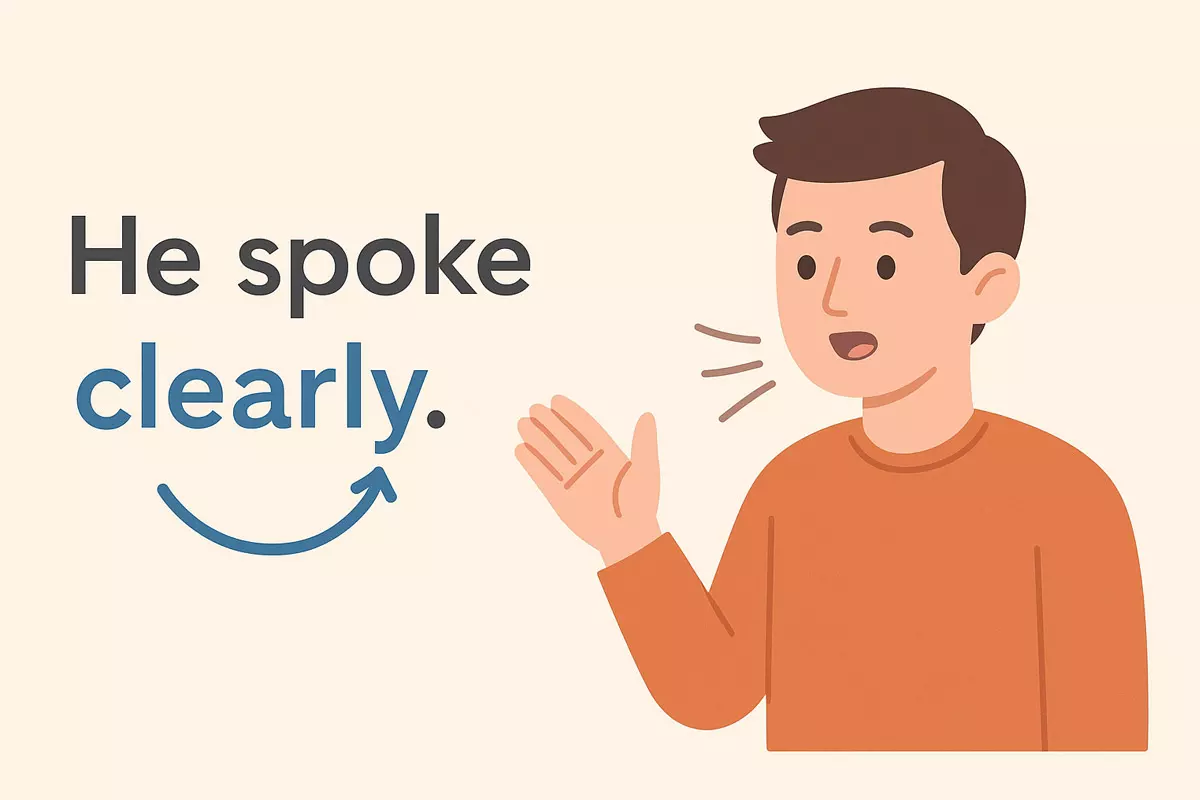 Here we what adverbs are, how to form them by adding -ly to adjectives, and key spelling and pronunciation rules. It also explains irregular adverbs such as fast and hard, highlights common mistakes, and provides practice exercises.
Have you ever thought about changing words that describe things, like adjectives, into forms that describe actions, such as adverbs? By doing this, you can make your writing more dynamic and precise. For example, turning the adjective "quick" into the adverb "quickly" allows you to modify how a verb is performed, as in "She ran quickly." This simple transformation not only adds detail but also improves the flow and clarity of your sentences, making your language more engaging and effective.
What Are Adverbs?
Adverbs are words that modify verbs, adjectives, or even other adverbs. They often describe how, when, where, or to what extent something happens. Unlike adjectives, which give more information about nouns, adverbs focus on actions or the qualities of other descriptive words. For example, in the sentence “She sings beautifully,” the word “beautifully” tells us how she sings.
What Do Adverbs Modify?
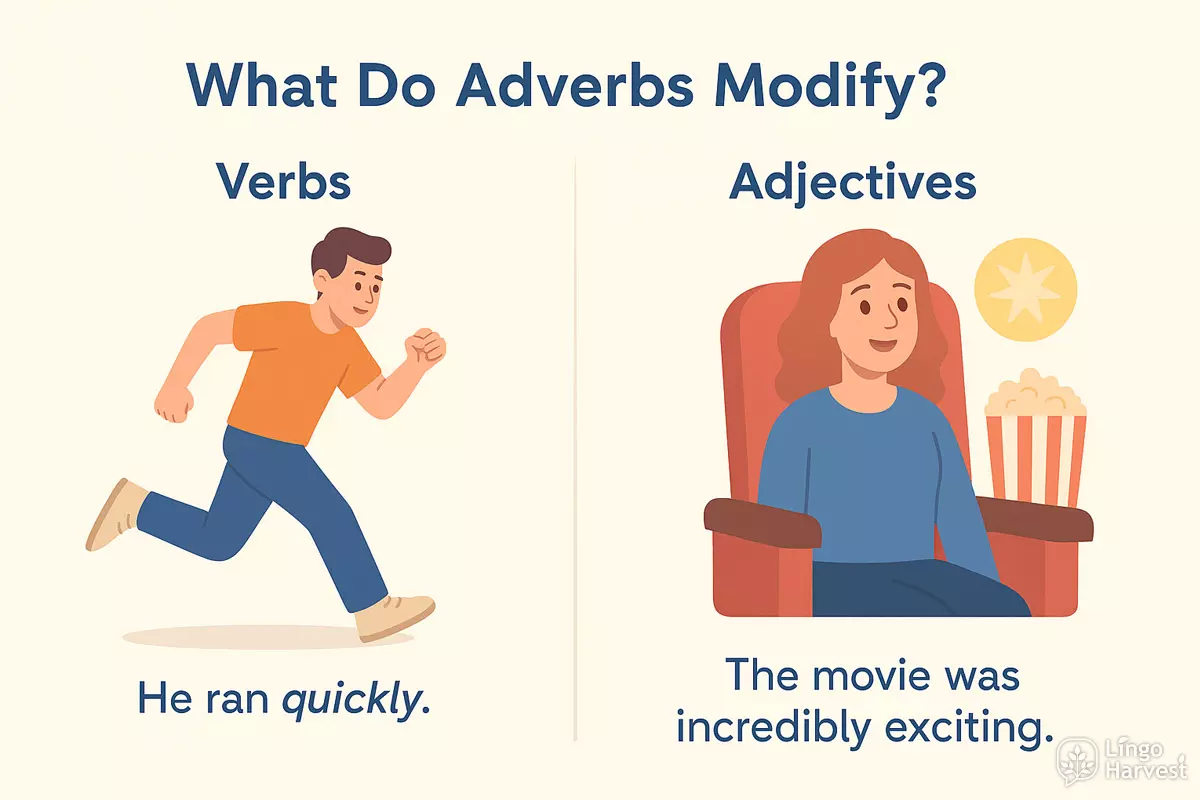
These versatile words can adjust the meaning of:
- Verbs: He ran quickly.
- Adjectives: The movie was incredibly exciting.
- Other adverbs: She finished very easily.
- Whole sentences: Fortunately, the rain stopped.
Common Questions About Adverbs
Many adverbs answer questions like:
- How? (slowly, carefully, badly)
- When? (yesterday, soon, always)
- Where? (here, everywhere, outside)
- To what extent? (completely, hardly, almost)
Examples of Adverbs in Sentences
- They laughed loudly.
- She will visit tomorrow.
- The cat sat outside.
- He almost finished his homework.
- The children played happily.
- We arrived late.
- She spoke softly.
- He is always on time.
- The answer was completely correct.
- They moved quickly to help.
Recognizing Adverbs
Many adverbs end in -ly, but not all do. Words like “fast,” “very,” and “well” are also adverbs. The key is to see if the word is describing how, when, where, or to what degree something happens.
Adding -ly to Adjectives
Forming adverbs from adjectives is often a straightforward process: simply attach -ly to the end of the adjective. This transformation usually signals that the word will now describe how an action is performed, rather than a quality or characteristic of a noun. For example, "quick" becomes "quickly" to show the manner in which something happens.
General Rule: Attach -ly
For most adjectives, just add -ly to the end. Here are some common examples:
- slow → slowly
- happy → happily
- careful → carefully
- quiet → quietly
- sad → sadly
- brave → bravely
- polite → politely
- honest → honestly
- strange → strangely
- angry → angrily
- fortunate → fortunately
- clear → clearly
- smooth → smoothly
- loud → loudly
- calm → calmly
- usual → usually
- final → finally
- simple → simply
Spelling Adjustments
Some adjectives need minor changes before adding -ly. For adjectives ending in -y, replace the y with i before adding -ly:
- easy → easily
- angry → angrily
- happy → happily
- busy → busily
If the adjective ends in -le, drop the e and add -y:
- gentle → gently
- simple → simply
- possible → possibly
- terrible → terribly
Overview Table: Adjective to Adverb Patterns
| Adjective Ending | Adverb Formation Example |
|---|---|
| Regular consonant ending | quick → quickly, slow → slowly |
| -y ending | angry → angrily, happy → happily |
| -le ending | gentle → gently, simple → simply |
| -ic ending | automatic → automatically, basic → basically |
Exceptions and Irregularities
Not all adverbs follow the -ly rule. Some adjectives have irregular adverb forms (like "good" becoming "well"), while others stay the same (for instance, "fast" is both an adjective and an adverb). These exceptions are important to recognize, but most transformations will use the strategies above.
Spelling and Pronunciation Rules
When forming adverbs from adjectives in English, certain patterns and changes often occur in both spelling and pronunciation. Most commonly, adverbs are created by adding -ly to the end of the adjective, but there are several important details and exceptions to keep in mind.
Common Patterns for Adding -ly
- Basic addition: For many adjectives, simply attach -ly (quick → quickly, quiet → quietly).
- Adjectives ending in -y: Change the -y to -i before adding -ly (happy → happily, angry → angrily).
- Adjectives ending in -le: Drop the final -e and add -y (simple → simply, gentle → gently).
- Adjectives ending in -ic: Usually add -ally (basic → basically, tragic → tragically).
- Irregular forms: Some adjectives have unique adverb forms or do not follow standard rules (good → well, fast → fast).
Silent Letters and Pronunciation
Pronunciation can shift when changing adjectives to adverbs. The added syllable -ly is typically pronounced as /li/, but pay attention to stress and silent letters:
- Public → publicly: The -ly is pronounced /li/; the -c- remains hard (publicly: /ˈpʌb.lɪk.li/).
- Gentle → gently: The -t- remains soft (/ˈdʒent.li/).
- Whole → wholly: The w is silent in both forms.
Words That Do Not Change
A few adverbs look identical to their adjective forms. In these cases, context and sentence structure indicate the function.
- Fast (He runs fast.)
- Late (She arrived late.)
- Hard (They work hard.)
- Early (We woke up early.)
| Adjective | Adverb | Notes |
|---|---|---|
| happy | happily | Change -y to -i |
| simple | simply | Drop final -e |
| tragic | tragically | Add -ally |
| good | well | Irregular form |
| public | publicly | No extra -al- |
| gentle | gently | Drop -e, add -y |
| basic | basically | Add -ally |
| angry | angrily | -y to -i |
Exceptions and Special Cases
Not every adjective fits neatly into the main transformation patterns. A few words take on entirely different forms or remain unchanged, while others, like “good,” have irregular adverb counterparts. Listening and practice help with mastering the pronunciation of these exceptions.
Irregular Adverbs (Fast, Hard, Early)
Some English adjectives form adverbs in a way that doesn’t follow the usual “add -ly” pattern. Knowing these exceptions makes your speech and writing more natural. Instead of “fastly,” “hardly,” or “earlyly,” these words remain the same or change meaning entirely when used as adverbs.
Key Irregular Forms
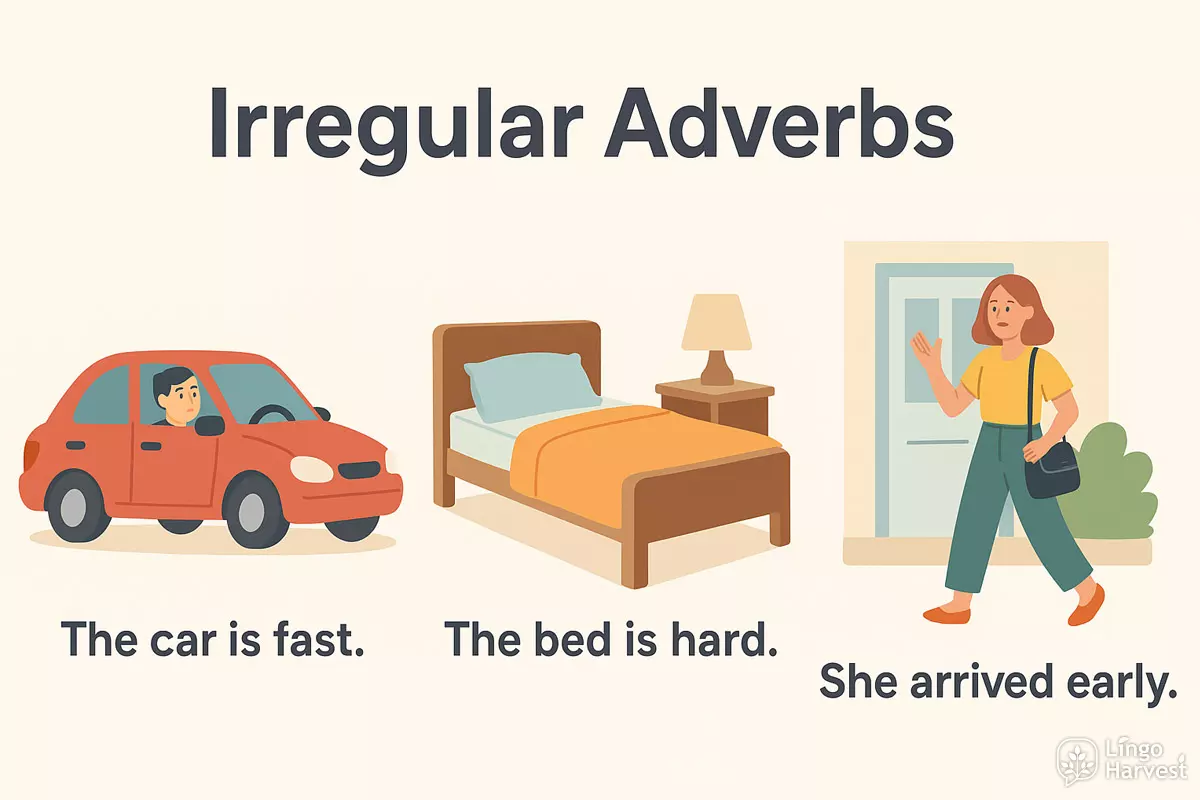
Here are some common adjectives that have irregular adverb forms or keep the same spelling in both roles:
- Fast (adjective & adverb): The car is fast. / She runs fast. ✅
- Hard (adjective & adverb): The bed is hard. / He works hard. ✅
- Early (adjective & adverb): An early flight. / She arrived early. ✅
- Late (adjective & adverb): A late train. / They came late. ✅
- High (adjective & adverb): A high wall. / Prices are rising high. ✅
- Low (adjective & adverb): Low prices. / He spoke low. ✅
- Near (adjective & adverb): A near neighbor. / Come near. ✅
- Far (adjective & adverb): A far country. / He walked far. ✅
- Long (adjective & adverb): A long road. / Wait long. ✅
- Straight (adjective & adverb): A straight line. / Go straight. ✅
- Right (adjective & adverb): The right answer. / Turn right. ✅
- Wrong (adjective & adverb): The wrong door. / You guessed wrong. ✅
- Daily (adjective & adverb): Daily news. / He calls daily. ✅
- Early (repeated intentionally for clarity): Early morning. / Finish early. ✅
- Late: Late night. / Arrive late. ✅
Confusing Forms: “Hard,” “Hardly,” “Late,” and “Lately”
Be careful with words like “hard” and “hardly.” While “hard” means “with a lot of effort,” “hardly” means “almost not at all.” Similarly, “late” refers to time, but “lately” means “recently.” Here’s how these forms differ:
| Form | Meaning & Example |
|---|---|
| hard | with effort She trains hard for competitions. |
| hardly | almost not I hardly know him. |
| late | after the expected time He arrived late. |
| lately | recently Have you seen her lately? |
Quick Tips for Remembering
- If it sounds odd with -ly (“fastly,” “hardly” for “with effort”), it’s probably irregular.
- Some adverbs look identical to their adjective forms but act differently in sentences.
- Pay attention to context, especially with words that have separate meanings in their -ly form.
Common Mistakes
Adverb formation from adjectives often trips up both native and non-native English users. Typically, people make errors by applying the wrong ending, misplacing the adverb in a sentence, or confusing adjectives and adverbs altogether. Recognizing these pitfalls can help you write and speak more clearly.
Mixing Up Adjective and Adverb Forms
One frequent issue is using the adjective form instead of the adverb, especially after verbs. For example, saying “She sings beautiful” instead of “She sings beautifully.” This confusion happens because in many languages, adjectives serve both roles.
- He runs quick ❌ → He runs quickly ✅
- She answered calm ❌ → She answered calmly ✅
- The dog barked loud ❌ → The dog barked loudly ✅
Incorrect Endings and Irregular Forms
Not all adverbs are formed by simply adding “-ly.” Some adjectives change spelling, and a few have irregular forms. Below is a summary of common patterns and exceptions:
| Adjective | Correct Adverb | Incorrect Form | Notes |
|---|---|---|---|
| Happy | Happily | Happyly | Change “y” to “i” before “-ly” |
| Easy | Easily | Easyly | Change “y” to “i” before “-ly” |
| Good | Well | Goodly | Irregular adverb |
| Fast | Fast | Fastly | No change for adverb |
| Hard | Hard | Hardly | “Hardly” means “barely,” not “with effort” |
| Loud | Loudly | Loud | Needs “-ly” for adverb |
| Late | Late | Lately | “Lately” means “recently,” not “after expected time” |
| Public | Publicly | Publically | Drop the “a” before “-ly” |
| Automatic | Automatically | Automaticly | Insert “-al-” before “-ly” |
| Basic | Basically | Basicly | Insert “-al-” before “-ly” |
Misplacing Adverbs in Sentences
Position matters for clarity. Placing the adverb too far from the verb or adjective it modifies can lead to ambiguity or awkward phrasing. For example:
- He only eats vegetables. (He eats nothing but vegetables.)
- Only he eats vegetables. (No one else eats vegetables.)
- He eats vegetables only. (He doesn’t eat fruits or meat.)
Be mindful of adverb placement to ensure your meaning comes across accurately.
Summary Tips
- Check if the word needs “-ly” or an irregular form.
- Watch for spelling changes when adding endings.
- Remember that not all adverbs are formed the same way as the adjective.
- Place adverbs close to the word they modify for clarity.
By staying aware of these typical snags, you can avoid common slip-ups and use adverbs with confidence.
Practice: Turn Adjectives into Adverbs
Turning descriptive words into their adverbial forms is a classic grammar skill. Adverbs often describe how, when, where, or to what extent something happens. They are usually formed by adding -ly to an adjective, but there are some exceptions and spelling changes to watch for.
Common Patterns and Examples
Most adjectives become adverbs by simply adding -ly. However, some require spelling adjustments. Here are several adjectives and their adverb forms:
- Quick → Quickly
- Careful → Carefully
- Happy → Happily
- Easy → Easily
- Angry → Angrily
- Quiet → Quietly
- Polite → Politely
- Slow → Slowly
- Safe → Safely
- Beautiful → Beautifully
- Bad → Badly
- Noisy → Noisily
- Brave → Bravely
- Gentle → Gently
- Simple → Simply
- Terrible → Terribly
- Loud → Loudly
- Lucky → Luckily
Practice Exercise
Try transforming each adjective below into its correct adverb form. Write your answers before expanding to check.
- Careful
- Happy
- Angry
- Simple
- Quiet
- Polite
- Bad
- Easy
- Gentle
- Beautiful
Show answers
- Carefully
- Happily
- Angrily
- Simply
- Quietly
- Politely
- Badly
- Easily
- Gently
- Beautifully
Spot the Incorrect Adverb
Some words do not follow the standard rules or are commonly misused. Identify which adverb below is incorrect.
- Quickly
- Nicely
- Goodly
- Safely
Show answers
Goodly is incorrect; the adverb form of "good" is "well".
Adjective vs. Adverb Forms
Here’s a quick reference for common transformations:
| Adjective | Adverb |
|---|---|
| Quick | Quickly |
| Happy | Happily |
| Easy | Easily |
| Polite | Politely |
| Gentle | Gently |
| Brave | Bravely |
| Loud | Loudly |
| Simple | Simply |
Remember, while most adverbs end in -ly, some irregular forms exist, and not all words follow the pattern perfectly. Practice helps you recognize the right form in context.