Adverbs with the Verb Be: Placement and Rules

 Here we adverb placement in sentences, focusing on their position after the verb be and for emphasis. It lists common frequency adverbs, highlights typical mistakes, and includes practice exercises for adding adverbs correctly.
Mastering the use of descriptive words such as sometimes, always, or never with the verb be can significantly improve your English sentences, but it is crucial to understand their correct placement for clarity and accuracy. Typically, these adverbs should come after the verb be in a sentence; for example, you would say, She is always on time or They are sometimes late. Placing the modifier before or after the verb incorrectly can lead to awkward or unclear sentences, so practicing the proper order will help your writing and speech sound more natural and precise.
Where Adverbs Go in Sentences
Understanding the typical spots for adverbs when used with the verb be helps your sentences sound natural and clear. The verb be (am, is, are, was, were, etc.) behaves differently from other verbs, so the position of adverbs often changes depending on what you want to emphasize.
Standard Placement with the Verb Be
For most adverbs, especially those of frequency such as always, never, often, and sometimes, the usual position is directly after the form of be. This rule is simple and works for both present and past forms. For example:
- She is always on time.
- They are never late.
- I am usually hungry after work.
- He was often tired in the evenings.
Other Adverb Types
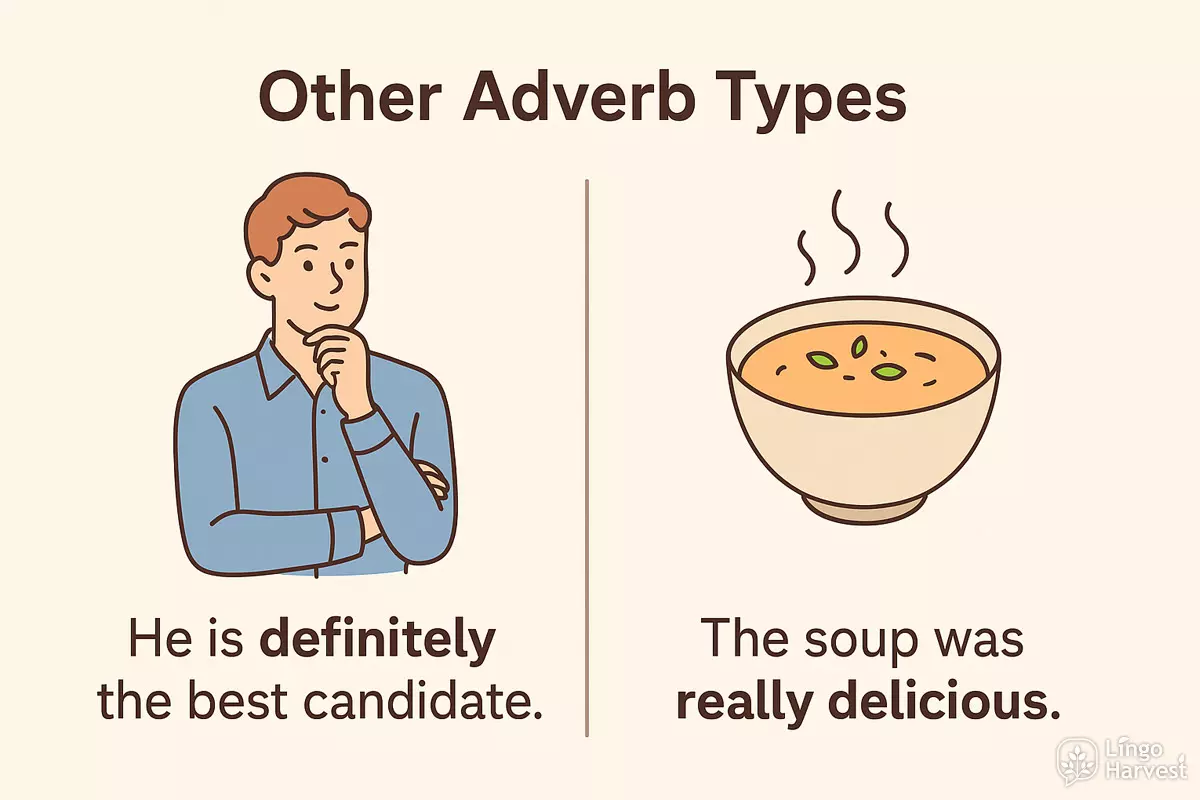
Adverbs of manner, degree, or certainty can also follow be. Some examples include:
- He is definitely the best candidate.
- The soup was really delicious.
- You are absolutely right.
- The answer is probably correct.
Before the Verb Be: When and Why?
It’s rare, but some adverbs can appear before be for emphasis or in literary style. For instance:
- Suddenly, she was gone.
- Maybe he is right.
However, this is not the standard in everyday conversation.
Comparing Adverb Placement: Be vs. Other Verbs
The position of adverbs changes when you use verbs other than be. Here’s a quick comparison:
| With the Verb Be | With Other Verbs |
|---|---|
| She is always happy. | She always eats breakfast. |
| They are often busy. | They often travel abroad. |
| I am never late. | I never forget your birthday. |
| He was sometimes sad. | He sometimes calls at night. |
Summary of Key Patterns
- Be + adverb (most common): She is usually happy.
- Adverb at the beginning for emphasis: Sometimes, he is quiet.
- Adverb before be is rare and usually for style.
When in doubt, place adverbs right after the verb be to sound natural. This approach works for most situations and helps avoid confusion.
Adverbs After Be (always, often)
Placing adverbs such as "always" and "often" after the verb "be" is a common feature in English. Unlike most verbs, where adverbs usually come before or after the main verb, the verb "be" requires a distinct word order. This pattern is essential for sounding natural and clear in both spoken and written English.
Basic Word Order with "Be"
The verb "be" (am, is, are, was, were) comes before frequency adverbs like "always" or "often." For example, we say "She is always late," not "She always is late." This rule helps avoid confusion and awkward sentences.
- He is always cheerful.
- They are often tired after work.
- I am sometimes busy on weekends.
- We are rarely at home in the evenings.
- You are never rude.
- It is usually quiet here.
- The meeting was frequently delayed.
- My friends are occasionally late.
- The weather is sometimes unpredictable.
- She is seldom unhappy.
- He is constantly hungry.
- The children are regularly active.
Common Adverbs Used After "Be"
Frequency adverbs that typically follow "be" include:
- always
- usually
- often
- sometimes
- rarely
- seldom
- never
- occasionally
- frequently
- regularly
- constantly
Patterns to Remember
The structure is straightforward: Subject + be + adverb + complement. This pattern keeps sentences clear and highlights the frequency or manner described by the adverb.
| Subject + Be | Adverb + Complement |
|---|---|
| She is | always on time. |
| We are | often busy on Mondays. |
| I am | never late for class. |
| They were | usually happy to help. |
| It is | sometimes difficult to hear. |
| You are | rarely absent. |
Notes on Formality and Emphasis
Using these adverbs after "be" is standard across both formal and informal contexts. For added emphasis, speakers sometimes use stress or intonation, but the placement remains unchanged. Moving the adverb elsewhere in the sentence can sound unnatural or create ambiguity. To summarize, frequency adverbs such as "always" and "often" should directly follow the correct form of "be." Mastering this word order will make your English sound more fluent and natural.
Different Positions for Emphasis
The placement of adverbs with the verb be is flexible, and speakers often shift adverbs to highlight certain information in a sentence. While the typical position is just after the verb (She is always late), you can move adverbs to the beginning or end of a sentence for stylistic reasons or to stress an idea.
Standard vs. Emphatic Placement
In most statements, adverbs such as always, never, usually, or often come directly after the verb be. For example:
- He is usually calm.
- They are never on time.
However, when you want to draw attention to the adverb, you can place it at the beginning or, less commonly, at the end of the sentence:
- Usually, he is calm.
- They are on time never. (rare, poetic or dramatic effect)
Comparing Emphasis in Adverb Placement
Moving adverbs changes the nuance. Here’s a comparison of how different placements affect meaning and emphasis:
| Adverb Position | Effect or Example |
|---|---|
| After be (neutral) | She is always helpful. ✅ (Standard, factual) |
| Sentence beginning | Always, she is helpful. (Highlights frequency, adds emphasis) |
| Sentence end | She is helpful always. (Less common, poetic or dramatic) |
| Before be (rare) | She always is helpful. (Possible in poetry or for contrast) |
Common Adverbs Used for Emphasis
When experimenting with placement, these adverbs are most frequently moved for stylistic effect:
- always
- never
- often
- sometimes
- rarely
- usually
- occasionally
- certainly
- definitely
- probably
- surely
- absolutely
- undoubtedly
- clearly
- simply
Common Frequency Adverbs
When talking about how often something happens, English speakers often use specific adverbs to express frequency. These words help communicate if an action is regular, rare, or somewhere in between. Understanding these terms and their typical order from most frequent to least can make your speech and writing much clearer.
Typical Words Used to Show Frequency
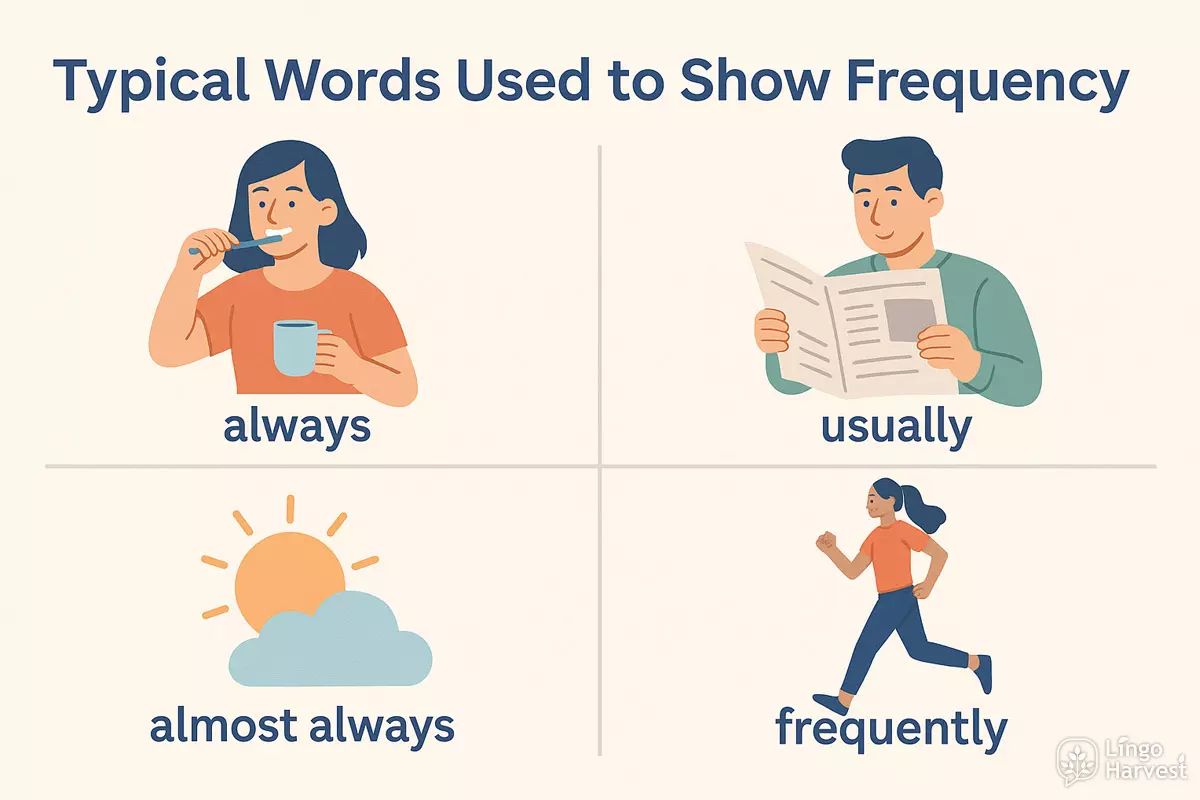
Here are some of the most widely used adverbs that describe how often something occurs. They work especially well with the verb be, as in "She is always happy" or "They are usually on time." These adverbs can range from describing events that happen all the time to those that hardly ever occur.
- always
- almost always
- usually
- frequently
- often
- regularly
- sometimes
- occasionally
- rarely
- seldom
- hardly ever
- almost never
- never
Comparing Frequency Adverbs and Their Usual Meanings
To make it easier to understand how these terms relate to each other, here is a table showing their approximate frequency as a percentage and a sample sentence with the verb be:
| Adverb | Approximate Frequency | Example with be |
|---|---|---|
| always | 100% | He is always prepared. |
| usually | 80–90% | They are usually busy. |
| often | 60–80% | She is often tired after work. |
| sometimes | 40–60% | It is sometimes noisy here. |
| occasionally | 20–40% | He is occasionally late. |
| rarely | 10–20% | We are rarely home on weekends. |
| never | 0% | I am never bored in class. |
Placement with the Verb Be
With forms of be (am, is, are, was, were), the frequency adverb almost always comes right after the verb. For example: "She is always cheerful." This rule helps your meaning stay clear and natural in conversation. Remember, choosing the right adverb and placing it correctly makes your statements about frequency both accurate and easy to understand.
Mistakes to Avoid
Placing adverbs in the wrong spot with forms of "be" is a common slip, especially for those learning English. This often leads to sentences that sound unnatural or even change the intended meaning. Understanding the right spot for frequency and manner adverbs is essential for clear communication.
Common Positioning Errors
Adverbs like "always," "never," "often," and "sometimes" usually sit between the verb "be" and the complement. Putting them before or after the entire verb phrase can make sentences awkward or confusing. For example:
- Incorrect: She always is happy. ❌
- Correct: She is always happy. ✅
- Incorrect: They are late usually. ❌
- Correct: They are usually late. ✅
Mixing Up Adverb and Complement Order
Another frequent issue is putting the adverb after the complement, which can make your sentence unclear or misleading. For instance:
- Incorrect: He is tired always. ❌
- Correct: He is always tired. ✅
- Incorrect: We are on time often. ❌
- Correct: We are often on time. ✅
Confusing "Be" with Other Verbs
It’s easy to mix up the rules for "be" with other verbs. With action verbs, adverbs usually go before the main verb, but with "be," the adverb should follow "be" directly. Compare these patterns:
| With "Be" | With Action Verb |
|---|---|
| She is always ready. | She always arrives early. |
| They are never late. | They never forget. |
| I am usually hungry. | I usually eat breakfast. |
| We are sometimes tired. | We sometimes travel. |
Overusing or Doubling Up Adverbs
Adding too many adverbs or repeating them is not only unnecessary, but it can also make sentences sound unnatural:
- She is very always happy. ❌
- He is never never late. ❌
- They are usually sometimes on time. ❌
Keep sentences clear by using only one frequency or manner adverb with "be."
Summary List: Frequent Pitfalls
- Placing adverbs before "be" (e.g., always is instead of is always)
- Putting adverbs after the complement (is happy always)
- Using adverb order meant for action verbs
- Combining multiple adverbs unnecessarily
- Forgetting that some adverbs (like "very") don’t work with all complements
- Using adverbs that don’t fit with "be" (e.g., "quickly" with "be" is rarely correct)
- Misplacing time adverbs (e.g., "is today tired" instead of "is tired today")
- Relying on word-for-word translation from another language
- Using adverbs with "be" in short answers incorrectly ("Yes, always I am" ❌)
- Misunderstanding the nuance of frequency adverbs (e.g., "hardly ever" vs. "never")
Awareness of these common issues will help you construct sentences with "be" and adverbs naturally and confidently.
Practice: Add Adverbs to Sentences
Understanding where to place adverbs with the verb be is important for clear and accurate English. In this section, you'll work with typical sentences and see how adding adverbs can change meaning or emphasis. Pay close attention to where the adverb fits, especially with be as the main verb.
Task 1: Insert the Adverb
Read each sentence below. Place the adverb in the correct spot. Sometimes more than one position is possible, but only one is typically natural with be.
- She ____ is tired. (always)
- They ____ are on time. (usually)
- He ____ is late for meetings. (never)
- The children ____ are happy after school. (often)
- I ____ am nervous before exams. (sometimes)
Show answers
- She always is tired.
- They usually are on time.
- He never is late for meetings.
- The children often are happy after school.
- I sometimes am nervous before exams.
Task 2: Choose the Correct Adverb Placement
For each sentence, decide which position for the adverb is natural. Select A or B.
- A. She is always tired.
B. She always is tired. - A. They are usually on time.
B. They usually are on time. - A. He is never late.
B. He never is late. - A. The children are often happy.
B. The children often are happy.
Show answers
- A
- A
- A
- A
Common Adverbs Used with Be
Here are some frequency adverbs and their typical placement with the verb be:
- always
- usually
- often
- sometimes
- rarely
- never
- occasionally
- hardly ever
- frequently
- seldom
- almost always
- almost never
- just
- already
- still
- yet
Task 3: Rewrite with a Frequency Adverb
Rewrite each sentence, adding the adverb in the most natural position.
- I am happy. (usually)
- He is late. (rarely)
- They are at home. (often)
- We are tired. (sometimes)
- She is busy. (always)
Show answers
- I am usually happy.
- He is rarely late.
- They are often at home.
- We are sometimes tired.
- She is always busy.
Remember, with the verb be, adverbs of frequency such as always, usually, and never are normally placed after the verb be (am, is, are). Practicing these patterns helps you sound more natural in everyday English.