Placement of Adverbs in Simple Sentences

 This article reviews basic word order and explains where to place adverbs at the beginning, middle, or end of a sentence. It also covers emphasis, style choices, common mistakes, and offers practice exercises to improve your adverb placement.
Placing adverbs thoughtfully in your sentences enhances both clarity and engagement, allowing your writing to flow more naturally. By understanding where adverbs fit best, you can emphasize the right aspects of your message and avoid confusion. Effective adverb placement not only improves readability but also ensures your intended meaning is communicated accurately, making your writing more impactful and enjoyable for readers.
Basic Word Order Review
Understanding how words are arranged in a simple sentence is essential before exploring where to place adverbs. In English, the typical sentence structure follows a clear pattern. This structure helps readers and listeners quickly grasp who is doing what, and to whom.
Common Sentence Structure
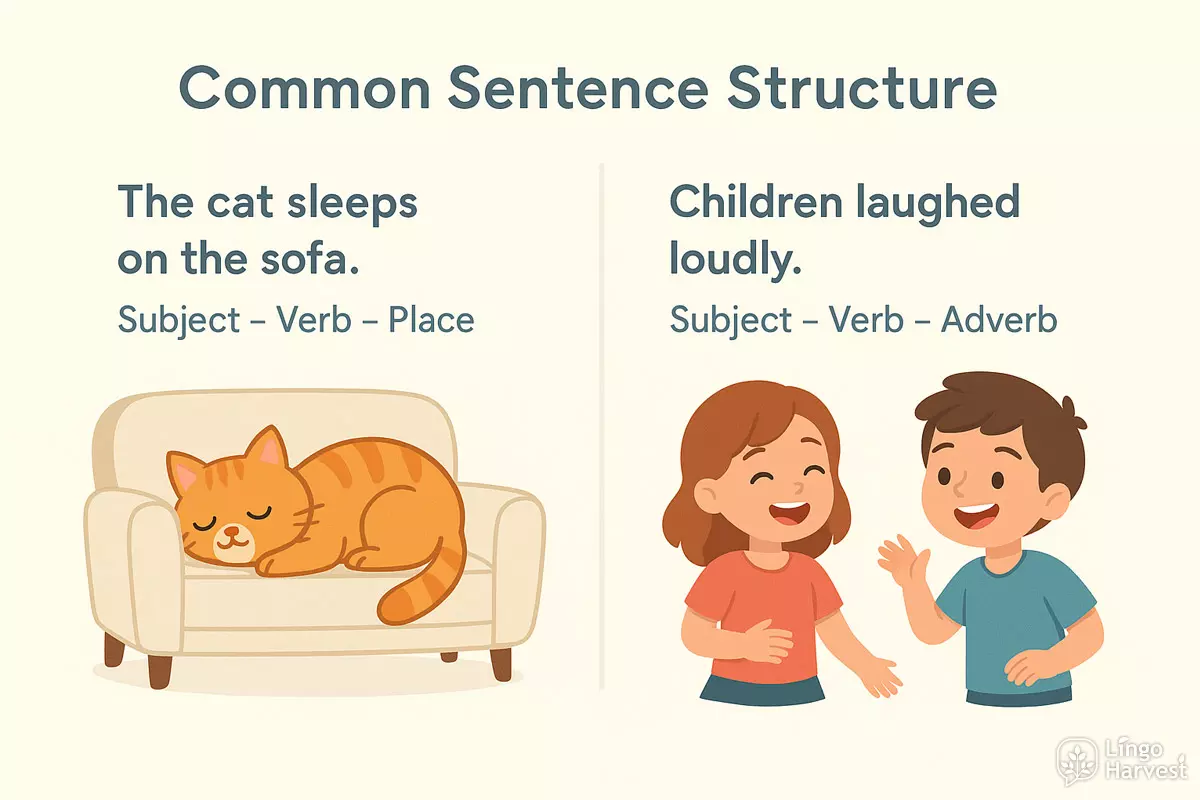
Most simple sentences in English use the Subject–Verb–Object (SVO) order. The subject comes first, followed by the verb, and then the object (if there is one). Other elements, such as time or place, usually appear at the end. Here are some basic patterns:
- She reads books. (Subject – Verb – Object)
- They play soccer every weekend. (Subject – Verb – Object – Time)
- Birds sing. (Subject – Verb)
- The cat sleeps on the sofa. (Subject – Verb – Place)
- We walked home yesterday. (Subject – Verb – Place – Time)
- Tom eats breakfast at 7 a.m. (Subject – Verb – Object – Time)
- My friends arrived early. (Subject – Verb – Adjective/Adverb)
- Children laughed loudly. (Subject – Verb – Adverb)
- I sent her a letter. (Subject – Verb – Indirect Object – Direct Object)
- He opened the window quietly. (Subject – Verb – Object – Adverb)
Why Word Order Matters
Changing the order of words can make a sentence confusing or even change its meaning. For example, "The dog bit the man" is not the same as "The man bit the dog." English relies on word order to signal the roles of each word, unlike some languages that use case endings.
Practice: Arrange the Words
Put the words in the correct order to form a simple sentence:
- always / breakfast / eats / Sarah / at home
- the guitar / plays / he / beautifully
- to school / the children / walk / every day
- quickly / finished / homework / I / my
Show answers
- Sarah always eats breakfast at home.
- He plays the guitar beautifully.
- The children walk to school every day.
- I finished my homework quickly.
Adverbs at the Beginning
Placing an adverb before the subject of a sentence can shift the focus or set the tone for what follows. This position is frequently used for adverbs that refer to time, frequency, or viewpoint, such as "yesterday," "often," or "fortunately." Starting with a modifying word can signal context, create emphasis, or connect ideas in a narrative. When an adverb appears at the front, it is usually followed by a comma, especially if the adverbial phrase is long or provides important context. This pause helps the reader process the introductory information and clarifies the sentence structure.
Common Types Used Initially
Adverbs that commonly appear in initial position include those of time, place, frequency, and manner. Here are typical examples:
- Yesterday, I finished the report.
- Usually, she walks to work.
- Fortunately, nobody was hurt.
- Quickly, he closed the door.
- In the morning, we practice yoga.
- Outside, the birds were singing.
- Suddenly, the lights went out.
- Perhaps, you could try again later.
- Honestly, I didn’t expect that answer.
- Next week, we will meet again.
- Sometimes, mistakes happen.
- Later, I’ll call you.
- Carefully, she placed the vase on the shelf.
- Usually, it rains in April.
- Recently, he changed jobs.
- Strangely, the phone stopped ringing.
- Everywhere, people were celebrating.
- Finally, the results were announced.
Effect on Emphasis and Style
Starting with a modifier can make writing feel more dynamic or formal. It can also highlight important information for the reader. For instance, beginning with "Suddenly" signals a change or surprise, while "Carefully" draws attention to the manner of the action. This approach is especially common in storytelling and descriptive writing.
Punctuation Guidelines
When using an introductory adverb or adverbial phrase, a comma usually follows it. This is particularly important for clarity if the adverb modifies the whole clause, or if it’s a longer phrase. For single-word adverbs, the comma is sometimes omitted in informal writing, but including it is generally safer.
Comparison: Sentence Patterns
| Adverb First | Adverb in Another Position |
|---|---|
| Usually, he arrives early. | He usually arrives early. |
| Yesterday, we saw a movie. | We saw a movie yesterday. |
| Suddenly, the alarm rang. | The alarm rang suddenly. |
| Fortunately, the train was on time. | The train was fortunately on time. |
| In the afternoon, she called her friend. | She called her friend in the afternoon. |
Positioning an adverb before the subject is a flexible way to add variety and nuance to your sentences. It’s especially useful for highlighting time, attitude, or context at the start of a statement.
Adverbs in the Middle Position
Placing adverbs within the main body of a sentence, often between the subject and the main verb, is a common pattern in English. This position is typically reserved for adverbs that modify the verb, such as those indicating frequency, certainty, or manner. Using adverbs mid-sentence can subtly change the focus or nuance of your message.
Common Types of Mid-Sentence Adverbs
Frequency adverbs like "often," "usually," and "sometimes" are frequently situated here. Degree adverbs, such as "almost" or "just," and certain modal adverbs like "probably" or "certainly" also fit naturally in this slot.
- He always arrives early.
- They usually eat breakfast together.
- She almost missed the train.
- We just finished the report.
- I certainly agree with you.
- You probably know the answer.
- It barely fits in the box.
- He still lives in Paris.
- My dog sometimes barks at night.
- She never drinks coffee.
- They already left the house.
- I often visit my grandparents.
- We hardly know each other.
- He simply forgot the meeting.
- She frequently travels for work.
- He easily solved the problem.
- The team recently won a prize.
- She occasionally goes hiking.
Placement Rules and Examples
For most simple sentences, the adverb is placed after the subject but before the main verb. With auxiliary verbs (like "have," "is," "will"), the adverb comes after the auxiliary and before the main verb. This placement ensures clarity and a natural flow.
| Sentence Pattern | Example |
|---|---|
| Subject + adverb + main verb | She often visits. |
| Subject + auxiliary + adverb + main verb | He has already left. |
| Subject + modal + adverb + main verb | They will probably call. |
| Negative sentences | She doesn’t usually eat meat. |
| Questions | Do you always work late? |
Exceptions and Special Cases
Not every adverb fits neatly in the middle. Some, especially adverbs of time or place, typically appear at the end or beginning. Also, with compound verb forms, the mid-position can shift based on emphasis or style. When crafting sentences, consider both clarity and tone. Placing an adverb mid-sentence often makes the statement sound more natural and fluent, especially in everyday English.
Adverbs at the End
In many English sentences, placing an adverb after the main verb or at the very end is not only possible but often the most natural choice. This position is especially common with adverbs of time, place, and manner. Using this structure, you can add important details without interrupting the flow of the sentence.
Common Types of Adverbs Used in Final Position
Adverbs that indicate when, where, and how something happens are typically found at the conclusion of a sentence. Here are some examples:
- Adverbs of time: yesterday, soon, later, now
- Adverbs of place: here, everywhere, outside, overseas
- Adverbs of manner: quickly, quietly, well, carefully
- Frequency (sometimes): occasionally, rarely
- Degree or certainty: completely, definitely
Examples in Context
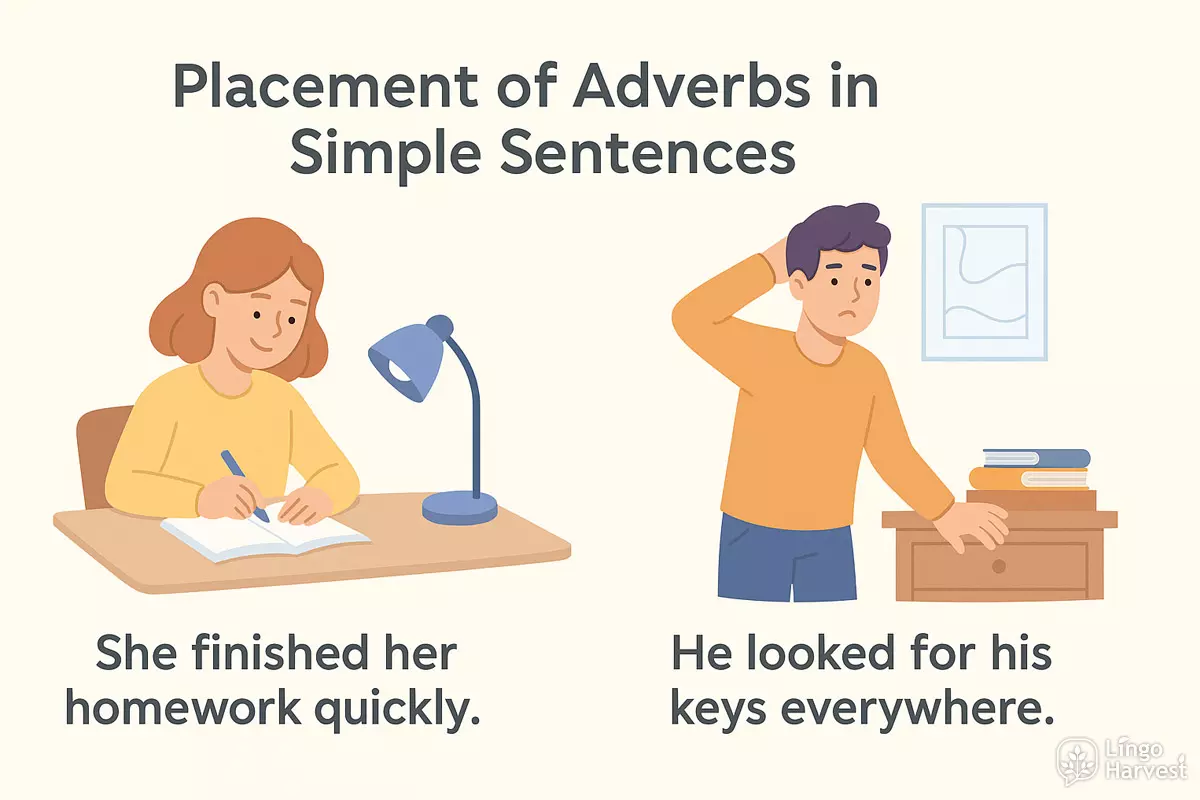
To illustrate the natural use of adverbs at the close of a sentence, consider these sample phrases:
- She finished her homework quickly.
- We will meet tomorrow.
- He looked for his keys everywhere.
- The children played outside.
- I will call you later.
- They arrived safely.
- He told the story well.
- She will travel overseas next year.
- The cat hid under the bed.
- We celebrated yesterday.
- He apologized sincerely.
- The team played badly.
- I understood completely.
- They will return soon.
- She smiled shyly.
Why Put Adverbs Last?
Ending a sentence with an adverb often makes the statement clearer and more natural. In simple structures, this placement avoids confusion about what the adverb is describing. For instance, “He answered politely” is more straightforward than “He politely answered,” especially for new learners.
Comparing Adverb Placement
Sometimes, the position of an adverb changes the emphasis or even the meaning. Here’s a comparison of sentences with adverbs in different spots:
| Sentence | Effect/Meaning |
|---|---|
| She spoke clearly. | Describes how she spoke; standard and natural. |
| She clearly spoke. | Emphasizes that it was obvious she spoke (not always about manner). |
| He finished the task quickly. | Focus on the speed of completion. |
| He quickly finished the task. | Focus on the quick action; both forms are correct, but the nuance shifts. |
Tips for Natural Usage
- For most simple sentences, place adverbs of time, place, and manner at the end for clarity.
- If you need to highlight the adverb, try placing it before the verb, but check if the meaning changes.
- Read sentences aloud to see which word order feels most natural and clear.
- Be aware that some adverbs (such as frequency adverbs: always, often) prefer other positions.
Choosing the final position for adverbs is a practical way to make sentences straightforward and easy to understand. This placement is especially recommended for beginners and in most everyday communication.
Emphasis and Style Choices
Choosing where to place an adverb in a simple sentence can subtly shift the focus or tone of your message. The position you select often reflects what you want to highlight—whether it’s the action, the subject, or the manner in which something is done. Writers and speakers can use this flexibility to make their sentences more engaging or to clarify their meaning.
How Position Alters Focus
Moving an adverb can change which part of a sentence draws the reader’s attention. For example, placing an adverb at the beginning often sets the scene or mood, while putting it before the verb tends to stress the manner of the action. End-placement, on the other hand, can make the adverb feel like an afterthought or reinforce the result.
- Initially, she hesitated. (Emphasis on timing)
- She quickly agreed. (Emphasis on speed)
- She agreed quickly. (Emphasis on the outcome)
- He always forgets his keys. (Habitual action)
- He forgets his keys always. (Unusual, poetic stress)
- Sadly, the show was cancelled. (Mood set at start)
- The show was cancelled sadly. (Less common, can sound awkward)
- They never arrive on time. (Frequency highlighted)
- They arrive on time never. (Rare, used for effect)
- Perhaps, he will come. (Uncertainty foregrounded)
- He will come perhaps. (Afterthought, less direct)
Style Preferences and Formality
In formal writing, adverbs are often placed before the main verb, especially for adverbs of frequency and certainty. Creative writing and speech, however, may experiment with initial or end positions to create a specific rhythm or dramatic effect. Overusing initial adverbs can make prose sound stilted, while too many final adverbs may weaken the impact of your statements.
Common Patterns and Their Effects
| Position | Effect on Emphasis | Example |
|---|---|---|
| Sentence-initial | Sets mood or context, foregrounds the adverb | Fortunately, they arrived on time. |
| Before main verb | Highlights the manner/frequency of the action | They easily solved the puzzle. |
| After main verb/object | Can highlight result, sometimes less formal or more conversational | They solved the puzzle easily. |
| Mid-sentence (between auxiliary and main verb) | Draws attention to the adverb within the action | They have always liked music. |
Tips for Effective Use
- Vary adverb placement to avoid monotony.
- Consider which element you want to spotlight—timing, frequency, or manner.
- Read sentences aloud to check for natural flow and emphasis.
- In formal contexts, prefer mid-sentence or pre-verb placements for clarity.
- Use initial or end positions for stylistic effect or to match spoken patterns.
By thoughtfully placing adverbs, you can fine-tune the nuance and impact of your writing, making your sentences clearer and more expressive.
Common Mistakes
Misplacing adverbs in simple sentences often leads to confusion or changes in meaning. Many learners struggle with where to insert words like "often," "never," or "quickly," especially in statements with auxiliary verbs or negatives. It’s important to notice how the position of these modifiers can subtly or dramatically alter the message.
Typical Placement Errors
- Putting the adverb at the very start or end when it should be near the verb.
- Inserting the adverb between the verb and its object, which can sound unnatural in English.
- Placing frequency adverbs after the main verb in the wrong tense.
- Using adverbs before the subject in statements (e.g., "Usually I go" is correct, but "I usually go" is more common).
- Confusing the location for adverbs of manner (e.g., "She sings beautifully" vs. "Beautifully she sings").
- Overusing adverbs at the end of a sentence, making the structure awkward.
- Incorrectly splitting verb phrases with an adverb (e.g., "He has quickly finished" instead of "He has finished quickly").
- Placing adverbs before auxiliary verbs instead of after them.
- Using adverbs before the main verb in questions, which can confuse the meaning.
- Forgetting that some adverbs (like "never" or "always") rarely begin a sentence in standard English.
- Misplacing "only," which can dramatically change a sentence’s focus (e.g., "Only she eats cake" vs. "She only eats cake").
- Assuming all adverbs go in the same place, regardless of type or context.
Comparison of Correct and Incorrect Adverb Placement
| Incorrect Placement | Correct Placement |
|---|---|
| She eats always breakfast at 8. | She always eats breakfast at 8. |
| He quickly speaks English. | He speaks English quickly. |
| I have finished already my homework. | I have already finished my homework. |
| They go rarely to the cinema. | They rarely go to the cinema. |
| We only will meet at noon. | We will meet only at noon. |
How to Avoid These Issues
Pay attention to the verb group and the type of adverb you’re using. Frequency adverbs (like "always," "often," "never") usually go before the main verb but after "be" verbs. Manner adverbs (like "quickly," "carefully") usually come after the verb or verb + object. Reading and listening to native examples can help you internalize these patterns. When in doubt, double-check with a reliable grammar source or try rephrasing the sentence to see which version sounds more natural.
Practice: Fix Adverb Order
Understanding where to put adverbs in a sentence can be tricky. Try these exercises to strengthen your skills. Read each sentence, spot the misplaced adverb, and rewrite it so the order is correct. Remember, adverbs of frequency (like “always,” “never,” “often”) usually come before the main verb but after “be” verbs. Manner, place, and time adverbs each have their preferred positions.
Rewrite the Sentences
Each sentence below contains an adverb in the wrong place. Rewrite the sentence with the adverb in the proper position.
- She goes to work by bus always.
- We finished yesterday our homework.
- John quickly runs every morning in the park.
- The cat on the sofa sleeps usually.
- They at home are now.
- My sister eats chocolate seldom.
- He does his best at school always.
- Lisa in the evening reads quietly.
- I last week saw him.
- You can easily solve this problem.
Show answers
- She always goes to work by bus.
- We finished our homework yesterday.
- John runs quickly in the park every morning.
- The cat usually sleeps on the sofa.
- They are at home now.
- My sister seldom eats chocolate.
- He always does his best at school.
- Lisa reads quietly in the evening.
- I saw him last week.
- You can solve this problem easily.
Common Adverb Placement Patterns
Review these typical adverb positions. Compare correct and incorrect forms to help you remember the rules:
| Incorrect Order | Correct Order |
|---|---|
| He eats quickly his lunch. | He eats his lunch quickly. |
| I always am happy here. | I am always happy here. |
| They go every day to the gym. | They go to the gym every day. |
| We at home are often. | We are often at home. |
| She last night arrived. | She arrived last night. |
| Mark plays in the garden sometimes. | Mark sometimes plays in the garden. |
| You can quickly finish the task. | You can finish the task quickly. |
| The dog in the kitchen barks always. | The dog always barks in the kitchen. |
Spot the Error
Find the adverb placement error in each sentence below. Write the corrected version.
- Anna speaks English fluently always.
- Tomorrow we will go early.
- My parents at the weekend travel usually.
- He never is late for work.
Show answers
- Anna always speaks English fluently.
- We will go early tomorrow.
- My parents usually travel at the weekend.
- He is never late for work.
Practicing where to place adverbs helps your sentences sound natural and clear. Review these patterns whenever you’re unsure, and soon correct order will come naturally.