Common Frequency Adverbs in Everyday English

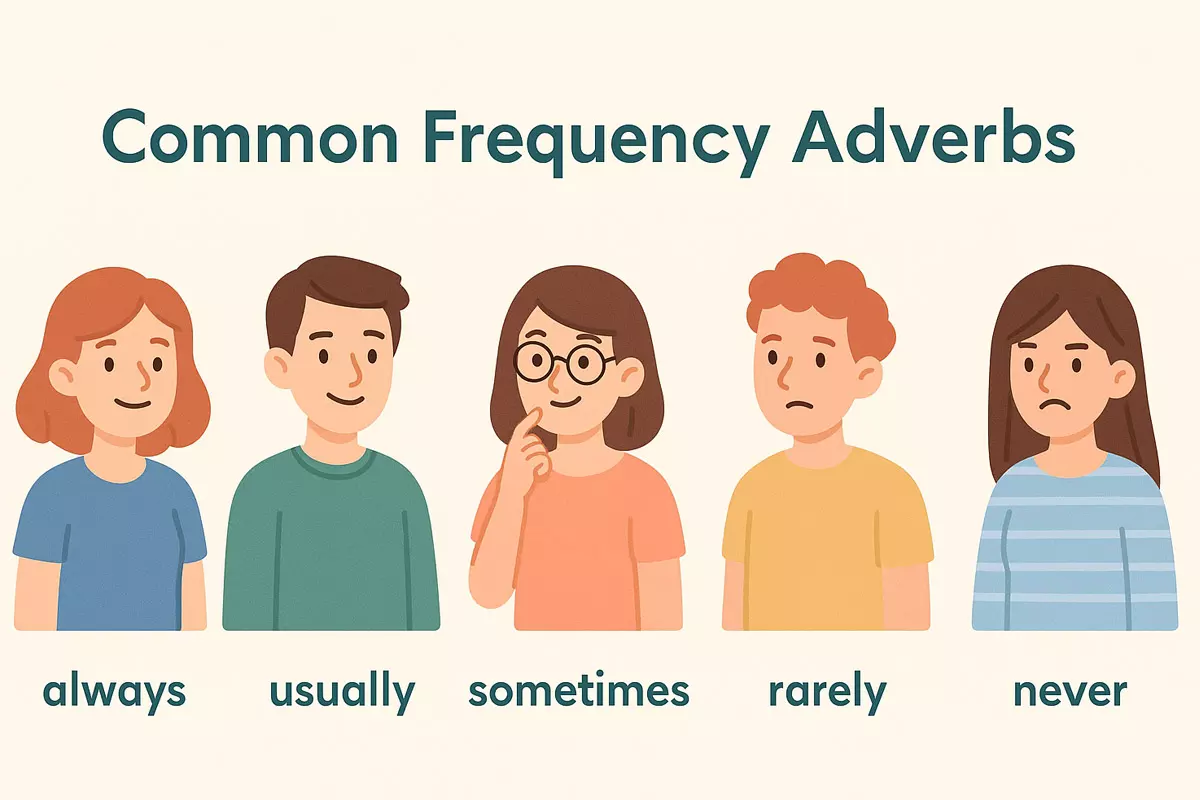 This article explains what frequency adverbs are, their typical order, and where to place them in sentences. It covers differences with be and action verbs, highlights common mistakes, and offers practice with correcting sample sentences.
Words like always, sometimes, or rarely are commonly used in daily conversations to describe how frequently something happens. These modifiers play an important role in expressing routines, habits, and general tendencies, allowing us to communicate more precisely and naturally. By including such words in our speech, we can give listeners a clearer understanding of our experiences and behaviors, making our conversations more detailed and relatable in a variety of everyday situations.
What Are Frequency Adverbs?
Frequency adverbs are words that describe how often something happens. They help us express the regularity of actions or events, making our communication more precise. For instance, when you want to talk about a habit or a repeated action, these adverbs give your listener a clear idea of how frequently it occurs.
Typical Uses in Sentences
These adverbs usually answer the question "How often?" and are commonly placed before the main verb but after the verb "to be." For example: "She always drinks coffee in the morning," or "They are usually on time." This placement helps the sentence flow naturally while clearly conveying frequency.
Common Frequency Adverbs
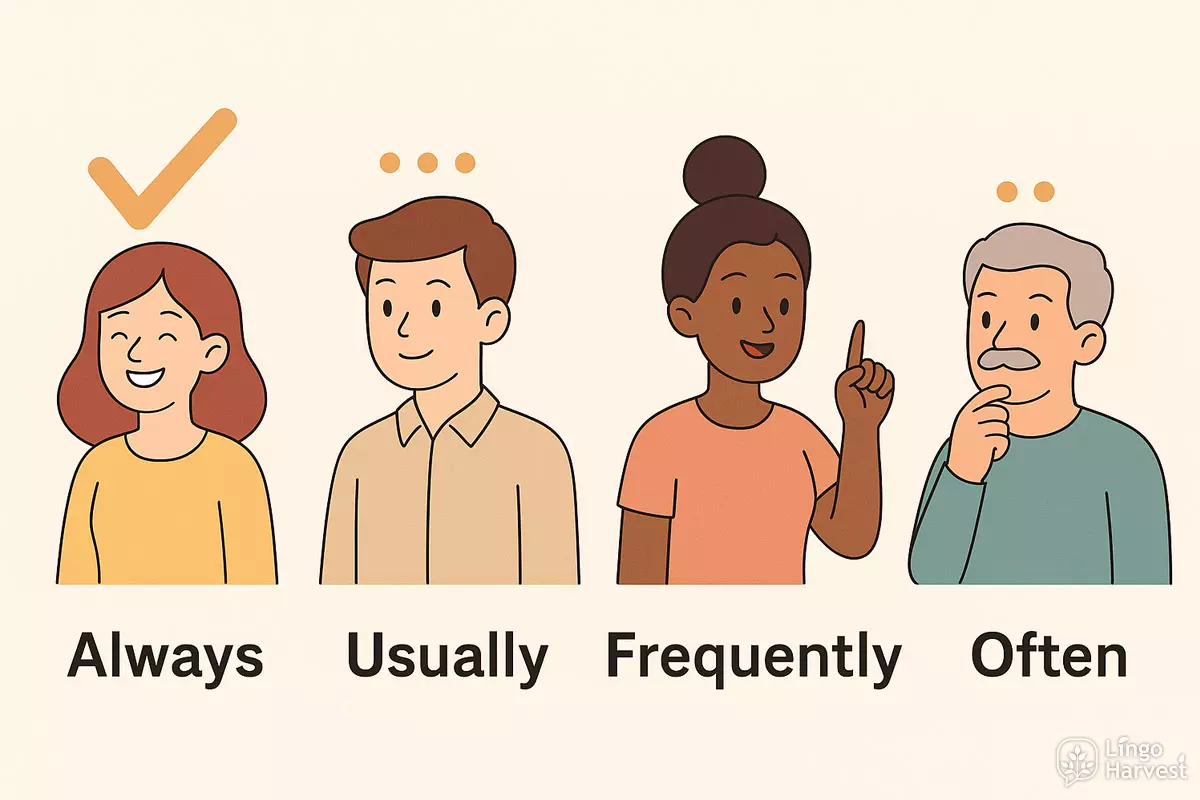
Here are some of the most widely used words and phrases that express regularity, ranging from actions that happen all the time to those that almost never occur:
- Always
- Usually
- Frequently
- Often
- Regularly
- Sometimes
- Occasionally
- Seldom
- Rarely
- Hardly ever
- Never
Range of Frequency
These words can indicate anything from 100% of the time to almost 0%. To visualize how they compare, here's a table showing common adverbs of frequency and their approximate percentage equivalents:
| Adverb | Approximate Frequency |
|---|---|
| Always | 100% |
| Usually | 80–90% |
| Often | 60–80% |
| Sometimes | 40–60% |
| Occasionally | 20–40% |
| Rarely | 5–20% |
| Never | 0% |
Choosing the right adverb helps your listener understand exactly how frequently something takes place. In everyday English, these words let you describe routines, habits, and exceptions with much greater clarity.
Order of Frequency Words
Understanding how to arrange adverbs that describe how often something happens is key for clear English communication. These words have a natural sequence, from the most frequent to the least. Using them correctly helps listeners or readers gauge the likelihood of an action or event.
Most Common Frequency Adverbs in Sequence
Generally, these modifiers are ranked by how often they indicate something occurs. Here’s a typical order, starting from actions that happen all the time down to those that rarely or never occur:
- Always
- Almost always
- Usually
- Normally
- Frequently
- Often
- Regularly
- Sometimes
- Occasionally
- From time to time
- Seldom
- Rarely
- Hardly ever
- Almost never
- Never
How Frequency Words Fit in Sentences
Placement usually depends on the verb. For most verbs, put the adverb before the main verb:
- She always drinks coffee in the morning.
- They rarely watch TV.
With the verb “to be”, the adverb comes after:
- He is usually on time.
- I am never late.
Comparing Frequency Adverbs
To better visualize the degree of certainty or regularity, here’s a table comparing common options with example meanings:
| Adverb | Approximate Frequency |
|---|---|
| Always | 100% of the time |
| Usually | About 80–90% |
| Often | Roughly 60–80% |
| Sometimes | About 40–50% |
| Occasionally | 20–30% |
| Rarely | 10% or less |
| Never | 0% |
Tips for Using Frequency Adverbs
- Choose the adverb that best matches how often something happens.
- Be precise—avoid exaggerating if you mean "sometimes" rather than "always."
- Mix up your vocabulary to sound more natural and less repetitive.
Using these words thoughtfully makes your English clearer and more expressive.
Position in a Sentence
When using adverbs of frequency such as "always," "usually," "often," "sometimes," and "never," their placement within a sentence is important for clarity and natural flow. Most commonly, these words appear before the main verb but after the subject. For example, "She always drinks coffee in the morning." However, if the main verb is "to be," the frequency adverb typically comes after the verb: "He is usually late."
General Placement Rules
- Before most verbs: "I often read before bed."
- After 'be' verbs: "They are never bored."
- At the beginning or end for emphasis: "Sometimes I walk to work." / "I walk to work sometimes."
Examples with Common Adverbs
Below are examples showing typical positions for the most frequently used adverbs in everyday English:
| Adverb | Example Sentence |
|---|---|
| Always | She always eats breakfast. |
| Usually | We are usually at home on Sundays. |
| Often | He often goes jogging in the park. |
| Sometimes | Sometimes they visit their grandparents. |
| Never | I never drink soda. |
| Rarely | She rarely watches TV. |
| Frequently | He frequently checks his email. |
| Occasionally | We occasionally eat out. |
| Seldom | They seldom argue. |
| Hardly ever | I hardly ever get sick. |
Additional Tips
- Adverbs like "sometimes" and "occasionally" can be placed at the beginning or end of a sentence for variety or emphasis.
- "Never" is used with affirmative verbs, not negatives (say "I never go," not "I don't never go").
- In questions, frequency adverbs come after the subject: "Do you often travel?"
- For strong emphasis, use adverbs at the start: "Always remember to lock the door."
Adverbs with Be vs Action Verbs
When using frequency adverbs in daily English, the placement of these words changes depending on whether you are working with the verb "be" or with other, more dynamic verbs. This difference is important for making your sentences sound natural and clear.
Placement with the Verb "Be"
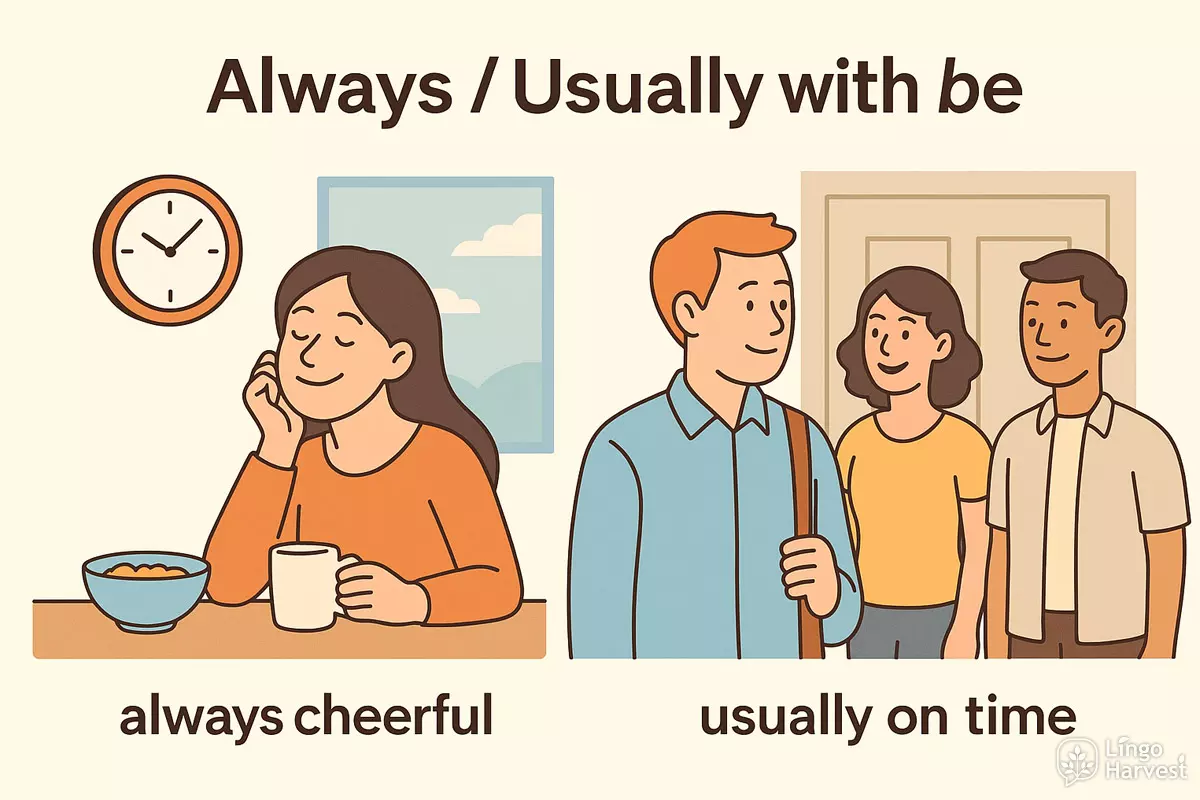
With forms of "be" (am, is, are, was, were), adverbs such as "always," "usually," "sometimes," and "never" typically come directly after the verb. For example:
- She is always cheerful in the morning.
- They are usually on time.
- I am never late for work.
- We were often tired after practice.
This pattern helps listeners immediately understand the frequency of the state or condition described.
Placement with Action Verbs
With most other verbs (run, eat, read, etc.), frequency adverbs are usually placed before the main verb. Here are some examples:
- He often reads before bed.
- They sometimes visit their cousins.
- I rarely eat fast food.
- She always forgets her keys.
This placement is standard for simple tenses in English and makes your meaning clear.
Quick Comparison Table
| With "Be" (am/is/are/was/were) | With Other Verbs |
|---|---|
| I am usually busy. | I usually work late. |
| He is never bored. | He never complains. |
| They are always friendly. | They always help others. |
| We were often tired. | We often played soccer. |
Common Frequency Adverbs
Here are some adverbs you’ll often use with both "be" and action verbs:
- always
- usually
- often
- frequently
- sometimes
- occasionally
- rarely
- seldom
- hardly ever
- never
Summary Tips
Remember: with "be," put the adverb after the verb; with most other verbs, place it before the verb. This small detail can make your English sound much more fluent and natural. Practicing this pattern will help you communicate habits and routines clearly in everyday conversations.
Common Mistakes
Understanding how to use adverbs like "always," "never," and "sometimes" can be tricky for English learners. Many errors happen with word order, frequency adverb meaning, and choosing the right adverb for the situation. Getting these details right helps your English sound more natural.
Word Order Problems
One of the most frequent challenges is placing the adverb in the correct spot. In English, these adverbs usually go before the main verb, but after the verb "to be." For example:
- I always eat breakfast. ✅
- I eat always breakfast. ❌
- She is usually late. ✅
- She usually is late. ❌
Mistakes with word order can make sentences confusing or unnatural.
Choosing the Wrong Adverb
Learners sometimes mix up words that seem similar, but have different meanings. For example, "seldom" and "rarely" are not as strong as "never," and "often" is not the same as "always." Picking the wrong term can change the meaning of your sentence.
| Incorrect Usage | Correct Usage |
|---|---|
| I never go to the gym, but I was there yesterday. | I rarely go to the gym, but I was there yesterday. |
| He always forgets his keys (if he only forgets sometimes). | He sometimes forgets his keys. |
| They are often always busy on weekends. | They are often busy on weekends. |
| She is never late (if she is late occasionally). | She is usually on time. |
Double Negatives and Redundancy
Using two negatives, like "never" with "not," is a common slip. For example:
- I don't never eat meat. ❌ (incorrect)
- I never eat meat. ✅ (correct)
Likewise, avoid stacking adverbs unnecessarily (e.g., "She is always usually tired").
Common Confusions: A Quick List
Here are some typical mix-ups and awkward uses with frequency adverbs:
- Using "hardly ever" and "never" together
- Placing the adverb at the end of the sentence ("I go shopping always")
- Using "sometimes" in the wrong position ("Sometimes I am late" is correct, "I am sometimes late" is also correct, but "I late sometimes am" is not)
- Confusing "ever" and "never" in statements ("I ever eat fish" is incorrect)
- Mixing up "usually" and "normal" ("I am normal late" is incorrect; "I am usually late" is correct)
- Inserting adverbs between modal verbs and main verbs ("She can always sings" is incorrect; "She can always sing" is correct)
- Overusing strong adverbs like "always" or "never" instead of more moderate options
- Forgetting subject-verb agreement when the adverb is present ("He always go" instead of "He always goes")
- Placing adverbs before auxiliary verbs ("He always has eaten" instead of "He has always eaten")
- Using two frequency adverbs together ("He never usually eats breakfast")
Paying attention to these pitfalls will help you use frequency words with confidence and clarity in daily conversation.
Practice: Rewrite with Correct Adverbs
Understanding how to use adverbs of frequency is essential for expressing how often actions occur in daily life. Below, you'll find practical exercises and examples to help you master these common adverbs.
Rewrite Sentences Using Suitable Frequency Adverbs
Choose the correct adverb from the list to make the sentences sound natural. Consider how often the action is likely to happen in everyday situations.
- I am late to work. (never, usually, always)
- She drinks coffee in the morning. (sometimes, rarely, always)
- We eat out on weekends. (never, often, always)
- They forget their keys. (always, rarely, frequently)
- He goes jogging before breakfast. (never, sometimes, usually)
- I watch TV after dinner. (always, occasionally, never)
- You call your grandmother. (often, never, seldom)
- My cat wakes me up early. (always, rarely, sometimes)
- We travel abroad. (never, occasionally, always)
- She forgets her umbrella. (rarely, always, usually)
Show answers
- I am usually late to work.
- She always drinks coffee in the morning.
- We often eat out on weekends.
- They rarely forget their keys.
- He usually goes jogging before breakfast.
- I occasionally watch TV after dinner.
- You often call your grandmother.
- My cat sometimes wakes me up early.
- We occasionally travel abroad.
- She rarely forgets her umbrella.
Frequency Adverbs in Context
To help you see patterns, here’s a comparison of how often each adverb is typically used. This can guide your choices when rewriting sentences.
| Adverb | Approximate Frequency |
|---|---|
| Always | 100% of the time |
| Usually | 80–90% of the time |
| Often | 60–80% of the time |
| Frequently | 60–80% of the time |
| Sometimes | 30–50% of the time |
| Occasionally | 10–30% of the time |
| Seldom | Less than 10% of the time |
| Rarely | Less than 10% of the time |
| Never | 0% of the time |
Quick Rewrite Challenge
Try rephrasing these statements using an appropriate frequency word:
- Tom eats vegetables. (He does it most days.)
- Maria goes to the gym. (She only does it a few times a year.)
- We see our cousins. (It happens every holiday.)
- You forget your wallet. (It almost never happens.)
Show answers
- Tom usually eats vegetables.
- Maria rarely goes to the gym.
- We always see our cousins on holidays.
- You seldom forget your wallet.
Practicing these rewrites will help you naturally choose the right adverb to describe how often something occurs in English conversation.