Really vs Very: How to Choose the Right Word

 Here we the difference between really and very, when they can be swapped, and how they pair with strong or weak adjectives. It also gives tips to avoid repetition, offers spoken English examples, and provides practice with better word choices.
Deciding when to use words that intensify meaning, such as "really" or "very," can be more challenging than it seems in both speaking and writing. These intensifiers often appear interchangeable, but each carries its own nuances and can subtly shift the tone or emphasis of your message. Being aware of these differences allows you to convey your thoughts more precisely and adapt your language to suit various situations or audiences. By choosing the right intensifier, you enhance clarity and make your communication sound more natural and effective.
Meaning Difference Between Really and Very
Understanding how "really" and "very" differ can help you sound more natural and precise in English. Both words intensify adjectives or adverbs, but they’re not always interchangeable. Their subtle distinctions affect the tone, emphasis, and even the level of formality in your sentences.
Core Distinctions
"Very" is typically used to strengthen adjectives or adverbs, suggesting a high degree of the quality described. It has a more neutral, sometimes formal tone. In contrast, "really" often adds emphasis in a way that feels more conversational and emotionally expressive. It can also suggest genuineness or truth, beyond mere intensity.
| Aspect | "Very" | "Really" |
|---|---|---|
| Degree of Intensity | High, but sometimes feels neutral | High, often with more emotional emphasis |
| Formality | Often more formal | More informal and conversational |
| Literal Meaning | Only intensifies | Can mean "truly" or "genuinely" |
| Common Usage | Adjectives and adverbs | Adjectives, adverbs, sometimes verbs |
| Example | very tired, very quickly | really tired, really want |
Usage Examples
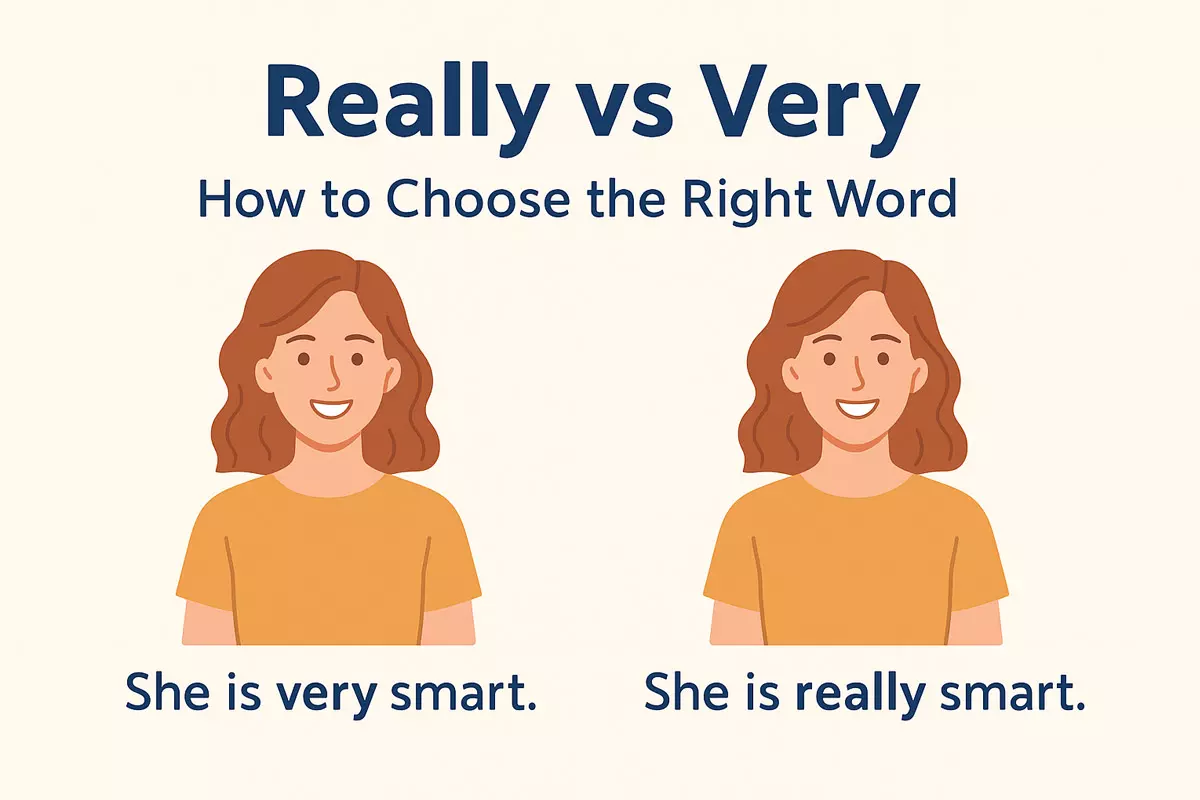
- She is very smart. → She has a high level of intelligence (neutral or formal).
- She is really smart. → Stronger, more conversational emphasis on her intelligence.
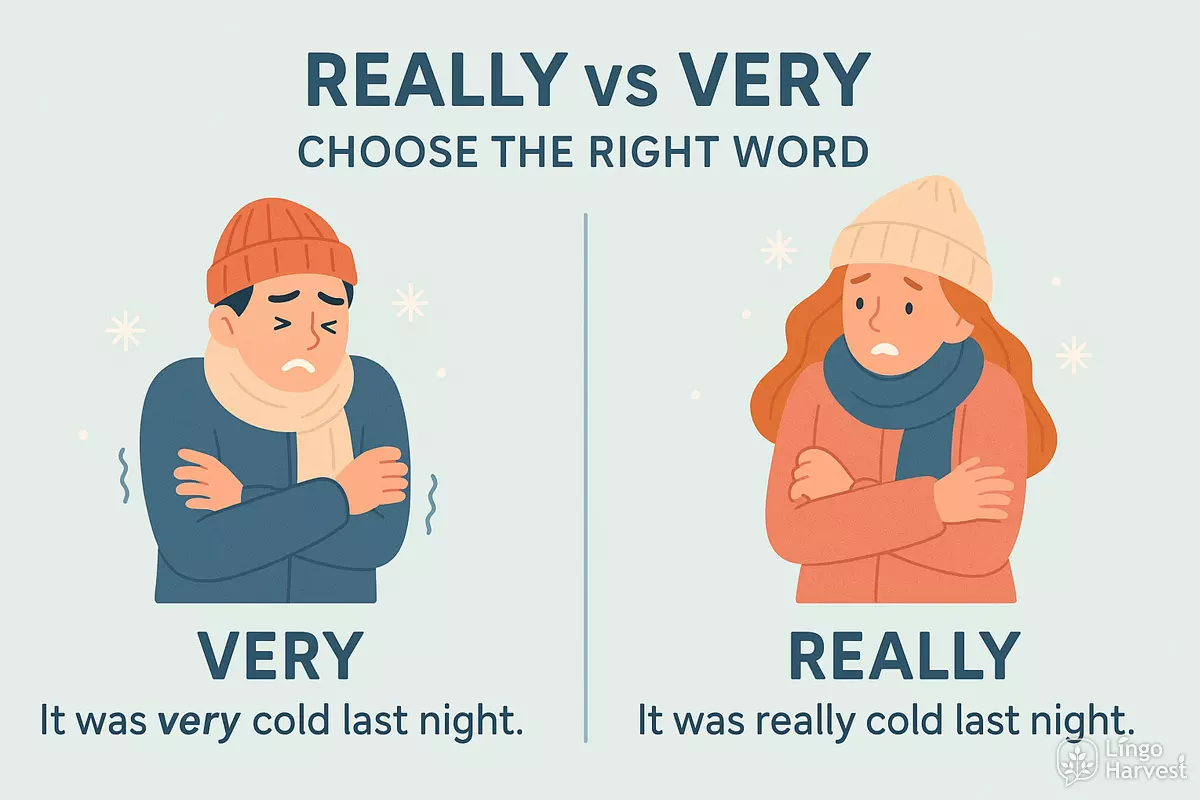
- It was very cold last night. → Describes a high degree of coldness.
- It was really cold last night. → Implies you personally felt or noticed the cold.
- I really appreciate your help. → Means "truly" appreciate, not just "very" much.
- The test was very difficult. → Focuses on the high level of difficulty.
- The test was really difficult. → Adds a sense of personal experience or surprise.
- He runs very fast. → Simply notes his speed.
- He runs really fast. → Stronger, more emphatic or surprised tone.
- I’m very sorry. → Formal apology.
- I’m really sorry. → Feels more heartfelt or sincere.
Summary
While both words intensify meaning, "very" tends to be more formal and neutral, while "really" brings a conversational and genuine tone. Choosing between them depends on context, your relationship with the listener, and the nuance you want to convey.
When They Are Interchangeable
In many everyday situations, both "really" and "very" can be used to emphasize adjectives or adverbs without changing the meaning of the sentence. This is particularly true when you want to intensify a basic quality, like how cold it is or how quickly something happens. For most native speakers, swapping one for the other in these contexts sounds natural and does not alter the intended message.
Common Contexts for Substitution
- Describing emotions: "really happy" vs. "very happy"
- Talking about weather: "really cold" vs. "very cold"
- Emphasizing speed: "really fast" vs. "very fast"
- Expressing degree: "really hard" vs. "very hard"
- Praising something: "really good" vs. "very good"
- Describing size: "really big" vs. "very big"
- Reacting to news: "really surprising" vs. "very surprising"
- Stating preferences: "really like" vs. "very much like" (though "very like" is less common, "very much like" works)
- Describing difficulty: "really easy" vs. "very easy"
- Talking about tiredness: "really tired" vs. "very tired"
- Describing beauty: "really beautiful" vs. "very beautiful"
- Emphasizing danger: "really dangerous" vs. "very dangerous"
Example Sentences
To illustrate, here are some pairs where either word can be used with little or no change in meaning:
- She is really excited about the trip. / She is very excited about the trip.
- This movie is really interesting. / This movie is very interesting.
- I'm really hungry. / I'm very hungry.
- He's really smart. / He's very smart.
When Substitution Feels Natural
Generally, if you are intensifying a regular adjective or adverb (not an absolute or extreme one), and your sentence feels natural with both choices, either can be used. However, keep in mind that "really" can sound a bit more conversational or informal, while "very" often feels a touch more formal or neutral.
Strong and Weak Adjectives
Understanding the difference between adjectives with strong meaning and those with a milder sense helps you choose between intensifiers like “really” and “very.” Some adjectives already convey a high degree of intensity, while others are more neutral and often need a boost from intensifiers.
What Makes an Adjective “Strong” or “Weak”?
Adjectives that express an extreme or absolute quality are often called “strong” (or “extreme”) adjectives. These words—like “enormous” or “freezing”—don’t usually require intensifiers such as “very.” In contrast, “weak” (or “gradable”) adjectives, such as “big” or “cold,” can vary in degree and commonly appear with intensifiers.
Examples of Gradable and Extreme Adjectives
Here are some common pairs that illustrate the difference:
- big → enormous
- small → tiny
- cold → freezing
- hot → boiling
- hungry → starving
- tired → exhausted
- angry → furious
- bad → terrible
- good → excellent
- scared → terrified
- funny → hilarious
- clean → spotless
- dirty → filthy
- happy → delighted
- sad → devastated
- interesting → fascinating
- surprised → amazed
- old → ancient
- pretty → gorgeous
- sure → certain
When to Use “Very” or “Really”
You’ll typically use “very” or “really” with adjectives that describe qualities on a scale. For example, “very cold” or “really big” both make sense. However, using these intensifiers with adjectives that already express an extreme meaning often sounds awkward or redundant. For example, “very freezing” or “really starving” is rarely used by native speakers.
Quick Reference: Intensifiers and Adjective Types
| Gradable Adjective | Extreme Adjective |
|---|---|
| cold (very/really cold) | freezing (absolutely freezing) |
| hungry (very/really hungry) | starving (absolutely starving) |
| good (very/really good) | excellent (absolutely excellent) |
| tired (very/really tired) | exhausted (absolutely exhausted) |
| angry (very/really angry) | furious (absolutely furious) |
In summary, choose intensifiers based on the adjective’s strength. Use “very” or “really” with gradable adjectives, but with extreme ones, consider alternatives like “absolutely” or simply use the adjective alone. This approach makes your English sound more natural and precise.
Avoiding Repetition
Choosing between "really" and "very" can quickly become tedious if one word is used repeatedly in your writing. To keep your language engaging and clear, it’s important to alternate intensifiers and explore alternatives. Overusing the same word makes sentences sound monotonous and weakens your message.
Why Variety Matters
Readers notice when the same intensifier appears again and again. This repetition can make your writing feel flat and distract from your ideas. By mixing things up, you not only keep your audience interested but also add more precise shades of meaning.
Alternatives to "Really" and "Very"
Instead of relying solely on these two words, try incorporating synonyms or using stronger adjectives. Here are some options to consider:
- Extremely
- Highly
- Exceptionally
- Incredibly
- Terribly
- Remarkably
- Absolutely
- Truly
- So
- Especially
- Quite
- Particularly
- Awfully
- Super
- Deeply
- Totally
- Severely
- Unusually
- Most (in formal contexts)
- Utterly
Using Stronger Words Instead of Intensifiers
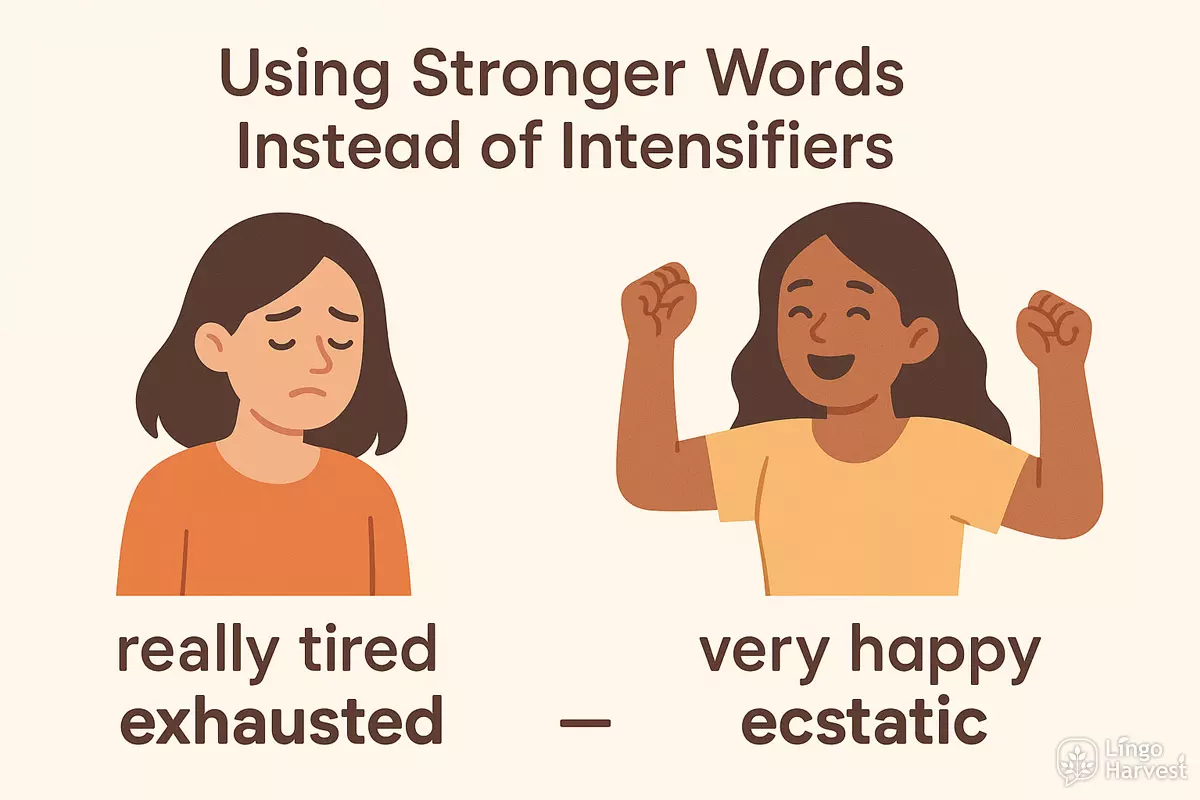
Another effective approach is to swap out weak adjective–intensifier pairs for single, more powerful words. For example, instead of "very big," you might use "enormous." This can make your writing more concise and vivid.
| With Intensifier | Stronger Single Word |
|---|---|
| really tired | exhausted |
| very happy | ecstatic |
| really cold | freezing |
| very good | excellent |
| really bad | terrible |
| very small | tiny |
| really fast | rapid |
| very old | ancient |
Tips for Natural Variation
- Read your sentences out loud to spot repeated patterns.
- Replace intensifiers with synonyms or stronger adjectives.
- Limit the use of "really" and "very" to moments where emphasis is truly needed.
- Use descriptive language that shows rather than tells (e.g., "shivered" instead of "very cold").
Experimenting with these techniques helps maintain interest and ensures your writing feels fresh and expressive.
Examples in Spoken English
When people talk, choosing between “really” and “very” depends on the situation, the feeling they want to express, and how natural the sentence sounds. In daily conversations, both words are used for emphasis, but “really” is often more informal, while “very” can sound a bit more formal or neutral. Notice how speakers might pick one over the other based on what feels right in the moment.
Common Ways "Really" and "Very" Are Used in Conversation
- That movie was really good! ✅
- She’s very talented.
- I’m really tired after that run.
- This coffee is very hot. Be careful!
- He’s really funny — I couldn’t stop laughing.
- The instructions were very clear.
- I’m really sorry about being late.
- The weather is very nice today.
- Are you really sure about this?
- She’s very patient with children.
- That test was really hard.
- Your idea is very interesting.
- I’m really happy you came.
- This is very important.
- He’s really into jazz music.
- She was very surprised by the news.
- This pizza tastes really fresh.
- It’s very cold outside.
Choosing the Natural Option
Speakers sometimes switch between “really” and “very” for a more casual effect, or to express stronger emotion. For example, “really” often sounds more personal or enthusiastic, while “very” can feel a bit more reserved. It also depends on which adjectives you use. Some words work better with one than the other in natural speech.
| Expression | More Common in Everyday Speech |
|---|---|
| I’m really sorry. | ✅ Sounds more heartfelt and casual |
| I’m very sorry. | ✅ Slightly more formal, often in apologies |
| This is really important. | ✅ Strong, direct emphasis |
| This is very important. | ✅ Neutral, standard emphasis |
| She’s really good at math. | ✅ More conversational |
| She’s very good at math. | ✅ Slightly more formal |
Quick Tips for Speaking Naturally
- “Really” often feels more relaxed and friendly in casual chats.
- “Very” is safe for both spoken and written English, especially when you want to sound a bit more polite or neutral.
- Some expressions, like “really sorry” or “really excited,” are more common than “very sorry” or “very excited.”
- Both words can be used before adjectives, but “really” sometimes comes before verbs (e.g., “I really like it”).
Choosing between these two words is about matching your tone to the situation. Listening to native speakers can help you notice which option fits best in different contexts.
Practice: Rewrite with Better Word Choice
Choosing between "really" and "very" can improve clarity and make your writing more precise. Below, you'll find practice sentences and a list of alternatives that help replace these intensifiers with stronger, more specific words. You’ll also have a chance to apply what you’ve learned by rewriting sentences for better impact.
Common Sentences to Improve
Review these sentences. Each uses "really" or "very" in a way that could be improved. Try to rewrite them using more vivid descriptions or stronger adjectives.
- The movie was really good.
- She is very tired after work.
- This soup is really hot.
- He did a very bad job on the project.
- The weather is really cold today.
- That test was very easy.
- I am really hungry.
- Her answer was very surprising.
- The book was very interesting.
- He runs really fast.
Show answers
- The movie was excellent.
- She is exhausted after work.
- This soup is scorching.
- He did a terrible job on the project.
- The weather is freezing today.
- That test was effortless.
- I am starving.
- Her answer was astonishing.
- The book was fascinating.
- He sprints.
Stronger Alternatives for "Really" and "Very"
Instead of relying on these common intensifiers, consider the following alternatives that add precision and color to your writing:
- extremely
- utterly
- completely
- absolutely
- incredibly
- immensely
- exceptionally
- highly
- particularly
- deeply
- profoundly
- tremendously
- remarkably
- totally
- overwhelmingly
- especially
- truly
- intensely
- significantly
- notably
Rewrite Challenge
Try to improve these sentences by replacing "really" or "very" with a more descriptive word or phrase. Write your rewrites before checking the suggested answers.
- The cake was very sweet.
- It’s really important to arrive on time.
- She is very smart.
- He was really angry about the mistake.
Show answers
- The cake was sugary.
- It’s crucial to arrive on time.
- She is brilliant.
- He was furious about the mistake.
Quick Reference: When to Use Stronger Words
Use this guide to decide when to swap out basic intensifiers for more impactful vocabulary.
- When you want to be specific (e.g., "freezing" instead of "very cold")
- If the sentence feels bland or repetitive
- To avoid overusing the same words in your writing
- When you want to show rather than tell emotion or quality
Practicing these rewrites builds your confidence and makes your writing more engaging and precise.