Frequency Ladder: From Always to Never

 This article explains the full range of frequency adverbs, their correct order, and placement in sentences. It includes a chart with examples, highlights common mistakes, and offers practice to help you use these adverbs accurately.
Consider how some activities become daily routines while others happen only occasionally, highlighting the wide range of frequencies with which we do things. By examining how often we engage in certain behaviors—from regular habits to rare events—we can gain insight into the patterns that shape our lives. This awareness can help us understand our routines, identify what is important to us, and even inspire changes that lead to personal growth or greater satisfaction.
Understanding Frequency Range
Frequency terms help us describe how often something happens, from events that occur all the time to those that never take place. In language, especially in English grammar and everyday conversation, these expressions create clarity. They let speakers and writers convey not only actions but also the regularity of those actions—an essential nuance for both native and non-native speakers.
What Is a Frequency Range?
When we talk about frequency in language, we refer to how regularly an event occurs. This spectrum stretches from "always" (at every opportunity) down to "never" (not at all). Between these two extremes, there are various gradations, each with its own meaning and usage. Understanding where each adverb or phrase falls on this scale can help avoid misunderstandings.
Common Frequency Adverbs and Their Meanings
Here are commonly used words and phrases that indicate different points along the frequency spectrum:
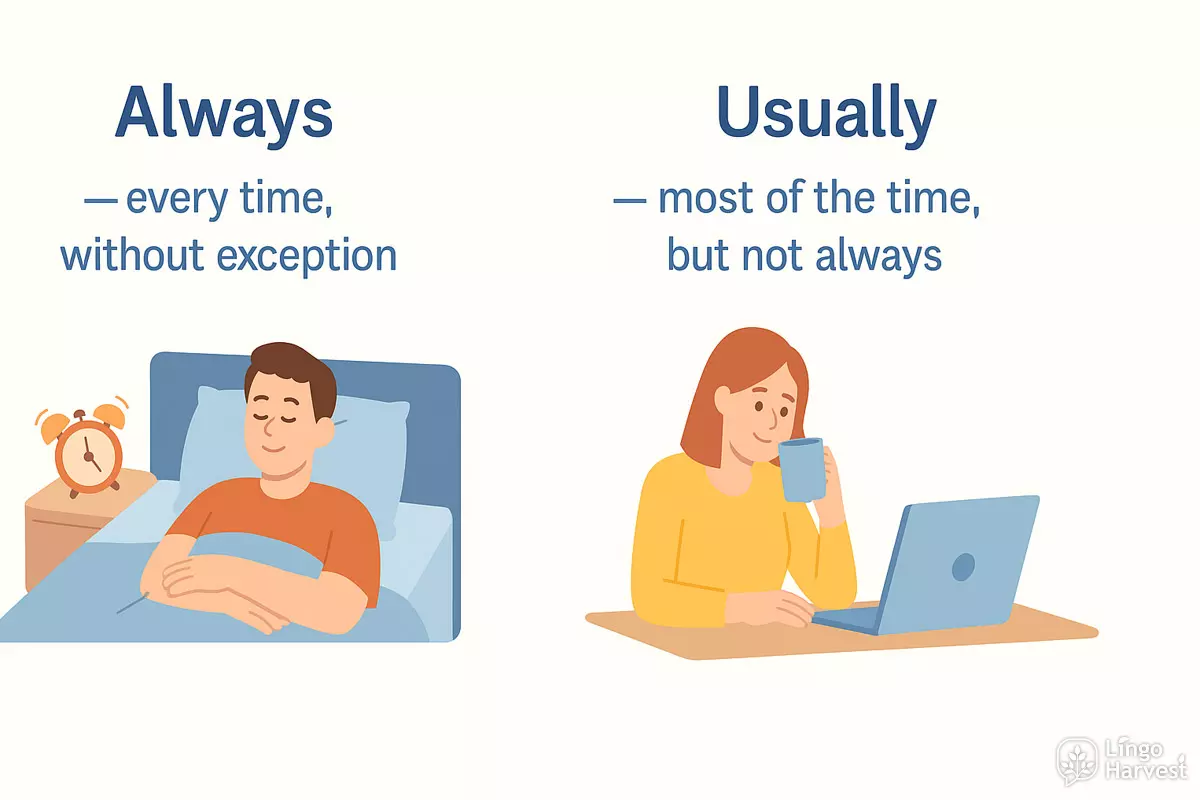
- Always ✅ – every time, without exception
- Almost always – just short of every time
- Usually – most of the time, but not always
- Frequently – often, at regular intervals
- Often – many times, but not as much as "usually"
- Regularly – at consistent times, following a pattern
- Sometimes – on occasion, but not regularly
- Occasionally – now and then, less than "sometimes"
- Rarely → infrequently, but it does happen
- Seldom – even less frequent than "rarely"
- Hardly ever – almost never, but still possible
- Never ❌ – not at any time
Comparing Frequency Adverbs
To see how these terms relate to each other, here's a structured comparison:
| Adverb/Phrase | Approximate Frequency |
|---|---|
| Always | 100% |
| Usually | 80–90% |
| Often/Frequently | 60–80% |
| Sometimes | 40–60% |
| Occasionally | 20–40% |
| Rarely/Seldom | 5–20% |
| Never | 0% |
Why the Range Matters
Choosing the right frequency word helps with precision. For example, saying "I always exercise" paints a very different picture from "I sometimes exercise." Misusing these expressions can lead to confusion or miscommunication, especially in instructions, habits, or reporting facts.
Context and Flexibility
Not every frequency term fits every context. Sometimes, cultural or personal habits affect which words are most natural. In addition, some adverbs can overlap in meaning or be used interchangeably, but subtle differences often remain. Awareness of this range allows for more effective and nuanced communication.
Top to Bottom Order
When thinking about how often something happens, it helps to visualize these frequency expressions arranged from the most frequent to the least. This hierarchy can clarify meaning and help you choose the right word or phrase for any context. Frequency language, from “always” down to “never,” forms a clear gradient of regularity, and understanding this spectrum is essential in both writing and conversation.
Common Frequency Words: From Most to Least
- Always
- Almost always
- Usually
- Frequently
- Often
- Regularly
- Generally
- Sometimes
- Occasionally
- From time to time
- Rarely
- Seldom
- Hardly ever
- Almost never
- Never
Visualizing the Frequency Ladder
This “ladder” not only helps with understanding but also with making your communication more precise. For example, saying you “rarely” do something gives a much different impression than saying you “sometimes” do it. Each rung on the scale represents a distinct level of occurrence, so choosing the right term helps avoid ambiguity.
Comparing Frequency Adverbs
| Adverb | Typical Meaning |
|---|---|
| Always | 100% of the time; without exception ✅ |
| Usually | Approximately 80–90% of the time |
| Often | Roughly 60–80% of the time |
| Sometimes | About 40–50% of the time |
| Rarely | Only 5–20% of the time ❌ |
| Never | 0% of the time; not at all ❌ |
Tips for Choosing the Right Frequency Expression
- Match your word with the actual frequency you mean.
- Be aware of subtle differences (e.g., “rarely” vs. “hardly ever”).
- Consider your audience and formality—some expressions are more conversational than others.
- Use these terms to add nuance and clarity to descriptions, routines, and habits.
Understanding the full spectrum of frequency terms helps make your statements accurate and your meaning clear, whether you’re describing daily habits or rare events.
Adverb Placement Rules
Understanding where to place adverbs of frequency, such as "always," "usually," "often," and "never," is essential for clear and natural English. These words typically describe how often something happens and can change the meaning of a sentence depending on their position. Most commonly, they appear in the middle of a sentence, but there are exceptions.
Standard Position in Sentences
For most present simple sentences with one main verb, frequency adverbs are placed before the main verb but after the subject. For example:
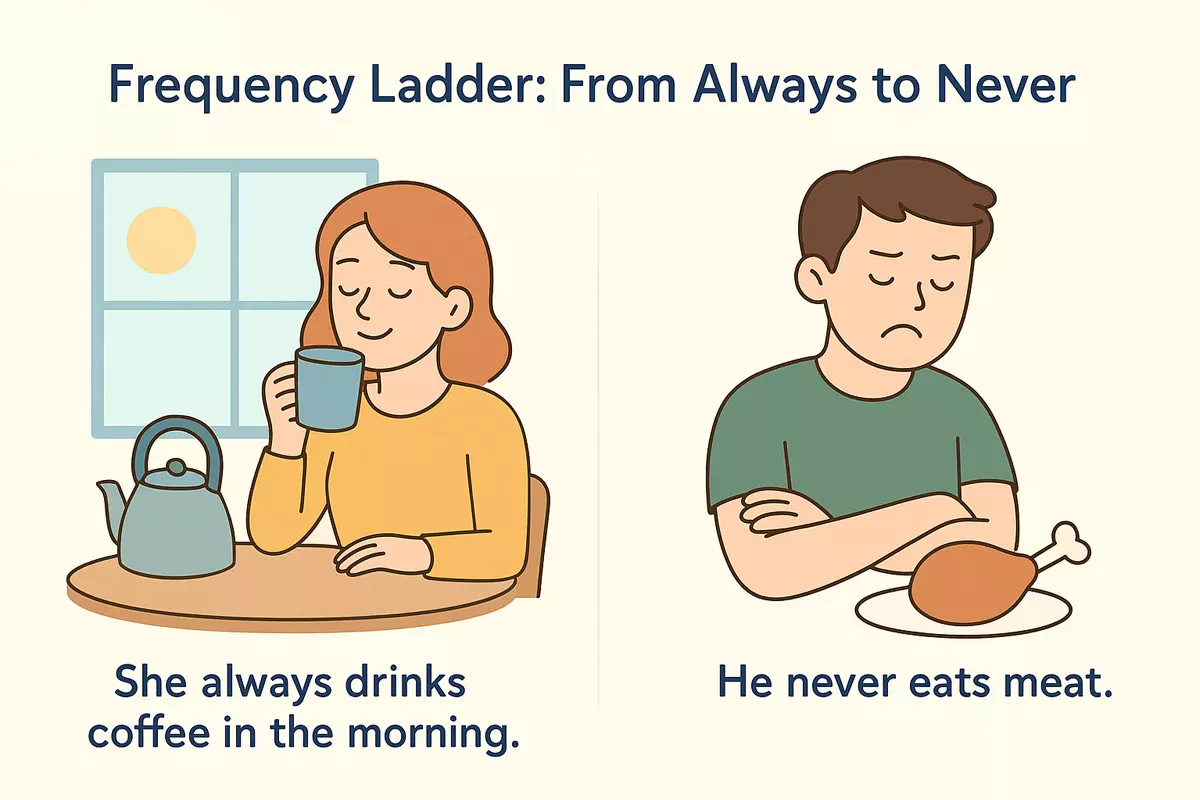
- She always drinks coffee in the morning.
- They usually walk to work.
- He never eats meat.
Placement with "Be" Verbs
When the main verb is a form of "to be" (am, is, are, was, were), the adverb comes after the verb:
- I am often late.
- They are always happy to help.
- He is rarely upset.
Adverbs with Auxiliary Verbs
If the sentence has an auxiliary (helping) verb, such as "have," "will," "can," or "should," the adverb appears after the auxiliary but before the main verb:
- She has never traveled abroad.
- We will always remember this day.
- You should rarely skip breakfast.
Sentence-Initial and Sentence-Final Positions
Some adverbs, especially "sometimes" and "occasionally," can be placed at the beginning or end of a sentence for emphasis or variation:
- Sometimes, I forget my keys.
- I go to the gym occasionally.
However, most frequency adverbs (like "always" or "never") rarely appear in these positions.
Comparing Adverb Placement Patterns
| Sentence Type | Correct Adverb Placement |
|---|---|
| Simple Present (main verb) | Subject + adverb + verb He always studies late. |
| With "Be" verb | Subject + be + adverb She is usually cheerful. |
| Auxiliary verb | Subject + aux + adverb + main verb We have never seen it. |
| Sentence-initial/final (rare) | Sometimes I read at night. I read at night sometimes. |
Typical Frequency Adverbs (with examples)
- Always: She always finishes her homework on time.
- Usually: We usually eat dinner at seven.
- Frequently: He frequently visits his grandparents.
- Often: I often walk in the park.
- Sometimes: They sometimes travel abroad.
- Occasionally: She occasionally bakes cookies.
- Seldom: He seldom watches TV.
- Rarely: We rarely eat out.
- Hardly ever: She hardly ever complains.
- Never: I never drink soda.
Correct placement of these modifiers improves clarity and makes your English sound more natural. Practice by creating your own sentences with different frequency adverbs and positions to master these patterns.
Chart with Examples
Understanding how often something occurs is easier when you see common frequency words arranged in order. English uses a set of standard adverbs and phrases to describe frequency, ranging from actions that happen all the time to ones that never occur. These expressions are especially useful for daily routines, habits, and general truths. Below, you’ll find a detailed comparison of these terms, including typical sentence examples and their approximate percentage of occurrence. This structured overview helps visualize where each word fits on the “always to never” scale.
| Frequency Word | Example Sentence | Approximate Frequency |
|---|---|---|
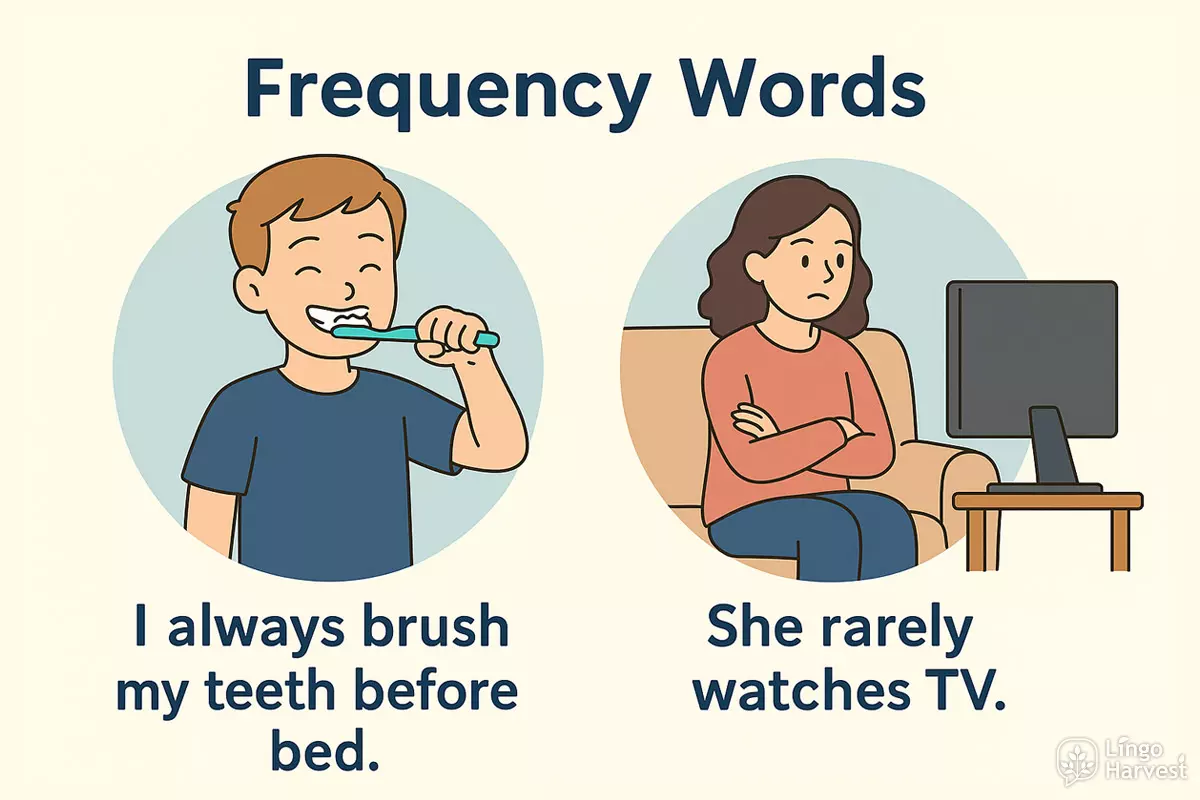
| Always | I always brush my teeth before bed. | 100% ✅ |
| Usually | She usually walks to work. | 80–90% |
| Frequently | We frequently visit our grandparents. | 70–80% |
| Often | He often reads before sleeping. | 60–70% |
| Sometimes | They sometimes eat out on weekends. | 40–50% |
| Occasionally | I occasionally drink coffee in the afternoon. | 20–30% |
| Rarely | She rarely watches TV. | 10–20% |
| Seldom | He seldom misses a class. | 5–10% |
| Hardly ever | We hardly ever go to the cinema. | 1–5% |
| Never | I never smoke. | 0% ❌ |
When choosing which word to use, consider the regularity of the event and the impression you want to give. This frequency “ladder” offers a practical framework for expressing how often activities or situations occur in English.
Common Mistakes
Misusing adverbs of frequency often leads to unclear or awkward sentences. Learners sometimes confuse word order, select the wrong term for the context, or fail to match the adverb’s intensity to what they actually mean. Understanding the subtleties of each frequency word is crucial for natural-sounding communication.
Word Order Confusion
Forgetting where to place words like “always,” “usually,” or “never” is a top issue. In English, these adverbs typically come before the main verb but after the verb “to be.” Mixing up their positions can make statements sound odd or incorrect.
- He always is late. ❌ → He is always late. ✅
- I go never there. ❌ → I never go there. ✅
Using the Wrong Term
Choosing a frequency word that doesn’t match what you want to say can mislead listeners. For instance, “often” and “sometimes” are not interchangeable, and “rarely” is not the same as “never.” Double-check that the adverb reflects your intended meaning.
Overusing the Same Adverb
Relying on just “always” or “never” can make your speech sound repetitive and less nuanced. Expanding your range with words like “frequently,” “occasionally,” or “hardly ever” helps you express yourself more precisely.
Confusing Similar Adverbs
Some adverbs seem close in meaning but differ slightly in frequency. Mixing these up can change the message:
| Adverb | Typical Frequency |
|---|---|
| Always | 100% of the time; no exceptions |
| Usually | About 80-90% of the time; most cases |
| Often | Roughly 60-70% of the time; many cases |
| Sometimes | Approximately 40-50% of the time; not regularly |
| Rarely | About 10-20% of the time; infrequently |
| Never | 0%; does not happen |
Other Frequent Pitfalls
- Placing two frequency words in one sentence (e.g., “I usually always eat breakfast”).
- Using frequency adverbs with stative verbs incorrectly (“I am sometimes know her”).
- Translating directly from your native language, which may use different word order or expressions.
- Neglecting to adjust verb tense when using these adverbs.
- Omitting the adverb altogether, which can make your meaning too vague.
Becoming aware of these stumbling blocks will help you use English frequency language more naturally and effectively.
Practice: Place Adverbs by Frequency
Understanding where to put adverbs of frequency in sentences is essential for natural English. These words—such as always, usually, sometimes, rarely, and never—have typical positions depending on the verb type. The following exercises will help you master their placement in both simple and more complex sentences.
Common Patterns for Adverb Placement
- Before the main verb (except to be):
She always eats breakfast. - After the verb "to be":
He is usually late. - Between auxiliary and main verb:
They have never visited Japan. - At the beginning or end for emphasis (less common):
Sometimes, we go hiking.
We go hiking sometimes.
Practice: Insert the Correct Adverb
Choose the best position for the adverb in each sentence. Use these adverbs: always, usually, often, sometimes, rarely, never.
- He _______ forgets his keys. (rarely)
- They are _______ on time. (usually)
- I have _______ seen such a beautiful sunset. (never)
- We _______ eat out on Fridays. (often)
- _______, it rains in April. (Sometimes)
- She _______ drinks coffee. (always)
Show answers
- He rarely forgets his keys.
- They are usually on time.
- I have never seen such a beautiful sunset.
- We often eat out on Fridays.
- Sometimes, it rains in April.
- She always drinks coffee.
Frequency Adverbs in Different Tenses
Adverbs of frequency can appear with various tenses. Notice the difference in placement:
| Sentence Type | Example with Adverb |
|---|---|
| Simple Present | I always take the bus. |
| Present Continuous | She is often studying late. |
| Present Perfect | We have never met before. |
| Modal Verbs | You can sometimes see deer here. |
Transform the Sentences
Rewrite these sentences by adding the given adverb in the correct place.
- He takes the train to work. (sometimes)
- She is late for class. (rarely)
- We have met before. (never)
- I drink tea in the morning. (usually)
Show answers
- He sometimes takes the train to work.
- She is rarely late for class.
- We have never met before.
- I usually drink tea in the morning.
Quick Reference: Adverb Placement Rules
- With “be”: adverb comes after the verb (She is always happy.)
- With other verbs: adverb goes before the main verb (They often visit us.)
- With auxiliaries: adverb between auxiliary and main verb (I have never tried sushi.)
Practicing these patterns will help you sound more natural and fluent when expressing how often things happen in English.