Prepositions for Common Places: In, At, On

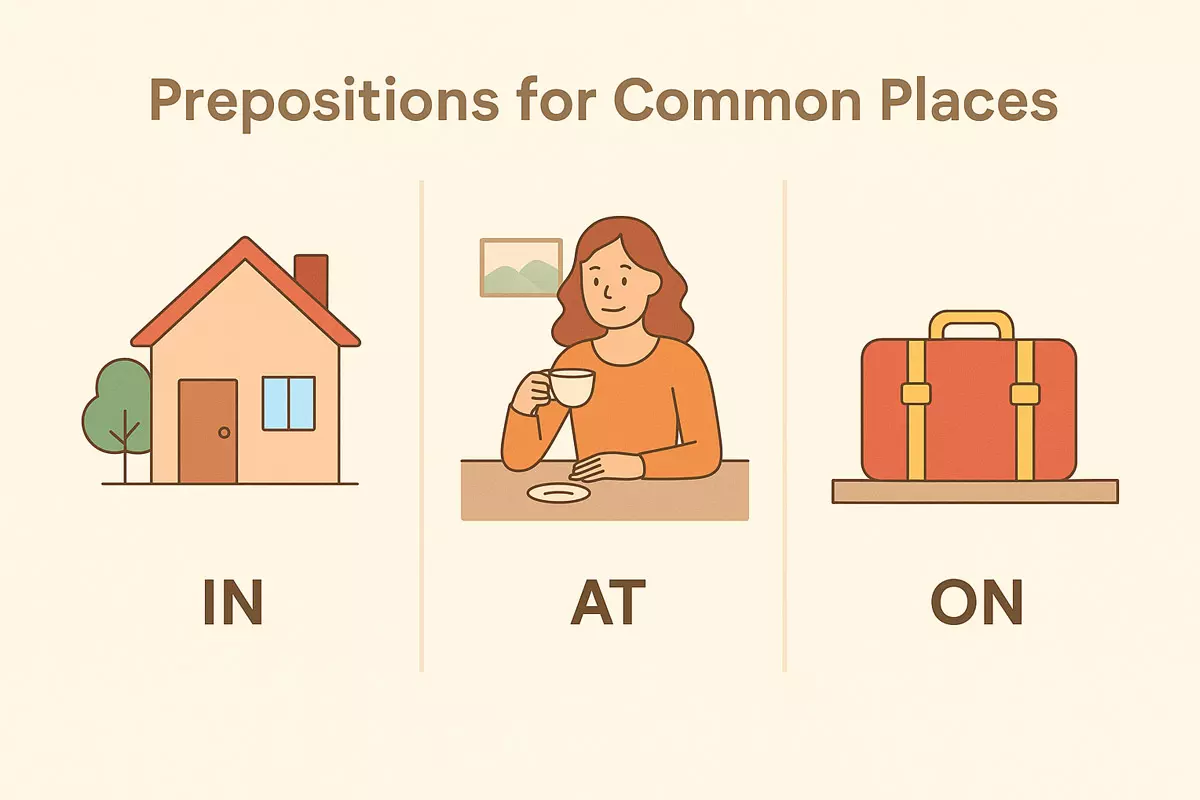 The article explains key rules for using in, at, and on, gives examples with places like buildings, cities, streets, and rooms, points out common mistakes made by Russian learners, and provides practice exercises to test your understanding.
Choosing the correct prepositions before place names in English, such as in, at, or on, can be surprisingly challenging for learners. These small words often carry specific meanings that change how a sentence is understood. For instance, we say in a country or city, at a specific address or event, and on a street or island. Mastering these distinctions helps make your everyday conversations clearer, more natural, and more precise, ensuring you communicate your intended meaning effectively in various situations.
Basic Rules for In, At, On
Understanding how to use "in," "at," and "on" with places is essential for clear communication in English. Each preposition has its own specific uses, often depending on the size, type, or concept of the location. While these words can sometimes seem confusing, there are some helpful guidelines and patterns that make them easier to master.
When to Use "In"
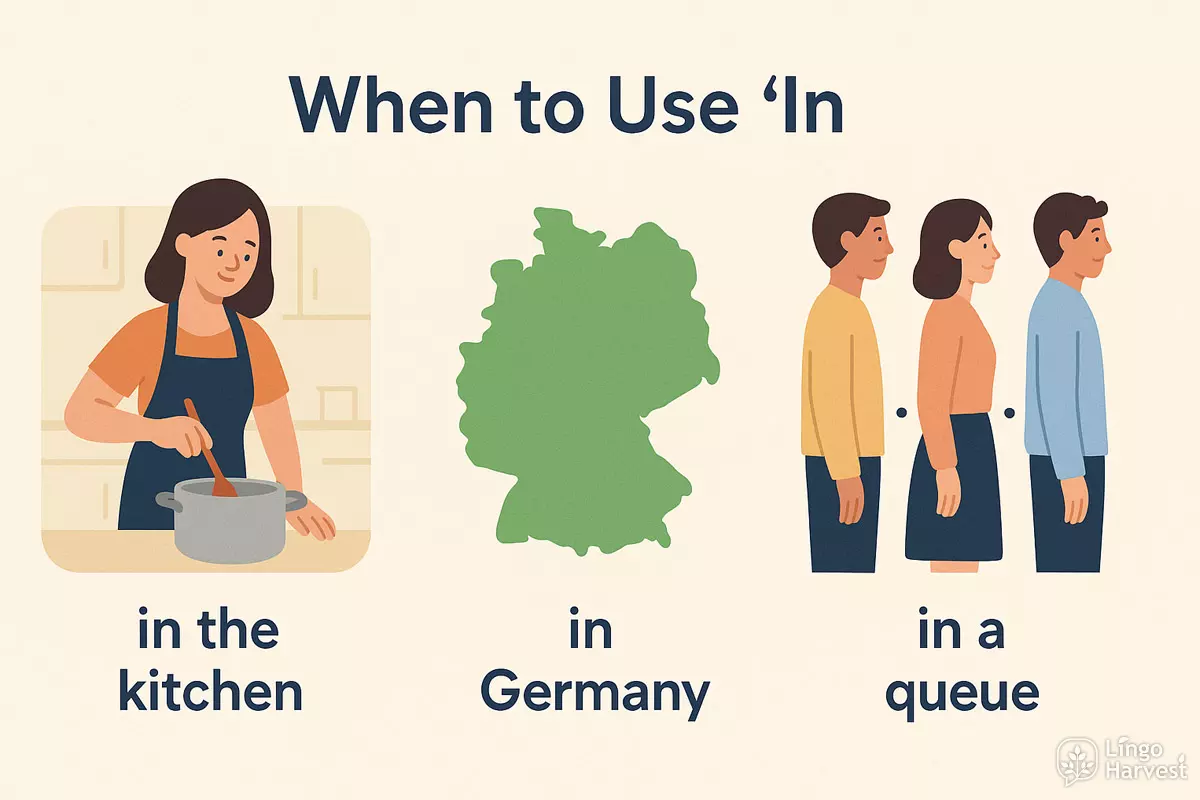
"In" is generally used for enclosed spaces or areas with boundaries. Think of it as being inside a three-dimensional space, whether physical or conceptual. Here are some common situations:
- In a room, building, or city: in the kitchen, in a hotel, in Paris
- In a country or larger area: in Germany, in South America
- In a car or taxi: in a car, in a taxi
- In a park or garden: in the park, in the garden
- In a queue or line: in line, in a queue
- In a picture or photo: in the picture
How "At" Works
"At" is used for specific points or locations. It often refers to a precise spot or an activity rather than an area. Use it for:
- At a specific address or building: at 123 Main Street, at the station
- At events or places of activity: at a concert, at school, at work
- At home or at someone's house: at home, at John's
- At the top, bottom, or end of something: at the top of the page
- At bus stops or other public places: at the bus stop, at the airport
Using "On" with Places
"On" is typically used for surfaces or when something is attached to a line or a flat area. It also applies to some forms of public transport and streets. Examples include:
- On a surface: on the table, on the wall
- On a street, road, or avenue: on Main Street, on 5th Avenue
- On public transport: on the bus, on a train, on a plane
- On a floor of a building: on the second floor
- On a list, map, or page: on the list, on the map
Quick Reference Table
| Preposition | Typical Use with Places |
|---|---|
| In | Enclosed spaces, countries, cities, neighborhoods, cars, parks |
| At | Specific addresses, events, points, public buildings, bus stops, home |
| On | Surfaces, streets, public transport, floors, lists, maps |
Keep in mind that some locations can take more than one preposition depending on context or meaning. For example, you can be in a building (inside) or at a building (outside or at the entrance). Practice with real sentences to get a feel for how these prepositions work with different places.
Common Place Expressions
Understanding how to talk about locations in English often comes down to choosing the right preposition. The words "in," "at," and "on" each have specific uses when referring to places, and they can change the meaning of a sentence in subtle ways. Here are some of the most frequent ways these prepositions appear in everyday language, along with typical phrases and situations where they're used.
Typical Phrases with "In," "At," and "On"
- in the room (inside a space or area)
- in the city (within a larger place or boundary)
- in a car (enclosed vehicles)
- at home (specific point, not inside a building but the place itself)
- at the station (specific location, often for public buildings or institutions)
- at work (general location, not the building itself)
- on the bus (public transport, surfaces, or platforms)
- on the street (surface or line, not inside)
- on the table (surface contact)
- in a park (within the boundaries of a place)
- at the corner (specific point or spot)
- on the corner (surface or edge)
- in a building (inside the structure)
- at the door (specific spot, not inside)
- on the second floor (surface/level)
- in an elevator (enclosed space)
- at the airport (point/place of activity)
- on a plane (public transport)
Comparing Usage: "In" vs. "At" vs. "On"
It's easy to mix up these prepositions, especially when referring to places that can use more than one, depending on context. The table below summarizes common expressions and the logic behind their use.
| Preposition | Example Expressions | Typical Usage |
|---|---|---|
| in | in the kitchen, in a box, in London | Inside an area or space, or within boundaries |
| at | at school, at the bus stop, at a party | Specific point or place, events, institutions |
| on | on the wall, on the train, on Main Street | Surface contact, public transport, lines/streets |
Common Errors and Tips
- We say in bed, not "on bed" or "at bed".
- Use on for most public transport ("on the bus," "on the train"), but in for cars and taxis.
- At is often used for events ("at a concert") and addresses ("at 10 Downing Street").
- Choose in for countries and cities, but at for specific places within them.
By mastering these set phrases and understanding why each preposition is used, you'll be able to communicate locations more naturally and clearly.
Buildings and Locations
When talking about where things happen or where people are, English uses different prepositions depending on the type of place and the context. The most common prepositions for physical structures or public places are in, at, and on, but each has its own usage pattern.
General Guidelines
- In is used for enclosed spaces or when you are inside the boundaries of a building or room.
- At is used for precise points, common meeting places, or events. It often suggests presence at a location for a purpose rather than being inside it.
- On is less common for buildings, but it’s used for surfaces or when referring to floors of a building.
Common Examples
- in the office
- in a restaurant
- at home
- at the airport
- at school
- in the hospital
- on the first floor
- on campus
- at the bus stop
- in a hotel
- at the cinema
- in a classroom
- at the library
- on the roof
- at the entrance
- in the supermarket
- on the balcony
- at the museum
Comparing Usage
| Preposition | Typical Usage With Places |
|---|---|
| in | in a building, in a room, in a shop, in the kitchen, in a hotel, in a museum |
| at | at the door, at the station, at school, at work, at a concert, at the entrance |
| on | on the second floor, on the roof, on the balcony, on campus, on the premises |
Special Cases and Exceptions
Some buildings or locations can take more than one preposition, depending on the focus. For example, "in the hospital" means inside the building, often as a patient, while "at the hospital" might mean visiting or being outside for an appointment. Similarly, "in school" refers to being enrolled as a student, and "at school" refers to being present at the location.
Understanding these subtle differences helps to convey your meaning clearly and naturally. If you’re unsure, consider whether you mean being inside a place (choose in), being present for an activity or event (at), or referring to a surface or level (on).
Cities, Streets, and Rooms
Understanding which preposition to use with locations like urban areas, roads, and indoor spaces can be confusing for English learners. The choice between in, at, and on depends on how specific the location is and the context of the sentence. Let’s look at some common usage patterns and exceptions.
Using in for Enclosed or General Areas
In is used with cities, countries, neighborhoods, and rooms because it suggests being inside a space or area. For example:
- in London
- in New York
- in my room
- in the kitchen
- in a hotel lobby
- in the city center
- in the office
- in the living room
- in a small village
- in the basement
When to Use at for Specific Points
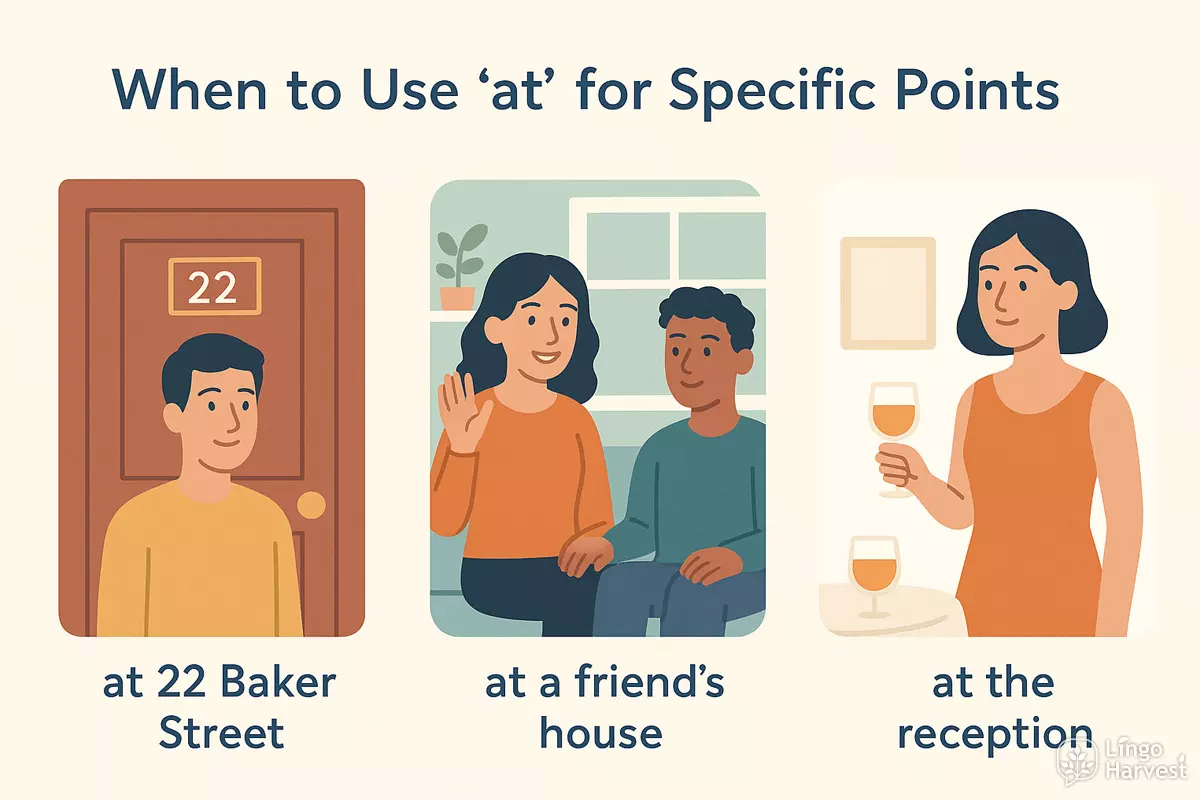
At is preferred for precise locations, such as a particular address, a well-known building, or a specific point. It’s also common with events or places seen as points rather than areas:
- at 22 Baker Street
- at the bus stop
- at the corner of Main Street
- at school
- at the entrance
- at the office desk
- at a friend's house
- at the reception
- at the station
- at the intersection
Using on for Surfaces and Streets
On is commonly used for surfaces and linear places like streets or avenues. It’s also used with floors of buildings:
- on Main Street
- on Oxford Avenue
- on the second floor
- on the corner (if you mean the surface of the street)
- on the map
- on the left/right side of the street
- on Broadway
- on the street (for general street life)
- on my street
- on the ground floor
Quick Reference: Prepositions with Place Types
| Place Type | Common Preposition | Example |
|---|---|---|
| City, Country, Neighborhood | in | in Paris, in Russia, in my neighborhood |
| Street, Avenue, Road | on | on Elm Street, on Fifth Avenue |
| Specific Address/Point | at | at 10 Downing Street, at the corner |
| Room or Enclosed Space | in | in the kitchen, in the classroom |
| Events or Buildings (as points) | at | at the cinema, at the party |
Tips for Choosing the Right Preposition
- Think of in as being inside boundaries (physical or imagined).
- Use on for surfaces and lines (streets, floors).
- Choose at for exact points or specific addresses.
- Some places can take more than one preposition depending on context: at the park (the point), in the park (inside the area).
Getting comfortable with these patterns will help you use English prepositions more naturally in everyday conversation.
Mistakes Russian Learners Make
For many native Russian speakers, prepositions like "in," "at," and "on" present real challenges because Russian uses very different structures to express location. The concepts often don’t match one-to-one, so learners tend to transfer Russian logic into English, leading to frequent errors.
Common Confusion with "In," "At," and "On" for Places
Russian learners may overuse one preposition or swap them in places where English speakers would never do so. Here are some typical mix-ups:
- Saying "in the bus stop" instead of "at the bus stop"
- Using "on the cinema" instead of "at the cinema" or "in the cinema"
- Choosing "in the street" when "on the street" is correct in English
- Translating "на работе" as "on work" instead of "at work"
- Saying "in the school" for general presence, when "at school" is expected
- Using "in the table" instead of "on the table"
- Saying "on the hospital" instead of "in hospital" (British English) or "at the hospital"
- Using "at the home" instead of "at home"
- Saying "on the station" instead of "at the station"
- Mixing up "in the airport" and "at the airport"
- Using "on the park" instead of "in the park"
- Saying "in the restaurant" when describing meeting someone there, instead of "at the restaurant"
- Choosing "at the bed" instead of "in bed"
- Saying "on the bus" as "in the bus" (literal translation from Russian "в автобусе")
- Using "at the internet" instead of "on the internet"
- Saying "on the photo" instead of "in the photo"
- Using "at the sea" when "on the sea" or "by the sea" might be correct
- Saying "in the corner" versus "at the corner" (context error)
Why These Errors Happen
Many of these mistakes occur because Russian prepositions "в" and "на" overlap with "in," "at," and "on" in English, but not always in the same way. For example, "на улице" literally means "on the street," but in English, this is also correct, while "на работе" becomes "at work," not "on work." The lack of articles in Russian also leads to misuse of "the" with place prepositions.
Quick Reference: Russian vs. English Prepositions for Common Places
| Russian Expression | Correct English Preposition | Typical Error |
|---|---|---|
| в автобусе | on the bus | in the bus |
| на работе | at work | on work |
| на улице | on the street | in the street |
| в школе | at school | in the school |
| на станции | at the station | on the station |
| на фотографии | in the photo | on the photo |
| в парке | in the park | on the park |
| на столе | on the table | in the table |
| в интернете | on the internet | at the internet |
| дома | at home | at the home |
Tips for Avoiding These Problems
Understanding which preposition to use often comes down to memorizing common collocations and practicing them in context. Pay close attention to set phrases in English, and don’t rely on literal translation from Russian. When in doubt, look up how native speakers talk about places, and remember that even small preposition mistakes can change the meaning or make your speech sound unnatural.
Practice: Choose Correct Preposition
It's time to apply what you've learned about using in, at, and on with places. Below, you'll find a variety of sentences and phrases where a preposition is missing. Carefully consider which preposition best completes each statement based on the context and meaning.
Fill in the Blank: Prepositions for Places
- She waited ___ the bus stop for twenty minutes.
- The kids are playing ___ the park after school.
- They met ___ the restaurant near the station.
- My keys are ___ the table in the hallway.
- He lives ___ London, but works ___ Oxford Street.
- I’ll see you ___ the cinema entrance.
- There’s a beautiful painting ___ the wall.
- We had lunch ___ the garden yesterday.
- She is ___ the hospital recovering from surgery.
- The cat is sleeping ___ the sofa.
- Are you ___ home tonight?
- Let’s meet ___ the corner of Main Street and First Avenue.
- The concert is ___ the stadium downtown.
- I found this book ___ the library shelf.
- He works ___ a bank ___ the city center.
Show answers
- at
- in
- at
- on
- in / on
- at
- on
- in
- in
- on
- at
- at
- at
- on
- at / in
Quick Check: Which Preposition?
Choose the correct preposition (in, at, or on) for each type of place below:
- ___ a bus
- ___ the airport
- ___ a street
- ___ a building
- ___ the office
- ___ the beach
- ___ a train
- ___ a supermarket
- ___ the corner
- ___ a farm
Show answers
- on a bus
- at the airport
- on a street
- in a building
- at the office
- on the beach
- on a train
- in a supermarket
- at the corner
- on a farm (sometimes in a farm is possible, but on is standard)
Common Patterns: Prepositions with Places
Some locations and activities follow predictable patterns. See how typical expressions use these prepositions:
| Place or Context | Usual Preposition |
|---|---|
| the airport, the bus stop, the station | at |
| the city, a country, a room, a building | in |
| the wall, the floor, the street, a page | on |
| home, work, school (as locations) | at |
| the bus, the train, a plane, a boat | on |
| the garden, the kitchen, the office | in |
Review these patterns to build confidence using the right prepositions in everyday situations. If you need to double check, refer back to this table as a quick guide.