Prepositions for Times of Day: In the Morning, At Night

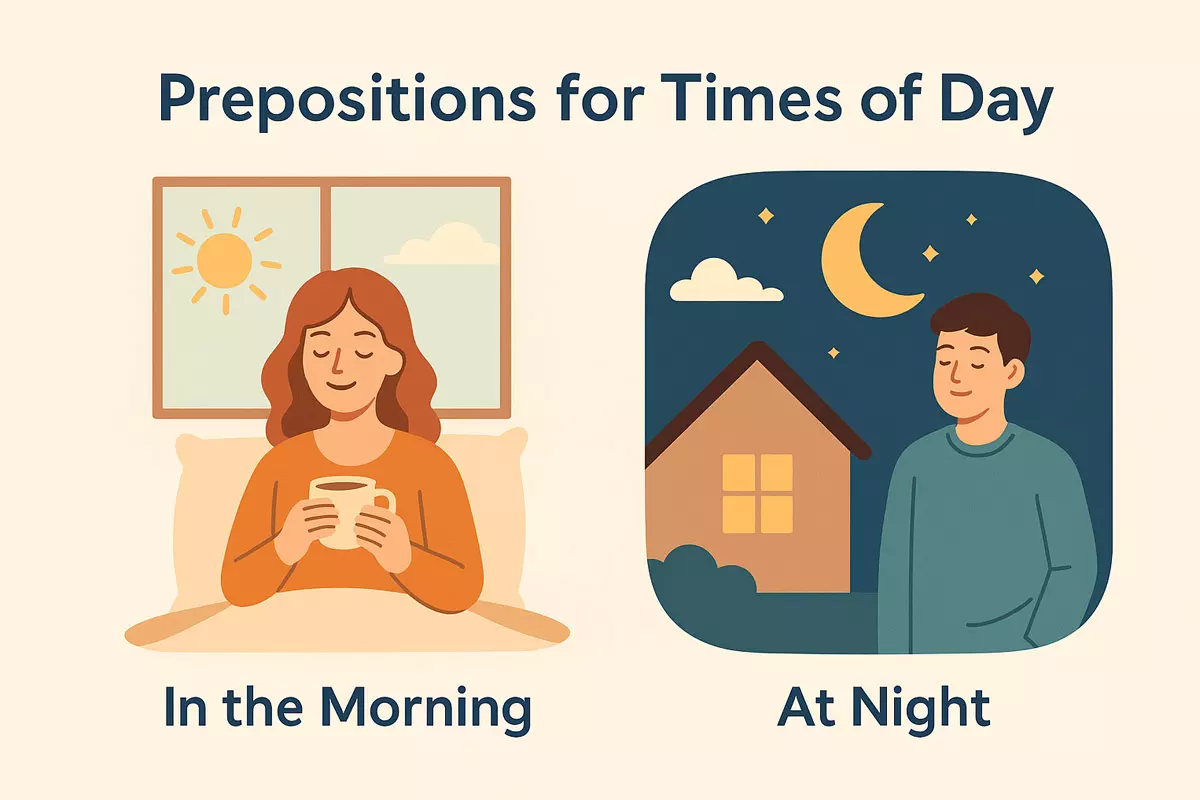 The article explains how to use in, on, and at for times of day, specific times, and parts of the day. It covers special cases such as at night and on time, highlights common mistakes, and provides practice sentences for learning.
Mastering the subtle rules of English, particularly when selecting the right words to describe different times of day, can be challenging for learners. Knowing whether to use terms like morning, afternoon, evening, or night not only improves your accuracy but also helps you communicate more naturally and fluently. For example, saying “early morning” for the hours just after sunrise or “late evening” for the time before nightfall ensures your meaning is clear. Practicing these distinctions will enhance both your confidence and your overall English skills.
When to Use In, On, At
Understanding how to choose between “in,” “on,” and “at” for times of day can make your English sound much more natural. Each preposition has its own pattern, and using the right one helps you express time more clearly. Let’s look at the main rules and examples to see how these prepositions work with different times.
General Patterns for Times of Day
- In is used for longer periods, such as parts of the day or months and years. Example: in the morning, in the afternoon, in June.
- On is chosen for specific days and dates. Example: on Monday, on my birthday, on July 4th.
- At is used for precise times and some set phrases. Example: at 7:00, at night, at noon.
Prepositions for Times of Day: Common Expressions
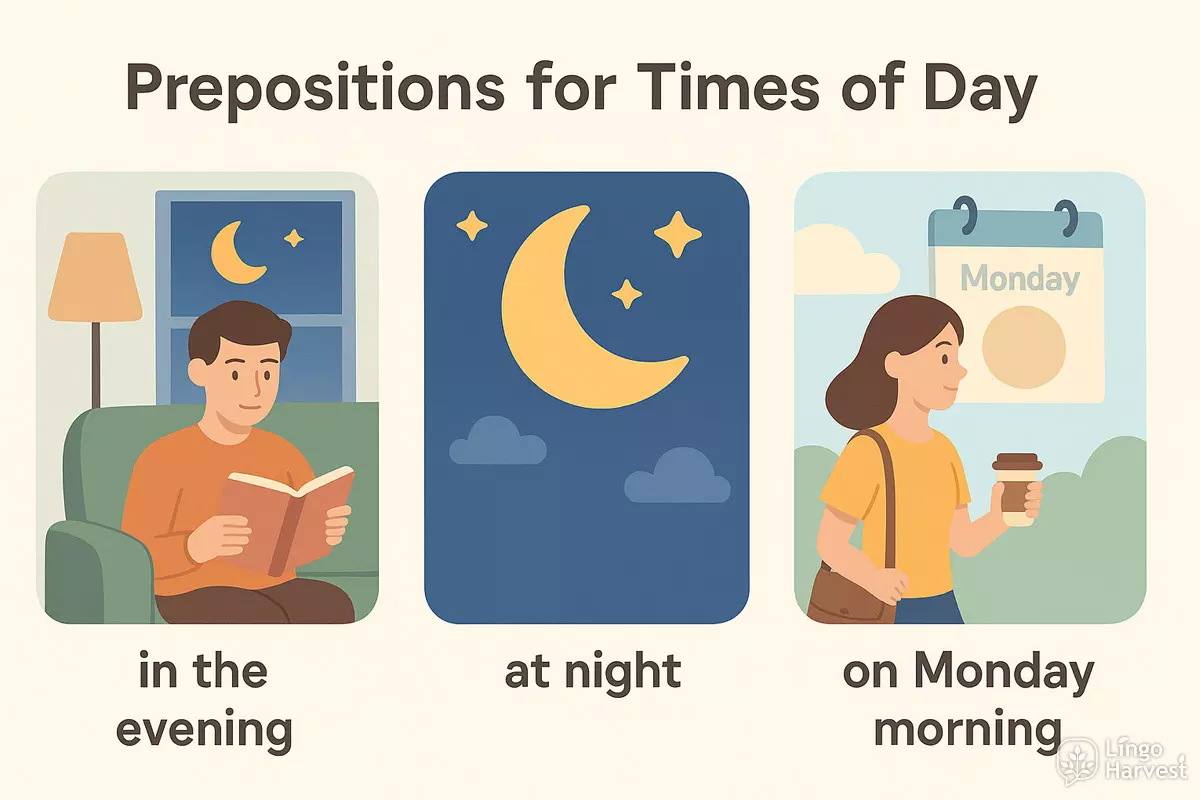
To help you remember which preposition to use, here’s a list of typical phrases:
- in the morning
- in the afternoon
- in the evening
- at night
- at noon
- at midnight
- at sunrise
- at sunset
- on Monday morning
- on a summer evening
- at 6 o’clock in the morning
- in the early afternoon
- at lunchtime
- on Friday night (in American English)
Comparing Usage: “In,” “On,” and “At”
| Preposition | Typical Time Expressions |
|---|---|
| In | in the morning, in the afternoon, in the evening, in June, in 2024 |
| On | on Monday, on Tuesday morning, on the weekend (UK), on my birthday, on July 4th |
| At | at night, at noon, at midnight, at 7am, at lunchtime, at sunrise |
Special Cases and Regional Differences
Some expressions can be confusing because of regional differences. For example, Americans say “on the weekend,” while British English prefers “at the weekend.” Likewise, “on Friday night” is common in American English, but British speakers may use “at night” for general nighttime.
Quick Tips
- Use in for general parts of the day (morning, afternoon, evening), but at for “night.”
- Use at for exact times and set phrases (at 6:30, at sunrise).
- Use on for days and dates, and when mentioning a day with a part of the day (on Monday morning).
Mastering these small differences will help you talk about time more naturally and accurately in English.
Specific Times vs Parts of Day
When talking about time in English, it’s important to know when to use prepositions like at, in, or on. The choice depends on whether you’re referring to a precise clock time or a general period within the day. Understanding this distinction helps your speech and writing sound more natural.
Using Prepositions with Exact Times
For clock times and specific moments, at is the standard choice. This includes both exact hours and common expressions for particular times. Here are some examples:
- at 7:00 a.m.
- at noon
- at midnight
- at 3:15 p.m.
- at sunrise
- at lunchtime
- at bedtime
- at 5 o’clock
- at the stroke of midnight
- at quarter past eight
Talking About Parts of the Day
When describing broader periods, such as general sections of the day, in is most commonly used. This applies to timeframes that aren’t tied to a specific minute or hour:
- in the morning
- in the afternoon
- in the evening
- in the early hours
- in the late afternoon
- in the middle of the day
- in the early morning
- in the evening rush hour
- in the daytime
- in the night (rare, but possible when talking about something happening during the night period)
Special Case: "At Night"
Unlike other general periods, English uses at night rather than in the night for most situations. For example, we say “at night, it’s quiet” instead of “in the night.” This is an exception to the usual pattern and is worth memorizing.
Summary Table: Prepositions for Times and Periods
| Use at for... | Use in for... |
|---|---|
| at 7:30 | in the morning |
| at midnight | in the afternoon |
| at noon | in the evening |
| at night | in the early hours |
| at sunrise | in the late afternoon |
| at lunchtime | in the daytime |
| at 5 o’clock | in the middle of the day |
| at quarter past eight | in the evening rush hour |
Special Cases (At Night, On Time)
Some expressions relating to times of day break the usual pattern of prepositions. For instance, we almost always say at night rather than in the night. Likewise, certain phrases use on or at for specific moments or scheduled events. Understanding these exceptions helps you sound more natural in English.
Why “At Night” Instead of “In the Night”?
We use at night to talk about the nighttime in general—when it’s dark, when people are usually sleeping, or when activities happen after sunset. It’s a fixed phrase. However, in the night can be used for something that happens during the night, often unexpectedly or as a single event, though it’s much less common.
- at night → I like to read at night.
- in the night → I woke up in the night because of a noise.
Using “On Time” and Related Expressions
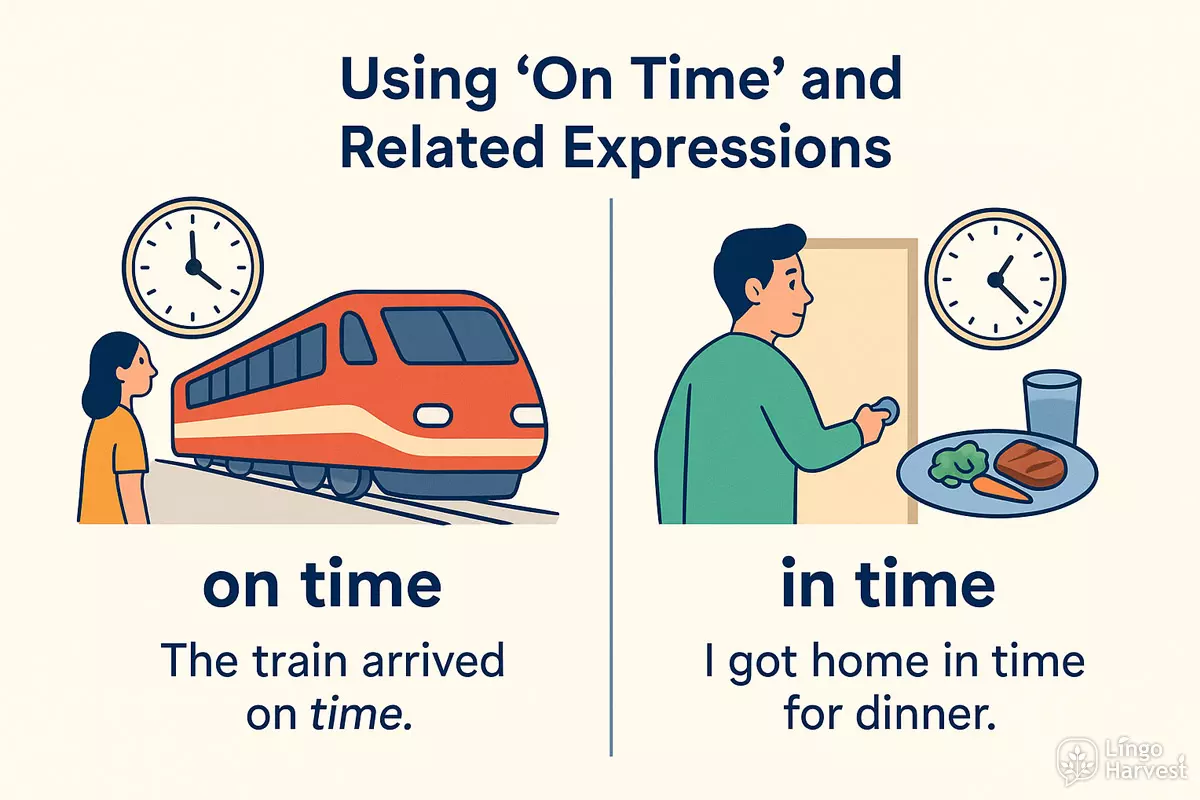
When talking about punctuality or scheduled events, English uses on time (not in time or at time). These expressions can be confusing, so it helps to see their typical uses:
- on time → The train arrived on time. (It was not late.)
- in time → I got home in time for dinner. (Soon enough, before it was too late.)
- at the right time → Please call me at the right time.
Quick Reference: Prepositions in Unusual Time Phrases
Some expressions just don’t follow the usual “in/at/on + time word” pattern. Here are common phrases with their typical prepositions:
- at night
- at midnight
- at noon
- at sunrise
- at sunset
- on time
- in time
- at the weekend (UK)
- on the weekend (US)
- at dawn
- in the morning
- in the afternoon
- in the evening
- on Monday morning
- at Christmas
- on Christmas Day
- at New Year
- on New Year’s Day
Comparing “At Night” and “In the Night”
The distinction between these two can be subtle. “At night” is for routine or general reference, while “in the night” is used for specific, often unexpected events. Here are some examples:
- Children sleep at night. ✅
- There was a thunderstorm in the night. ✅
- It’s dangerous to go out at night. ✅
- I heard a strange sound in the night. ✅
Remember, these special cases are exceptions and should be learned as fixed phrases. They’re common in daily conversation, so paying attention to them will help you use English more confidently and correctly.
Common Mistakes
Many English learners stumble when choosing the correct preposition for times of day. Mixing up “in,” “at,” and “on” can make sentences sound unnatural. These errors often happen because other languages use different rules, or because learners try to apply general patterns without exceptions in mind.
Mixing Up “In” and “At”
One frequent slip is using “in” where “at” is needed, or vice versa. For example, people may say “in night” instead of “at night,” or “at the morning” instead of “in the morning.” These small words can change the meaning or make the phrase sound awkward.
- ❌ in night → ✅ at night
- ❌ at the morning → ✅ in the morning
- ❌ at afternoon → ✅ in the afternoon
- ❌ in the midnight → ✅ at midnight
Dropping or Adding “the” Incorrectly
Articles can also cause confusion. While it’s usually “in the morning,” we say “at night” without “the.” Some phrases require the article, but others do not.
- ❌ in morning → ✅ in the morning
- ❌ at the night → ✅ at night
- ❌ in the midnight → ✅ at midnight
Confusing Prepositions for Specific and General Times
Learners sometimes use the wrong preposition for general periods versus exact times. “At” is for precise moments (“at 7 a.m.”), while “in” is for periods (“in the evening”).
| Incorrect Usage | Correct Usage |
|---|---|
| at morning | in the morning |
| in night | at night |
| in 5 p.m. | at 5 p.m. |
| at the evening | in the evening |
| at midnight (for general time) | at midnight (only for the exact moment) |
| in the noon | at noon |
Using “On” with Times of Day
Another pitfall is inserting “on” before times of day, which is not idiomatic. For instance, “on the morning” is incorrect unless specifying a particular day (“on the morning of July 1st”).
- ❌ on morning → ✅ in the morning
- ❌ on night → ✅ at night
Careful attention to these patterns will help you sound more natural and avoid the most common errors with prepositions for times of day.
Practice: Complete Sentences with Prepositions
Understanding when to use "in the morning," "at night," and similar expressions is essential for describing time accurately in English. Below, you'll find a variety of exercises to help you master these prepositions. Read each sentence and choose the correct preposition to complete it.
Fill in the Blanks
Insert the correct preposition ("in," "at," or "on") to talk about times of day.
- I usually have coffee ___ the morning.
- She likes to read ___ night before bed.
- We go for a walk ___ the afternoon.
- They arrived ___ midnight.
- He watches TV ___ the evening.
- We have a meeting ___ 10 a.m.
- The party is ___ Friday night.
- I do yoga ___ the morning and ___ night.
- My alarm rings ___ 7 o’clock ___ the morning.
- He feels most energetic ___ the afternoon.
Show answers
- in
- at
- in
- at
- in
- at
- on
- in, at
- at, in
- in
Common Expressions: Times of Day
Here are some examples of how different prepositions are used with times of day. Review these patterns and consider how they fit into real-life situations.
- in the morning
- in the afternoon
- in the evening
- at night
- at noon
- at midnight
- at sunrise
- at sunset
- on Monday morning
- on Friday night
- at 7 a.m.
- at 10 p.m.
Choose the Correct Preposition
Decide which preposition best fits each sentence. These practice items help reinforce your understanding of how prepositions work with times of day.
- I study English ___ the afternoon.
- The stars are bright ___ night.
- Our flight is ___ 8 p.m.
- We eat lunch ___ noon.
- My friend calls me ___ the evening.
Show answers
- in
- at
- at
- at
- in
Quick Reference: Prepositions for Times of Day
Use this table to compare the most frequent prepositions in time expressions related to parts of the day.
| Preposition | Time Expression Example |
|---|---|
| in | in the morning, in the afternoon, in the evening |
| at | at night, at noon, at midnight, at 7 a.m., at sunset |
| on | on Monday morning, on Friday night |
| — (no preposition) | today, tomorrow, yesterday |
Pay attention to these patterns as you practice. Over time, choosing the right preposition will become automatic!