Travel Phrases with Prepositions: At the Airport, On the Train

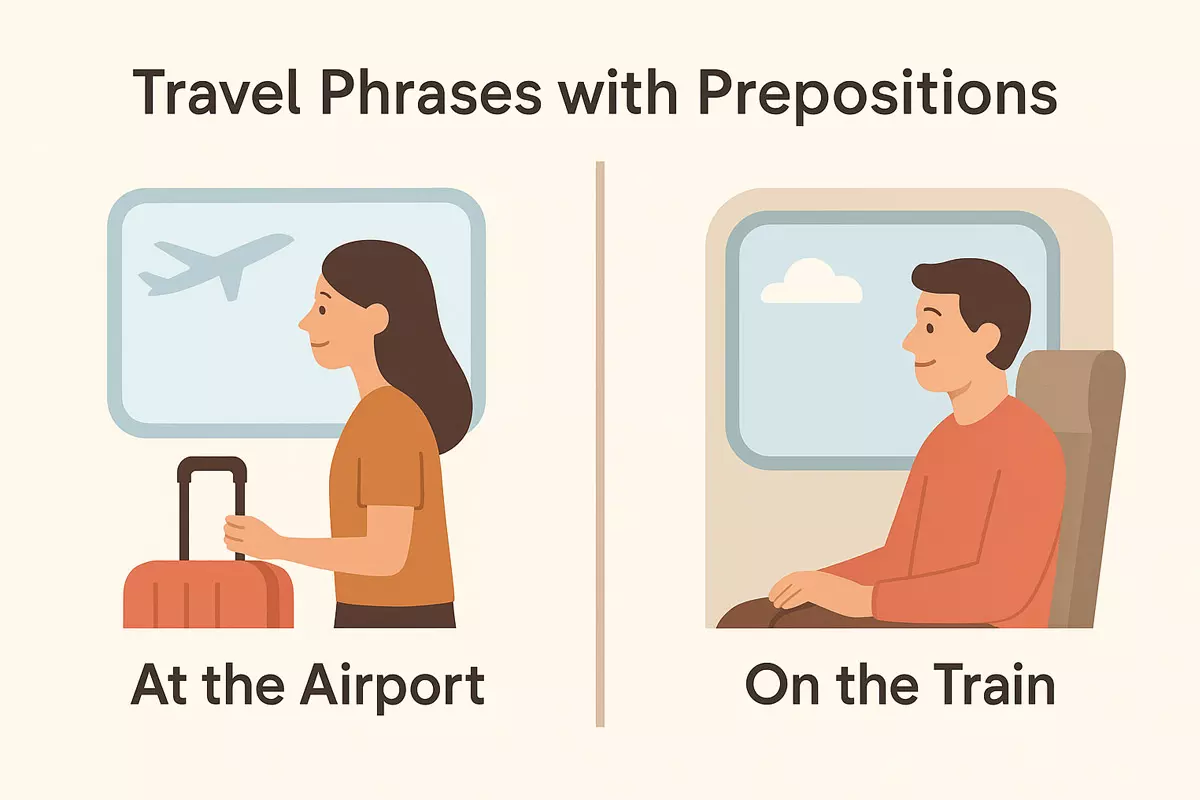 The article teaches how to use at, in, and on for transport, provides essential airport and hotel phrases, points out common mistakes, and offers practice exercises to help you select correct travel-related prepositions and expressions.
Traveling in unfamiliar places becomes much simpler when you have the right expressions at your disposal, particularly those involving prepositions for common situations such as catching a flight, boarding a train, or getting off a bus. Knowing how to ask for directions, clarify your destination, or confirm your boarding point can make your journey smoother and less stressful. For example, phrases like "at the airport," "on the train," or "to the city center" are essential when communicating your plans or seeking assistance.
Prepositions for Transport
When talking about travel, prepositions help clarify how we move from place to place and what means of travel we use. English uses certain prepositions with different types of transport, and choosing the right one makes your speech sound natural.
Common Prepositions with Transport
Some prepositions are almost always paired with specific vehicles or travel methods. Here’s how they’re typically used:
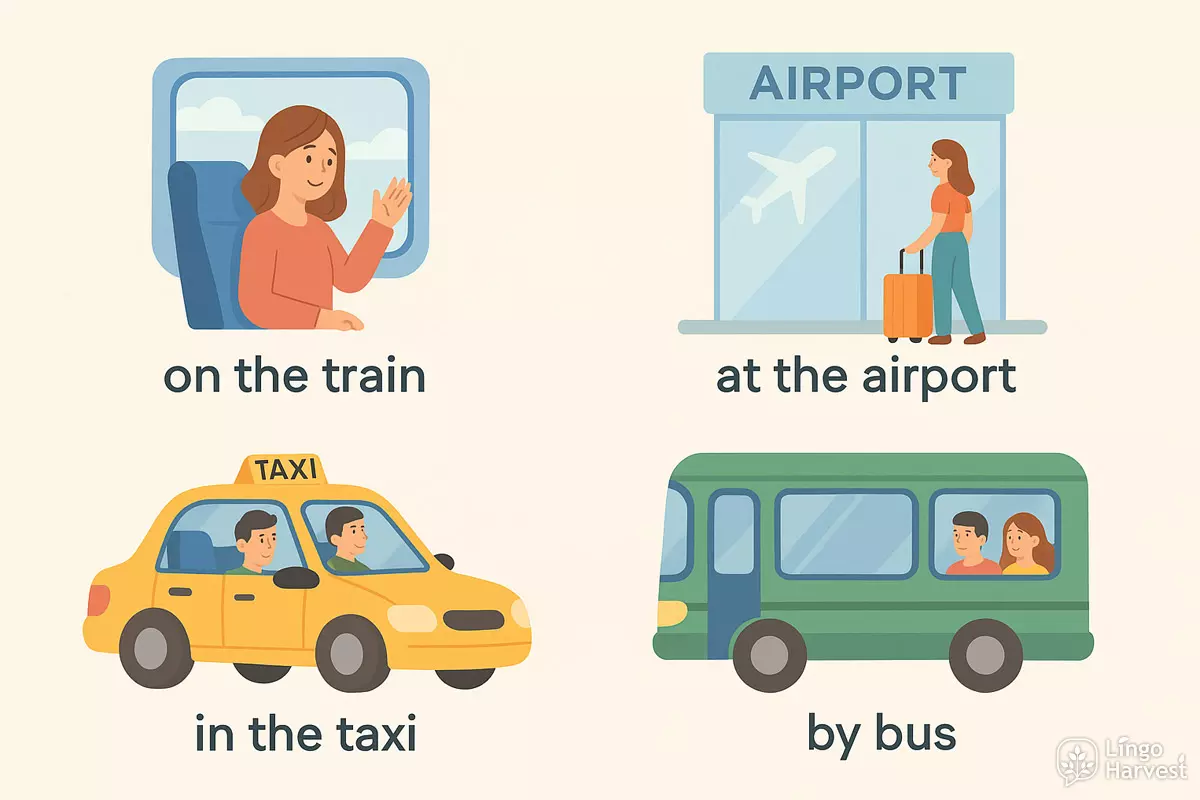
- On – for public and large shared vehicles (on the train, on the bus, on a plane, on a ferry, on a tram, on a ship, on a subway)
- In – for smaller, enclosed vehicles (in a car, in a taxi, in a helicopter, in a van)
- By – to talk about means of transport in general (by train, by bus, by car, by bicycle, by plane, by boat)
- At – for locations or stops (at the airport, at the station, at the bus stop, at the terminal)
Examples in Context
- She is on the train to London.
- We arrived at the airport early.
- He got in the taxi outside the station.
- They travelled by bus during their holiday.
- I waited at the bus stop for 20 minutes.
- We went on a cruise ship last summer.
- Are you in your car or on the bus?
- She flew by helicopter to the island.
- The meeting point is at the train station.
- He likes to travel by bicycle to work.
Quick Reference Table: Choosing the Right Preposition
| Transport Type | Common Preposition |
|---|---|
| Train, bus, plane, ship, tram, subway | on |
| Car, taxi, small van, helicopter | in |
| General means (no article or vehicle) | by |
| Stations, stops, airports, terminals | at |
Tips for Remembering
Remember: use on for most public or large transport, in for private or small vehicles, by for the method, and at for locations. If you’re unsure, think about whether you can stand up and walk around—if so, you’re usually “on” it!
At, In, On in Travel Contexts
Understanding how to use “at,” “in,” and “on” while traveling can make your conversations smoother and help you avoid confusion in different situations. These prepositions often signal your location or movement relative to places and vehicles, but their use changes depending on whether you’re talking about a point, an enclosed space, or a surface/vehicle.
How Each Preposition Works in Travel Settings
- At is used for specific points or locations, such as “at the airport” or “at the bus stop.” It pinpoints a spot where something is happening or where you are expected to be.
- In implies being inside a space or vehicle, like “in the taxi” or “in the hotel.” It suggests enclosure or being surrounded by boundaries.
- On is used with surfaces and most forms of public transport: “on the train,” “on the plane,” “on the platform.” It usually indicates being atop or aboard something.
Common Travel Phrases with Prepositions
Here are examples of how these prepositions appear in real travel conversations and signs:
- at passport control
- at the check-in desk
- at the gate
- at the arrivals hall
- in the terminal
- in a taxi
- in the baggage claim area
- in the waiting room
- on the bus
- on the subway
- on board the aircraft
- on the escalator
- on the ferry
- on platform 2
- in first class (on the train/plane)
- at customs
- in the departure lounge
- on the tram
- at the hotel reception
- in your seat
Comparison Table: Usage in Travel Scenarios
| Preposition | Typical Travel Examples |
|---|---|
| At | at the airport, at the station, at gate 12, at the exit, at the ticket office |
| In | in the taxi, in the terminal, in the lounge, in your cabin, in the city |
| On | on the train, on the plane, on the bus, on the ferry, on platform 3 |
Tips for Remembering the Difference
- Think of at as a point (a stop or location).
- Use in when you are inside something.
- Choose on when you are aboard a vehicle or on a surface.
Airport and Hotel Phrases
Navigating airports and checking into hotels often requires specific language, especially when prepositions are involved. Whether you’re looking for the right counter or asking about your room, understanding how to use prepositions in context can make your journey much smoother.
Common Expressions for the Airport
At airports, prepositions like "at," "to," "from," and "on" are frequently used. Here are some practical phrases you might need:
- At the check-in desk
- On the plane
- At the gate
- In front of security
- Through passport control
- By the baggage claim
- Next to the information desk
- Between terminals
- With my boarding pass
- From the arrivals hall
- To the departure lounge
- Under the seat
- Overhead compartment
- Across from the restroom
- Behind the counter
Useful Questions and Requests in Hotels
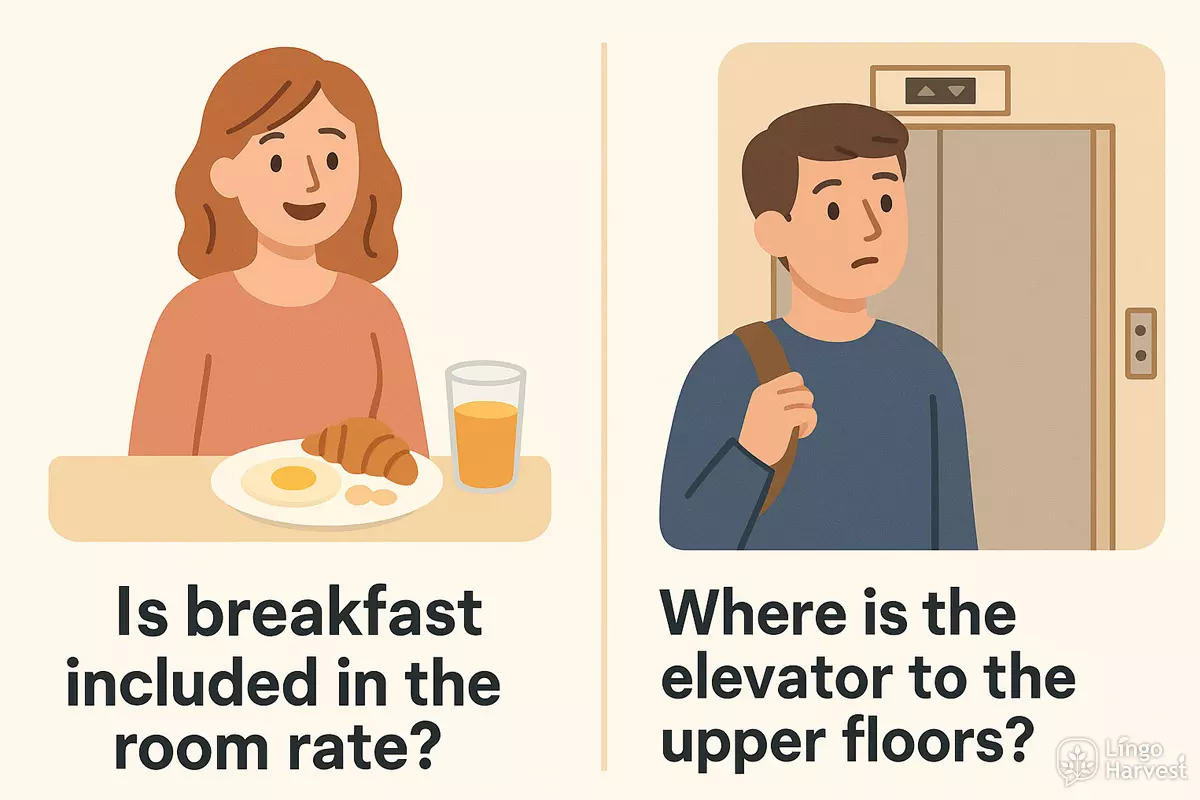
When you arrive at your accommodation, prepositions help clarify your needs. Here are some examples:
- Is breakfast included in the room rate?
- Can I leave my luggage at reception?
- Where is the elevator to the upper floors?
- Is there a safe in the room?
- Could I have a room with a view of the city?
- How do I get to the pool from here?
- May I pay for my stay at checkout?
- Is there parking on site?
- Can I get a taxi from the front desk?
- Are pets allowed in the hotel?
- Can I connect to Wi-Fi in my room?
- What time is breakfast served in the restaurant?
Sample Prepositional Patterns
Travelers often encounter set phrases that combine prepositions with places or actions. Here’s a quick overview of useful patterns and their contexts:
| Phrase | Typical Use |
|---|---|
| At the airport | General location: “I’m at the airport.” |
| On the shuttle | Transport: “I’m on the shuttle to the hotel.” |
| In the lobby | Hotel area: “Wait for me in the lobby.” |
| With a reservation | Booking status: “I have a reservation with your hotel.” |
| By the window | Room preference: “Can I get a seat by the window?” |
| From the airport | Point of origin: “Take a taxi from the airport.” |
Mastering these phrases and patterns will help you communicate clearly and avoid confusion during your travels. Feel free to adapt these examples to fit your specific needs, whether you’re moving through terminals or settling into your accommodation.
Mistakes to Avoid
When using prepositions in travel phrases, especially in contexts like airports and trains, small errors can easily lead to confusion or misunderstandings. Paying attention to the details helps you communicate clearly and avoid awkward situations.
Common Preposition Mix-Ups
It's easy to confuse prepositions such as at, in, and on when talking about locations and transportation. For example, saying "in the airport" instead of "at the airport" might sound unnatural in English. Similarly, "on the train" is correct, while "in the train" is rarely used unless you mean physically inside the train car.
- Saying "in the airport" instead of "at the airport"
- Using "on the airport" (incorrect) instead of "at the airport"
- Mixing up "on the train" with "in the train"
- Saying "at the train" instead of "on the train"
- Using "to" when "at" is needed: "I'm to the airport" (should be "I'm at the airport")
- Omitting prepositions entirely: "I am airport" or "I am train"
- Using "on" with places: "on the gate" (should be "at the gate")
- Confusing "at" and "in" for waiting areas: "in the gate" vs "at the gate"
- Using "by" for location: "by the airport" (means nearby, not inside)
- Switching "in" and "on" with transportation: "in the bus" vs "on the bus"
Misunderstanding Set Phrases
Some expressions are fixed and changing the preposition changes the meaning or makes the phrase incorrect. For instance, "on board" is standard for planes and trains, but "in board" is not.
| Incorrect Phrase | Correct Usage |
|---|---|
| I am in the airport. | I am at the airport. |
| I am in the train. | I am on the train. |
| I am on gate 5. | I am at gate 5. |
| I am to the airport. | I am at the airport. |
| I am in board. | I am on board. |
Tips for Getting Prepositions Right
- Remember that "at" is usually for points and locations (at the airport, at the station).
- "On" is standard for most forms of public transport (on the train, on the plane, on the bus).
- Use "in" for cars and taxis ("in the taxi"), but not for trains or planes.
- Listen to native speakers and notice set phrases.
- When in doubt, check a reliable phrasebook or translation app.
Being careful with these small words can make a big difference when you’re traveling. Take a moment to double-check your prepositions so your questions and requests are understood the first time.
Practice: Choose the Right Phrase
Understanding how to use prepositions in travel situations is essential for clear communication. At airports and on trains, specific phrases help you ask for directions, find your seat, or clarify information. Below, you’ll find exercises and practical examples to help you select the appropriate preposition and phrase for various scenarios you may encounter during your journey.
Fill in the Missing Preposition
Read each travel-related sentence and choose the correct preposition from the options in parentheses.
- My flight leaves ___ 9:30. (at/on)
- We are waiting ___ gate 15. (at/in)
- Is this seat ___ the train reserved? (on/in)
- Please put your bag ___ the overhead compartment. (in/on)
- I will meet you ___ the arrivals hall. (in/at)
Show answers
- at
- at
- on
- in
- in
Choose the Correct Phrase for Each Situation
Match the scenario to the best travel phrase. Select the most natural expression for each context.
- You want to know where your train is departing.
a) Where is my train?
b) Where does the train leave from?
c) Where is the train on? - Asking a staff member about your luggage location at the airport.
a) Where is my suitcase at?
b) Where can I find my luggage?
c) Where is my baggage on? - You are looking for your seat on the train.
a) Where is my seat at?
b) Where can I sit in?
c) Where is my seat on the train? - Clarifying the platform for a departing train.
a) What platform is the train at?
b) What platform is the train on?
c) What platform is the train in?
Show answers
- b) Where does the train leave from?
- b) Where can I find my luggage?
- c) Where is my seat on the train?
- b) What platform is the train on?
Common Prepositional Phrases for Travel
Here are some useful expressions you might hear or need to use at the airport or on the train:
- at the check-in desk
- on platform 7
- in the waiting area
- at passport control
- on board the train
- in the departure lounge
- at the baggage claim
- on the escalator
- in the ticket office
- at the information desk
- on the timetable
- in the terminal
- at gate 23
- on the track
- in the café
- at the arrivals area
Quick Reference Table: Preposition Usage
| Situation | Correct Phrase |
|---|---|
| Finding your gate | at the gate |
| Locating your seat on a train | on the train |
| Waiting for departure | in the lounge |
| Asking for the platform | on platform 3 |
| Collecting luggage | at baggage claim |
Practice using these phrases in real or imagined travel situations. Being able to select the right preposition improves your confidence and ensures you are understood wherever your journey takes you.