Prepositions for Directions: To, From, Across, Through

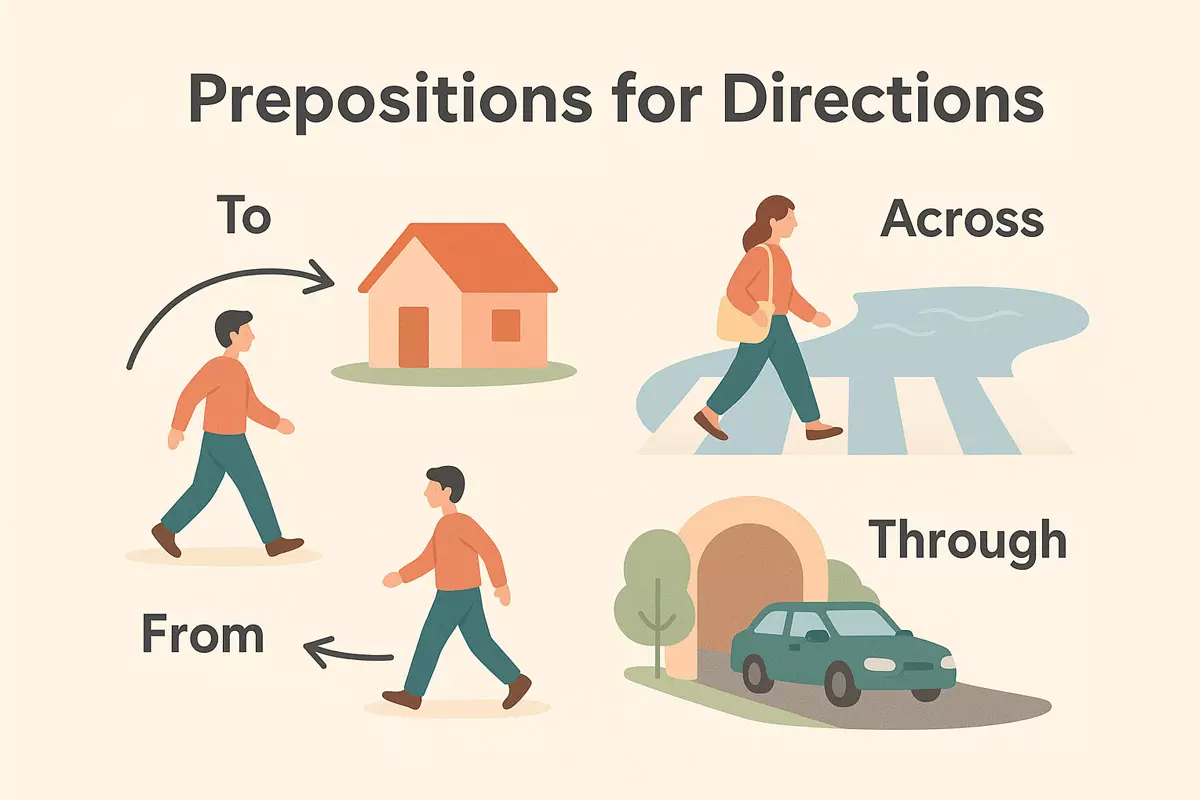 This article explains basic directional prepositions, how they pair with movement verbs, and clarifies the difference between across and through. It also compares to and towards, and includes a practice activity to match verbs with prepositions.
Describing how to get around a city or give directions can be challenging if you are not familiar with the proper vocabulary for movement and direction. Learning and practicing the correct connecting words, such as “turn left,” “go straight,” or “across from,” allows you to explain locations clearly and help others navigate unfamiliar places with confidence. By improving your understanding of these terms, you can communicate directions more effectively and avoid confusion when discussing routes or landmarks in English.
Basic Directional Prepositions
Directional words help us describe movement or location in relation to a place or object. When giving instructions, telling stories, or simply explaining where things are, these terms are essential. English uses a set of common prepositions to express direction, and understanding their use can make communication much clearer.
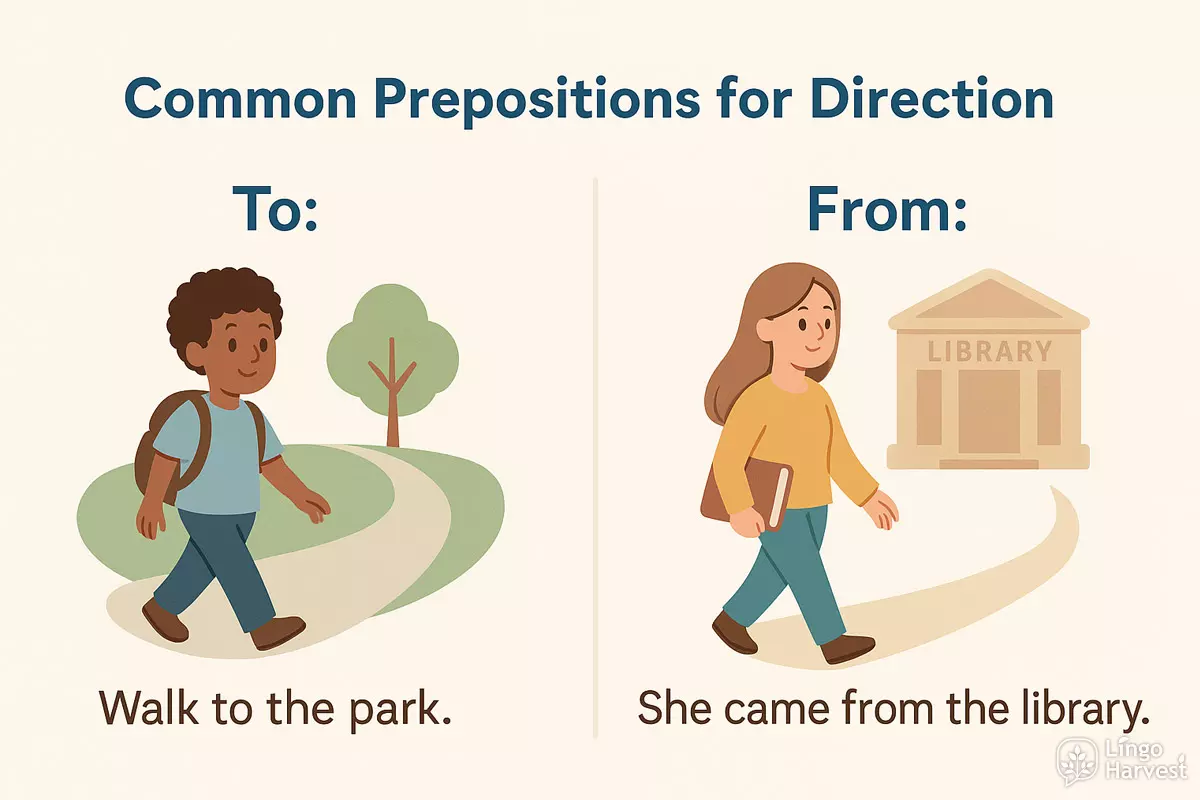
Common Prepositions for Direction
- To: Indicates movement toward a specific place. Example: Walk to the park.
- From: Shows the starting point of movement. Example: She came from the library.
- Across: Describes movement from one side to the other. Example: Drive across the bridge.
- Through: Means going in one side and out the other. Example: Walk through the tunnel.
- Into: Entering a space. Example: Go into the room.
- Out of: Leaving a space. Example: Step out of the car.
- Along: Moving in a line beside something. Example: Stroll along the river.
- Past: Going by or beyond a point. Example: Run past the school.
- Over: Moving above something, often without touching it. Example: Jump over the fence.
- Under: Going below something. Example: Crawl under the table.
- Up: Moving to a higher place. Example: Climb up the stairs.
- Down: Moving to a lower place. Example: Go down the hill.
- Around: Moving in a circular path or bypassing something. Example: Walk around the building.
- Toward: Moving in the direction of something. Example: Head toward the exit.
- Away from: Moving in the opposite direction. Example: Move away from the crowd.
Comparing Directional Prepositions in Context
| Preposition | Example Sentence |
|---|---|
| To | She walked to the market. |
| From | He traveled from Paris last night. |
| Across | They ran across the field. |
| Through | We drove through the city center. |
| Into | The cat jumped into the box. |
| Out of | She stepped out of the elevator. |
| Past | He cycled past the museum. |
| Along | We walked along the avenue. |
| Over | The plane flew over the mountains. |
| Under | The dog ran under the fence. |
| Up | Climb up the ladder. |
| Down | She walked down the stairs. |
| Around | They drove around the city. |
| Toward | He headed toward the station. |
| Away from | The rabbit ran away from the fox. |
Paying attention to the nuance in each word helps you choose the right term for every situation. Whether you’re describing a journey, giving directions, or telling a story, selecting the correct preposition clarifies your meaning and makes your instructions easy to follow. Practice using these in sentences to become more comfortable with their different uses.
Movement Verbs and Prepositions
Understanding how verbs of motion work with different prepositions is essential for giving and following directions in English. The choice of preposition can completely change the meaning of a sentence, so it’s important to pay attention to which ones are used with each verb. Some prepositions indicate a destination, while others show the starting point or the path taken.
Common Verbs for Describing Movement
Here are some of the most frequently used action words when talking about directions or physical movement:
- go
- walk
- drive
- run
- cycle
- move
- travel
- fly
- swim
- come
- return
- leave
- head
- cross
- pass
- enter
- exit
- step
- climb
- descend
How Prepositions Change Meaning
The prepositions "to," "from," "across," and "through" each add a different nuance to the verb they are paired with. For example, "to" usually marks the destination, "from" indicates the starting point, "across" shows movement from one side to another, and "through" describes movement within or inside something.
| Verb + Preposition | Example Sentence |
|---|---|
| walk to | She walks to the park every morning. |
| come from | They came from the train station. |
| run across | He ran across the street quickly. |
| drive through | We drove through the tunnel. |
| move to | I moved to London last year. |
| return from | She returned from her trip yesterday. |
| cycle across | They cycled across the bridge. |
| walk through | He walked through the forest. |
Tips for Using Prepositions with Motion Verbs
- Use to when describing the end point of a journey: "She is going to school."
- Use from to show the origin: "He came from the library."
- Use across for movement over a surface or from one side to another: "They walked across the bridge."
- Use through for movement inside or within a space: "We drove through the city."
Across vs Through Explained
Understanding when to use across and through helps you describe movement and direction more accurately in English. Both prepositions indicate movement, but they are used in different contexts depending on what kind of space or barrier is being crossed.
When to Use "Across"
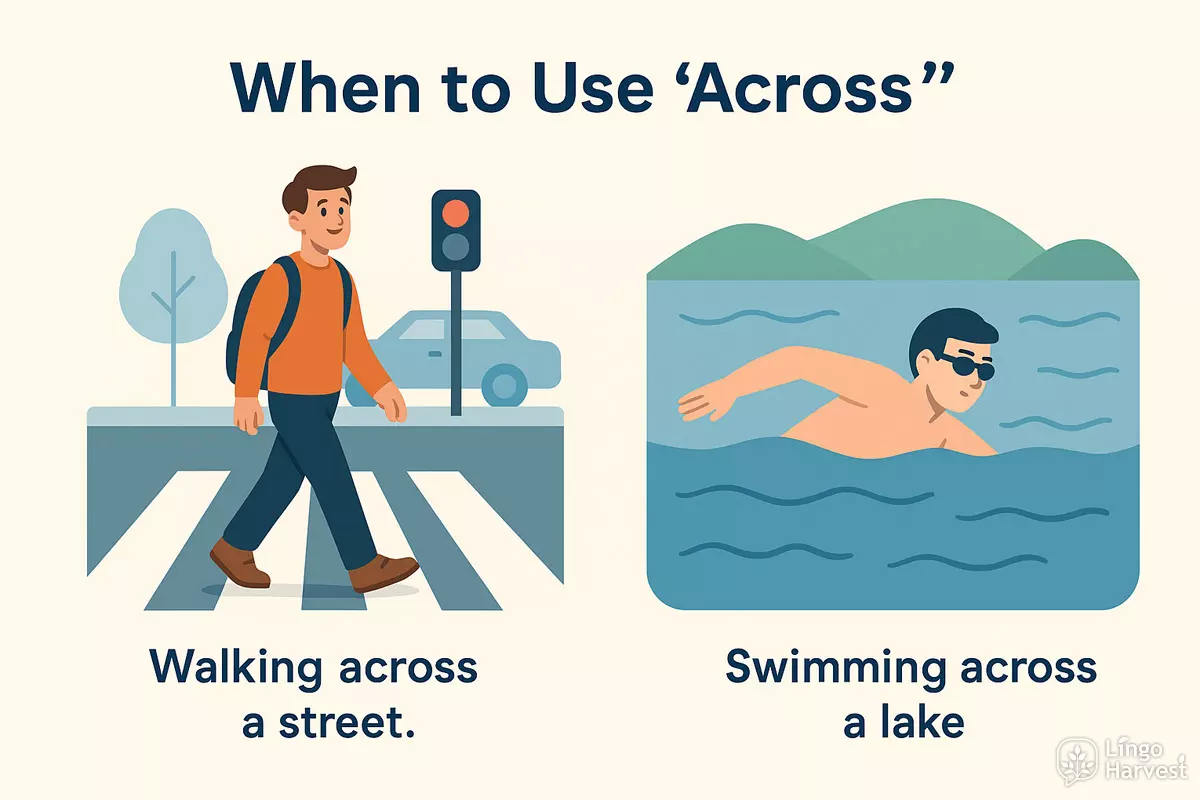
The preposition across is typically used for flat, open spaces or surfaces, or when moving from one side of something to the other. It often implies movement over or on the surface rather than inside it. Common contexts include:
- Walking across a street
- Swimming across a lake
- Traveling across a field
- Looking across a room
- Moving across a bridge
- Running across the playground
- Driving across the country
- Walking across the ice
- Flying across the ocean
- Throwing something across the table
When to Use "Through"
Through is used when movement happens inside a space, passage, or volume—often enclosed or surrounded by something. It suggests entering one side and exiting another, typically involving some kind of interior or obstacle. Examples include:
- Walking through a tunnel
- Going through a door
- Driving through a forest
- Passing through a crowd
- Swimming through seaweed
- Looking through a window
- Running through the park’s path
- Moving through traffic
- Travelling through a city
- Cutting through paper
Key Differences at a Glance
| Across | Through |
|---|---|
| Movement over or on a surface | Movement inside or within something |
| Usually open or flat spaces | Usually enclosed or filled spaces |
| From one side to the other (surface) | From one side to the other (interior) |
| Examples: across the road, across the river | Examples: through the tunnel, through the forest |
Choosing between these two prepositions depends on whether the action is happening on a surface or inside a space. Noticing the context will help you decide which to use, making your descriptions of movement much clearer.
To vs Towards
When talking about movement or direction, English speakers often choose between "to" and "towards," but these prepositions express slightly different meanings. "To" usually indicates movement with a specific destination in mind, while "towards" suggests movement in the direction of something, but not necessarily arriving there. Understanding this subtle distinction can help you sound more natural and precise.
Using "to" for a Definite Destination
"To" is used when the movement ends at a particular place or target. It answers the question "Where?" with a clear endpoint. For example:
- She walked to the library. → She arrived at the library.
- They are going to Paris next week.
- Send this letter to your friend.
- He drove to the supermarket.
- We moved to a new apartment.
Using "towards" for General Direction
"Towards" is chosen when the focus is on the direction rather than the destination. It implies movement in the direction of something, but the endpoint may not be reached. Examples include:
- The cat ran towards the door. → The cat may or may not reach the door.
- She looked towards the mountains.
- He was walking towards the station.
- The car is coming towards us.
- They headed towards the city center.
Comparing Usage in Sentences
To clarify the difference, compare these sentences:
- We are going to the park. (We will arrive at the park.)
- We are walking towards the park. (We are moving in that direction, but may not get there.)
- She threw the ball to me. (I am the target and will probably catch it.)
- She threw the ball towards me. (The ball is going in my direction, but may not reach me.)
Summary Table: "To" vs "Towards"
| Preposition | Typical Use | Example | Implies Arrival? |
|---|---|---|---|
| To | Specific destination or endpoint | He went to school. | ✅ Yes |
| Towards | General direction, not necessarily reaching the place | He walked towards school. | ❌ Not always |
Quick Tips
- Use "to" when you mean arriving at a place.
- Choose "towards" for movement in the direction of something, especially if you might not reach it.
- If you’re unsure, ask yourself: Is my focus on getting there, or just on heading that way?
By paying attention to these differences, you can clarify your meaning and avoid common mistakes with directional prepositions.
Practice: Match Preposition with Verb
Understanding which prepositions pair naturally with certain verbs is essential for giving and following directions in English. This activity helps you recognize the most common verb-preposition combinations related to movement and directions, such as “go to,” “come from,” “walk across,” and “drive through.” Read the verbs below and decide which preposition best fits each one in the context of directions.
Choose the Best Preposition
Match each verb with the most appropriate preposition: to, from, across, or through. Write your answer next to each verb phrase.
- Travel ____
- Walk ____
- Arrive ____
- Return ____
- Drive ____
- Move ____
- Pass ____
- Cross ____
- Come ____
- Go ____
- Run ____
- Cycle ____
- Depart ____
- Enter ____
- Exit ____
- Step ____
- Sail ____
- Jump ____
Show answers
- 1. Travel to / from / across / through (all are possible depending on context)
- 2. Walk to / across / through
- 3. Arrive at / in / from
- 4. Return to / from
- 5. Drive to / through / across
- 6. Move to / from / through
- 7. Pass through / across
- 8. Cross (always) across
- 9. Come to / from
- 10. Go to / through / across
- 11. Run to / across / through
- 12. Cycle to / through / across
- 13. Depart from
- 14. Enter through
- 15. Exit from / through
- 16. Step across / through
- 17. Sail to / from / across / through
- 18. Jump across / through
Common Verb + Preposition Patterns for Directions
Here’s a handy reference for some typical verb-preposition pairs you’re likely to see in directions. Notice how the preposition changes the sense of movement:
| Verb | Usual Preposition(s) |
|---|---|
| go | to, through, across |
| come | from, to |
| walk | to, across, through |
| cross | across |
| drive | to, through, across |
| depart | from |
| arrive | at, in, from |
| pass | through, across |
| return | to, from |
| enter | through |
| exit | from, through |
| cycle | to, through, across |
Notice that some verbs, like “go” and “travel,” combine with several prepositions, each giving a different sense of movement or direction. Practicing these combinations will help you understand and give directions more naturally.