Prepositions with Activities: Good At, Interested In, Afraid Of

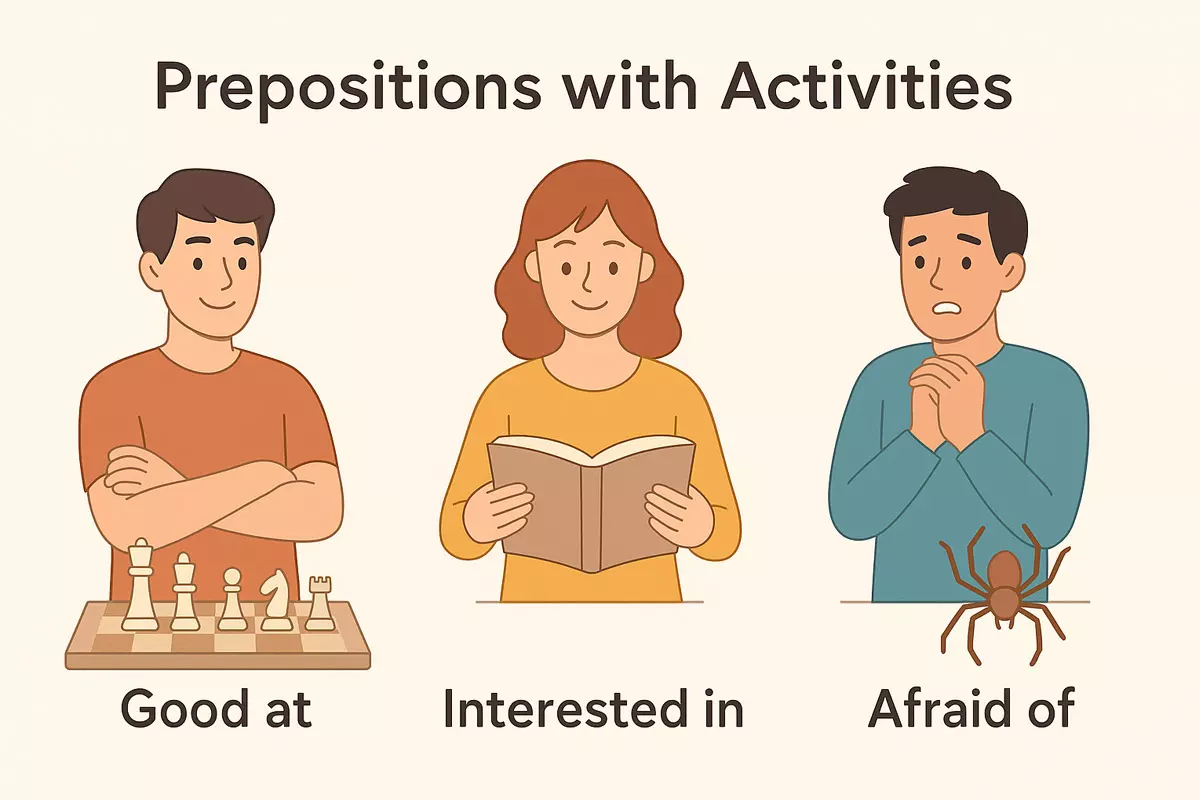 This article explains adjective and verb preposition patterns like good at, interested in, and listen to. It covers common collocations, typical mistakes, and includes practice sentences to help you use these forms correctly in daily English.
Have you ever wondered why we say someone excels at painting, is fascinated by chess, or fears heights? Understanding and using the small connecting words, such as prepositions, that link activities to feelings and abilities can significantly improve your English. These words may seem minor, but they play a crucial role in expressing ideas clearly and naturally. By mastering them, you will not only make your speech and writing sound more fluent but also avoid common mistakes that can lead to confusion or misunderstanding.
Adjective + Preposition Patterns
Understanding how adjectives and prepositions combine is essential for expressing opinions, feelings, and abilities related to activities. These combinations often follow set patterns in English, and using the correct preposition can change the meaning of a sentence. For example, being "good at" something is not the same as being "good for" something. When describing your skills or interests, certain adjectives naturally pair with specific prepositions. These partnerships help clarify what you mean, especially when talking about hobbies, fears, or preferences.
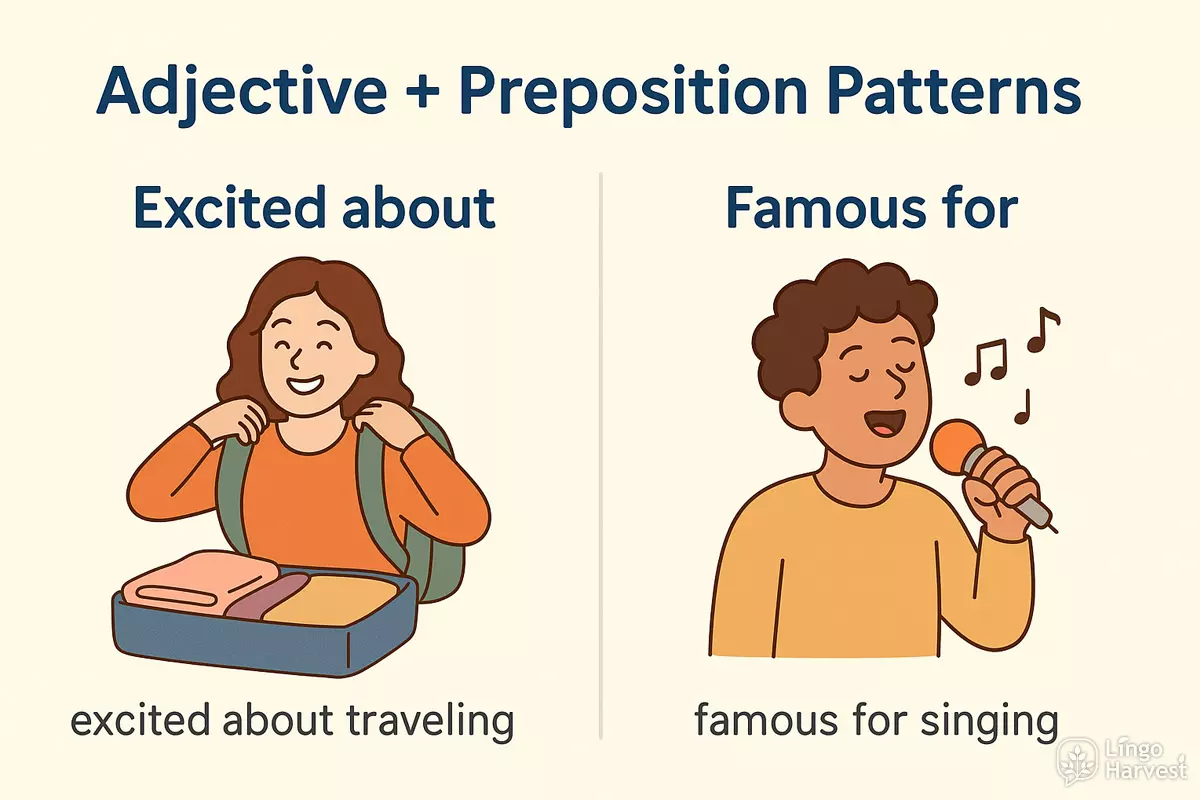
Here are some common adjective-preposition pairs connected to activities:
- Good at (e.g., good at swimming)
- Bad at (bad at dancing)
- Interested in (interested in painting)
- Bored with (bored with studying)
- Afraid of (afraid of flying)
- Excited about (excited about traveling)
- Famous for (famous for singing)
- Responsible for (responsible for organizing events)
- Fond of (fond of reading)
- Keen on (keen on hiking)
- Worried about (worried about missing the bus)
- Tired of (tired of waiting)
- Capable of (capable of solving problems)
- Famous for (famous for acting)
- Opposed to (opposed to changing the plan)
- Accustomed to (accustomed to working late)
- Surprised by (surprised by the results)
- Similar to (similar to playing chess)
How These Patterns Work
Most of these combinations are followed by a noun, pronoun, or a gerund (the -ing form of a verb). For example, "She is interested in learning languages." Only certain adjectives are used with certain prepositions, so memorizing these pairs helps you sound more natural.
Common Mistakes
Mixing up prepositions is a frequent problem for learners. For instance, saying "good in" instead of "good at" is incorrect when talking about skills. Pay attention to which preposition matches each adjective.
| Adjective + Preposition | Example with Activity |
|---|---|
| Good at | She is good at painting. |
| Interested in | He is interested in learning guitar. |
| Afraid of | They are afraid of hiking alone. |
| Keen on | We are keen on cooking new dishes. |
| Tired of | I'm tired of running every day. |
| Responsible for | She is responsible for organizing the workshop. |
| Famous for | The city is famous for hosting music festivals. |
| Bored with | He is bored with playing the same game. |
Tips for Practice
To master these structures, practice making your own sentences with different activities. Notice how the meaning changes if you use a different preposition, and always check if a gerund (-ing form) is needed after the preposition. Over time, these pairs will become second nature.
Good At, Interested In, Afraid Of
These common adjective + preposition combinations help describe abilities, preferences, and fears related to different activities. Understanding which prepositions to use and how to follow them with verbs or nouns is essential for clear and natural English. Each phrase is usually followed by a noun, pronoun, or gerund (the -ing form of a verb).
Usage Patterns and Examples
When you want to express skill, enjoyment, or fear about an activity, use these expressions with the correct preposition:
- good at + noun/gerund: She is good at painting.
- interested in + noun/gerund: They are interested in learning French.
- afraid of + noun/gerund: He is afraid of flying.
Notice that the verb after these phrases takes the -ing form. For example, "good at swim" is incorrect; the correct form is "good at swimming."
Common Activities with These Phrases
Here are some typical ways to combine these structures with activities:
- good at playing chess
- good at solving puzzles
- interested in reading novels
- interested in traveling
- afraid of speaking in public
- afraid of driving at night
- good at making friends
- interested in cooking
- afraid of swimming in the ocean
- good at drawing
- interested in photography
- afraid of taking tests
- good at dancing
- interested in hiking
- afraid of missing deadlines
- good at organizing events
- interested in gardening
- afraid of heights
Comparing the Structure
Below is a comparison of how these expressions are structured with different activities:
| Expression | Example with Activity |
|---|---|
| good at | good at singing |
| interested in | interested in learning Spanish |
| afraid of | afraid of flying |
| good at | good at playing football |
| interested in | interested in painting |
| afraid of | afraid of making mistakes |
To summarize, always use the correct preposition and follow it with either a noun or the -ing form of a verb. This helps your sentences sound natural and precise when talking about skills, interests, or fears.
Verbs with Prepositions (Listen To, Wait For)
When learning English, it’s easy to forget that some verbs require specific prepositions. For example, we don’t just “listen music,” but “listen to music.” Similarly, we “wait for” the bus, not simply “wait the bus.” These small words can make a big difference in your sentences and help you sound more natural.
Common Verb + Preposition Combinations
Many verbs in English are followed by particular prepositions. These combinations often don’t translate directly from other languages, so it’s important to memorize them as set phrases. Here are some frequently used patterns:
- Listen to – She likes to listen to podcasts every morning.
- Wait for – We will wait for you at the station.
- Look at – Please look at the board.
- Talk to – I need to talk to my teacher.
- Depend on – Success can depend on hard work.
- Belong to – This book belongs to Sam.
- Agree with – I agree with your idea.
- Apologize for – He apologized for being late.
- Think about – She’s thinking about her future.
- Pay for – Who will pay for dinner?
- Complain about – They complained about the noise.
- Apply for – He applied for a new job.
- Rely on – You can rely on your friends.
- Believe in – Do you believe in luck?
- Smile at – The baby smiled at her mother.
- Laugh at – Don’t laugh at mistakes.
- Care for – She cares for her grandparents.
- Focus on – Please focus on your work.
Understanding the Patterns
Some verbs always take a certain preposition, even if it feels unnecessary. For example, “listen” is almost always followed by “to,” and “wait” is followed by “for.” This is just a quirk of English — using the wrong preposition can sound strange or even change the meaning.
Examples: Listen To vs. Wait For
Let’s look at these two common combinations in more detail:
- I like to listen to classical music when I study.
- Are you listening to me?
- We’re waiting for the train.
- She waited for her friend outside the café.
Comparison of Verb + Preposition Usage
| Verb + Preposition | Example Sentence |
|---|---|
| listen to | He listens to music every day. |
| wait for | They waited for the bus in the rain. |
| look at | Please look at the picture. |
| talk to | Can I talk to you for a minute? |
| belong to | This pen belongs to Anna. |
| depend on | The outcome depends on your decision. |
Tips for Mastering These Combinations
Practice is key: try to memorize these phrases as fixed expressions. When you learn a new verb, check if it commonly pairs with a preposition. Reading and listening to natural English will help you notice these patterns. Over time, using the right preposition will become automatic.
Common Collocations in Daily English
Understanding how prepositions pair with adjectives and activities helps you sound more natural when you speak English. Many expressions, such as “good at” or “interested in,” are commonly used in everyday conversation to describe abilities, preferences, and fears. These combinations, called collocations, often follow specific patterns that learners can memorize and practice.
Typical Preposition + Activity Patterns
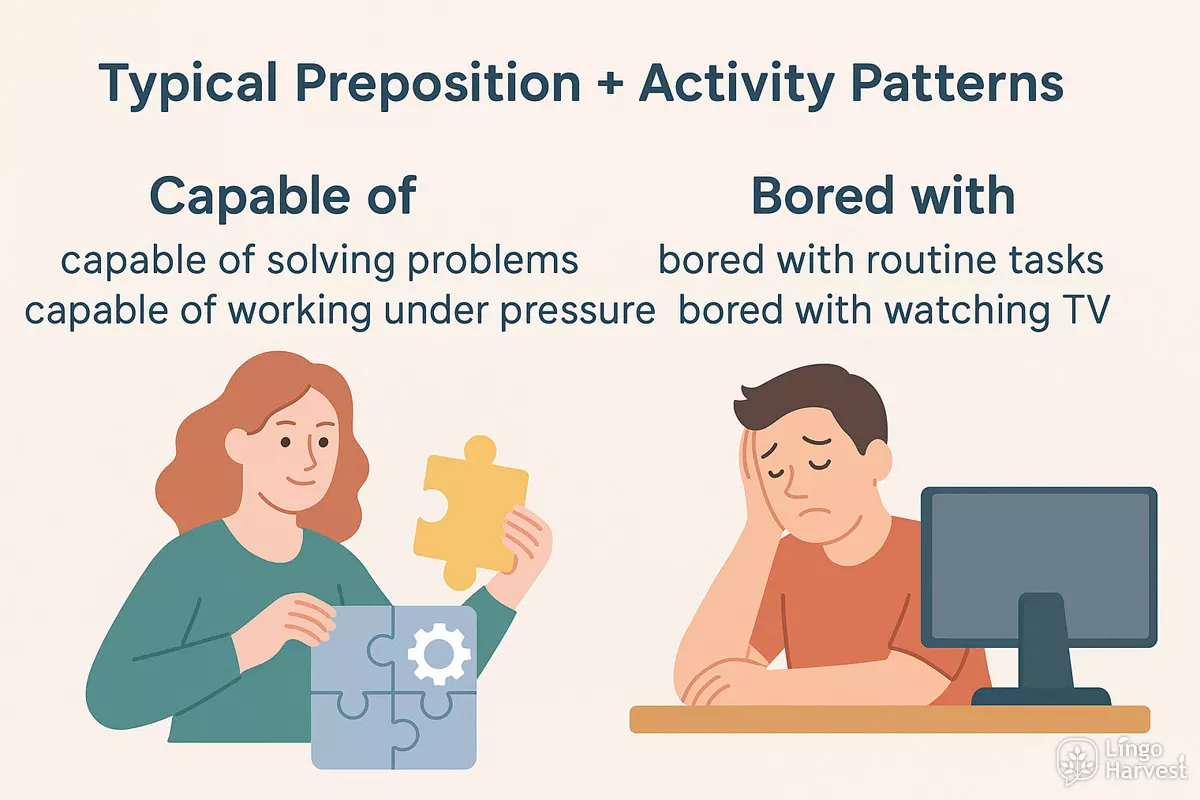
Some adjectives almost always use the same preposition when talking about activities. Here are several familiar patterns you’ll encounter:
- Good at (an activity or skill): good at swimming, good at math, good at cooking
- Interested in (a hobby or topic): interested in photography, interested in learning languages, interested in history
- Afraid of (something or doing something): afraid of heights, afraid of flying, afraid of speaking in public
- Bad at: bad at drawing, bad at remembering names
- Keen on: keen on running, keen on playing chess
- Tired of: tired of waiting, tired of studying all night
- Capable of: capable of solving problems, capable of working under pressure
- Bored with: bored with routine tasks, bored with watching TV
- Famous for: famous for singing, famous for inventing something
- Responsible for: responsible for organizing events, responsible for managing a team
- Excited about: excited about traveling, excited about meeting new people
- Worried about: worried about exams, worried about losing keys
- Accused of: accused of cheating, accused of stealing
- Fond of: fond of animals, fond of hiking
- Committed to: committed to improving skills, committed to helping others
How These Expressions Are Used
People often use these collocations to describe themselves, other people, or even things. For example, you might say, “She’s good at painting,” or “He’s interested in science.” The pattern is usually: adjective + preposition + noun/gerund.
| Adjective + Preposition | Example with Activity |
|---|---|
| good at | good at playing guitar |
| interested in | interested in reading novels |
| afraid of | afraid of speaking in public |
| bad at | bad at cooking |
| tired of | tired of doing homework |
| excited about | excited about starting a new job |
| keen on | keen on playing tennis |
| capable of | capable of learning quickly |
| bored with | bored with watching TV |
| responsible for | responsible for organizing meetings |
Tips for Mastering Collocations with Prepositions
Pay attention to how native speakers use these pairings. Practice by making your own sentences describing your abilities or feelings. Try to notice which prepositions naturally follow which adjectives, and remember that direct translation from your native language may not always work. Regular exposure and usage will help you internalize these combinations and use them confidently in daily conversations.
Typical Mistakes
Many English learners stumble when using prepositions with adjectives like "good at," "interested in," and "afraid of." These errors usually happen when translating directly from another language, mixing up prepositions, or forgetting to use them at all. Recognizing common slip-ups can help you avoid them and sound more natural.
Mixing Up Prepositions
One of the most frequent issues is using the wrong preposition after certain adjectives. For example, it's easy to say "good in sports" instead of the correct "good at sports." This confusion can make sentences sound awkward or unclear.
Omitting the Preposition
Sometimes, learners drop the necessary preposition entirely, especially in spoken English. This can lead to sentences like "She is interested painting," which should be "She is interested in painting."
Using Gerunds and Nouns Incorrectly
After these adjective + preposition combinations, it's standard to use a noun or gerund (-ing form). Using an infinitive by mistake (e.g., "good at to swim") is a common error.
Common Incorrect and Correct Patterns
- ❌ She is good in dancing. → ✅ She is good at dancing.
- ❌ He is interested about chess. → ✅ He is interested in chess.
- ❌ They are afraid to spiders. → ✅ They are afraid of spiders.
- ❌ I am good with drawing. → ✅ I am good at drawing.
- ❌ She is interested for music. → ✅ She is interested in music.
- ❌ He is afraid from darkness. → ✅ He is afraid of darkness.
- ❌ Are you good on math? → ✅ Are you good at math?
- ❌ They are interested about learning languages. → ✅ They are interested in learning languages.
- ❌ We are afraid with heights. → ✅ We are afraid of heights.
- ❌ I'm good at to swim. → ✅ I'm good at swimming.
Confusing Similar Expressions
Some expressions look or sound similar but use different prepositions. Being aware of these can help you choose the right form:
| Incorrect Form | Correct Form |
|---|---|
| good in sports | good at sports |
| interested about science | interested in science |
| afraid from dogs | afraid of dogs |
| good with languages | good at languages |
| interested for history | interested in history |
| afraid with the dark | afraid of the dark |
Practice: Complete the Sentences
Understanding how to use prepositions with adjectives and activities is essential for clear communication. Below, you’ll find exercises that focus on the correct use of “good at,” “interested in,” and “afraid of.” Read each sentence carefully and fill in the blank with the correct preposition or phrase.
Fill in the Blanks
Try to complete these sentences with the correct preposition and activity. Focus on the meaning of each adjective and the activity it describes.
- Maria is ________ painting. She creates beautiful artwork.
- Are you ________ learning new languages?
- Tom is ________ spiders. He won’t go near them.
- We are ________ playing chess after school.
- She is not ________ cooking, but she loves eating out.
- He is ________ singing; his voice is amazing!
- My brother is ________ swimming in the ocean.
- They are ________ hiking in the mountains.
- Anna is ________ public speaking. She gets nervous on stage.
- Are you ________ solving puzzles?
Matching Activities and Prepositions
Match the adjectives in the left column with the correct prepositional phrase in the right column.
| Adjective | Prepositional Phrase |
|---|---|
| Good | at drawing |
| Interested | in playing tennis |
| Afraid | of flying |
| Good | at solving problems |
| Interested | in reading novels |
| Afraid | of speaking in public |
Challenge: Write Your Own
Now, create your own sentences using the patterns above. Choose any activity you like and use “good at,” “interested in,” or “afraid of.”
- Example: I am interested in learning photography.
- Example: She is afraid of driving at night.
- Example: They are good at playing the piano.
Show answers
- 1. good at
- 2. interested in
- 3. afraid of
- 4. interested in
- 5. interested in
- 6. good at
- 7. afraid of
- 8. interested in
- 9. afraid of
- 10. good at