Articles in There Is / There Are Sentences

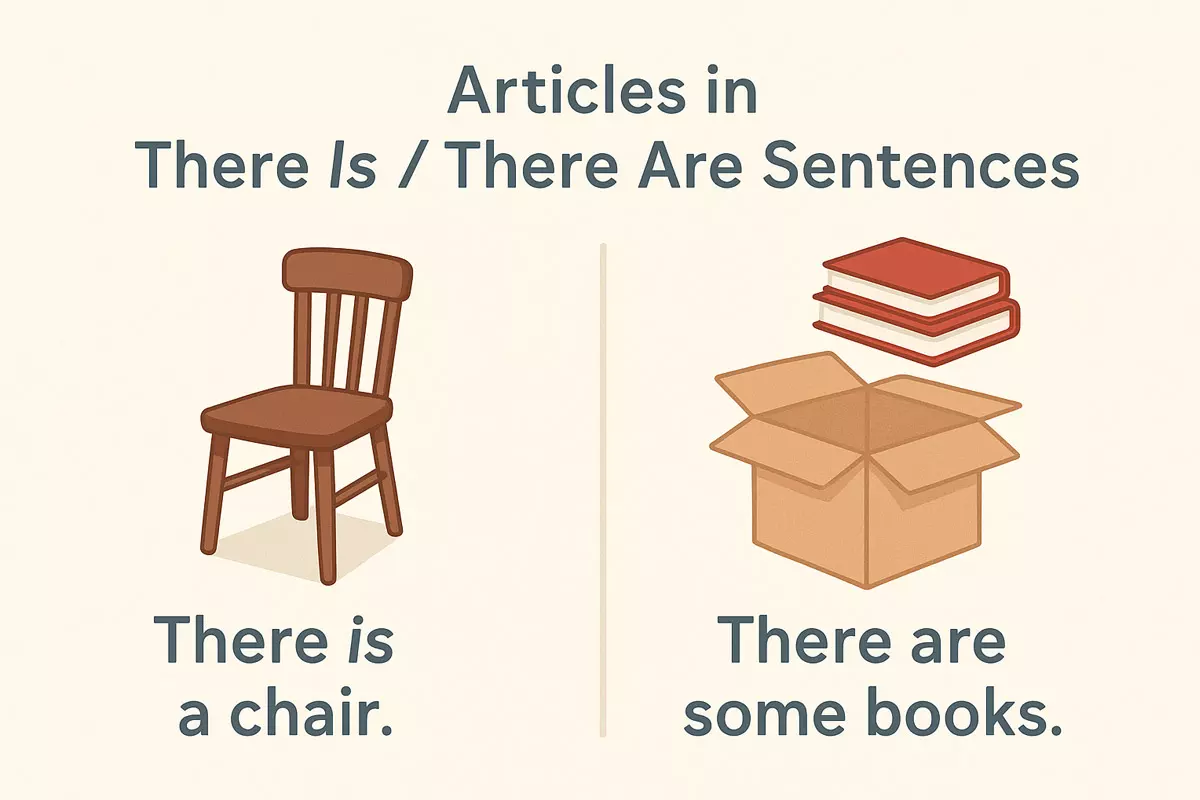 The article explains how to use a, an, and the with there is and there are, discusses countable and uncountable nouns, and reviews singular and plural rules. It also provides practice sentences for you to complete.
Have you ever wondered why we use a, an, or the when talking about what is present in a certain place? Learning how to use these small words, known as articles, helps make your English clearer and more precise. Articles like a and an are used when mentioning something for the first time or when it is not specific, while the is used for something already known or previously mentioned. Mastering the use of articles is an important step in improving your overall English communication skills.
When to Use a/an in There Is
Understanding how to choose between "a" and "an" in sentences with "there is" is essential for clear English. These articles are used to introduce singular, countable nouns that are mentioned for the first time. The choice depends on the sound at the beginning of the next word, not just the letter.
Basic Rule: Sound Matters
Use "a" before words that begin with a consonant sound, and "an" before words that begin with a vowel sound. For example, "a cat" and "an apple." This rule applies regardless of spelling. For instance, "an hour" uses "an" because "hour" starts with a vowel sound.
Examples of "There is a/an"
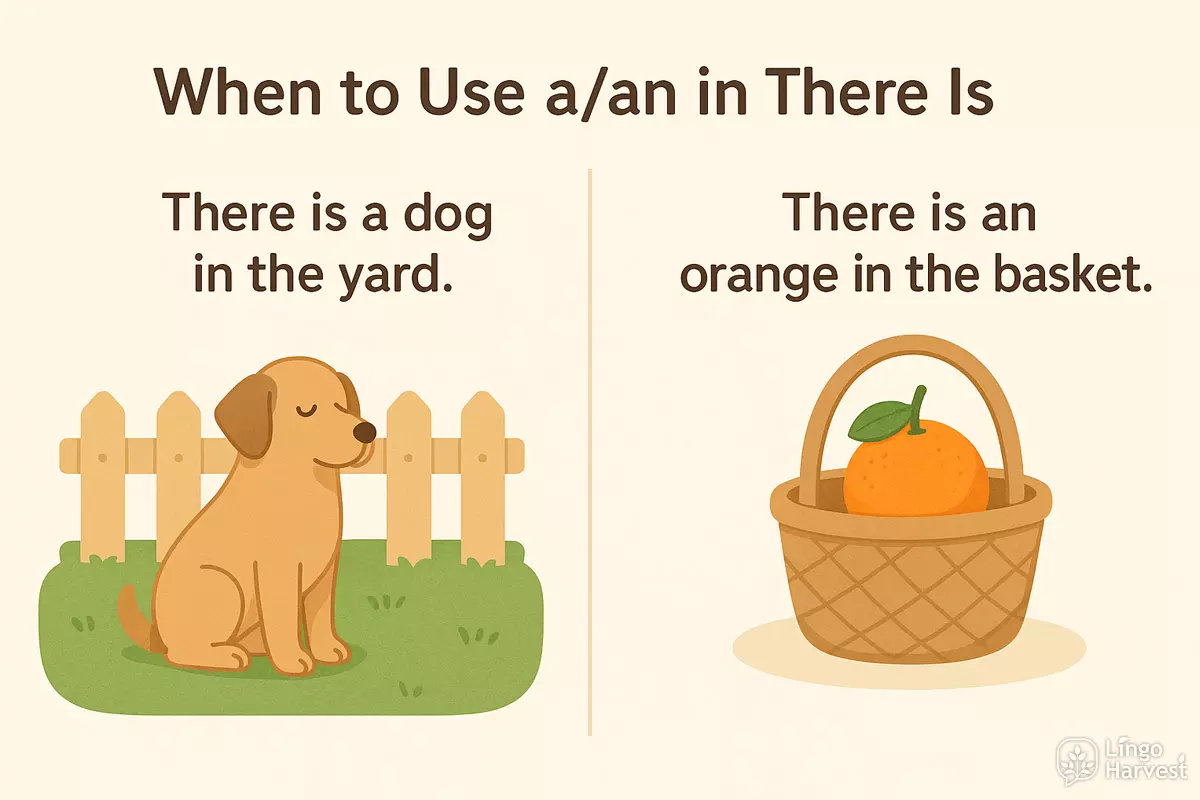
Here's a list of sentences showing the correct use of each article:
- There is a book on the table.
- There is an umbrella by the door.
- There is a dog in the yard.
- There is an orange in the basket.
- There is a university in the city. (“university” starts with a “juː” sound, a consonant sound)
- There is an hour left.
- There is a house on the hill.
- There is an elephant at the zoo.
- There is a car outside.
- There is an idea I want to share.
- There is a user waiting. (“user” starts with “juː”, not a vowel sound)
- There is an honest person here.
- There is a phone ringing.
- There is an egg in the fridge.
- There is a map on the wall.
- There is an uncle visiting.
- There is a one-way street. (“one” starts with a “w” sound)
- There is an heir to the throne.
Special Cases and Common Errors
Some words can be tricky because their spelling and pronunciation differ. For example, "honest" and "hour" start with a silent "h," so use "an." On the other hand, "university" and "user" start with a "y" sound, so use "a." Always listen for the first sound, not just the first letter.
Quick Reference Table
| Next Word | Correct Form |
|---|---|
| apple | There is an apple |
| book | There is a book |
| hour | There is an hour |
| university | There is a university |
| orange | There is an orange |
| user | There is a user |
Summary
Use "a" or "an" in "there is" sentences to introduce something singular and countable for the first time. Listen for the first sound of the noun—this will guide your choice. With practice, these patterns become automatic in everyday speech and writing.
When to Use the in There Are
The definite article the is used in "there are" sentences when you are talking about specific things that both the speaker and listener know about. This might be because the things have already been mentioned, are unique, or are defined by a phrase that follows. Using the can signal that you are not speaking generally, but rather about particular items or groups in a context.
Situations Where the is Needed
- When the noun has been mentioned before: There are the keys I was looking for.
- If the noun is made specific by a clause or phrase: There are the students who won the prize.
- When only one set of things can be meant in context: There are the mountains we visited last year.
- With unique objects or groups: There are the planets in our solar system.
- For things previously identified or obvious in the situation: There are the documents on your desk.
Comparing Use of the vs. No Article
| With the | Without Article |
|---|---|
| There are the books you asked for. | There are books on the table. |
| There are the students from my class. | There are students in the library. |
| There are the results we expected. | There are results to analyze. |
| There are the answers at the back of the book. | There are answers for every question. |
| There are the files you need. | There are files on my computer. |
Helpful Patterns and Examples
Here are some more examples of when the is used after "there are" to refer to definite things:
- There are the reasons I mentioned earlier.
- There are the people you met at the party.
- There are the instructions you should follow.
- There are the options we discussed.
- There are the gifts from your friends.
- There are the answers everyone wanted.
- There are the cars we rented last summer.
- There are the problems we need to solve.
- There are the tickets for tonight's show.
- There are the houses on my street.
- There are the photos you took in Paris.
- There are the questions on the final exam.
- There are the emails you missed.
- There are the shoes I bought yesterday.
In short, use the in "there are" sentences when you want to point to a specific group or set that your listener can identify. If you are speaking about things in general or things not previously mentioned, leave out the definite article.
Countable vs Uncountable Nouns
Understanding the distinction between things we can count and things we cannot is essential when using articles in sentences with "there is" and "there are." This difference affects which articles ("a," "an," or "some") you can use, and even the structure of your sentence.
What Are Countable Nouns?
Items or concepts you can count—like "apples," "books," or "cars"—fall into this category. These words have both singular and plural forms. If there is only one, use "a" or "an" (for example, "There is an apple on the table."). For more than one, use the plural: "There are three apples."
What Are Uncountable Nouns?
Substances, ideas, or mass concepts that you cannot count individually are known as uncountable nouns. Words like "water," "information," or "furniture" fit here. These nouns do not have a plural form and are never used with "a" or "an." For example, "There is some water in the glass." The word "some" is often used instead of a number or an article.
Common Examples
- Countable: chair, dog, idea, coin, child, bottle, pencil, apple, cat, friend
- Uncountable: sugar, advice, bread, money, equipment, knowledge, luggage, rice, air, news
How Article Usage Changes

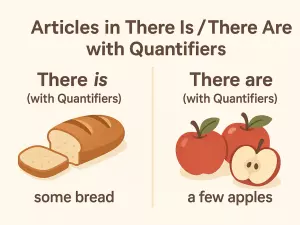
The choice of article or quantifier in "there is/there are" sentences depends on whether the noun is countable or not. Here is a quick comparison:
| Type | Example with "There is/There are" |
|---|---|
| Singular countable noun | There is a book on the desk. |
| Plural countable noun | There are some books on the desk. |
| Uncountable noun | There is some water in the glass. |
| Uncountable noun (negative) | There isn’t any milk left. |
Quick Tips
- Use "a/an" only with singular, countable nouns. ✅
- Use "some" or "any" with plurals or uncountable nouns. ✅
- Never use "a/an" with uncountable nouns. ❌
- Check if a noun has a plural form to decide if it’s countable.
Choosing the right article or quantifier depends on whether you refer to individual objects or mass/abstract concepts. This skill helps make your "there is/there are" sentences clear and correct.
Singular and Plural Rules
Understanding how to use articles with "there is" and "there are" depends on whether the noun is singular or plural. The choice of article also changes based on if the noun is countable or uncountable. Let's explore how this works in practice.
When to Use "There is" and "There are"
"There is" is used before singular nouns and uncountable nouns, while "there are" is for plural nouns. Articles like "a" or "an" are only used with singular countable nouns, not with plurals or uncountable nouns.
- There is a book on the table. (singular, countable)
- There is an apple in the basket. (singular, countable, vowel sound)
- There is water in the glass. (uncountable, no article)
- There are books on the shelf. (plural, no "a/an")
- There are some apples in the bag. (plural, "some" instead of "a/an")
- There is some sugar in the bowl. (uncountable, "some")
- There are children in the playground. (plural)
- There is an umbrella near the door. (singular, countable, vowel sound)
- There are a few coins on the table. (plural, "a few")
- There is no milk in the fridge. (uncountable, negative)
- There are no students in the classroom. (plural, negative)
- There is an orange on the counter. (singular, vowel sound)
- There are many people outside. (plural, "many")
- There is little hope left. (uncountable, negative)
- There are several options to choose from. (plural)
Choosing the Right Article
The article "a" is used before singular countable nouns that start with a consonant sound, while "an" is for those starting with a vowel sound. Plural and uncountable nouns do not use "a" or "an." For plural nouns, determiners like "some," "many," or "a few" are common.
| Form | Example | Article/Determiner |
|---|---|---|
| Singular, countable | There is a cat in the garden. | a/an |
| Singular, countable (vowel) | There is an elephant at the zoo. | an |
| Plural, countable | There are cats in the garden. | no article / some, many, a few |
| Uncountable | There is milk in the fridge. | no article / some, much, little |
Common Mistakes to Avoid
- ❌ There is books on the table. → Incorrect (should be "there are books")
- ❌ There are a apple in the bag. → Incorrect (should be "there is an apple")
- ✅ There is an apple in the bag. → Correct
- ✅ There are some apples in the bag. → Correct
Practice: Complete the Sentences
Understanding how to use articles (a, an, the, or zero article) with “there is” and “there are” structures is essential for accurate English. Below are several exercises to help you apply the rules in practical contexts. Each item provides a sentence with a missing article. Choose the correct article for each blank.
Fill in the Blanks
Select the appropriate article (a, an, the, or leave blank) for each sentence:
- ______ cat is sitting on the sofa.
- There is ______ apple on the table.
- There are ______ books on the shelf.
- There is ______ old museum in this city.
- There are ______ oranges in the basket.
- There is ______ umbrella near the door.
- There are ______ children playing outside.
- There is ______ university in the town.
- There are ______ interesting paintings in the gallery.
- There is ______ noise coming from the street.
- There are ______ eggs in the fridge.
- There is ______ beautiful park next to the river.
- There are ______ cars in the parking lot.
- There is ______ hospital near here.
- There are ______ birds in the tree.
- There is ______ hour left before the meeting.
- There are ______ students in the classroom.
- There is ______ European restaurant nearby.
- There are ______ flowers on the windowsill.
- There is ______ elephant at the zoo.
Show answers
- A
- An
- (No article)
- An
- (No article)
- An
- (No article)
- A
- (No article)
- A
- (No article)
- A
- (No article)
- A
- (No article)
- An
- (No article)
- A
- (No article)
- An
Common Patterns and Examples
Here are some typical examples of using articles in these structures:
- There is a dog in the yard.
- There are some cookies on the plate.
- There is an interesting book on the desk.
- There are many people in the park.
- There is the answer you were looking for.
- There is no milk in the fridge.
- There are a few shops nearby.
- There is an elephant at the zoo.
- There are two cats on the roof.
- There is the museum we talked about.
Notice the difference between using indefinite articles (a/an) for singular, non-specific nouns, and zero article for plural or uncountable nouns when speaking generally. The definite article (the) is used when the noun is specific or has been mentioned before.
Quick Check: Which Article?
Decide which article you would use in these short phrases:
- ______ interesting movie on TV
- ______ water in the glass
- ______ only child in the room
- ______ apples on the table
Show answers
- An
- (No article)
- The
- (No article)