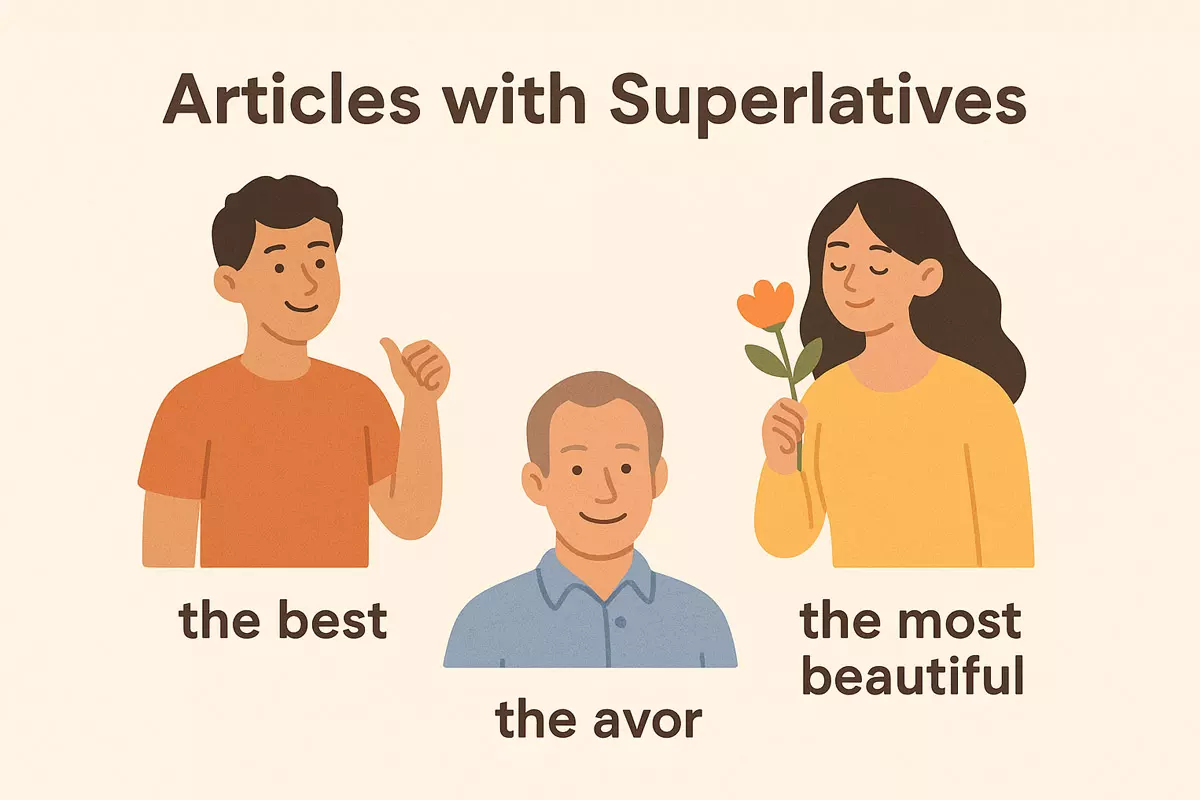
Articles with Superlatives: the Best, the Most Beautiful

 Here we rules for using the with superlative adjectives, explains how to form them, lists common expressions, and notes exceptions. It also includes practice exercises to help you apply what you've learned.
Describing something that stands out above all others requires choosing words that convey its ultimate or most striking qualities. By selecting powerful adjectives such as exceptional, outstanding, or unparalleled, you can make your descriptions more vivid and compelling. Superlatives like best, greatest, or most impressive also help highlight the unique features of a person, place, or thing. Mastering this expressive aspect of English allows you to communicate enthusiasm and clarity, making your writing or speech more engaging and memorable for your audience.
Rule for Using the with Superlatives
When we use superlative adjectives or adverbs in English, we almost always add the definite article the before them. This is because superlatives refer to a unique person or thing in a group—something that stands out as the “most” or “least” in some way. For example, when you say “the tallest building,” you are talking about the single building that is taller than all the others.
Why Use "the" Before Superlatives?
Superlatives identify one thing as having the highest or lowest degree of a quality among a group. The article the signals that we are talking about something specific and unique, not just any example. Without the, the meaning is incomplete or incorrect in standard English.

- The best solution
- The most interesting question
- The least expensive option
- The oldest tree
- The fastest runner
- The most delicious cake
- The biggest mistake
- The happiest moment
- The worst result
- The brightest star
- The most difficult challenge
- The coldest day
- The smallest detail
- The most popular song
- The earliest train
- The most dangerous animal
- The least likely answer
- The most expensive car
When "the" Is Omitted
There are a few cases where the definite article is dropped with superlatives, usually in informal speech or set expressions. For example, “Mount Everest is highest in the world” (less common, but possible in headlines or poetic language). In everyday English, however, including the is standard.
Quick Reference: Correct and Incorrect Usage
| ✅ Correct | ❌ Incorrect |
|---|---|
| She is the smartest student in the class. | She is smartest student in the class. |
| This is the most comfortable chair. | This is most comfortable chair. |
| He ran the fastest in the race. | He ran fastest in the race. |
| That was the least expensive option. | That was least expensive option. |
Summary
In nearly all cases, always place the before superlative forms to indicate you are referring to a specific, unique member of a group. This simple rule helps your English sound natural and clear. Exceptions are rare and usually limited to special styles or set phrases.
Superlative Adjective Formation
Superlatives in English let us express the highest degree of a quality. They’re typically used when comparing three or more things, like in “the tallest building” or “the most interesting book.” The way you form a superlative depends on the length and structure of the adjective in question.
Regular Patterns
For most short adjectives—those with one syllable, and some two-syllable adjectives ending in -y—add -est to the end. If the adjective ends with a single vowel followed by a consonant, double the consonant before adding -est (for example, big → biggest). For adjectives ending in -y, change the -y to -i before adding -est (e.g., happy → happiest).
- small → smallest
- fast → fastest
- big → biggest
- happy → happiest
- early → earliest
- sad → saddest
- funny → funniest
- thin → thinnest
- hot → hottest
- lucky → luckiest
Forming Superlatives with "Most"
Longer adjectives—usually those with two or more syllables (except for some ending in -y)—require “most” before the adjective, instead of an -est ending. This pattern helps keep sentences clear and natural.
- beautiful → most beautiful
- important → most important
- dangerous → most dangerous
- expensive → most expensive
- comfortable → most comfortable
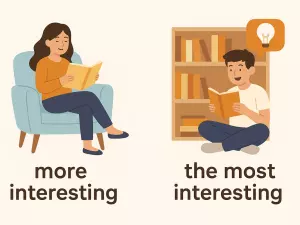
- interesting → most interesting
- generous → most generous
- popular → most popular
- delicious → most delicious
- intelligent → most intelligent
Irregular Forms
Some common adjectives don’t follow the usual rules and have irregular superlative forms. Here’s a quick overview:
| Adjective | Superlative Form |
|---|---|
| good | best |
| bad | worst |
| far | farthest / furthest |
| little | least |
| many / much | most |
When using the superlative, always include the definite article “the” before the adjective: “the smallest,” “the most amazing,” or “the best.” This signals that you’re referring to a unique highest or lowest degree within a group.
Common Expressions (the tallest, the most popular)
Superlative forms often appear in everyday English when we want to compare people, places, or things and show that one stands out above all others. These patterns are used in both spoken and written language, making them essential for clear and natural communication.
Typical Patterns with Superlatives
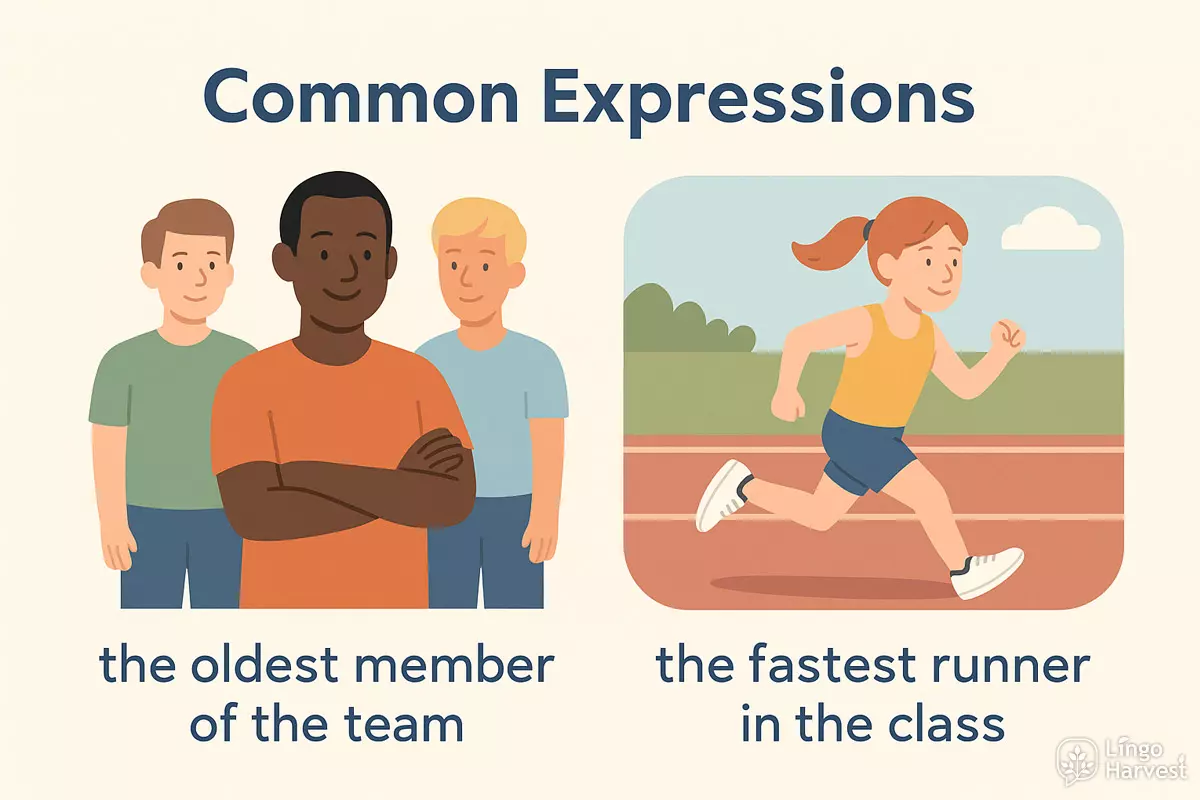
You’ll frequently see the definite article “the” before superlative adjectives and adverbs, emphasizing that something is at the highest or lowest degree within a group. Here are some of the most common ways these appear:
- the oldest member of the team
- the fastest runner in the class
- the most expensive restaurant in town
- the least interesting chapter
- the best solution
- the worst day of my life
- the happiest moment
- the biggest challenge
- the most important reason
- the earliest flight
- the latest news
- the smallest detail
- the most popular choice
- the longest journey
- the brightest idea
- the coldest winter
- the most successful project
- the prettiest dress
How Superlatives Are Formed
Most one-syllable adjectives add “-est” (e.g., tallest, fastest), while longer adjectives use “most” or “least” (e.g., most beautiful, least expensive). The structure with “the” is what marks these as superlatives.
| Superlative Form | Example in a Sentence |
|---|---|
| the tallest | She is the tallest student in her class. |
| the most talented | He is the most talented musician here. |
| the least expensive | This is the least expensive option available. |
| the best | That was the best concert I’ve ever attended. |
| the most popular | This app is the most popular among teenagers. |
| the worst | It was the worst storm of the year. |
| the earliest | He caught the earliest train this morning. |
| the most difficult | This exam was the most difficult so far. |
Usage Tips
Remember, superlative expressions almost always require “the” in English. Omitting it can sound unnatural or change the meaning. Also, these phrases often appear with a specific group, place, or time to clarify what is being compared. For example: “the smartest in the group,” “the coldest day this year,” or “the most visited museum in the city.”
Exceptions in Usage
Some situations require us to break the usual rules for using articles with superlative adjectives like "the best" or "the most beautiful." While these forms typically need "the," there are notable cases where the article is omitted or the pattern changes.
Here are several common cases where the definite article is not used with superlatives or where the usage differs from the standard:
- When superlatives are used in exclamations without a noun: What most interesting news!
- In certain idiomatic expressions: Best wishes!, Best regards
- After possessive pronouns: My best friend, her oldest memory
- With names of awards or titles: Nobel Prize for Best Actor
- In headlines or titles: 10 Best Places to Visit
- When superlatives act as adverbs: Try your best
- With some names of institutions or groups: Best Buy (as a brand name)
- When the superlative is used as part of a compound adjective: World-famous most talented singer
- In informal speech, especially for emphasis: Best day ever!
- When "most" means "very" or "extremely" (not a superlative): That was most kind of you
- In poetic or literary language, omitting "the" for stylistic effect
- Before uncountable nouns in generalizations: Most important is honesty
- When referring to a unique relationship or role: She is mother’s best friend
- With some prepositional phrases: At best, at most
- In set phrases and proverbs: Second best is never enough
- When "most" is used as a quantifier, not a superlative: Most people agree
Comparing Standard and Exceptional Patterns
To clarify, here's a comparison of regular versus irregular article use with superlatives:
| Standard Usage | Exceptional Usage |
|---|---|
| He is the oldest in the class. | She is my oldest friend. |
| This is the most beautiful painting here. | Best wishes! |
| It was the best decision. | Try your best. |
| He won the most important prize. | At best, we’ll arrive by noon. |
Understanding these variations helps you sound more natural in both formal and informal English. Recognizing when the article is optional or omitted altogether is essential for mastering the use of superlatives in real-world contexts.
Practice: Fill in Missing Articles
Understanding when to use articles with superlatives is crucial for accurate English. In this set of exercises, you'll complete sentences by adding the correct article where necessary. Focus on the definite article (the), which is typically used with superlative adjectives such as "best," "most beautiful," or "oldest." Read each sentence carefully and decide if an article is needed.
Exercise: Insert the Correct Article
For each sentence below, fill in the blank with the where appropriate, or leave it blank if no article is needed.
- Mount Everest is ____ highest mountain in the world.
- She is ____ smartest student in our class.
- That was ____ most exciting movie I have ever seen.
- He bought ____ fastest car available.
- January is usually ____ coldest month of the year here.
- Venus is ____ brightest planet in the night sky.
- This is ____ most comfortable chair in the house.
- Who is ____ oldest person in your family?
- It's ____ worst experience I've ever had.
- Is this ____ most expensive restaurant in town?
- She wore ____ most beautiful dress at the party.
- That was ____ funniest joke of the night.
- He is ____ least talkative member of the team.
- Which city is ____ largest in your country?
- Today is ____ best day to go hiking.
Show answers
- the
- the
- the
- the
- the
- the
- the
- the
- the
- the
- the
- the
- the
- the
- the
Common Patterns with Superlatives
Superlative adjectives nearly always require the definite article. Here are some patterns to notice:
- the + superlative adjective + noun: the highest mountain
- the + most/least + adjective + noun: the most beautiful place
- the + superlative + of/in + group: the smartest in the class
More Practice: Identify Correct and Incorrect Usage
Decide if the article is used correctly in each sentence. Mark ✅ for correct, ❌ for incorrect.
- She is best player on the team.
- He climbed the tallest tree in the park.
- This is the most delicious cake I've tasted.
- It was coldest night of the year.
Show answers
- ❌ (Should be "the best player")
- ✅
- ✅
- ❌ (Should be "the coldest night")
Review these examples and patterns to solidify your understanding of article use with superlatives. Practicing with a variety of sentences will help you master this essential grammar point.