When Articles Are Not Used in English

 Here we the rules for using the zero article in English. It explains when to omit articles before plural and uncountable nouns, abstract concepts, meals, places, and institutions, and discusses common exceptions with practice exercises.
Many English learners are often puzzled about when to leave out articles such as "a" or "the" in sentences, since these small words play a significant role in conveying meaning and clarity. Knowing when articles can be omitted is not always straightforward, as it depends on specific rules and contexts, like when talking about general ideas, using uncountable nouns, or referring to things in a broad sense. Mastering the use and omission of articles helps learners sound more natural and fluent in both written and spoken English.
Zero Article Definition
In English, there are many situations where neither "a/an" nor "the" is required before a noun. This omission is known as using no article, or the "zero article." Native speakers do this naturally, but for learners, it can be confusing to know when a noun stands alone. The absence of an article often signals that a noun is being used in a general, non-specific sense, or that it fits into certain grammatical categories.
When Is No Article Used?
The zero article typically appears in several common cases:
- With plural and uncountable nouns when talking about things in general: Books are expensive. Water is essential.
- Before most proper nouns: Asia, John, Oxford University
- With names of languages and subjects: She speaks French. I study biology.
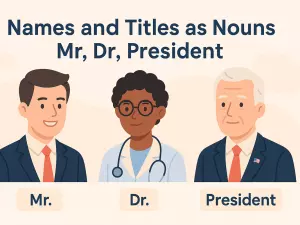
- In titles and roles: He became president. She is captain of the team.
- With meals and days: We have breakfast at 8. School starts Monday.
- In most street names and certain places: They live on Baker Street. He visited Hyde Park.
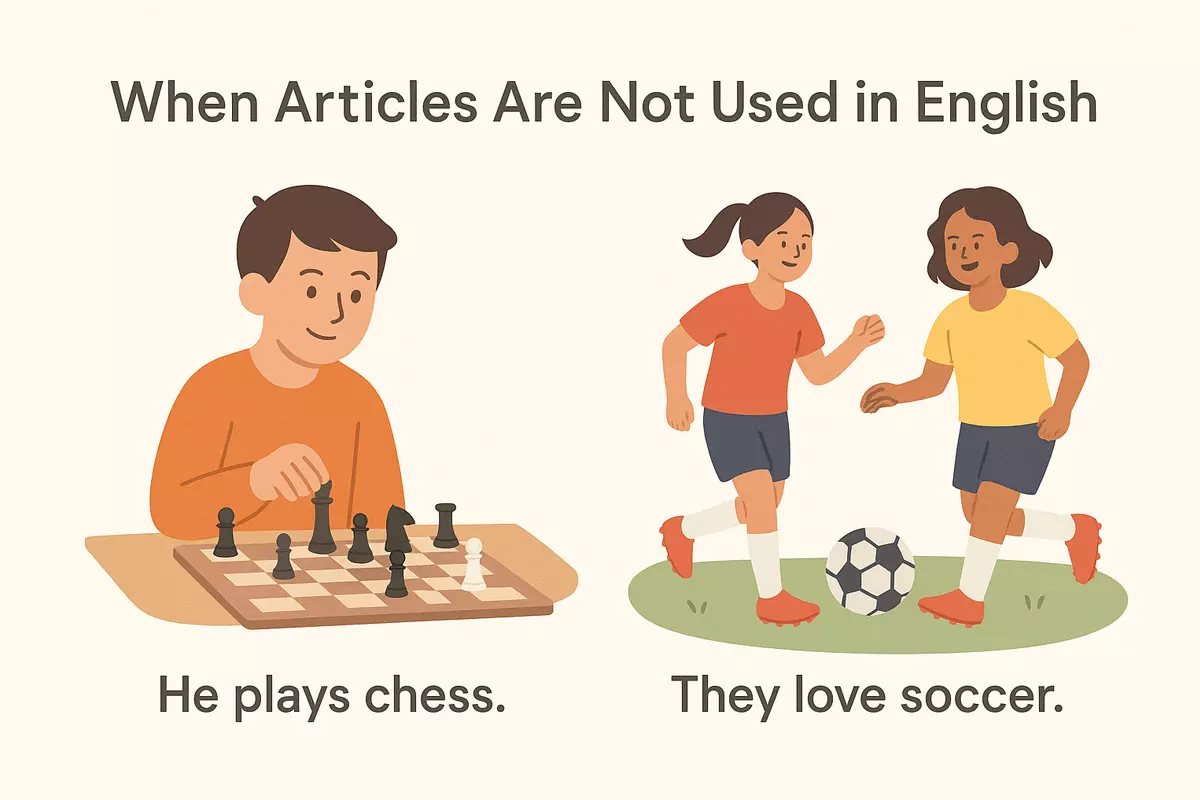
- Before names of sports and games: He plays chess. They love soccer.
- With means of transport (when preceded by "by"): She goes to work by bus.
- In set phrases: Go to bed, at home, in prison, at school, by car
- With festivals and holidays: Christmas, Thanksgiving
- For most countries, cities, and continents: Germany, Paris, Africa
- With materials and abstract nouns: Gold is valuable. Honesty is important.
- When talking about general concepts: Life is unpredictable. Time flies.
- With seasons, when used generally: Spring is beautiful.
Common Mistakes to Avoid
Learners often insert an article when none is needed. For example, saying "the gold" when talking about the metal in general, or "the breakfast" for the daily meal, is incorrect unless you are referring to a specific instance.
Comparison: Zero Article vs. Definite/Indefinite Articles
| Example Context | Article Usage |
|---|---|
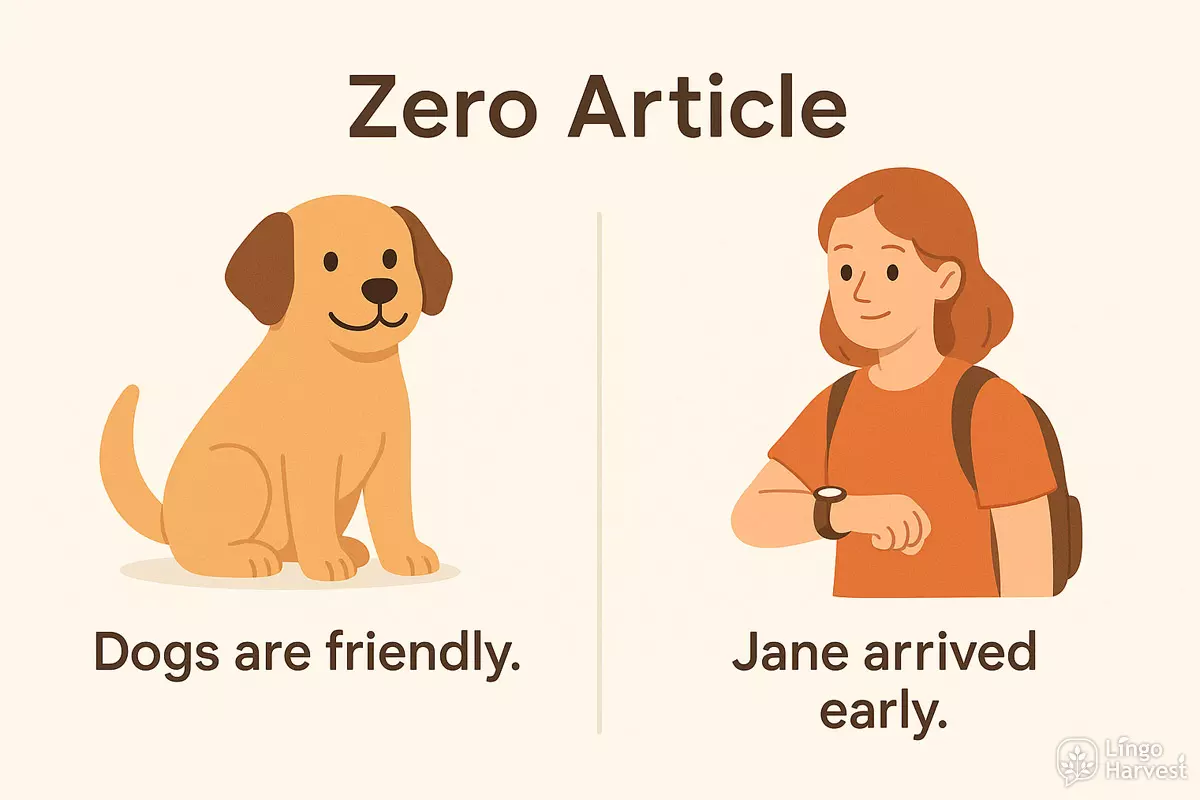
| General idea | No article: "Dogs are friendly." |
| Specific thing | Definite article: "The dogs in the yard are barking." |
| One of many/unspecified | Indefinite article: "A dog barked." |
| Proper noun | No article: "Jane arrived early." |
| Unique, known object | Definite article: "The sun is shining." |
Key Takeaways
Understanding when to leave out articles is crucial for sounding natural in English. Pay attention to whether you are making a general statement, referring to a category, or using a proper noun. Practice listening and reading to become more comfortable with these patterns.
Before Plural and Uncountable Nouns
In English, articles like a and an are not used with nouns that are either plural or uncountable when talking about things in general. This pattern is a common source of confusion for learners, but it’s an essential part of sounding natural. Instead of saying “the apples are healthy” or “an information is useful,” English speakers drop the article entirely in these contexts.
General Statements Without Articles
When making broad, general statements, articles are omitted. Plural nouns and uncountable nouns refer to things as a category or substance rather than to specific items or amounts. For example:
- Cats are independent animals. ✅ (not The cats or A cats)
- People need water to survive. ✅
- Books can be expensive. ✅
- Children like sweets. ✅
- Rice is a staple food in many countries. ✅
- Music helps me relax. ✅
- Information is valuable. ✅
- Cars pollute the air. ✅
- Advice is often free. ✅
- Ideas change the world. ✅
- Love is important. ✅
- News travels fast. ✅
When Articles Are Incorrect
Using a or an with uncountable or plural nouns is a mistake in English. In these cases, the article is simply omitted. For example:
- Incorrect: I have a informations. ❌
- Correct: I have information. ✅
- Incorrect: She likes a apples. ❌
- Correct: She likes apples. ✅
Quick Reference Table: Articles and Noun Types
| Noun Type | Article Use Example |
|---|---|
| Singular, Countable | a book, an apple, the cat |
| Plural, Countable | books, apples, cats (no article for general meaning) |
| Uncountable | water, information, music (no article for general meaning) |
| Specific Reference (any type) | the books, the information, the rice (with the for specificity) |
Summary
Whenever you talk about things in general and the noun is either plural or uncountable, drop the article. This rule helps English sound natural and clear, especially in statements about categories, groups, or substances.
With Abstract Concepts
When discussing ideas or qualities that are not physical objects, English often omits articles. This tendency is especially noticeable with uncountable nouns representing intangible notions, such as "freedom," "happiness," or "information." In these cases, including an article can sound unnatural or even change the meaning.
Common Patterns Without Articles
Abstract nouns are typically used without "a," "an," or "the" when referring to the concept in general, not a specific instance. Consider these patterns:
- She values honesty above all.
- Love can change lives.
- He is searching for meaning in his work.
- Knowledge is power.
- We need patience to succeed.
- Justice must be served.
- They discussed beauty in art.
- Time brings wisdom.
- Peace is the goal.
- She felt relief after the news.
- Truth is important.
- He admires courage.
- Progress requires effort.
- They experienced joy together.
- Hope kept them going.
- She found inspiration in nature.
- Success takes time.
- Fear can be overcome.
- Respect is earned.
- He seeks adventure.
When Articles Are Used with Abstract Nouns
Sometimes, articles do appear with these nouns, but only when referring to a particular example or aspect. For instance:
- He had a hope that things would improve. (one specific hope)
- The knowledge she brought was invaluable. (specific knowledge)
- This is the beauty of the plan. (a particular aspect of beauty)
In these cases, the use of an article narrows the meaning.
Summary Table: Article Use with Abstract Nouns
| Example | Article Usage |
|---|---|
| Freedom is essential. | No article – concept in general |
| The freedom we enjoy is precious. | With "the" – specific instance |
| She showed courage. | No article – general quality |
| A courage like hers is rare. | With "a" – particular example |
| They need information. | No article – general reference |
| The information you gave helped. | With "the" – specific details |
With Meals, Places, and Institutions
In English, certain words related to daily routines and common locations often appear without articles. This typically happens when we refer to these concepts in a general sense, rather than pointing to a specific instance. Understanding when to omit "a," "an," or "the" helps your speech sound more natural and fluent.
Meals
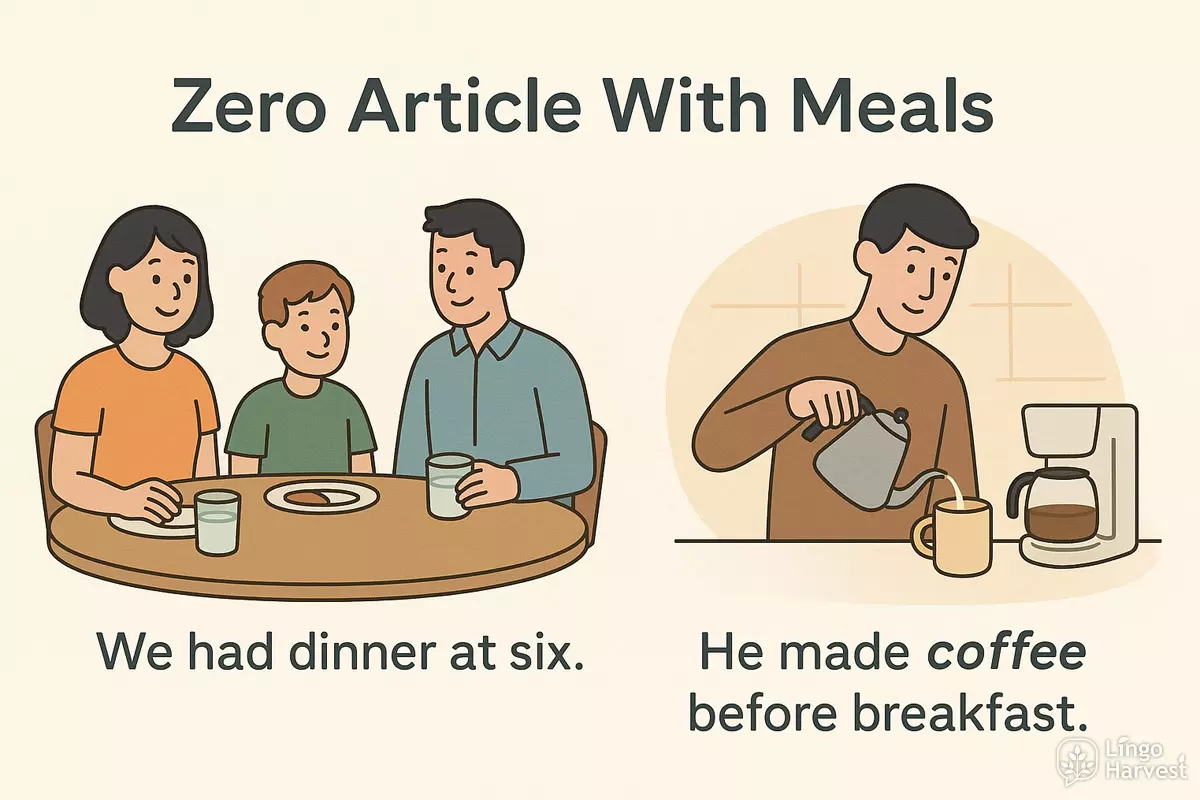
When talking about meals as regular events rather than specific occasions, articles are usually left out. For example, we say "have breakfast" or "eat lunch" instead of "have a breakfast" or "the lunch," unless we mean a particular meal.
- We had dinner at six.
- She never skips breakfast.
- Let's meet after lunch.
- They invited us to supper.
- He made coffee before breakfast.
Public Places and Institutions
Common institutions and locations—such as school, university, church, bed, hospital, prison, and home—generally drop the article when referring to their main purpose or function. If you are talking about visiting the place for its typical use, no article is needed. However, if you mean a specific building or are using it in a different context, articles may be necessary.
| Without Article (General/Usual Purpose) |
With Article (Specific/Unusual Context) |
|---|---|
| go to school | visit the school (as a visitor) |
| in prison | walk past the prison |
| in hospital | paint the hospital (the building) |
| at home | clean the home (a specific house) |
| go to bed | jump on the bed |
| at university | tour the university |
Common Expressions Without Articles
Here are some frequent phrases where articles are omitted due to convention or general meaning:
- start school
- leave home
- go to bed
- be at work
- in class
- go to church
- stay in hospital (BrE)
- be in prison
- return home
- have lunch
- go to sea (as a sailor)
- be in court
- be in town
- go to market (traditional sense)
- be at table (formal)
Remember, omitting articles in these phrases is a feature of natural English usage. Adding an article in these cases can sound unusual or change the meaning, so it's important to notice and practice these patterns.
Common Exceptions
While English articles ("a," "an," and "the") are used in many cases, there are numerous situations where they are deliberately omitted. Recognizing these patterns can help learners avoid common mistakes and sound more natural. Below are some of the most frequent scenarios where articles are not used.
General Rules for Article Omission
- Plural and uncountable nouns in a general sense: "Dogs are friendly." / "Information is power."
- Meals: "We have breakfast at 8." (not "a breakfast" or "the breakfast")
- Languages and subjects: "She studies French and biology."
- Sports and games: "He plays tennis and chess."
- Most countries, cities, and continents: "They visited Italy and Europe."
- Names of people: "Maria is coming."
- Days, months, and holidays: "Monday is busy." / "Christmas is special."
- Abstract concepts (in general): "Freedom is important."
- Transport with 'by': "She goes to work by bus."
- Most proper nouns: "Mount Everest is high."
- Institutional use (when referring to the function): "He is in prison." (as a prisoner, not visiting)
- Home, work, bed (for their primary purpose): "She is at home." / "He is in bed."
- Titles and ranks (when used with names): "President Lincoln" / "Doctor Smith"
- Some fixed expressions: "Go to school," "go to church," "at sea," "in hospital" (BrE)
Special Cases: Article Omission in Set Phrases
Certain phrases in English almost never use articles, even though they might seem necessary. Here are some notable patterns:
- At night
- On foot
- By chance
- From start to finish
- In fact
- After work
- At sunset
- From morning till evening
- Without doubt
- In demand
- By mistake
- At first sight
Comparison Table: Article Use vs. Omission
| With Article | Without Article |
|---|---|
| The dog in the yard is barking. (Specific dog) |
Dogs are loyal animals. (All dogs, general statement) |
| She had a lunch with a friend. (Specific occasion) |
She has lunch at noon. (Routine, general) |
| The English spoken here is formal. | She speaks English. (Language in general) |
| I took the bus. (A specific bus) |
I go by bus. (Mode of transport) |
Understanding these variations helps avoid overusing articles and makes your English more idiomatic. Many learners find that memorizing common expressions and set phrases is the most effective way to internalize when articles are not needed.
Practice: Remove Unnecessary Articles
English sometimes omits articles, especially in certain grammatical situations. Reviewing and editing sentences to remove extra "a," "an," or "the" helps you write more naturally. Let’s work through some practical examples to build your confidence in identifying where articles are not required.
Common Contexts Where Articles Are Unnecessary
- Before most proper nouns (e.g., Mount Everest, Harvard University)
- With uncountable nouns when speaking generally (Information is important)
- In plural nouns used in a general sense (Dogs are friendly)
- After possessive adjectives (her house, my idea)
- With names of meals (We had breakfast)
- Before languages and subjects (He studies physics)
- In certain institutional phrases (go to bed, in hospital in British English)
- Before seasons when speaking generally (Spring is beautiful)
- With most names of countries, cities, and continents (Italy, Asia)
- In titles or labels (President Lincoln, Professor Smith)
- Before some forms of transport (by car, by train)
- With days and months (on Monday, in July)
Task: Edit the Sentences
Below are sentences where articles may be unnecessary. Rewrite each sentence, removing any extra articles.
- She goes to the school by the bus every morning.
- The Mount Everest is highest mountain in the world.
- I have the information you need.
- He likes the mathematics and the biology.
- They visited the Paris last year.
- We had the lunch at noon.
- He is the President of the United States.
- My mother is in the hospital.
- The Water covers most of the Earth’s surface.
- She studies the English at the university.
Show answers
- She goes to school by bus every morning.
- Mount Everest is highest mountain in the world.
- I have information you need.
- He likes mathematics and biology.
- They visited Paris last year.
- We had lunch at noon.
- He is President of the United States.
- My mother is in hospital. (British English; in American English: in the hospital)
- Water covers most of Earth’s surface.
- She studies English at university.
Quick Reference: When to Omit Articles
| Situation | Example (Correct Usage) |
|---|---|
| Proper nouns | I live in Canada. |
| Uncountable nouns (general) | Milk is good for you. |
| Plural nouns (general) | Cats are independent. |
| Meals | We have dinner at seven. |
| Languages/subjects | She speaks Spanish. |
| Institutional phrases | He goes to school. |
| Transport (by + vehicle) | She travels by train. |
| Days/months/seasons (general) | Summer is hot. |
| Titles (without name) | Professor Smith will join us. |
Review these patterns and practice editing your own writing. Over time, omitting unnecessary articles will become automatic.