Using When in Time Clauses and Sentences

 The article explains how time clauses work, compares the use of when, while, and as, and outlines tense agreement in time clauses. It also gives daily English examples and includes practice writing sentences with when.
Mastering how to express actions that happen at specific moments is essential for clear communication in English because it allows speakers to convey their intended meaning precisely. By learning how to structure phrases that refer to particular points in time, such as using the correct verb tenses and time expressions, individuals can make their statements more accurate and understandable. This skill not only improves clarity in both spoken and written English but also helps avoid confusion, making interactions more effective and meaningful.
How Time Clauses Work
Time clauses help us describe when something happens in relation to another activity or event. They often begin with words like when, before, after, while, and as soon as. These clauses do not stand alone; they are attached to a main sentence to show the timing between two actions.
Structure and Usage
A typical time clause contains a subject and a verb, introduced by a time word. The order of the main and time clause can be switched without changing the meaning, but punctuation may differ. If the time clause comes first, use a comma before the main clause.
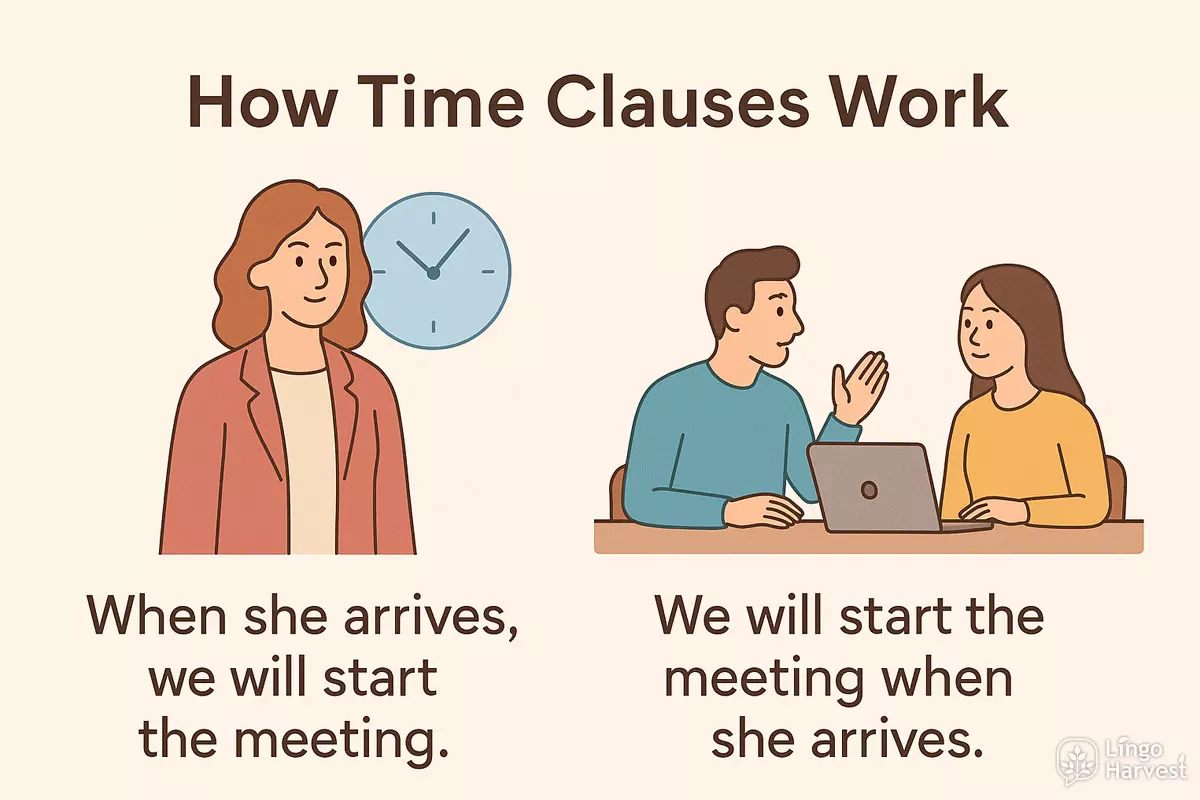
- When she arrives, we will start the meeting. ✅
- We will start the meeting when she arrives. ✅
Verb Tense Patterns
One important rule is that future tenses are not usually used in the time clause, even if the action happens in the future. Instead, we use the present simple or present perfect in the time clause, and future forms in the main clause.
| Time Word | Time Clause Example | Main Clause Example |
|---|---|---|
| when | When he finishes work | he will call you |
| before | Before you leave | lock the door |
| after | After they eat dinner | they watch TV |
| as soon as | As soon as I get home | I’ll text you |
| while | While she is studying | please be quiet |
Common Patterns and Tips
- Don’t use will or going to in the time clause (e.g., When I arrive, not will arrive).
- Both clauses must have a subject and verb.
- Time clauses can describe past, present, or future relationships.
- Start with the time word or the main idea—both orders are correct.
- Use a comma if the sentence begins with the time clause.
- Choose the correct tense for each clause based on the relationship of events.
- Time clauses often answer the question “When?” about the main action.
- They add clarity and detail about sequence or overlap of events.
- Some time words (like until, since) can also introduce time clauses.
- Practice helps with mastering the correct tense and word order.
Understanding how to use these clauses makes your sentences clearer and more precise, allowing you to show when events happen in relation to each other.
When vs While vs As
Understanding the differences among "when," "while," and "as" helps you express the timing and relationship of actions more precisely. These three connectors are often used in time clauses, but each has its own typical uses and nuances.
General Usage
- When is commonly used for actions that happen at a specific moment, or for one event following another.
- While generally indicates that two actions are happening at the same time, often over a period.
- As can be similar to "while" but sometimes suggests that two actions change or develop together, or that one action happens during another.
Examples in Context
- When I arrived, the meeting started. → My arrival and the meeting's start were closely connected in time.
- While I was cooking, she was setting the table. → Both actions happened simultaneously over a period.
- As the sun set, the sky turned orange. → The two events happened together, with one occurring during the other.
Comparison Table
| Connector | Typical Use | Example | Notes |
|---|---|---|---|
| When | Specific moments or single events | Call me when you arrive. | Often used for sequences |
| While | Parallel actions in progress | While I studied, he watched TV. | Stresses duration |
| As | Actions developing together | As she spoke, he listened. | Focus on change or process |
Quick Reference: Choosing the Right Connector
- Use when for one-time events or sequences: When I was young, I played outside.
- Use while for two continuous actions: While she was reading, I was writing.
- Use as for simultaneous changes or background actions: As it rained, the streets became wet.
Choosing between these connectors depends on whether you want to highlight a point in time, ongoing parallel activities, or actions unfolding together. Practicing with real-life examples will help you notice their subtle differences and use them confidently in your own sentences.
Tense Agreement in Time Clauses
Understanding how verb forms work together in time clauses is essential for clear, natural English. When using "when" to introduce a time clause, the verb tenses in both the main and subordinate clauses must match logically. The choice of tense depends on the relationship between the two actions—whether they occur at the same time, one after the other, or in different periods.
Present, Past, and Future Connections
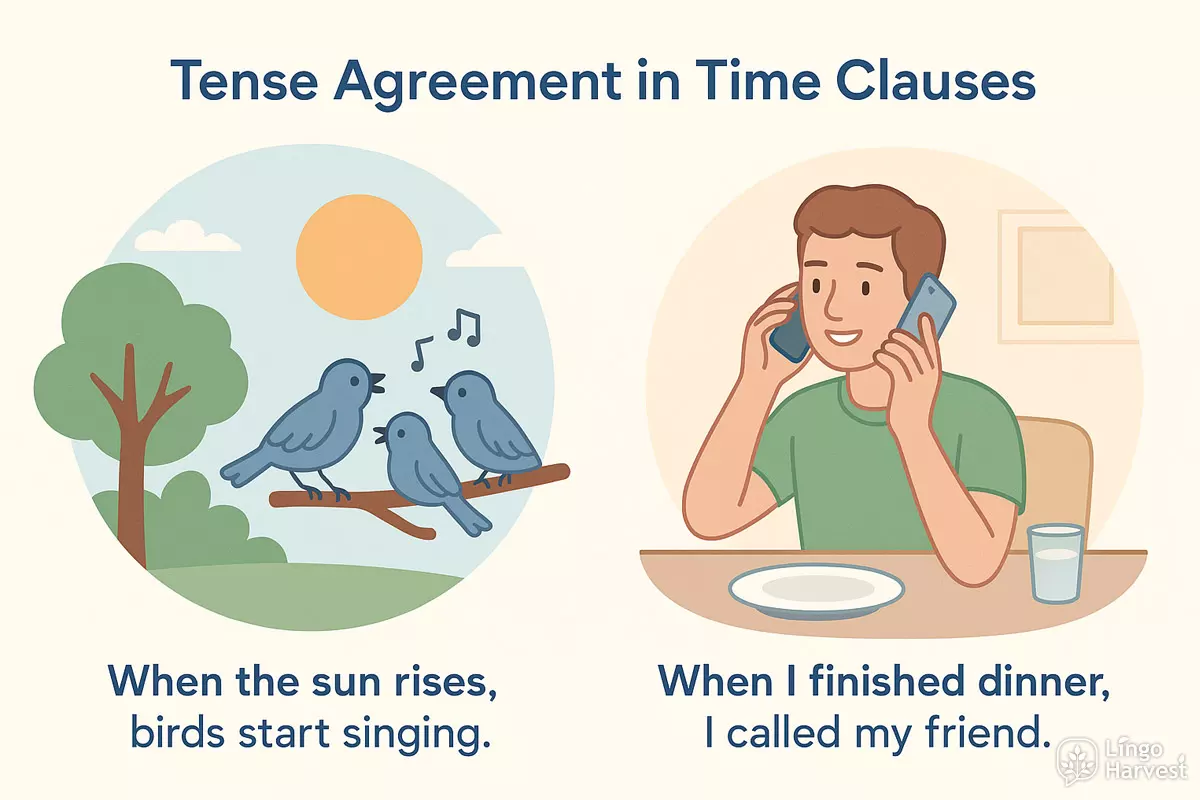
The tense in the time clause often reflects the timing of the action relative to the main clause. Here are some general patterns:
- Present Simple + Present Simple: Used for routines or facts.
Example: When the sun rises, birds start singing. - Past Simple + Past Simple: Both actions happened in the past.
Example: When I finished dinner, I called my friend. - Future (will) + Present Simple: The future action is in the main clause, and the time clause uses present simple.
Example: I will text you when I arrive.
Common Patterns with "When"
It's helpful to recognize the most frequent pairings of tense in sentences using "when." These pairings clarify the sequence or connection of actions.
| Main Clause Tense | Time Clause with "When" |
|---|---|
| Present Simple | Present Simple (general truth) ✅ When water boils, it evaporates. |
| Past Simple | Past Simple (completed past events) ✅ I smiled when I saw her. |
| Future Simple (will) | Present Simple (future event after 'when') ✅ She will call when she arrives. |
| Imperative | Present Simple (instructions) ✅ Call me when you get home. |
| Present Continuous | Present Simple (ongoing action + trigger) ✅ I am cooking when you call. |
| Past Continuous | Past Simple (interrupted action) ✅ I was reading when the phone rang. |
| Present Perfect | Present Simple (action up to now) ✅ I have finished when you return. |
| Past Perfect | Past Simple (sequence in the past) ✅ I had left when she arrived. |
Key Points to Remember
- Don’t use "will" or "would" in the time clause after "when"—use present or past forms instead.
- Match the verb forms to show the correct sequence and timing of events.
- For habitual actions or general truths, both clauses often use the present simple.
- To express instructions, start with an imperative and follow with a present simple time clause.
- For past events, the past simple is used in both clauses, or combine with past perfect for clear sequence.
Examples for Practice
Here are more sample sentences illustrating various tense pairings with "when":
- We eat dinner when Dad gets home. (routine)
- She was sleeping when the alarm went off. (interrupted action)
- I’ll help you when I finish my work. (future + present)
- He had already left when they arrived. (past perfect + past simple)
- When you press this button, the machine starts. (instruction)
- They called when they reached the station. (past events)
- When the movie ends, we’ll go for ice cream. (future plan)
- When I am older, I want to travel the world. (future intention)
- When it rains, the streets get slippery. (general truth)
- Call me when you’re ready. (imperative + present)
- When the bell rings, students leave the classroom. (habitual)
- She cried when she heard the news. (past simple)
- I’m going to bed when this show is over. (present + future sense)
By paying attention to how verb tenses interact in time clauses, you can create sentences that are accurate and easy to understand. This consistency makes your English sound more natural and clear.
Examples in Daily English
Understanding how "when" works in time clauses is essential for everyday conversations, emails, and storytelling. It’s common to use "when" to connect actions or describe sequences of events in the past, present, or future. Let’s look at some typical ways this word appears in practical situations.
Common Patterns with "When"
- When I wake up, I drink coffee.
- Call me when you arrive.
- She was reading when the phone rang.
- We’ll start dinner when Dad gets home.
- When it rains, the streets get slippery.
- I’ll help you when I finish my work.
- He always smiles when he sees his dog.
- When you’re ready, let me know.
- The lights went out when the storm began.
- Don’t interrupt when someone is speaking.
- When I was a child, I loved cartoons.
- They left when the movie ended.
- When you press this button, the machine starts.
- She called me when she needed advice.
- What do you do when you feel tired?
- When the bell rings, class is over.
- We met when we were in college.
- You can go out when you finish your homework.
Comparing "When" in Different Tenses
The word "when" can link actions in various tenses, often changing the meaning slightly. Here are some structured examples:
| Sentence with "When" | Explanation |
|---|---|
| When I finish, I’ll call you. | Future event after another future action |
| When he was young, he played soccer. | Describing a past habit or state |
| I was watching TV when she arrived. | Ongoing past action interrupted by another |
| Call me when you’re free. | Request for action at a future time |
| When it rains, I take the bus. | General truth or repeated situation |
Spoken English Tips
In casual speech, "when" is often used to make instructions, share routines, or recall memories. Notice how the verb tense after "when" changes with context. Practice using these structures to sound more natural and clear in conversation.
Practice: Write Sentences with When
Understanding how to use "when" in time clauses can help make your sentences clearer and more natural. Here are some practical exercises and example sentences to help you practice. Try to focus on the structure: notice where "when" appears in the sentence and which verb tenses are used.
Example Sentences Using "When"
- When I wake up, I drink a glass of water.
- I always listen to music when I study.
- She called me when she arrived at the airport.
- When it rains, the streets get slippery.
- We will start dinner when everyone arrives.
- He smiles when he sees his friends.
- When you finish your homework, you can play outside.
- My dog barks when someone knocks on the door.
- When I was a child, I loved to draw.
- The lights turn off automatically when you leave the room.
- When the movie ends, let's go for ice cream.
- I met her when I was traveling in Spain.
- When the phone rings, please answer it.
- We will celebrate when the project is complete.
- She laughs when she reads funny stories.
Practice Tasks
Complete the following sentences using your own ideas. Think about the best verb tense and context for each situation.
- When I feel tired, ______________________________.
- ______________________________ when it gets dark.
- My family always ______________________ when we visit my grandparents.
- When the bell rings, ______________________________.
- ______________________________ when I hear my favorite song.
Show answers
- When I feel tired, I take a short nap.
- I go home when it gets dark.
- My family always has dinner together when we visit my grandparents.
- When the bell rings, the students leave the classroom.
- I start dancing when I hear my favorite song.
Identifying Time Clauses with "When"
Look at the sentences below. Decide which part is the main clause and which part is the time clause introduced by "when".
- When you call me, I feel happy.
- I will text you when I arrive.
- When the weather is nice, we go for a walk.
- She studies when she has free time.
Show answers
- Time clause: When you call me Main clause: I feel happy.
- Main clause: I will text you Time clause: when I arrive.
- Time clause: When the weather is nice Main clause: we go for a walk.
- Main clause: She studies Time clause: when she has free time.
Common Patterns with "When"
Below are typical patterns for using "when" in sentences. Notice how the verb tenses can change based on the meaning.
| Pattern | Example |
|---|---|
| Present Simple + when + Present Simple | I drink coffee when I wake up. |
| Past Simple + when + Past Simple | She smiled when she saw her friend. |
| Future Simple + when + Present Simple | We will leave when the movie ends. |
| Imperative + when + Present Simple | Call me when you arrive. |
| When + Past Simple, Past Simple | When I finished my work, I went home. |
Practicing these patterns will help you use "when" naturally in both speaking and writing. Try creating your own sentences using each structure above.