Much vs Many: Beginner Grammar Guide

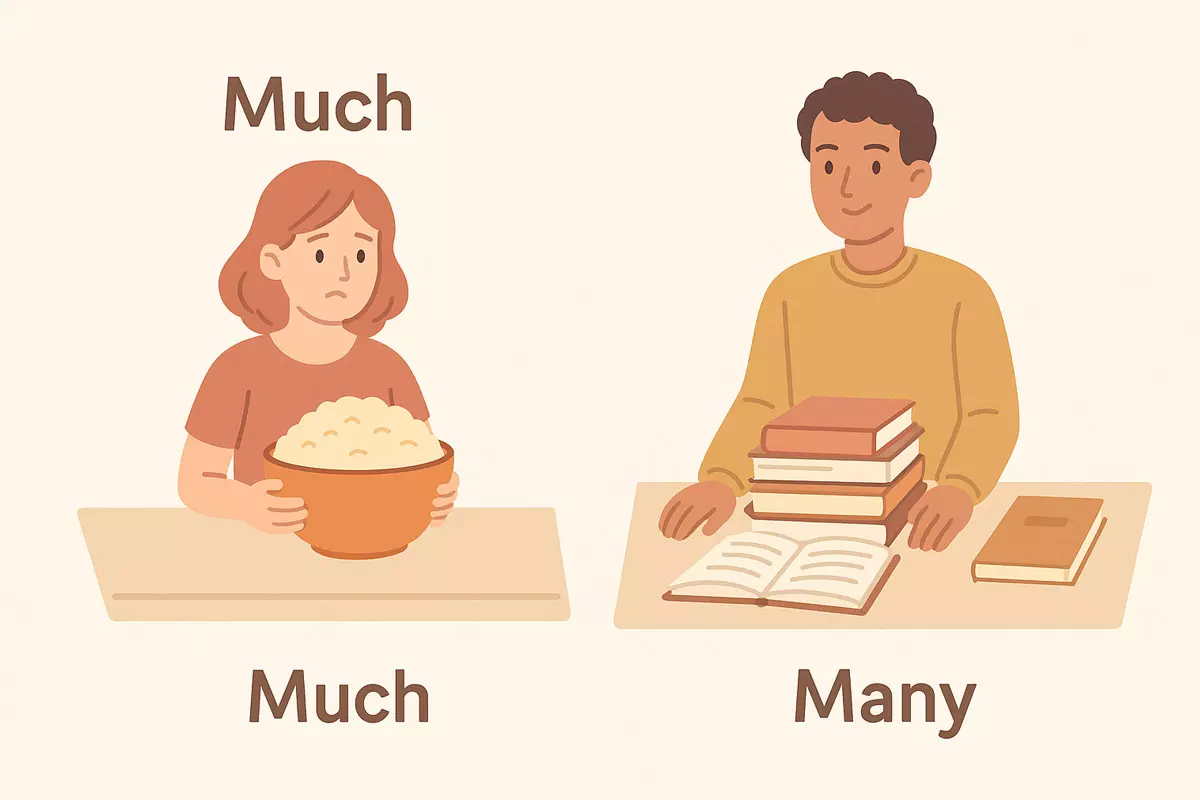 This article explains when to use much, many, and their alternatives with countable and uncountable nouns. It covers simple rules, common mistakes, and includes a practice section to help you choose the correct quantifier.
Understanding when to use the correct word to describe quantity can be challenging for English learners, but mastering this distinction is important for clear communication. Countable nouns refer to items you can count individually, such as apples or books, and use words like many or few. Uncountable nouns, such as water or information, represent things you cannot count separately and are paired with words like much or little. By learning which terms to use with each type of noun, you can make your English more precise and natural.
Countable vs Uncountable Reminder
To understand when to use much and many, it’s important to know the difference between nouns you can count and those you can’t. Countable nouns are things you can separate into individual units—like apples or chairs. Uncountable nouns refer to substances or concepts that can’t be divided in this way, such as water or information.
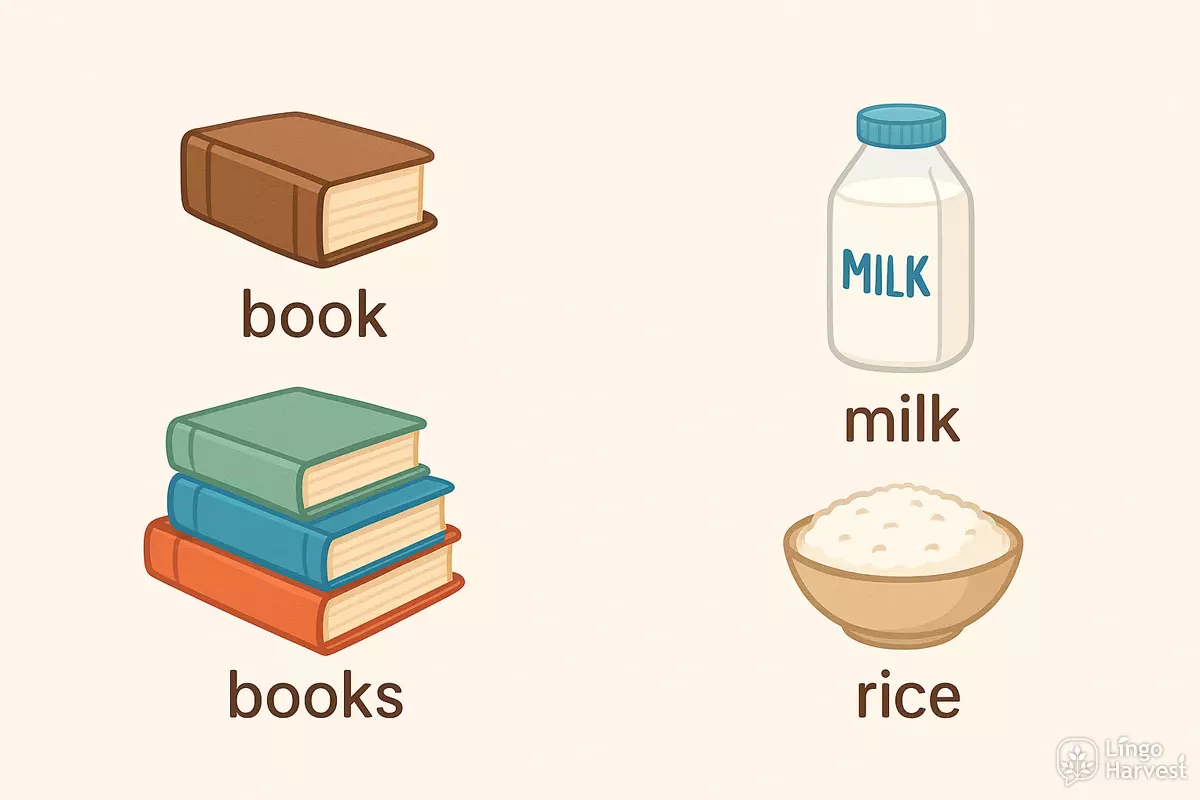
What Are Countable Nouns?
Countable nouns are items you can number. You can use them in both singular and plural forms, and they often answer the question “How many?” Some common examples include:
- book, books
- dog, dogs
- car, cars
- idea, ideas
- student, students
- egg, eggs
- pen, pens
- friend, friends
- country, countries
- apple, apples
What Are Uncountable Nouns?
Uncountable nouns, sometimes called mass nouns, describe things you can't count individually. They don’t have a plural form and usually answer “How much?” Here are some typical examples:
- milk
- rice
- music
- advice
- furniture
- bread
- water
- money
- information
- sand
- time
- equipment
Quick Comparison
| Countable Nouns | Uncountable Nouns |
|---|---|
| Can be counted: 1 apple, 2 apples | Cannot be counted: some rice, much rice |
| Have singular and plural forms | Only singular form |
| Use “many” and numbers | Use “much,” not numbers |
| Examples: books, cars, eggs | Examples: water, bread, advice |
Remember, “many” goes with nouns you can count, while “much” is for things you can’t. This distinction is key for making your sentences clear and correct in English.
When to Use Many
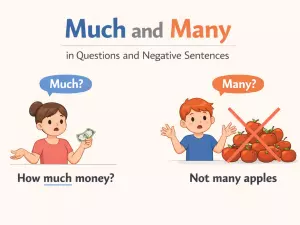
Use many to talk about a large number of countable things. Countable nouns are items you can count individually, such as books, apples, or cars. This word is common in questions and negative sentences, but it can also appear in positive statements, especially in more formal writing or speech.
Countable Nouns and "Many"
You need to use many with nouns that have plural forms. For example, you can say "many dogs," "many ideas," or "many opportunities." If you can add "s" or "es" to the noun, it's usually countable and suitable for this word.
- There aren’t many buses after midnight.
- Do you have many friends in this city?
- She has visited many countries.
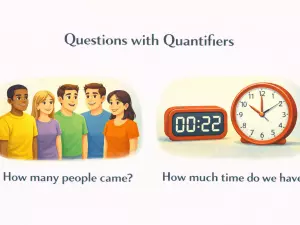
- How many pencils do you need?
- We saw many birds in the park.
- Are there many mistakes in my essay?
- He doesn’t eat many sweets.
- They don’t have many options.
- Have you read many books this year?
- There aren’t many shops open on Sunday.
- How many chairs should we bring?
- I don’t know many people here.
- We haven’t had many sunny days this month.
- Are there many children in the playground?
- She doesn’t make many mistakes.
- Do many students live on campus?
- We don’t need many eggs for the recipe.
- How many emails did you get?
- There aren’t many cars in the parking lot.
- He hasn’t tried many sports.
Common Sentence Patterns
Some typical ways to use this word include:
- How many + plural noun + verb? (e.g., How many apples are there?)
- There aren’t/aren’t many + plural noun (e.g., There aren’t many students today.)
- Do/does + subject + have many + plural noun? (e.g., Do you have many hobbies?)
Quick Reference: "Many" or "Much"?
| Use with | Examples |
|---|---|
| Countable nouns (plural) | books, chairs, apples, cars, ideas |
| Uncountable nouns (singular) | (Use much instead: water, sugar, information) |
To sum up, choose many when the noun is something you can count, and be sure the noun is in its plural form. This helps your English sound clear and natural.
When to Use Much
Use much with uncountable nouns to talk about large quantities, especially in questions and negative sentences. Uncountable nouns are things you cannot count individually, like water, money, or information. You won’t use much with things you can count one by one (like books or apples); it fits with nouns that are seen as a whole or mass.
Typical Contexts for "Much"
- Negative sentences: I don’t have much time.
- Questions: How much sugar do you want?
- Formal or academic writing: There isn’t much evidence.
- Expressions of quantity: Much of the information is outdated.
Common Uncountable Nouns with "Much"
- water
- money
- advice
- rice
- time
- homework
- news
- furniture
- equipment
- traffic
- bread
- music
- salt
- luggage
- information
- work
- progress
- air
- oil
- luck
Patterns and Examples
"Much" is rarely used in positive sentences in everyday conversation. Instead, people often use "a lot of" or "lots of" for positive statements. However, "much" is standard in negatives and questions.
- ❌ She has much money. (awkward in conversation)
- ✅ She doesn’t have much money.
- ✅ Is there much traffic today?
- ✅ How much milk do we need?
Quick Comparison: Much vs. Many
| Word | Type of Noun | Example |
|---|---|---|
| Much | Uncountable | How much water? |
| Many | Countable | How many apples? |
Remember: choose much for things you can’t count individually, especially in questions and negatives. For everyday use, swap in "a lot of" in positive sentences if you want a more natural tone.
A Lot Of and Lots Of Alternatives
When you want to talk about a large quantity in English, "a lot of" and "lots of" are very common and informal choices. However, there are many other ways to express this idea, especially if you want to be more precise, formal, or simply vary your language. Choosing the right phrase often depends on whether you are talking about countable or uncountable nouns, your tone, and the context.
Other Ways to Say "A Lot Of" or "Lots Of"
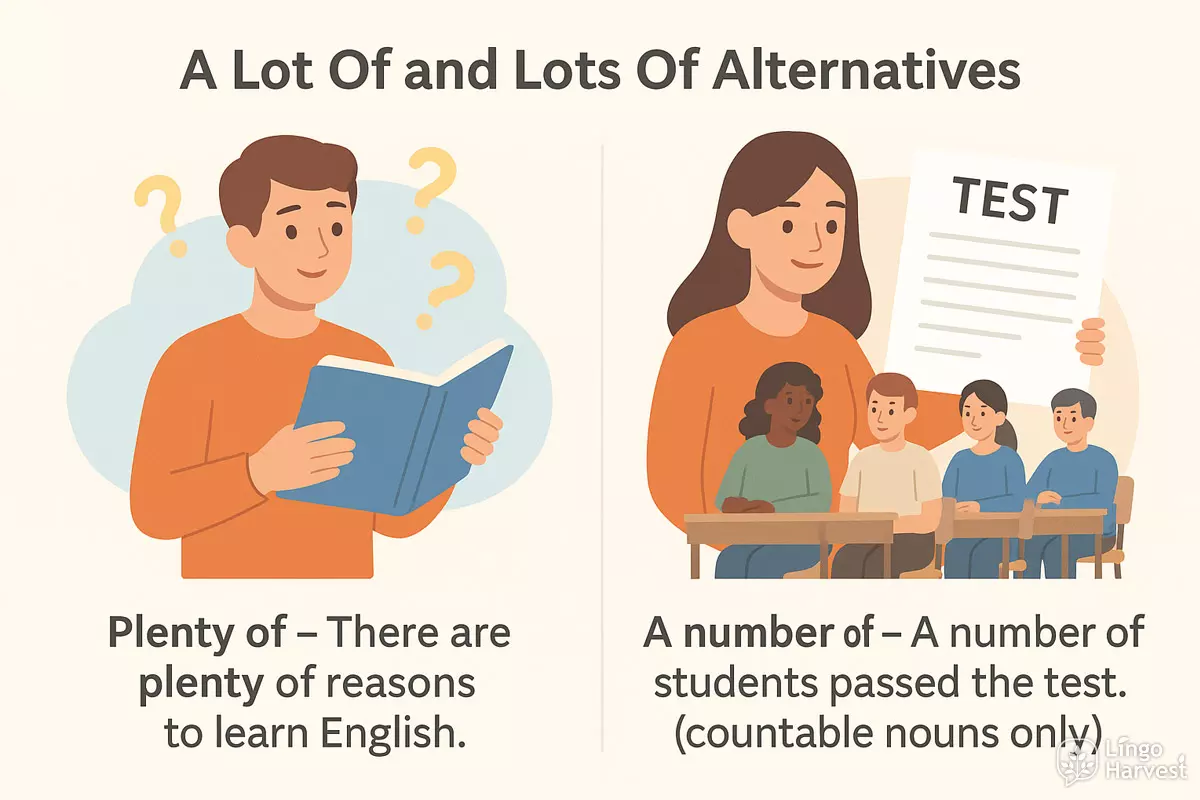
- Plenty of – There are plenty of reasons to learn English.
- A great deal of – She has a great deal of patience. (mainly for uncountable nouns)
- A number of – A number of students passed the test. (countable nouns only)
- A large amount of – We need a large amount of water. (uncountable nouns only)
- A large number of – There are a large number of books here. (countable nouns only)
- Numerous – Numerous people attended the meeting.
- Many – Many ideas were discussed.
- Much – Much information is available online.
- Heaps of – He has heaps of energy. (informal, mostly British/Australian English)
- Tons of – We ate tons of pizza. (very informal, spoken English)
- Loads of – She has loads of friends. (informal, British English)
- Scores of – Scores of fans cheered for the team. (literary/formal)
- Hundreds of – Hundreds of people lined up.
- Thousands of – Thousands of stars lit up the sky.
- Countless – There are countless opportunities out there.
- Dozens of – Dozens of emails flooded in.
- A wealth of – The museum offers a wealth of information.
- A variety of – The store sells a variety of products.
- Masses of – Masses of people gathered in the square. (informal)
- Copious – She took copious notes during the lecture. (formal)
Choosing the Right Alternative
Consider whether the noun is countable or uncountable. For example, use "a large number of" with countable nouns (like "students") and "a large amount of" with uncountable nouns (like "water"). Some alternatives, like "heaps of" and "loads of," are quite informal and common in spoken English, while "copious" and "scores of" are more formal or literary.
Quick Comparison Table
| Alternative | Typical Use & Style |
|---|---|
| Plenty of | Both countable/uncountable; neutral/informal |
| A large amount of | Uncountable nouns; formal |
| A large number of | Countable nouns; formal |
| Heaps of | Both types; informal, spoken |
| Numerous | Countable nouns; formal/written |
| Tons of | Both types; very informal, spoken |
| Countless | Usually countable; formal |
| A great deal of | Uncountable nouns; formal |
| Loads of | Both types; informal, British |
| Scores of | Countable nouns; literary/formal |
Using a range of these expressions can make your English sound more natural and precise. Adjust your choice based on the context, level of formality, and whether the noun is countable or not. This will help you communicate quantities more clearly and flexibly.
Common Mistakes
When learning to use “much” and “many,” it’s easy to mix them up, especially if your first language doesn’t make the same distinction. One frequent issue is using the wrong word with countable or uncountable nouns. Remember, “many” pairs with things you can count, while “much” goes with things you cannot count individually.
Mixing Up Countable and Uncountable Nouns
Choosing the incorrect quantifier can make sentences sound awkward or incorrect. For example, saying “much apples” instead of “many apples” is a common slip.
- Incorrect: She doesn’t have much friends. ❌
- Correct: She doesn’t have many friends. ✅
- Incorrect: How many money do you need? ❌
- Correct: How much money do you need? ✅
Overusing in Positive Sentences
Another pitfall is using “much” and “many” too often in positive statements. In everyday English, speakers prefer “a lot of” or “lots of” in affirmative sentences.
- Unnatural: I have much homework. ❌
- Better: I have a lot of homework. ✅
- Unnatural: There are many people at the park. (Correct, but “a lot of” is more natural in speech.)
Confusing Question and Negative Forms
“Much” and “many” are most commonly used in questions and negatives. Learners sometimes forget this and use them oddly in statements.
- Incorrect: I have much books. ❌
- Correct: I don’t have many books. ✅
- Correct (Question): Do you have much time?
Quick Reference: Typical Problems
| Incorrect Usage | Corrected Version |
|---|---|
| How many milk do you want? | How much milk do you want? |
| She didn’t eat much apples. | She didn’t eat many apples. |
| Much people came to the meeting. | Many people came to the meeting. |
| There isn’t many water left. | There isn’t much water left. |
| We have many information. | We have much information. |
| He doesn’t have much friends. | He doesn’t have many friends. |
Summary of Typical Errors
To avoid these issues, always check if the noun can be counted or not. Listen for how native speakers use these words—especially in questions and negatives. With practice, choosing between them will become more natural.
Practice: Fill in the Correct Quantifier
Understanding when to use "much" or "many" is essential for clear communication in English. Try these exercises to check your grasp of these quantifiers. Read each sentence and decide which word fits best: "much" (for uncountable nouns) or "many" (for countable nouns). If you’re unsure, think about whether you can count the item or not.
Choose the Right Word
- How ______ apples do you eat every week?
- There isn’t ______ milk left in the fridge.
- She doesn’t have ______ friends in this city.
- Is there ______ sugar in your tea?
- We saw ______ birds in the park yesterday.
- He doesn’t spend ______ money on clothes.
- Do you have ______ homework tonight?
- There weren’t ______ chairs in the room.
- I don’t have ______ time to finish this today.
- Are there ______ cars in the parking lot?
Show answers
- many
- much
- many
- much
- many
- much
- much
- many
- much
- many
Quick Reference: When to Use "Much" vs "Many"
If you need a summary, look at the table below for a clear comparison of these two quantifiers and their typical uses:
| Quantifier | Used With | Example | Typical Questions/Negatives? |
|---|---|---|---|
| Much | Uncountable nouns | much water, much time | Yes: "How much?" "Not much." |
| Many | Countable nouns | many books, many people | Yes: "How many?" "Not many." |
Fill in the Blanks (Short List)
- There aren’t ______ eggs in the basket.
- I don’t have ______ patience today.
- Did you take ______ photos on your trip?
- We don’t need ______ salt for this recipe.
Show answers
- many
- much
- many
- much
Practicing with sentences like these helps build confidence in using "much" and "many" correctly. Keep an eye on whether the noun can be counted or not and you’ll soon find these words easy to use.