A Few vs A Little: Simple Visual Tip

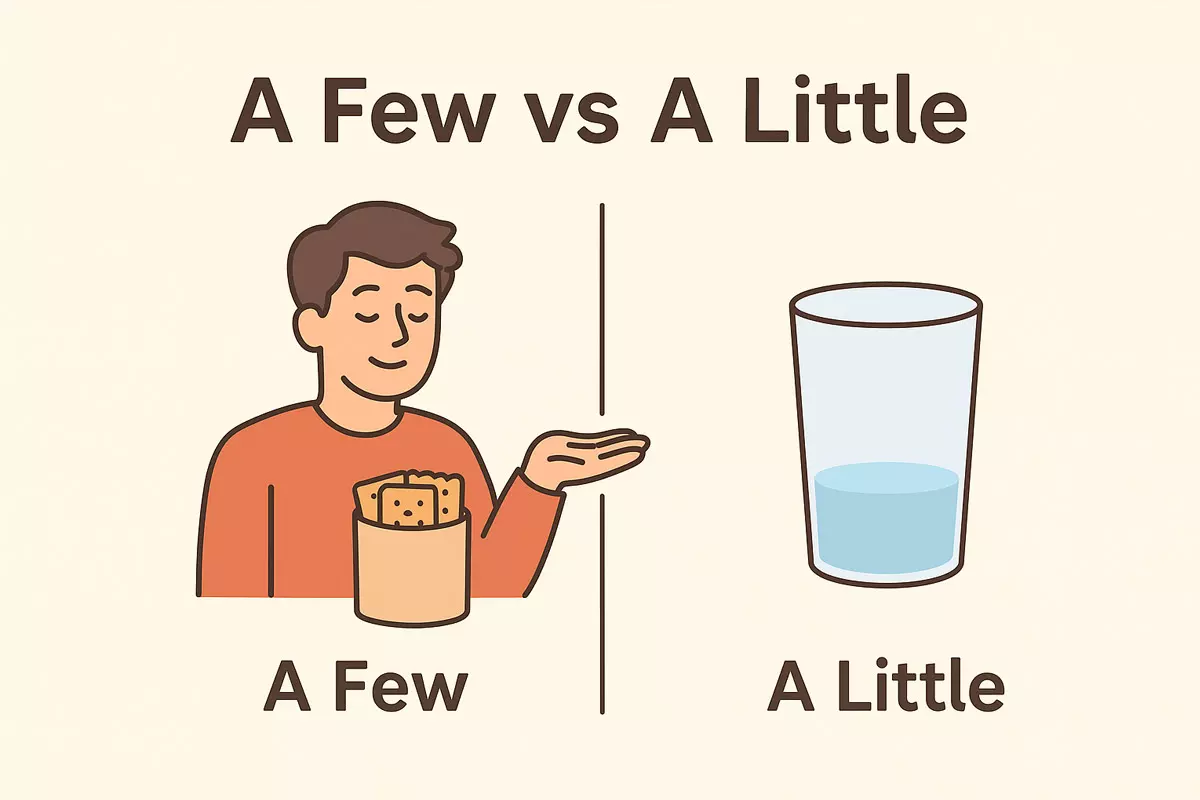 The article reviews countable and uncountable nouns, clarifies the difference between few and little, discusses positive and negative feelings, compares a few vs few and a little vs little, points out common mistakes, and provides practice exercises.
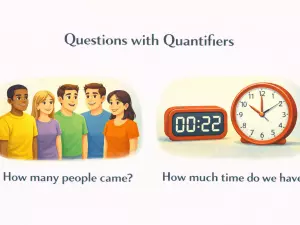
Knowing when to use "a small number" versus "a small amount" in English can improve the clarity of your communication. Use "a small number" with countable nouns, like "a small number of books," because books can be counted individually. In contrast, "a small amount" is for uncountable nouns, such as "a small amount of water," since water cannot be counted in separate units. A helpful trick is to ask yourself if you can count the items; if yes, use "number," if not, use "amount."
Countable vs Uncountable Review
Understanding the difference between countable and uncountable nouns is essential for using phrases like "a few" and "a little" correctly. In English, nouns are grouped based on whether you can count them individually or not. This influences which quantifiers you should use.
What Are Countable Nouns?
Countable nouns are items you can separate and count as individual units. For example, you can say "one apple," "two apples," or "three apples." These nouns have both singular and plural forms.
- book/books
- car/cars
- dog/dogs
- idea/ideas
- friend/friends
- pen/pens
- chair/chairs
- cup/cups
- coin/coins
- student/students
What Are Uncountable Nouns?
Uncountable nouns, on the other hand, refer to things you cannot count as separate units. They often describe substances, concepts, or collective categories. These nouns do not have a plural form and are not used with numbers directly.
- water
- rice
- advice
- information
- furniture
- money
- bread
- music
- sand
- news
Key Differences at a Glance
| Countable Nouns | Uncountable Nouns |
|---|---|
| Can use numbers (one, two, three...) | Cannot use numbers directly |
| Have singular and plural forms | Usually only one form |
| Use "a few," "many," "several" | Use "a little," "much," "some" |
| Examples: chairs, apples, ideas | Examples: milk, advice, sugar |
Test Your Understanding
Decide if these nouns are countable or uncountable:
- Chocolate
- Egg
- Time
- Bag
- Homework
- Chair
- Salt
- Letter (as in mail)
- Cheese
- Apple
Show answers
- Chocolate – Uncountable (unless talking about individual chocolates)
- Egg – Countable
- Time – Uncountable
- Bag – Countable
- Homework – Uncountable
- Chair – Countable
- Salt – Uncountable
- Letter – Countable
- Cheese – Uncountable (unless talking about types or pieces)
- Apple – Countable
Choosing the correct quantifier depends on whether a noun is countable or uncountable. Practice helps you get used to these patterns so you can use "a few" and "a little" naturally in conversation.
Meaning Difference Between Few and Little
Understanding when to use “few” versus “little” comes down to the type of noun you are describing. “Few” is used with countable nouns—those you can count individually—while “little” applies to uncountable nouns, referring to things measured as a whole or in mass.
Countable vs. Uncountable Nouns
“Few” relates to items you can enumerate one by one, such as “apples,” “books,” or “friends.” In contrast, “little” is used for substances or concepts that cannot be counted individually, like “water,” “money,” or “time.”
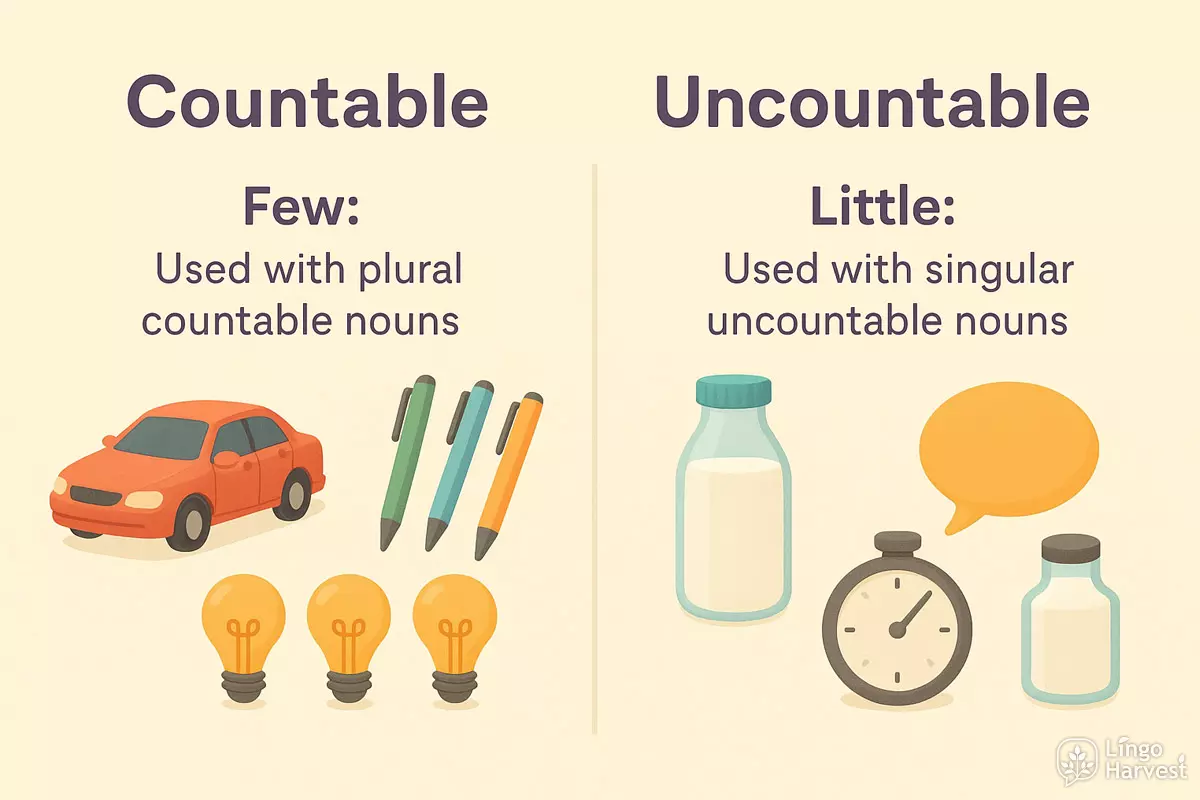
- Few: Used with plural countable nouns (cars, pens, ideas)
- Little: Used with singular uncountable nouns (milk, advice, patience)
Implied Quantity and Tone
Both terms suggest a small amount, but there’s often a subtle difference in feeling. Saying “few” or “little” without “a” (as in “few people” or “little hope”) implies an almost negligible quantity—sometimes with a negative undertone. Using “a few” or “a little” softens this, suggesting a small but sufficient amount.
- “Few students attended.” (Almost none)
- “A few students attended.” (Some did, enough for a purpose)
- “Little progress was made.” (Hardly any progress)
- “A little progress was made.” (Some progress, though not much)
Quick Comparison
For clarity, here’s a side-by-side look at how these words function with different nouns:
| Countable Example | Uncountable Example | Meaning/Use |
|---|---|---|
| few chairs | little furniture | Not many chairs / Not much furniture |
| a few questions | a little information | Some questions / Some information |
| few coins | little money | Hardly any coins / Hardly any money |
| a few friends | a little time | A small number of friends / A small amount of time |
| few options | little choice | Very limited options / Very limited choice |
Summary Points
- “Few” = plural, countable things (books, cars, opportunities)
- “Little” = singular, uncountable things (sugar, patience, help)
- Adding “a” (“a few,” “a little”) makes the statement less negative, indicating some presence rather than almost none
- Both words describe a small quantity, but their use depends on the noun type
The difference is all about what you can count and the feeling you want to express about the quantity.
Positive vs Negative Feelings
When choosing between "a few" and "a little," the emotional tone of your sentence often shifts depending on which phrase you use. "A few" and "a little" both indicate a small amount, but the nuance is important: "a few" (used with countable nouns) often carries a more optimistic or neutral implication, whereas "a little" (used with uncountable nouns) can sound either positive or slightly negative, depending on the context.
How Tone Changes with "A Few" and "A Little"
Writers and speakers often use "a few" to suggest satisfaction or sufficiency, while "few" (without "a") tends to express disappointment. Similarly, "a little" is generally neutral or slightly positive, while "little" (without "a") can sound more negative. This subtle difference can change the mood of your message.
- "A few" = a small number, but enough to be useful or appreciated
- "Few" = not many, possibly not enough
- "A little" = a small amount, but enough for the purpose
- "Little" = not much, probably not enough
Examples: Positive and Negative Connotations
Notice how adding or removing "a" changes the feeling:
- I have a few friends. ✅ (positive: some friends, enough to feel good)
- I have few friends. ❌ (negative: not many, possibly lonely)
- There's a little sugar left. ✅ (positive: some sugar remains, enough for use)
- There's little sugar left. ❌ (negative: almost gone, possibly a problem)
- She made a few mistakes. (not many, not a big problem)
- She made few mistakes. (very positive: almost perfect)
- We need a little more time. (just a bit more needed, manageable)
- We have little time. (almost none, urgent or problematic)
Quick Comparison Chart
| Phrase | Typical Feeling | Example Sentence |
|---|---|---|
| a few | Positive or neutral (sufficient amount) | He brought a few books to read. |
| few | Negative (not enough) | Few people understood the instructions. |
| a little | Positive or neutral (enough for now) | There's a little hope left. |
| little | Negative (almost none) | We have little information about the event. |
Summary
To express a positive or at least neutral idea, use "a few" or "a little." For a negative or insufficient feeling, drop the "a" and use "few" or "little." This small change in phrasing can have a big impact on how your message is received.
A Few vs Few / A Little vs Little
Understanding the subtle difference between “a few” and “few” (and likewise, “a little” vs “little”) is important for expressing quantity and attitude in English. These pairs look similar but actually convey very different feelings about the amount—one is more positive, while the other is more negative.
Core Meaning
When you use “a few” (with countable nouns) or “a little” (with uncountable nouns), you suggest there is some amount—enough for your needs or at least not nothing. In contrast, “few” and “little” (without “a”) imply a small, often disappointing or insufficient amount.
- A few = some, not many, but enough
- Few = not many, almost none, too little
- A little = some, not much, but enough
- Little = not much, almost none, too little
Quick Comparison Table
| Form | Countable Nouns | Uncountable Nouns |
|---|---|---|
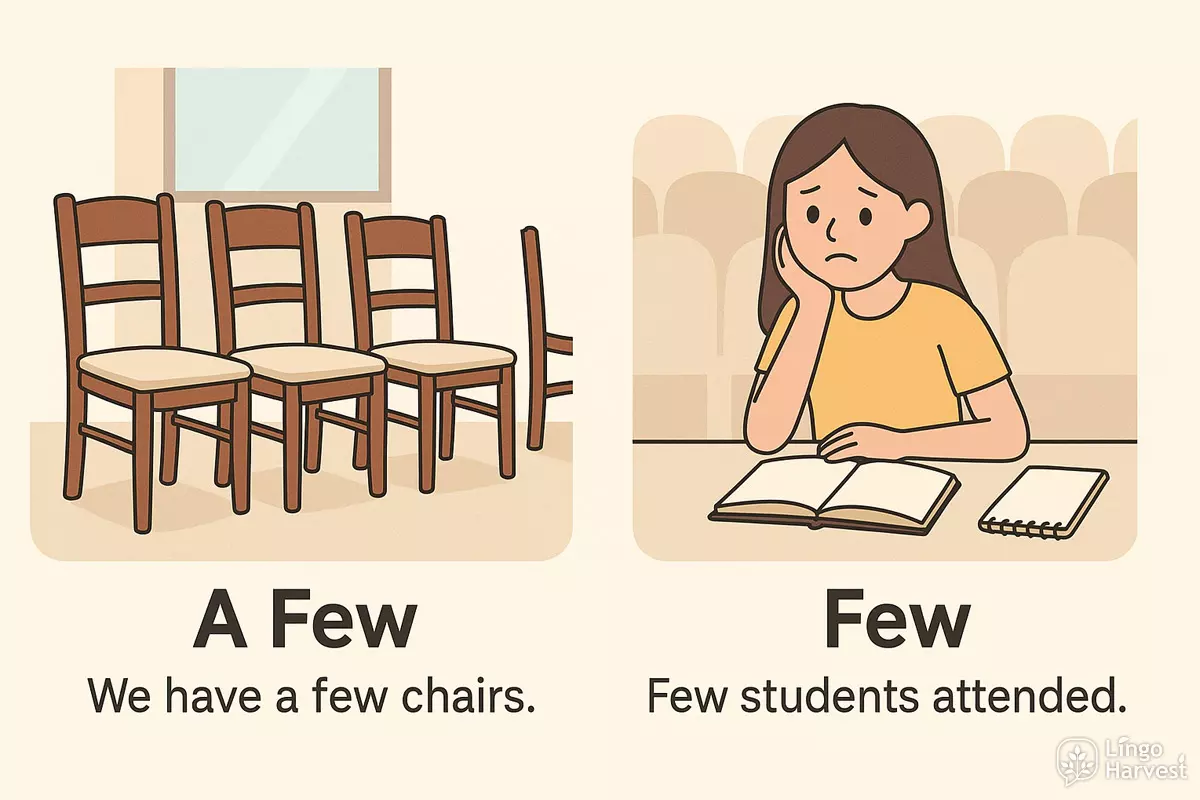
| A few | We have a few chairs. (Some chairs, enough for us) | ❌ |
| Few | Few students attended. (Very small number, almost none) | ❌ |
| A little | ❌ | There is a little milk left. (Some milk, enough for tea) |
| Little | ❌ | Little hope remains. (Almost no hope) |
Common Usage Patterns
Here are some typical examples to help you spot the difference:
- She has a few friends in the city. (positive: some friends)
- He has few reasons to stay. (negative: almost no reasons)
- Can I have a little water? (positive: some water)
- There is little time left. (negative: almost no time)
- We found a few mistakes. (not many, but more than zero)
- They gave us little information. (not enough information)
- She spent a little money on lunch. (some money, enough for lunch)
- Few people understood the joke. (very small number, almost nobody)
- I need a little help. (some help is needed)
- Few options are available. (almost no options)
Quick Visual Tip
Remember: Adding “a” usually makes the meaning more positive or neutral. Without “a,” the word is more negative and means “not enough.” This small change can completely shift the tone of your sentence. Use this trick to avoid misunderstandings in conversation or writing.
Common Mistakes
Many English learners mix up "a few" and "a little" because both expressions refer to small quantities. However, they are used with different types of nouns, and using one in place of the other can make your sentence sound unnatural or even incorrect. Recognizing these frequent errors will help you avoid confusion and communicate more clearly.
Mixing Countable and Uncountable Nouns
"A few" is used with countable nouns (like "apples," "books," "minutes"), while "a little" is for uncountable nouns (such as "water," "money," "time"). One of the most widespread pitfalls is using "a little" with countable nouns, or "a few" with uncountable nouns. To clarify, here are some common slip-ups:
- ❌ I have a little friends. → a few friends. (Friends are countable.)
- ❌ There is a few sugar in the bowl. → a little sugar. (Sugar is uncountable.)
- ❌ She made a little mistakes. → a few mistakes.
- ❌ We need a few information. → a little information.
Forgetting the Difference in Meaning
Learners sometimes believe "a few" and "few" (or "a little" and "little") mean the same thing. In reality, the presence or absence of "a" changes the meaning—sometimes quite dramatically:
- A few = some (positive tone): "I have a few questions." (I have some questions—enough.)
- Few = not many (negative tone): "I have few questions." (I have almost none—too few.)
- A little = some (positive): "There's a little hope." (There is some hope.)
- Little = not much (negative): "There's little hope." (Almost no hope.)
Confusing Similar Expressions
Sometimes, students substitute "some," "any," or "several" when "a few" or "a little" would be more natural. Notice the differences in nuance:
- "Some" can refer to both countable and uncountable nouns, but it’s less precise about amount than "a few" or "a little."
- "Several" is only for countable nouns and suggests more than "a few."
- "Any" is mostly used in questions or negatives, not to specify quantity.
Typical Error Patterns
Below is a quick-reference table contrasting correct and incorrect uses, to help you spot and fix these common pitfalls.
| Incorrect | Correct |
|---|---|
| I have a little coins. | I have a few coins. |
| She needs a few advice. | She needs a little advice. |
| There are a little chairs in the room. | There are a few chairs in the room. |
| We have a few milk left. | We have a little milk left. |
Summary of Frequent Problems
- Using "a little" with plural/countable nouns.
- Using "a few" with uncountable nouns.
- Ignoring the positive/negative connotation of "a few" vs. "few" and "a little" vs. "little."
- Replacing these phrases with less precise words, losing the intended meaning.
- Translating directly from your native language—structures may not match English rules.
- Assuming both phrases are always interchangeable.
- Forgetting to use "a" before "few" or "little" when you mean "some."
- Adding "of" after "a few" or "a little" when not followed by "the," "my," etc. (e.g., "a few of apples" ❌)
- Missing context: choosing the phrase without considering whether the noun is countable or uncountable.
- Using these expressions in formal writing where a more precise measurement is needed.
Paying attention to these typical missteps will help you make your English sound more natural and accurate, especially when expressing amounts visually or in conversation.
Practice: Choose the Correct Option
Test your understanding of how to use “a few” and “a little” with these short exercises. Read each sentence, then choose the correct word to complete it. This practice will help reinforce the visual distinctions and rules discussed earlier.
Fill in the Blanks
- She has ______ friends in the city, so she never feels lonely. (a few / a little)
- There’s ______ milk left in the fridge. (a few / a little)
- Can you give me ______ advice about this problem? (a few / a little)
- I bought ______ apples from the market. (a few / a little)
- We need ______ time to finish the project. (a few / a little)
- He made ______ mistakes on the test, but still passed. (a few / a little)
- There’s only ______ sugar in the bowl. (a few / a little)
- She wrote ______ notes during the lecture. (a few / a little)
- After the meeting, I had ______ questions. (a few / a little)
- We have ______ hope that things will improve. (a few / a little)
Show answers
- a few
- a little
- a little
- a few
- a little
- a few
- a little
- a few
- a few
- a little
Quick Reference: Countable vs. Uncountable
Remember, “a few” goes with countable nouns (things you can count individually), while “a little” is for uncountable nouns (things measured in bulk or mass). Here’s a handy comparison:
| Countable Nouns (Use “a few”) |
Uncountable Nouns (Use “a little”) |
|---|---|
| books | water |
| coins | money |
| friends | time |
| questions | information |
| mistakes | sugar |
| apples | milk |
Mini Quiz: Identify the Correct Phrase
- Choose the correct option for each:
- I have (a few / a little) coins in my pocket.
- Can you spare (a few / a little) time to help me?
- There are (a few / a little) cookies left.
- May I have (a few / a little) water?
Show answers
- a few
- a little
- a few
- a little
Use these exercises to check your grasp of the difference and to build confidence with similar expressions in your everyday English.