Every vs All: Easy Rule for Beginners

 The article explains the differences between every and all, details their singular and plural usage, lists common collocations, highlights frequent mistakes, and provides practice sentences for rewriting to improve accuracy.
Deciding which words to use when talking about groups can be challenging for English learners, particularly when you want to refer to individual members versus the group as a whole. Understanding the difference between words like each, every, all, and both is important for expressing your thoughts accurately. This article offers straightforward explanations and practical tips to help you choose the right word in different situations, making your communication clearer and helping you feel more confident when speaking or writing in English.
When to Use Every
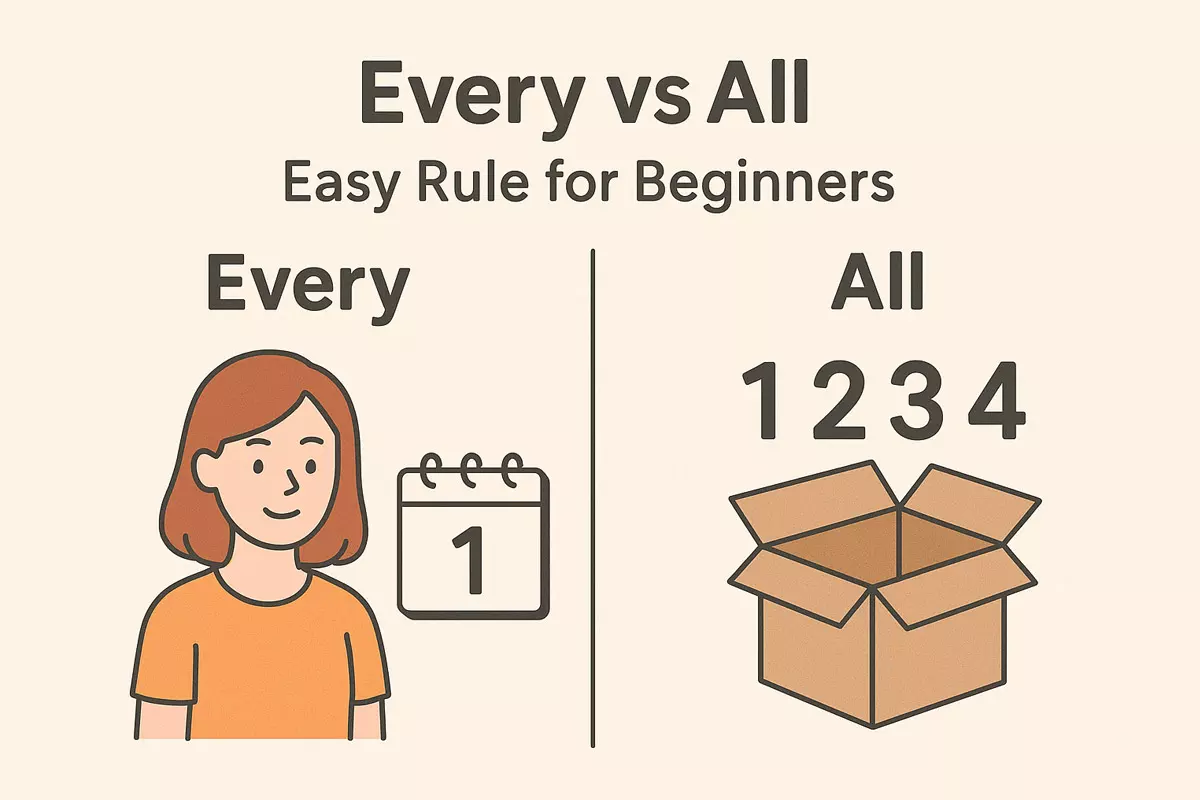
To use "every" correctly, focus on situations where you refer to each member of a group individually, but where the statement applies to all members. "Every" is always used with singular countable nouns, and it emphasizes the idea that something is true for each item in the whole set, one by one. Unlike "all," which can refer to groups collectively, "every" singles out each item in the group even though it’s talking about the entire group.
Key Uses of "Every"
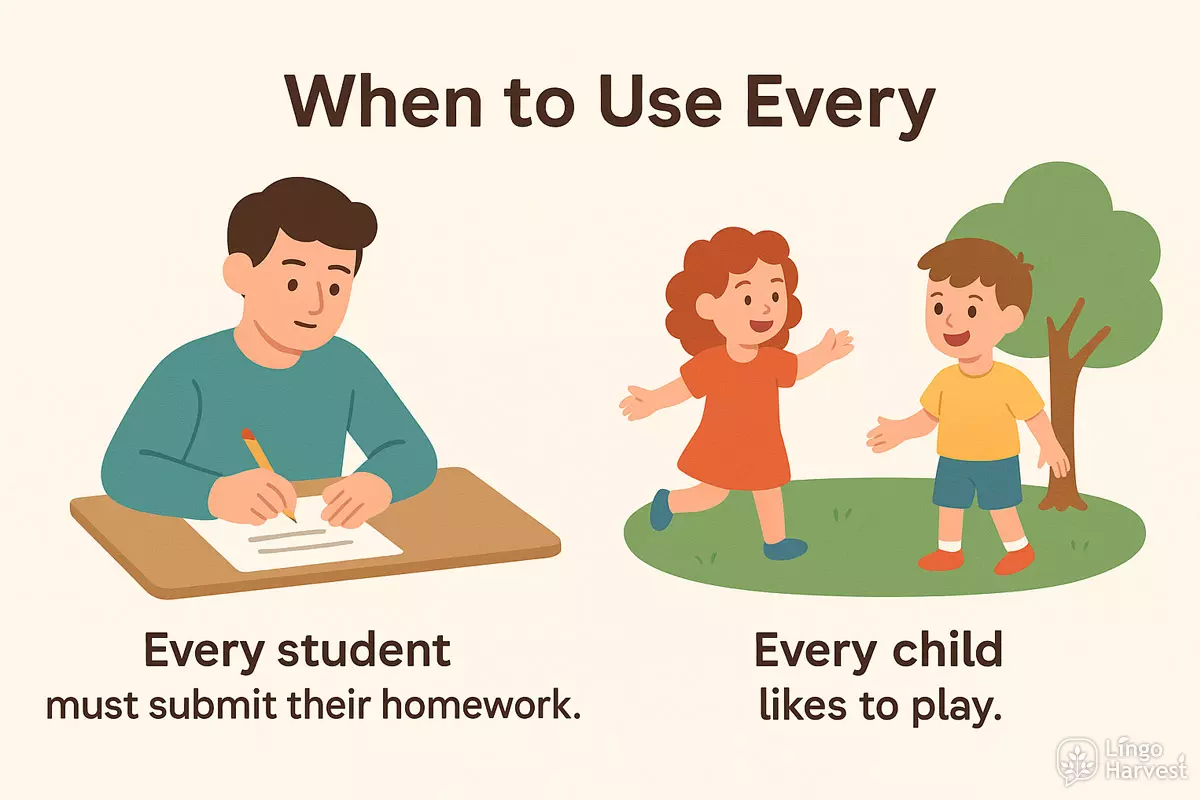
- Talking about each member of a group individually: Every student must submit their homework.
- Describing repeated or regular actions or events: The train leaves every hour.
- Referring to time intervals: She goes jogging every morning.
- Making generalizations about groups: Every child likes to play.
- Highlighting frequency: I check my email every day.
- Emphasizing inclusiveness, one by one: Every book on the shelf is new.
- With expressions of quantity: Every few minutes, the phone rings.
- In instructions or rules: Every visitor must wear a badge.
- Describing schedules: The meeting is held every Monday.
- Expressing exceptions: Every person except John was present.
Grammar Patterns with "Every"
- every + singular countable noun: every car, every question
- every + number + plural noun: every two hours, every five days
- every + ordinal (first, second, etc.): every first Monday
Common Mistakes ❌
- Don’t use "every" with uncountable nouns: Incorrect: every information
- Don’t use "every" with plural nouns (except in time expressions): Incorrect: every students
- Don’t use "every" to refer to a group as a single unit; use "all" for that
Quick Reference Comparison
| Correct Use | Example |
|---|---|
| Each member individually, singular noun | Every student received a certificate. |
| Regular intervals or frequency | The bus comes every 15 minutes. |
| Generalizations about all items separately | Every apple in the basket is ripe. |
| Instructions or requirements | Every guest must register at the front desk. |
Understanding these patterns helps you use "every" naturally, whether describing habits, rules, schedules, or groups of people and things. Remember, "every" always refers to individuals within a group, not the group as a whole.
When to Use All
The word “all” is used to talk about an entire group or quantity, emphasizing that every single member or item is included with no exceptions. You typically use “all” with plural countable nouns (“all students”), uncountable nouns (“all information”), and sometimes with pronouns (“all of them”). This word is especially helpful when you want to stress completeness or totality.
Situations Where “All” Fits Naturally
- Describing 100% of a group: All children love to play.
- Referring to the whole amount of something uncountable: All water evaporated.
- Talking about members of a category: All doctors must study hard.
- With “of” before pronouns or specific nouns: All of the cakes are gone., All of us agree.
- For emphasis in negative or positive statements: Not all people understand math.
Common Patterns With "All"
- All + plural noun: All students passed.
- All + uncountable noun: All information is correct.
- All of + specific noun: All of the cookies are fresh.
- All of + pronoun: All of them were invited.
- All + day/week/year: She worked all night.
Examples of “All” in Use
- All books on the shelf belong to the library.
- All advice given was helpful.
- All of my friends are here.
- All of it was delicious.
- All birds can fly. (Generalization; but note that some exceptions exist!)
- All the lights are off.
- All of those ideas are interesting.
- All hope was lost.
- All staff must attend the meeting.
- All of us enjoyed the trip.
- All equipment must be checked.
- All the money was spent.
- All of these answers are correct.
- All is well. (Formal, rare, but possible.)
- All roads lead to Rome.
Quick Guide: “All” vs. “Every”
| Use With | Example |
|---|---|
| Plural countable nouns | All students, all cars |
| Uncountable nouns | All water, all information |
| Pronouns (with “of”) | All of us, all of them |
| Specific groups (“of the”) | All of the cookies, all of the books |
Using “all” helps you express inclusion and totality, whether you’re talking about people, things, or even time. Remember, “all” is flexible and can be used with both countable and uncountable nouns, as well as with pronouns for clarity.
Singular vs Plural Rules
Understanding when to use “every” or “all” depends on whether we’re talking about single things or groups. “Every” works with single, countable nouns to highlight each item separately. In contrast, “all” is used with plural or uncountable nouns to refer to the whole group or quantity. Picking the right form changes the meaning and clarity of your sentence.
When to Use “Every”
“Every” is always followed by a singular, countable noun, never a plural. It emphasizes each member of a group, one at a time. For example:
- Every student needs a pencil. ✅
- Every apples are fresh. ❌ (Incorrect: “apples” is plural)
- Every child likes stories. ✅
- Every books are on the shelf. ❌
- Every car in this lot is red. ✅
- Every information is helpful. ❌
How to Use “All”
“All” is used before plural countable nouns or uncountable nouns. It refers to the entire group as a whole or the complete amount of something. Examples include:
- All students must wear uniforms. ✅
- All water was filtered. ✅
- All books are new. ✅
- All child are happy. ❌ (Incorrect: “child” is singular)
- All information is useful. ✅
Quick Comparison
| Form | Example |
|---|---|
| Every + singular countable noun | Every door is locked. |
| All + plural countable noun | All doors are locked. |
| All + uncountable noun | All sugar was used. |
| Every + time expression (day, week, year, etc.) | Every morning she runs. |
Tips and Common Mistakes
- Don’t use “every” with uncountable or plural nouns.
Incorrect: Every water is clean.
Correct: All water is clean. - “All” can be used with plural and uncountable nouns, but not with singular countable nouns.
Incorrect: All student is here.
Correct: All students are here. - Use “all” to refer to a group as a whole; use “every” to refer to individual members.
Example (all): All the cars are new. (The group as a unit)
Example (every): Every car is new. (Each car individually) - Avoid mixing plural and singular after “every.” “Every” must always be followed by a singular noun.
Incorrect: Every students must join.
Correct: Every student must join. - Don’t use “all” before a singular countable noun; it must be plural or uncountable.
Incorrect: All day is noisy.
Correct: The whole day is noisy. / All days are noisy. - Practice switching “every” and “all” to understand the change in meaning.
Example: Every child received a gift. (focus on each child)
Example: All children received a gift. (focus on the group)
Common Collocations
When learning the difference between "every" and "all," it’s helpful to see how these words naturally pair with other terms in real sentences. These word partnerships can make your speech and writing sound more fluent and native-like. Below, you’ll find practical examples and patterns to show how each term is typically used.
Typical Patterns with "Every"
- every + singular noun (e.g., every student, every car, every morning)
- every time + clause (e.g., every time I call, every time it rains)
- every one of the + plural noun (less common, formal situations)
- every single + noun (for emphasis: every single day)
- every two/three/etc. + plural noun (e.g., every two hours, every three days)
- every now and then (idiomatic: sometimes, occasionally)
- every other + noun (meaning: alternate, e.g., every other week)
- every so often (meaning: occasionally)
- nearly every + noun (for almost all: nearly every page)
- every part/aspect/detail (used to emphasize thoroughness)
Natural Uses for "All"
- all + plural noun (e.g., all students, all cars, all mornings)
- all of the + noun/pronoun (e.g., all of the cookies, all of us)
- all my/your/their + noun (e.g., all my friends, all their money)
- all day/night/week/year (e.g., all day long, all year round)
- all over + place (e.g., all over the world, all over the place)
- all the time (meaning: constantly or very often)
- all at once (meaning: suddenly or together)
- all by myself/himself (meaning: alone)
- all kinds/sorts/types of (e.g., all kinds of people)
- all set (idiomatic: ready)
Comparison of Common Structures
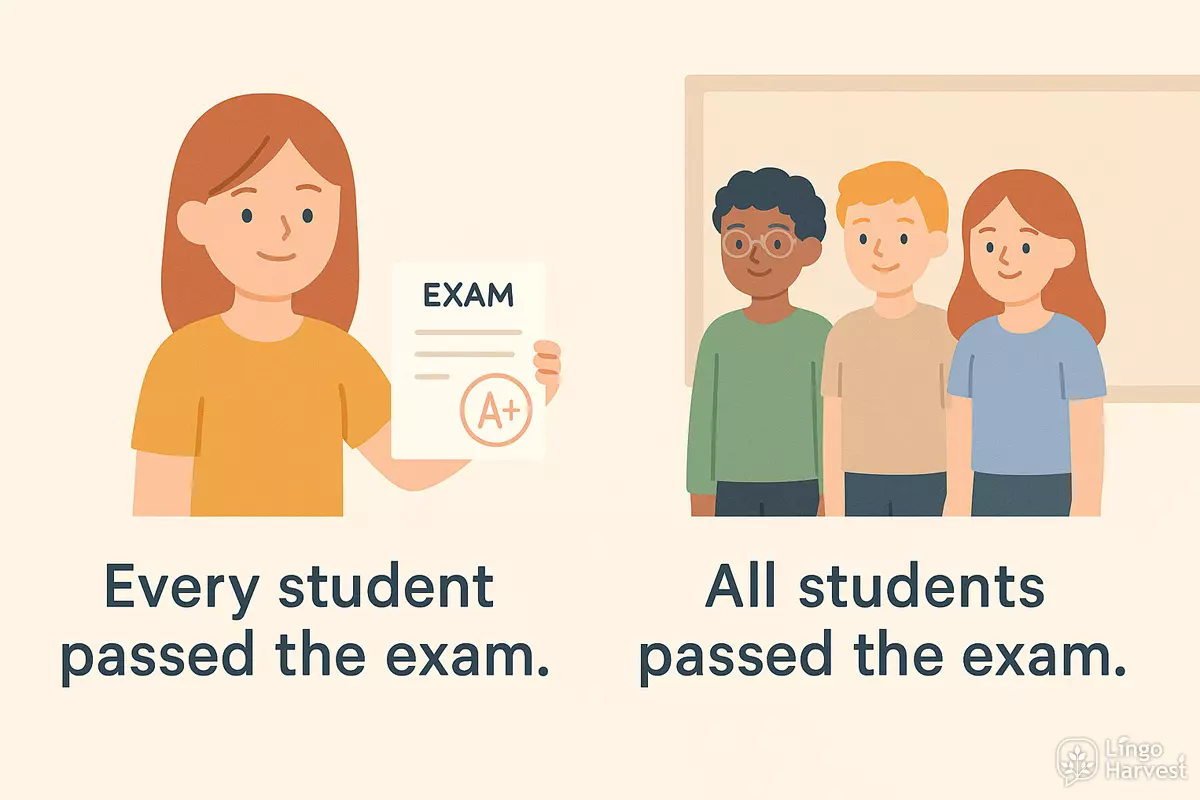
| "Every" Example | "All" Example |
|---|---|
| Every student passed the exam. | All students passed the exam. |
| She goes jogging every morning. | She jogs all mornings in summer. |
| Every time I call, you answer. | All the times I called, you answered. |
| Every two weeks, we meet. | All meetings are on Fridays. |
Understanding these combinations will help you avoid common mistakes and choose the correct word in context. Notice how "every" usually works with singular nouns and emphasizes each individual part, while "all" is used with plurals or uncountable nouns, focusing on the group as a whole. Practice using these patterns to improve your English fluency.
Mistakes to Avoid
Understanding the difference between "every" and "all" can be tricky for English learners. Many mix them up because both refer to groups, but they are not used the same way. Paying attention to these common blunders will help you sound more natural and avoid confusion.
Confusing Countable and Uncountable Nouns
One widespread issue is using "every" with uncountable nouns. Remember, "every" is only for singular, countable things. For example, saying "every water" is incorrect, while "every bottle of water" works.
- ❌ Every information is useful.
- ✅ All information is useful.
- ✅ Every piece of information is useful.
Incorrect Verb Agreement
Another source of mistakes is verb agreement. "Every" uses a singular verb, while "all" with plural nouns takes a plural verb.
- ❌ Every students are here.
- ✅ Every student is here.
- ✅ All students are here.
Mixing Up Emphasis
"Every" puts focus on individuals within a group, while "all" refers to the group as a whole. Using the wrong one can change the meaning of your sentence.
- ❌ All person must sign the form.
- ✅ Every person must sign the form.
- ✅ All people must sign the form.
Forgetting About Determiners
Learners sometimes forget that "every" cannot be used with other determiners (like "my" or "these"), but "all" can.
- ❌ Every my friend is invited.
- ✅ All my friends are invited.
Summary Table: Typical Errors and Corrections
| Wrong Example | Correct Version |
|---|---|
| Every books are on the table. | All books are on the table. |
| All student is here. | Every student is here. |
| Every advice is helpful. | All advice is helpful. |
| Every my colleague joined the call. | All my colleagues joined the call. |
| All child needs care. | Every child needs care. |
| Every these solutions work. | All these solutions work. |
| All of the student passed. | All of the students passed. |
| Every of the answer is correct. | Every answer is correct. |
Quick Tips
- Use "every" only with singular, countable nouns.
- Pair "all" with plural countable or uncountable nouns.
- Check your verb: singular for "every," plural for "all."
- Don’t use "every" with possessive words like "my" or "these."
- If you talk about a group as a whole, "all" is usually better.
By watching for these pitfalls, you’ll quickly improve your accuracy and confidence when choosing between these two words.
Practice: Rewrite Sentences Correctly
Understanding the difference between “every” and “all” can be tricky for beginners. The best way to master these words is through hands-on exercises. Below, you’ll find a series of sentences that use “every” and “all”—some are correct, others need revision. Read each one and decide if it uses the right word. If not, rewrite it to make it correct.
Instructions
- Read each sentence carefully.
- If the sentence is incorrect, rewrite it using “every” or “all” correctly.
- Some sentences are already correct—try to spot them!
Sentences to Practice
- All student in the class passed the test.
- Every students in this group speaks English.
- All my friends like pizza.
- Every book on the shelf is interesting.
- Every children need care and love.
- All of the water in the bottle is gone.
- Every of my shoes is dirty.
- All cars have wheels.
- Every Monday, I go jogging.
- All Mondays are busy for me.
- Every of us enjoyed the trip.
- All the information was helpful.
- Every information in the report is true.
- All birds can fly.
- Every bird in the park was singing.
Quick Tips
- Use “every” with singular countable nouns: every student, every car.
- Use “all” with plural nouns or uncountable nouns: all students, all the water.
- Don’t use “every” directly before plural nouns or uncountable nouns.
- “All” can be used with “of” + a pronoun or determiner: all of the people, all of them.
Common Mistake Patterns Table
| Incorrect Usage | Correct Form |
|---|---|
| Every students | Every student |
| All student | All students |
| Every of us | All of us |
| Every children | All children / Every child |
| Every information | All the information |
Show answers
- All students in the class passed the test. ✅
- Every student in this group speaks English.
- All my friends like pizza. ✅
- Every book on the shelf is interesting. ✅
- All children need care and love. or Every child needs care and love.
- All of the water in the bottle is gone. ✅
- All of my shoes are dirty.
- All cars have wheels. ✅
- Every Monday, I go jogging. ✅
- All Mondays are busy for me. ✅
- All of us enjoyed the trip.
- All the information was helpful. ✅
- All the information in the report is true.
- All birds can fly. ✅ (Note: not all birds can actually fly, but grammatically correct)
- Every bird in the park was singing. ✅