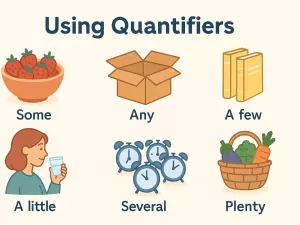
Most Useful Quantifiers for Everyday English

 The article defines quantifiers, explains basic ones such as some, many, much, few, and little, and demonstrates their use with count and noncount nouns. It also covers their order in sentences and includes practice activities.
Being able to express quantities clearly is essential for effective communication in daily life, from shopping and dining out to discussing preferences or giving instructions. When you use the correct words and phrases to describe amounts, you avoid misunderstandings and ensure that your message is understood as intended. This skill not only helps you convey your needs more accurately but also boosts your confidence in various social and practical situations, making your interactions in English more fluent and successful.
What Are Quantifiers?
Quantifiers are words or phrases that tell us about the amount or quantity of something, without needing to specify the exact number. These expressions are essential tools in English for talking about how much or how many of something there is—whether that’s a handful of apples, a little sugar, or plenty of ideas. They help to give clarity and nuance to statements, making conversations more precise and natural.
How Quantifiers Work in Sentences
Quantifiers come before nouns and can be used with countable nouns (like "books" or "apples") or uncountable nouns (like "water" or "information"). The choice of quantifier depends on whether you’re describing something you can count individually or something that’s measured in bulk or mass. For example:
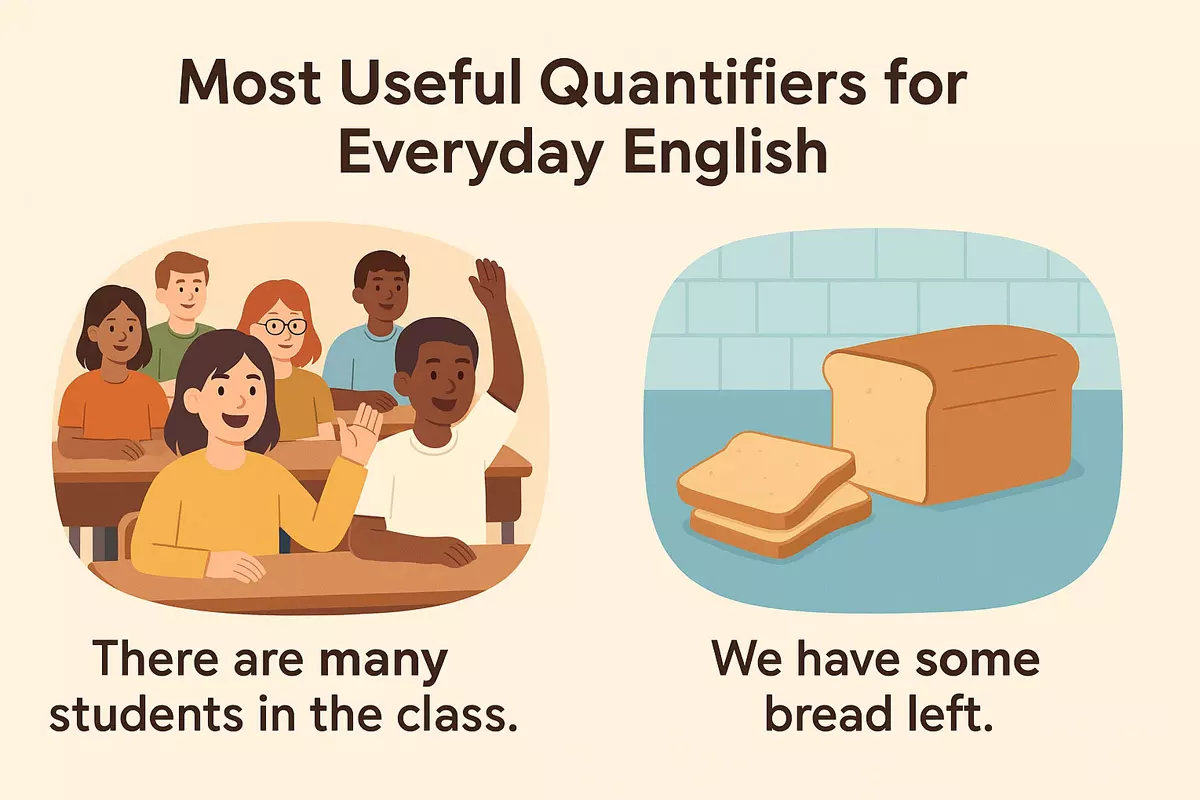
- There are many students in the class. (countable)
- We have some bread left. (uncountable)
Common Types of Quantifiers
Some quantifiers are specific to either countable or uncountable nouns, while others can be used with both. Here’s a helpful overview:
| Quantifier | Used With | Example |
|---|---|---|
| many | Countable nouns | Many cars are parked outside. |
| much | Uncountable nouns | There isn’t much time left. |
| some | Both | Some people like jazz. / Some water spilled. |
| few | Countable nouns | Few friends called today. |
| little | Uncountable nouns | There’s little hope now. |
| several | Countable nouns | Several books are missing. |
| a lot of | Both | A lot of people arrived early. / A lot of rain fell last night. |
| plenty of | Both | Plenty of food is available. / Plenty of chairs are free. |
| any | Both (usually in questions/negatives) | Do you have any milk? / Are there any cookies? |
| no | Both | No money was found. / No students passed. |
Why Use Quantifiers?
Using these terms helps avoid awkward repetition and makes your English sound more natural. Rather than saying “I have apples, I have oranges, I have bananas,” you can summarize with “I have some fruit.” They’re also handy for expressing uncertainty or general amounts, such as “a little effort” or “several reasons.”
Quick List of Useful Quantifiers
Here are more examples you’ll encounter in daily English:
- all
- none
- each
- every
- most
- a few
- a little
- both
- half
- dozens of
- tons of
- almost all
- nearly every
- not much
- not many
- more
- less
- fewer
With practice, these words become second nature, making your communication clearer and more fluent. Quantifiers are a simple way to add detail, express opinions, and describe situations in everyday English.
Basic Quantifiers: Some, Many, Much, Few, Little
Understanding how to use essential quantifiers helps you express amounts and quantities clearly in English. These words let you talk about numbers and amounts without always needing to be specific, which is especially useful in everyday conversation.
When and How to Use Common Quantifiers
Each of these quantifiers has its own rules about when it can be used. For example, "many" and "few" are used with countable nouns (like apples, books), while "much" and "little" are used with uncountable nouns (like water, time). "Some" can be used with both types, but often appears in positive sentences or polite requests.
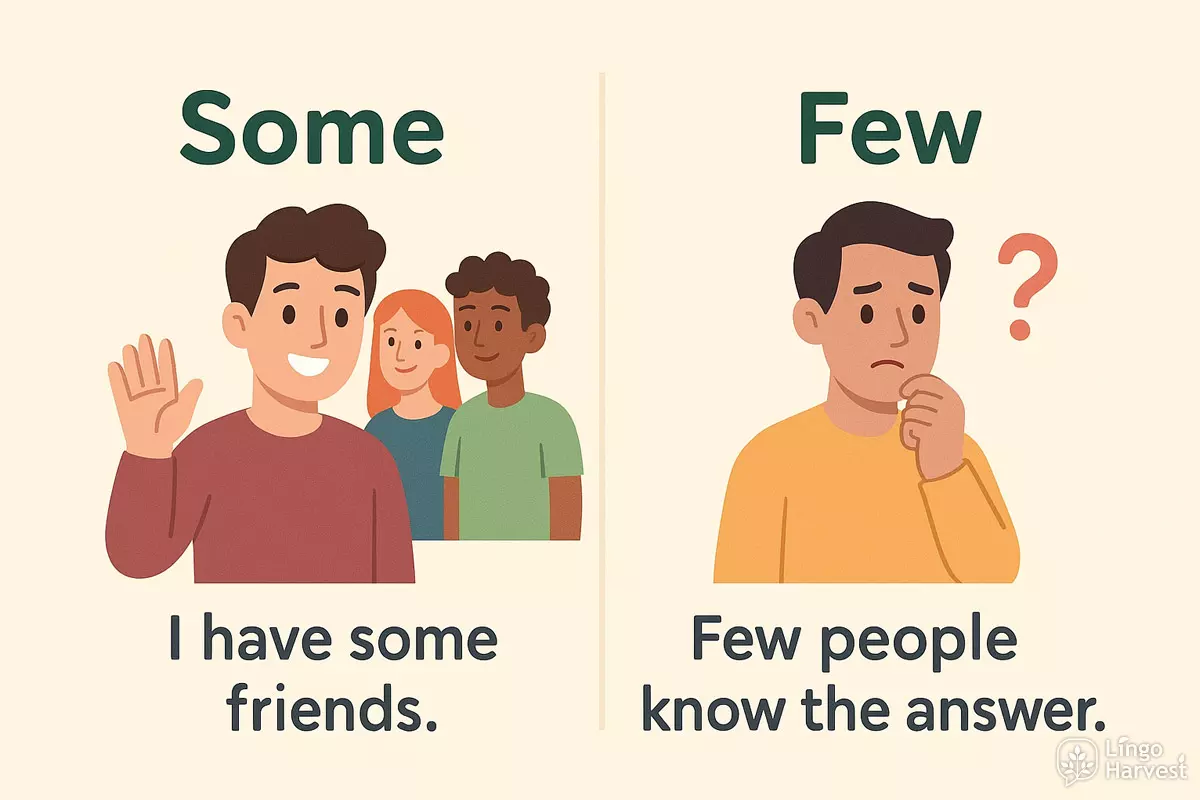
- Some – Used for an indefinite amount, usually positive statements or offers: "I have some friends."
- Many – Refers to a large number of countable items: "There are many students in the class."
- Much – Describes a large amount of something uncountable: "She doesn’t have much money."
- Few – A small number of countable things: "Few people know the answer."
- Little – A small amount of something uncountable: "There’s little hope left."
Comparing Countable and Uncountable Nouns
To decide which quantifier to use, check whether the noun is countable or not. Here are some examples to clarify the difference:
| Quantifier | Example Sentence |
|---|---|
| Some (countable) | I bought some apples. |
| Some (uncountable) | Would you like some water? |
| Many | She has many ideas for the project. |
| Much | There isn’t much time left. |
| Few | Few buses run after midnight. |
| Little | We have little information about the event. |
Quick Reference: Usage Patterns
These quantifiers appear in different contexts. For everyday English, try these patterns:
- “Some” for making offers or requests: "Can I have some coffee?"
- “Many” in questions or negatives: "Do you have many books?" / "I don’t have many options."
- “Much” mostly in negatives and questions: "Is there much traffic?" / "Not much has changed."
- “Few” for a limited number: "Few children like spinach."
- “Little” for a limited amount: "There’s little chance of rain today."
- “Some” is often used in polite suggestions: "Would you like some help?"
- “Many” is rarely used in positive statements in spoken English: "Many people agree" (more formal).
- “Much” is common in written or formal contexts: "Much research has been done."
- “Few” and “little” can sound negative, implying not enough: "Few tickets are left." / "Little hope remains."
- “A few” and “a little” are more positive: "A few friends came." / "A little milk is left."
Learning to use these quantifiers naturally will make your English sound smoother and more precise in daily life.
Quantifiers for Count and Noncount Nouns
Understanding how to use words like many, much, a lot of, and some can make your English sound more natural and precise. These words help describe quantities, but choosing the right one depends on whether the noun is countable (like apples) or uncountable (like water). Let’s break down the different types and how they’re used in everyday conversation.
Common Quantifiers for Countable and Uncountable Nouns
Some expressions work with both types of nouns, but others are specific. Here’s a closer look:
- Many (for countable nouns): many books, many friends
- Much (for uncountable nouns): much time, much information
- A few (for countable nouns): a few coins, a few chairs
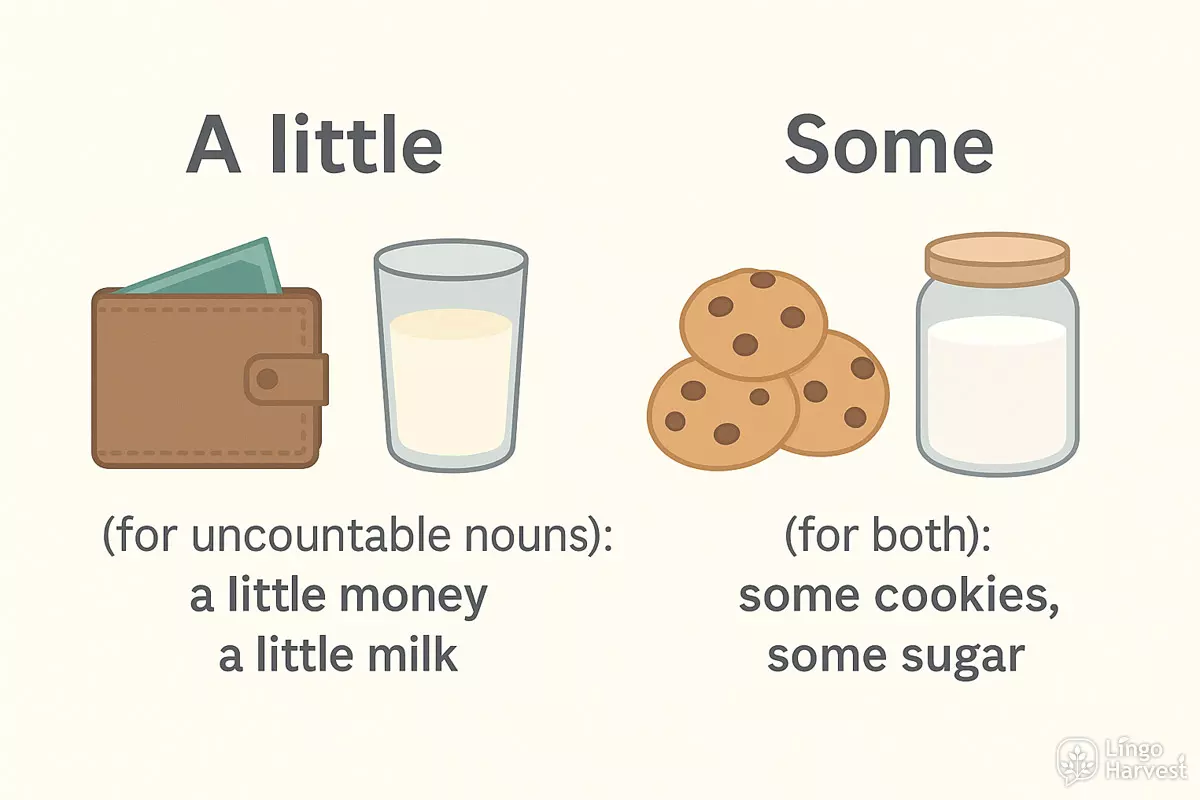
- A little (for uncountable nouns): a little money, a little milk
- Some (for both): some cookies, some sugar
- Any (for both, usually in negatives/questions): any pencils, any advice
- Several (countable): several chances, several emails
- A lot of / lots of (for both): a lot of cars, a lot of snow
- Plenty of (for both): plenty of chairs, plenty of space
- No (for both): no students, no water
- Each / every (countable, singular): each person, every child
- All (for both): all students, all equipment
- None (for both): none left, none available
Choosing the Right Quantifier
It’s easy to get mixed up if you aren’t sure whether a noun is countable or not. For example, you wouldn’t say “much apples” or “many water.” Use much for things you can’t count as individual units, and many for things you can.
| Quantifier | Countable Nouns | Uncountable Nouns |
|---|---|---|
| many | ✅ many books | ❌ |
| much | ❌ | ✅ much water |
| a few / few | ✅ a few coins | ❌ |
| a little / little | ❌ | ✅ a little salt |
| some | ✅ some apples | ✅ some cheese |
| any | ✅ any pencils | ✅ any advice |
| plenty of | ✅ plenty of chairs | ✅ plenty of space |
| no | ✅ no students | ✅ no water |
| all | ✅ all students | ✅ all equipment |
| none | ✅ none left | ✅ none available |
Useful Tips
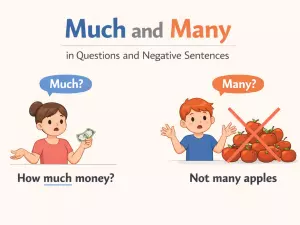
- Use much and many mostly in questions and negatives: “Do you have much time?” “There aren’t many options.”
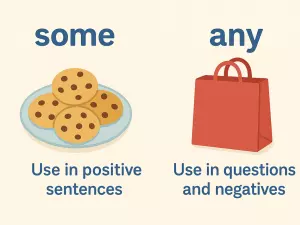
- Some and any are flexible, but any is often used for questions or negative sentences.
- For large, vague amounts, a lot of and lots of are convenient and work for almost any noun.
- When in doubt, check if you can count the noun as individual items. If not, it’s uncountable.
Practicing these patterns will help you choose the right words to describe amounts, making your English clearer and more effective in daily situations.
Order in Sentences
When using quantifiers in English, their position can affect both meaning and clarity. The most common place for these words is directly before the noun they describe. For example, in “many people” or “a little water,” the quantifier comes right before the noun. This helps listeners quickly understand the quantity being discussed.
Standard Placement Patterns
Quantifiers usually appear before adjectives and nouns, but after articles if present. Here are some common arrangements:
- Quantifier + noun: “Some apples”
- Quantifier + adjective + noun: “Several interesting books”
- Article + quantifier + noun: “A few options”
Note that certain quantifiers, like “enough,” can also come after the adjective: “big enough rooms.”
Examples of Common Quantifiers in Sentences
- Much time was wasted.
- A little patience goes a long way.
- Few people know the answer.
- Several students passed the test.
- Plenty of sunshine today.
- All children must be accompanied.
- Each person gets a ticket.
- No money was found.
- Any questions?
- Most days are busy.
- Enough milk for everyone?
- Half the class left early.
- Neither option works for me.
- Every seat was taken.
- Both answers are correct.
- Lots of people attended.
- More sugar, please.
- Less noise, please.
- Some help would be nice.
- Several reasons exist.
Comparing Placement: Countable vs. Uncountable Nouns
The position remains similar whether the noun is countable or uncountable, but the choice of quantifier changes. Here’s a simple comparison:
| With Countable Nouns | With Uncountable Nouns |
|---|---|
| Many books | Much information |
| Few friends | Little time |
| Several cars | Some water |
| A number of ideas | A bit of luck |
Special Notes on Word Order
Some quantifiers, such as “all,” “both,” and “each,” can be used before a noun or after a pronoun, for instance: “All students” or “They all left.” Keep in mind that quantifiers rarely come after the noun unless used for emphasis or in certain expressions (“the students, all of whom…”). Adjusting their position can subtly change the tone or emphasis in your sentence.
Practice: Fill in Missing Quantifiers
Understanding how to use quantifiers such as "some," "any," "much," "many," "few," and "a lot of" can make everyday English more natural and precise. Below, you'll find a range of exercises to help you practice choosing the right word for each situation. Read each sentence and decide which quantifier fits best.
Exercise 1: Choose the Correct Quantifier
Insert the most suitable quantifier in each blank. Options include: some, any, much, many, a few, a little, a lot of, several, few, little, plenty of.
- There aren't _______ apples left in the basket.
- We have _______ time before the meeting starts.
- She doesn't have _______ friends in this city.
- Would you like _______ tea?
- There were _______ people at the concert last night.
- I didn’t see _______ mistakes in your essay.
- We need to buy _______ bread for breakfast.
- He has _______ experience in graphic design.
- Are there _______ questions about the assignment?
- They spent _______ money on their holiday.
Show answers
- many
- a little
- many
- some
- a lot of
- few
- some
- much
- any
- a lot of
Exercise 2: Identify Suitable Quantifiers
For each context below, select all quantifiers that could work. Not every option fits every blank.
- ________ water (options: much, some, a lot of)
- ________ chairs (options: many, several, a few)
- ________ information (options: much, a little, any)
- ________ patience (options: little, a lot of, plenty of)
- ________ problems (options: many, few, any)
Show answers
- much, some, a lot of
- many, several, a few
- much, a little, any
- little, a lot of, plenty of
- many, few, any
Useful Quantifiers at a Glance
This reference table helps you compare some of the most common quantifiers and their typical use with countable and uncountable nouns.
| Quantifier | Used With | Example |
|---|---|---|
| many | Countable nouns | Many students attended the class. |
| much | Uncountable nouns | There isn’t much sugar left. |
| some | Countable & Uncountable | Would you like some water? |
| few / a few | Countable nouns | We have a few minutes to talk. |
| little / a little | Uncountable nouns | She has a little hope left. |
| a lot of / lots of | Both types | We made a lot of progress. |
| any | Countable & Uncountable (mainly in negatives/questions) | Do you have any questions? |
| plenty of | Both types | There is plenty of food. |
| several | Countable nouns | She visited several countries last year. |
| no | Both types | We have no time to waste. |
Exercise 3: Make Sentences with Quantifiers
Write your own sentences using these quantifiers: few, much, plenty of, no.
- ________
- ________
- ________
- ________
Show answers
- Few people know about this shortcut.
- There isn’t much milk in the fridge.
- We have plenty of time before the film starts.
- No mistakes were found in the report.
Regular practice with these types of fill-in-the-gap tasks makes it easier to select the right quantifier in real conversations. Try writing your own examples or noticing quantifiers when you listen or read in English.