Using Can’t for Prohibition and Rules

 Here we how can’t is used to talk about rules, the difference between can’t and mustn’t, common mistakes learners make, and provides practice exercises to rewrite rules using can’t. It focuses on practical grammar points.
Learning to clearly express what is not allowed is essential for effective communication, particularly when outlining rules or restrictions. Using negative forms appropriately helps set boundaries and ensures that guidelines are understood, which can prevent confusion and misunderstandings. By mastering this skill, you can communicate expectations more precisely and help others follow the necessary protocols or standards in various situations.
What Can’t Means
When you use "can’t" in English, it often signals that something is not allowed or is against the rules. This modal verb is a straightforward way to express prohibition, making it clear that a certain action is forbidden. For example, signs such as "You can’t park here" or "Students can’t use phones in class" use this form to communicate restrictions.
How "Can’t" Expresses Prohibition
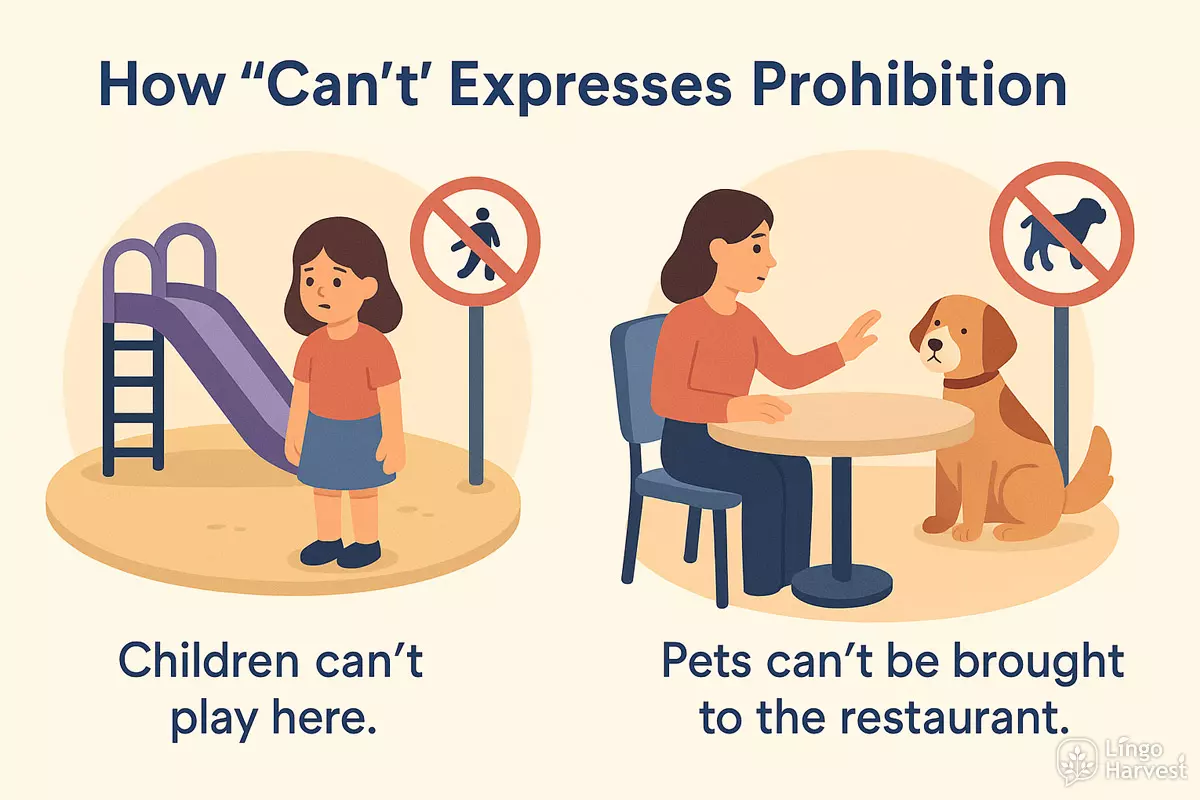
"Can’t" is commonly used for setting boundaries in public places, schools, workplaces, and even homes. By choosing this word, the speaker or authority figure removes permission and draws a firm line. Here are some everyday uses:
- You can’t smoke inside the building.
- Visitors can’t enter after 8 PM.
- Children can’t play here.
- Employees can’t access this area without a badge.
- Pets can’t be brought to the restaurant.
- People can’t take photos during the performance.
- Guests can’t stay overnight.
- Drivers can’t turn left at this intersection.
- Students can’t wear hats in class.
- Customers can’t return opened products.
Comparing "Can’t" with Other Forms
While "can’t" is direct, there are other ways to express similar ideas. Sometimes, rules are stated more formally or indirectly (like using "must not" or "not allowed to"). Notice how "can’t" is often less formal but very clear.
| Pattern | Example |
|---|---|
| can’t + verb | You can’t eat in the library. |
| must not + verb | You must not eat in the library. |
| not allowed to + verb | You are not allowed to eat in the library. |
| prohibited from + verb-ing | You are prohibited from eating in the library. |
Key Points to Remember
- "Can’t" is used for clear, direct prohibition.
- It’s common in both spoken and written English, especially on signs and in rules.
- Other phrases like "must not" or "not allowed to" can be used for more formal or official rules.
- Choosing "can’t" often makes the restriction feel straightforward and easy to understand.
In summary, "can’t" is a practical tool for stating what is not permitted, making communication about rules and boundaries simple and effective.
Talking About Rules
When explaining what is allowed or not allowed, we often use “can’t” to clearly show that something is prohibited by a rule or regulation. This is especially common in public places, schools, workplaces, or when guiding children. Using “can’t” makes it clear that an action is not permitted—not just a suggestion, but a firm instruction. For example, in classrooms, teachers might say, “You can’t use your phone during lessons.” In public transport, signs often say, “You can’t eat or drink here.” These statements use “can’t” to express official policies, not just personal preferences.
Common Situations with Prohibitive Rules
- You can’t smoke inside the building. ❌ → You must not smoke inside the building. ✅
- Visitors can’t enter this area without a badge. ❌ → Visitors are not allowed to enter this area without a badge. ✅
- Students can’t leave the school grounds during school hours. ❌ → Students must not leave the school grounds during school hours. ✅
- You can’t park here after 6 PM. ❌ → Parking is not allowed here after 6 PM. ✅
- Passengers can’t bring large bags on the bus. ❌ → Passengers are not allowed to bring large bags on the bus. ✅
- Children can’t play in this part of the park. ❌ → Children are not allowed to play in this part of the park. ✅
- Employees can’t access the server room. ❌ → Employees must not access the server room. ✅
- You can’t take photos in the museum. ❌ → Taking photos in the museum is not allowed. ✅
- Pets can’t be left unattended. ❌ → Pets must not be left unattended. ✅
- Customers can’t return used items. ❌ → Customers are not allowed to return used items. ✅
How “Can’t” Differs from Other Modal Verbs
The word “can’t” is direct and leaves no room for negotiation. It is stronger than “shouldn’t” or “mustn’t,” which can sometimes sound softer or more formal. “Can’t” gives a clear signal that something is forbidden by rule or law.
| Phrase | Use and Meaning |
|---|---|
| You can’t park here. | Direct rule; parking is not allowed at any time. |
| You shouldn’t park here. | Advice; it’s better not to park here, but not strictly forbidden. |
| You mustn’t park here. | Formal prohibition; not allowed, often in written rules. |
| You may not park here. | Formal/legal; often used in official notices. |
Tips for Using “Can’t” in Rules
- Use “can’t” for clear, everyday prohibitions.
- Pair “can’t” with the base form of a verb: You can’t run, They can’t enter.
- Avoid using “can’t” for your own preferences—save it for rules, not opinions.
- Remember, “can’t” is less formal than “must not” or “may not.”
When setting or explaining rules, “can’t” is a practical and common choice, especially in spoken English or informal writing. It helps everyone understand what is and isn’t allowed, reducing confusion and misunderstandings.
Difference Between Can’t and Mustn’t
Understanding how "can’t" and "mustn’t" are used for rules and prohibitions helps avoid confusion in English. Both words express that something is not allowed, but they carry different levels of strength and implication.
How "Can’t" Is Used
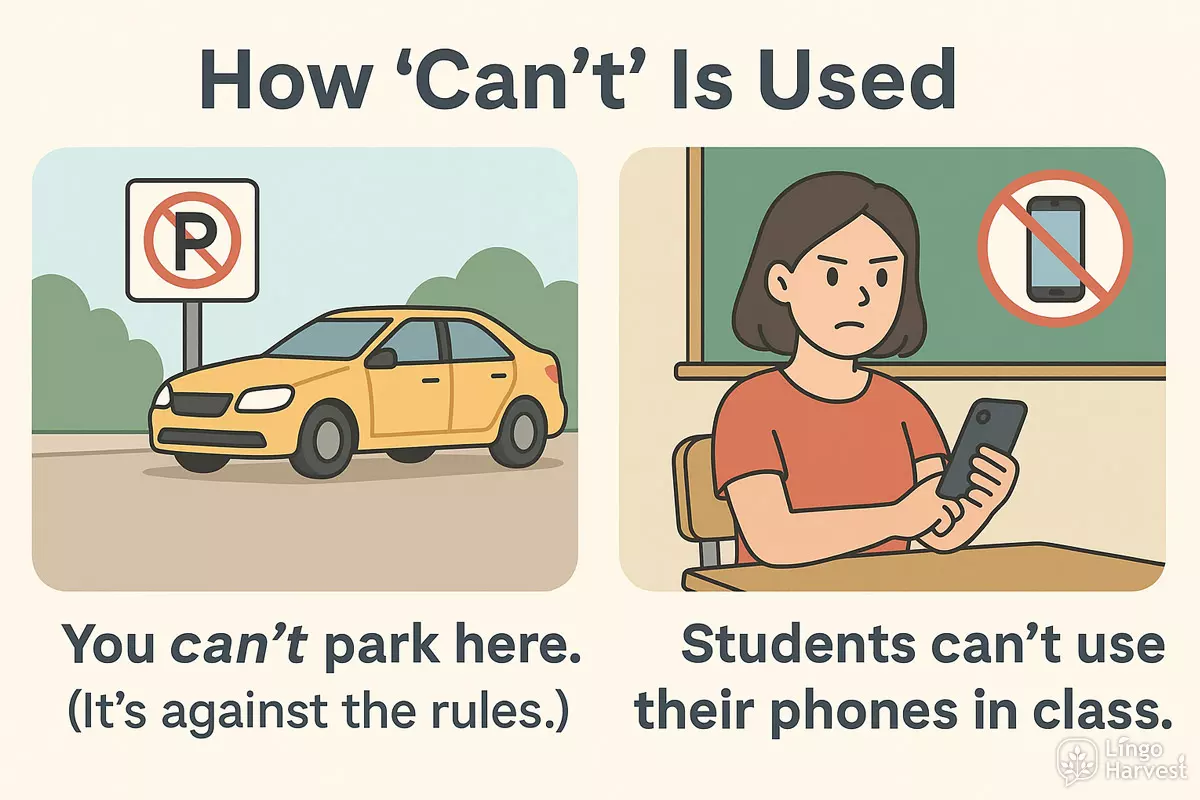
"Can’t" is typically used to show that something is not permitted, often because of a rule, law, or general agreement. It’s common in everyday conversation and tends to sound a bit softer or less strict than "mustn’t." For example:
- You can’t park here. (It’s against the rules.)
- Students can’t use their phones in class.
- You can’t enter the building after 10 PM.
How "Mustn’t" Is Used
"Mustn’t" is stronger and more formal. It suggests a strict prohibition, often with a sense of warning or serious consequence. It’s less common in casual speech but important in official instructions or warnings. For instance:
- You mustn’t touch the wires. (It’s dangerous.)
- Visitors mustn’t feed the animals.
- You mustn’t forget your passport.
Key Differences at a Glance
The following table compares the typical use and feeling of "can’t" and "mustn’t" in the context of prohibitions and rules:
| Expression | Implication | Typical Use | Formality |
|---|---|---|---|
| Can’t | Not allowed, due to rules or possibility | Everyday conversation, general rules | Neutral or informal |
| Mustn’t | Strict prohibition, strong warning | Instructions, warnings, official rules | Formal or serious |
Summary of Usage
Use "can’t" when you want to express that something is not allowed, especially when talking about rules that are common or widely accepted. Choose "mustn’t" when you need to stress that something is strictly forbidden, often for safety or legal reasons. Being aware of these nuances helps you sound more natural and accurate when discussing what is or isn’t permitted in English.
Common Mistakes
When using "can't" to indicate rules or prohibitions, learners often confuse it with other modal verbs like "mustn't" or "shouldn't." This can lead to misunderstandings about how strict a rule is, or whether something is simply not recommended rather than forbidden. It's important to recognize the specific contexts where "can't" is the best choice for expressing prohibition.
Mixing Up Modals
A frequent error is using "can't" in situations where advice or suggestion is intended, rather than a strict rule. For example, saying "You can't eat too much sugar" may sound like a law, while "You shouldn't eat too much sugar" is softer and more appropriate for advice. This confusion can make your meaning unclear or unintentionally harsh.
Wrong Contexts for "Can't"
Some English learners use "can't" for personal ability or possibility, rather than for social rules or laws. Remember, "can't" for prohibition is about what is not allowed, not what is impossible for someone to do.
- Incorrect: "I can't swim in the morning" (if you mean you are not permitted, that's correct; if you mean you are unable, use "cannot" for ability).
- Correct: "You can't smoke here." (prohibited by law or rule)
- Incorrect: "You can't forget your homework." (should be "mustn't" for rules or "shouldn't" for advice)
- Correct: "Children can't enter the bar." (forbidden by law)
Comparing "Can't" and Other Modals
To clarify the differences, here's a comparison of how "can't," "mustn't," and "shouldn't" are used for rules and prohibitions:
| Expression | Typical Meaning |
|---|---|
| can't | Prohibited by rule or law (not allowed at all) |
| mustn't | Strong prohibition, often by authority or moral rule |
| shouldn't | Advice or recommendation (not strictly forbidden) |
| cannot (ability) | Describes lack of ability, not prohibition |
Overusing "Can't"
Relying on "can't" for every rule or instruction can make speech sound unnatural or overly strict. In English, instructions often use the imperative ("Do not touch"), or softer modals like "shouldn't" for recommendations. Adjust your language based on the context and the level of strictness you want to express.
Summary Checklist ✅
- Use "can't" only for clear, external prohibitions.
- Do not use "can't" when giving advice—use "shouldn't" instead.
- Remember the difference between personal inability and external prohibition.
- Choose the modal that matches the strength of the rule or law.
Practice: Rewrite Rules Using Can’t
Understanding how to express prohibitions is essential for clear communication. One common way to state what is not allowed in English is by using “can’t.” Below, you’ll practice changing formal or descriptive rule statements into sentences using “can’t” to show prohibition. This is a practical skill for both everyday situations and formal contexts, such as schools, workplaces, or public spaces.
Task: Transform the Rules
Read each rule below. Rewrite it as a sentence using “can’t” to clearly express what is not allowed. This helps make rules direct and easy to understand.
- It is forbidden to eat in the library.
- Smoking is not permitted inside the building.
- Do not use your phone during the exam.
- Running in the hallways is against the rules.
- Students must not leave the classroom without permission.
- Pets are not allowed in the restaurant.
- Visitors are not allowed to enter after 8 PM.
- Parking in front of the entrance is prohibited.
- Children are not allowed to play in the parking lot.
- Drinks are not permitted near the computers.
Show answers
- You can’t eat in the library.
- You can’t smoke inside the building.
- You can’t use your phone during the exam.
- You can’t run in the hallways.
- You can’t leave the classroom without permission.
- You can’t bring pets into the restaurant.
- You can’t enter after 8 PM.
- You can’t park in front of the entrance.
- Children can’t play in the parking lot.
- You can’t have drinks near the computers.
Common Patterns for Prohibition
When expressing rules with “can’t,” the structure is simple: Subject + can’t + base verb + rest of the sentence. Here are more examples to help you recognize and create similar sentences:
- You can’t shout in the classroom.
- People can’t take photos here.
- Guests can’t stay overnight.
- Employees can’t wear jeans on Mondays.
- Drivers can’t park here.
- Children can’t enter the kitchen.
- Students can’t use calculators during the test.
- Visitors can’t touch the exhibits.
- Customers can’t return items without a receipt.
- Members can’t lend their cards to others.
Compare: Formal vs. “Can’t” Rules
Notice how using “can’t” makes the rule sound more direct and conversational. Here’s a comparison:
| Formal Rule | Rule with “Can’t” |
|---|---|
| Photography is prohibited. | You can’t take photos. |
| No food or drink allowed. | You can’t eat or drink here. |
| Entry after 10 PM is not permitted. | You can’t enter after 10 PM. |
| Unauthorized persons are not allowed beyond this point. | You can’t go past this point without permission. |
| Mobile phone usage is forbidden during meetings. | You can’t use your phone during meetings. |
Practicing these conversions will help you give and understand rules more efficiently in English. Try creating your own examples from rules you see in real life!