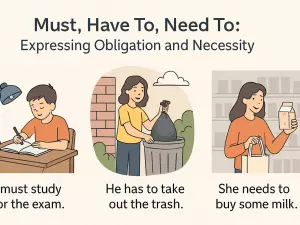
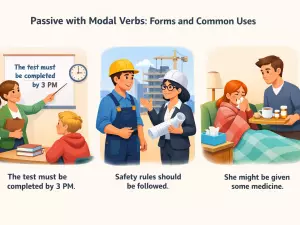
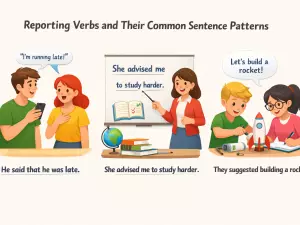
Using Must for Obligation and Strong Rules

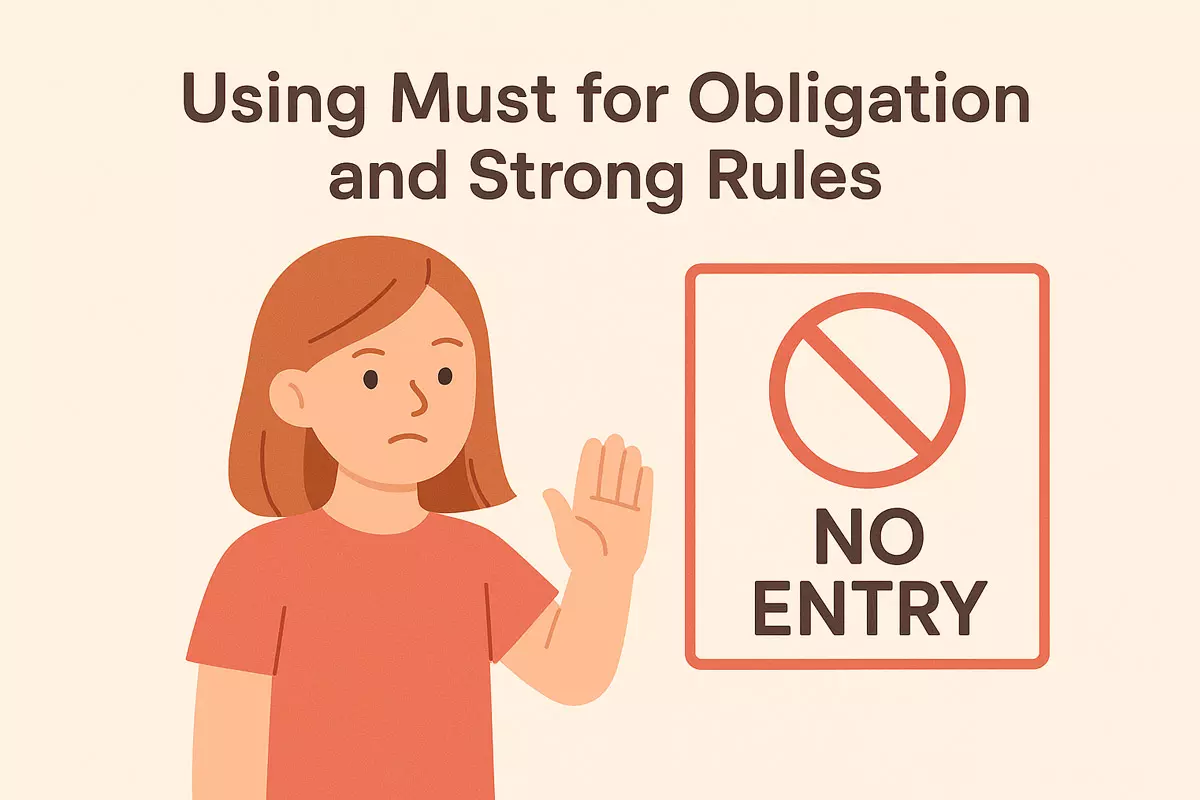 The article explains how to use must for necessity and rules, how to form positive and negative sentences, and compares must with have to. It also covers polite versus firm commands, common mistakes, and includes practice exercises.
Expressing necessity or firm requirements in English typically involves using modal verbs and specific phrases that communicate obligation or rules, such as must, have to, or need to. Mastering these expressions is important for giving clear instructions, setting expectations, and ensuring that responsibilities are understood in both formal and informal situations. By using the appropriate language, speakers can effectively convey what actions are required, which helps avoid misunderstandings and ensures that everyone knows what is expected of them.
What Must Means
When we use “must” in English, it expresses a sense of necessity, obligation, or a very strong rule. This modal verb signals that something is required, not optional, and usually comes from the speaker’s authority or a set of rules. It’s much stronger than simply suggesting or recommending; “must” tells us that there is no choice in the matter.
Core Uses of “Must”
- Obligation: Tells someone what they are required to do (often by rules or laws).
- Strong Rules: Used when the rule cannot be ignored or broken.
- Necessity: Indicates that something is absolutely needed for a purpose or result.
- Logical Deduction: Sometimes, “must” is used to show a conclusion based on evidence (e.g., “You must be tired after that trip.”). However, this article focuses on rules and obligations.
Examples of “Must” in Context
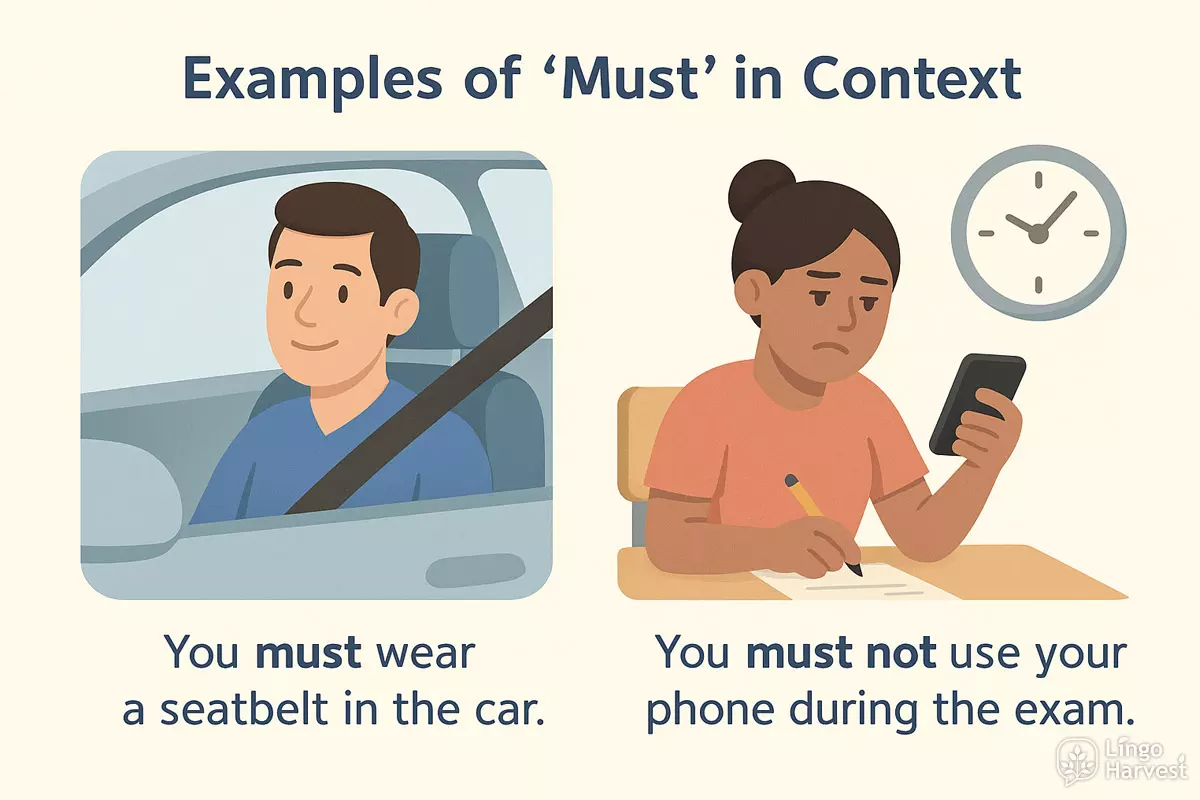
- You must wear a seatbelt in the car. ✅
- All students must hand in their assignments on time.
- Visitors must sign in at the front desk.
- Employees must wash their hands before returning to work.
- Passengers must not smoke on the train. ❌
- Children must be accompanied by an adult.
- You must not use your phone during the exam.
- Applicants must fill out all required fields on the form.
- Drivers must stop at a red light.
- Pets must be kept on a leash in this park.
- Guests must leave the premises by 10 PM.
- Everyone must follow safety instructions.
- Food must be stored in the refrigerator.
- Packages must not exceed 2 kg.
- Tickets must be shown upon request.
- Members must renew their subscriptions annually.
How “Must” Differs from Other Modals
While “must” is used for strong requirements, it differs from “have to,” “should,” and “may.” The table below compares these common modal verbs as they relate to rules, obligations, and advice:
| Modal Verb | Meaning/Use | Example |
|---|---|---|
| Must | Strong obligation, rule from the speaker or authority | You must wear a helmet. |
| Have to | External obligation, rule from outside (law, policy) | You have to pay taxes. |
| Should | Advice, recommendation (not required) | You should eat more vegetables. |
| May | Permission or possibility | You may leave early today. |
Summary
In summary, “must” is reserved for situations where there is no room for choice or negotiation. It establishes firm expectations and communicates that compliance is essential, whether the source is the speaker, a rulebook, or a legal requirement. Understanding this modal helps you interpret and give instructions clearly and confidently in English.
Positive and Negative Sentences
Understanding how to use “must” in both affirmative and negative forms is essential when expressing obligations or strict rules in English. The structure changes slightly depending on whether you’re insisting that something is required, or strictly forbidding it.
Affirmative Forms with “Must”
When you want to state that something is necessary or required, use “must” followed by the base form of the verb. This construction is direct and leaves little room for flexibility. It’s often used in rules, instructions, or when giving strong advice.
- You must wear a seatbelt.
- Students must submit their assignments by Friday.
- Visitors must sign in at the front desk.
- Employees must wash their hands before returning to work.
- Passengers must have a valid ticket.
- Children must be accompanied by an adult.
- Everyone must follow the safety procedures.
- Drivers must stop at the red light.
- Applicants must provide proof of identity.
- All pets must be on a leash.
Negative Forms: Prohibition with “Must Not”
To express that something is not allowed or is forbidden, use “must not” (often contracted as “mustn’t”). This form is strong and is generally used to state rules or prohibitions, not just suggestions.
- You must not use your phone during the exam.
- Visitors must not enter this area.
- Food must not be left uncovered.
- Employees must not share confidential information.
- Children must not play near the road.
- Students must not cheat on the test.
- Passengers must not stand while the bus is moving.
- People must not smoke inside the building.
- Pets must not be brought into the restaurant.
- Members must not lend their cards to others.
Comparing Affirmative and Negative Usage
The difference between saying someone is required to do something and strictly telling them not to do something is clear in the sentence structure. Here’s a comparison for clarity:
| Obligation (Affirmative) | Prohibition (Negative) |
|---|---|
| You must wear a helmet. | You must not ride without a helmet. |
| Employees must clock in by 9 a.m. | Employees must not arrive late. |
| Visitors must show ID at the entrance. | Visitors must not enter without permission. |
| Children must stay with their parents. | Children must not run in the hallways. |
Summary
Using “must” in its positive form expresses a strong necessity or rule, while “must not” is used to communicate prohibition. Both forms are direct and authoritative, making them suitable for formal regulations, instructions, and situations where clarity is essential.
Must vs Have to
Understanding the difference between "must" and "have to" is essential when expressing obligation or necessity in English. While both forms are used to talk about rules, requirements, or things that are necessary, there are subtle distinctions in meaning, use, and tone that can affect your message.
Key Differences in Use
- "Must" is often used for strong personal obligation or when the speaker is imposing the rule themselves. It can also signal an official or strict rule, especially in written instructions or formal contexts.
- "Have to" tends to refer to external obligations—rules or requirements decided by someone else, not the speaker. It is common in everyday spoken English, especially when discussing laws, regulations, or workplace requirements.
| Form | Typical Context | Example Sentence |
|---|---|---|
| Must | Personal obligation, official rules, formal instructions | You must wear a helmet. |
| Have to | External obligation, general rules, spoken English | She has to finish her homework before dinner. |
| Must not / Mustn’t | Prohibition or something forbidden | You mustn’t smoke here. |
| Don’t have to | Lack of necessity (not required) | You don’t have to come if you’re busy. |
Examples in Everyday Contexts
- Must: I must remember to call my boss.
- Must: Visitors must sign in at the reception desk.
- Have to: We have to leave early tomorrow.
- Have to: Students have to wear uniforms at this school.
- Must not: You must not drive without a license. ❌
- Don’t have to: You don’t have to pay now; you can pay later. ✅
- Have to (question): Do I have to attend the meeting?
- Must (question): Must I complete this form?
- Have to (past): He had to cancel his trip.
- Must (no past form): (Instead: had to) I had to study for the exam.
Summary
In summary, "must" often shows a stronger, sometimes more urgent or formal, sense of necessity, especially when the obligation comes from the speaker or an authority. "Have to" is generally used for obligations that come from outside the speaker and is more neutral in tone. Choosing the right form can help clarify who is making the rule and how important the requirement is.
Polite and Firm Commands
When expressing obligation or setting strong rules in English, choosing the right language can make a big difference. The word "must" is often used to convey necessity or strict requirements, but the way it's phrased affects how the command is received—either as polite guidance or as a strict directive. Understanding this nuance helps speakers communicate with clarity and respect.
Using "Must" for Strong Rules
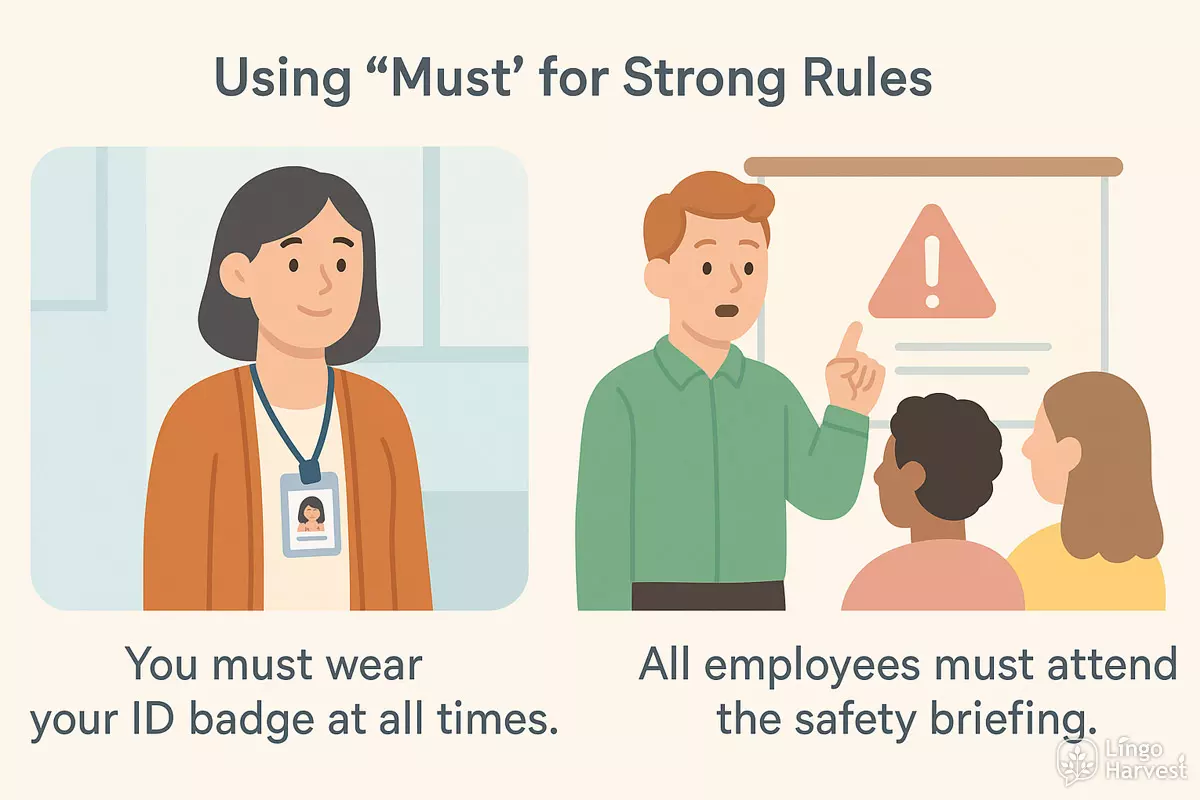
"Must" is typically reserved for rules, laws, or instructions that allow little room for choice. It signals that something is not optional. For example, in formal settings such as workplaces, schools, or public notices, "must" is used to show that compliance is required.
- You must wear your ID badge at all times.
- All employees must attend the safety briefing.
- Visitors must sign in at the reception desk.
- Students must submit assignments by Friday.
- Drivers must stop at red lights.
Making Commands More Polite
While "must" is clear and authoritative, it can sound harsh in everyday conversation. To soften the tone, speakers sometimes use modal verbs like "should" or polite phrases. However, when obligation is non-negotiable, "must" can still be made more considerate by adjusting word order or adding softening language.
- To enter, you must show your ticket, please.
- For your safety, you must keep your seatbelt fastened.
- To avoid delays, passengers must be ready at the gate.
- For everyone's comfort, you must turn off your phone during the performance.
Comparing Firm and Polite Forms
Sometimes, it's helpful to compare direct commands with more tactful alternatives. The table below illustrates how the same rule can be delivered with varying degrees of firmness or politeness.
| Direct Command | Softer/Polite Alternative |
|---|---|
| You must leave now. | Could you please leave now? |
| Guests must not enter this area. | We kindly ask guests not to enter this area. |
| Everyone must remain seated. | For your comfort, please remain seated. |
| Phones must be switched off. | We appreciate it if you switch off your phones. |
| Children must be accompanied by an adult. | Children should be accompanied by an adult, thank you. |
Tips for Balancing Authority and Courtesy
- Use "must" for legal, safety, or official obligations. - Add polite words like "please" or "thank you" to soften the message. - Consider the context: formal rules require clarity, but everyday requests benefit from a gentler touch. - If strictness is essential, combine "must" with a brief explanation to show empathy. Choosing between firmness and politeness helps ensure your message is both understood and well-received, whether you're setting boundaries or guiding behavior.
Common Mistakes
Misusing "must" can lead to confusion or unintended meanings, especially for learners of English. This often happens when people try to express obligation, but choose the wrong form or use it in situations where another modal verb would be more appropriate. Let’s look at some frequent pitfalls and how to avoid them.
Confusing "Must" with "Have to"
Many English learners mix up "must" and "have to." While both can show necessity, "must" is typically used for rules or strong personal obligation, while "have to" often refers to external requirements. For example, "You must wear a helmet" (rule) vs. "I have to finish my homework" (outside requirement).
Using "Must" for Past or Future Obligations
"Must" does not have past or future forms. To talk about necessity in the past, use "had to." For the future, "will have to" is preferred.
- Incorrect: I musted go yesterday. ❌
- Correct: I had to go yesterday. ✅
- Incorrect: I must go tomorrow. (can work, but "will have to" is often clearer for the future)
- Correct: I will have to go tomorrow. ✅
Negative Forms: "Mustn't" vs. "Don't Have to"
A common error is confusing "mustn't" (prohibition) with "don't have to" (lack of necessity). Their meanings are quite different.
| Form | Meaning/Example |
|---|---|
| mustn't | You are not allowed to do it. You mustn't smoke here. |
| don't have to | It is not necessary, but you can if you want. You don't have to come early. |
| must | It is necessary/obligatory. You must wear a uniform. |
| have to | External obligation. I have to pay my bills. |
Directness and Politeness
"Must" can sound very direct or even rude if used with people you don’t know well. In spoken English, especially in requests, "have to" or softer modals like "should" are often better choices.
Incorrect Word Order or Missing Auxiliary
Another frequent mistake is incorrect sentence structure, especially in questions and negatives. For example:
- Incorrect: Must I to finish it?
- Correct: Must I finish it?
- Incorrect: You must not to enter.
- Correct: You must not enter.
Summary of Frequent Issues
- Using "must" for past or future when "had to" or "will have to" is needed
- Mixing up "mustn't" and "don't have to"
- Being too direct with "must" in polite conversation
- Incorrect structure: adding "to" after "must"
- Forgetting that "must" has no infinitive or participle form
- Assuming "must" and "have to" are always interchangeable
- Overusing "must" for personal advice when "should" fits better
- Using "must" in reported speech without changing the form
- Applying "must" with all subjects without checking context
- Ignoring regional differences (British vs. American usage)
Awareness of these patterns helps avoid misunderstandings and improves both spoken and written communication when expressing necessity or rules.
Practice: Write Sentences with Must
Understanding how to express necessity or strong rules is essential in English. The word must is commonly used to indicate obligations, strong recommendations, or things that are not optional. Below, you'll find practical exercises to help you get comfortable with this modal verb.
Exercise 1: Complete the Sentences
Fill in the blanks with the correct use of must to show obligation or strong rules.
- You ________ wear a helmet when riding a bike.
- Students ________ hand in their assignments by Friday.
- Visitors ________ show their ID at the entrance.
- You ________ not use your phone during the exam.
- Everyone ________ wash their hands before eating.
Show answers
- You must wear a helmet when riding a bike.
- Students must hand in their assignments by Friday.
- Visitors must show their ID at the entrance.
- You must not use your phone during the exam.
- Everyone must wash their hands before eating.
Useful Patterns with "Must"
Here are some common ways to use "must" in sentences about rules and obligations:
- You must arrive on time.
- Employees must wear their badges.
- We must respect the rules.
- Children must not touch the stove.
- All passengers must fasten their seatbelts.
- Drivers must stop at a red light.
- Guests must sign in at reception.
- Food must be stored in the refrigerator.
- Pets must be on a leash.
- Customers must pay before leaving.
- Everyone must keep quiet in the library.
- Patients must follow the doctor’s instructions.
- Students must not cheat on exams.
- You must return books on time.
- Visitors must remove their shoes.
Exercise 2: Rewrite the Rules
Transform these instructions into sentences using "must".
- (Obligation) It is necessary to wear a uniform at school.
- (Prohibition) It is not allowed to smoke inside the building.
- (Requirement) You are required to show your ticket.
- (Necessity) It is essential to lock the door at night.
Show answers
- You must wear a uniform at school.
- You must not smoke inside the building.
- You must show your ticket.
- You must lock the door at night.
Quick Reference Table: Affirmative and Negative Forms
| Affirmative | Negative |
|---|---|
| You must wear a mask. | You must not (mustn't) touch the wires. |
| Visitors must register at the desk. | Students must not use calculators during the test. |
| Employees must attend the meeting. | Children must not play in the street. |
| Drivers must carry a license. | Pets must not enter the kitchen. |
Practicing with real-life examples will help you use "must" naturally to express rules and obligations in English conversations and writing.