Passive with Modal Verbs: Forms and Common Uses

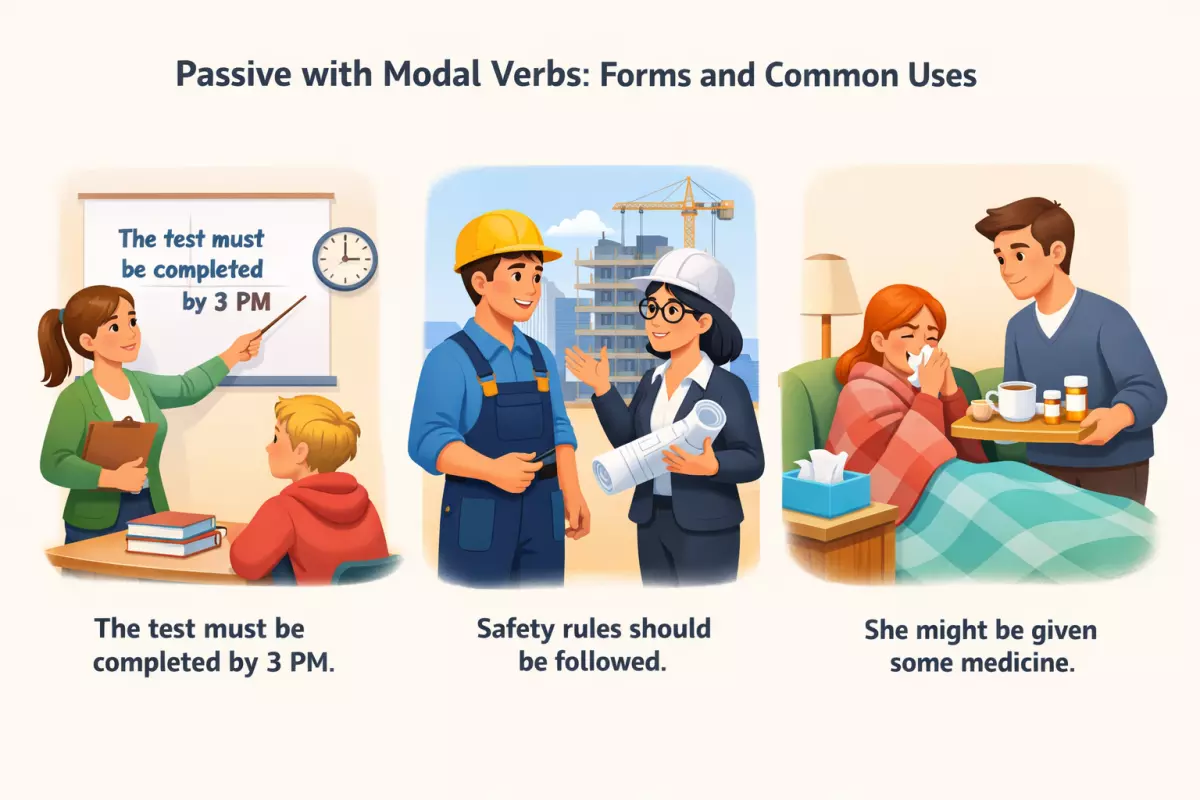 Explains how modal verbs work in the passive, starting with the basic form modal + be + past participle. Covers meanings and use with may, must, should, and can, plus questions, negatives, and when to include or omit agent phrases. Ends with common mistakes and homework practice tasks.
- How modal verbs work in the passive
- Basic form: modal + be + past participle
- Passive modals in different meanings
- Passive with may, must, should, can
- Questions and negatives in passive modals
- Agent phrases and when to omit them
- Typical learner mistakes and fixes
- Homework: passive modal practice tasks
In everyday English, we often pair modals like can, must, or should with the passive to emphasize what happens to something rather than who does it. This is helpful when the actor is unknown, unimportant, or obvious, especially in instructions, rules, and reports. This article explains the key patterns and shows when this form sounds natural and clear.
How modal verbs work in the passive
When a sentence with a modal is made passive, the modal stays the same and the main verb changes form. The object of the active sentence becomes the subject, and the verb phrase typically becomes modal + be + past participle. This keeps the meaning of ability, permission, obligation, possibility, or advice, but shifts the focus to the receiver of the action.
Core pattern
- Basic form: modal + be + past participle (V3)
- Active → passive shift: object becomes subject; the agent can be added with by if it matters.
- Agent optional: “by + doer” is often omitted when it is unknown, obvious, or unimportant.
Common modal-passive forms (with examples)
- can be + V3 (ability/possibility): The file can be downloaded from the portal.
- could be + V3 (weaker possibility/past ability): The cause could be explained in several ways.
- may be + V3 (permission/possibility): Late submissions may be accepted at the instructor’s discretion.
- might be + V3 (uncertain possibility): The results might be affected by temperature.
- must be + V3 (strong necessity/requirement): Safety goggles must be worn in the lab.
- should be + V3 (recommendation/expected standard): The report should be submitted by Friday.
- ought to be + V3 (advice/duty): Personal data ought to be protected carefully.
- will be + V3 (future fact/promise): All tickets will be checked at the entrance.
- would be + V3 (polite/conditional): The request would be handled by our support team.
- shall be + V3 (formal rules/requirements): Payments shall be made within 30 days.
Negatives and questions
- Negative: place not after the modal: The form cannot be processed without a signature.
- Question: invert the modal and the subject: Can the package be delivered today?
- Short answers: Yes, it can. / No, it can’t. (the main verb phrase is usually omitted in replies)
Choosing the right subject in passive clauses
- Use passive when the receiver is the topic: The equipment must be cleaned after use.
- Add the agent only when it clarifies responsibility: The password must be reset by an administrator.
- Avoid passive when the “doer” is essential and unknown would confuse: If who does it matters, consider active or include “by + agent.”
Frequent learner errors (and fixes)
- ❌ The report must submitted today. → ✅ The report must be submitted today.
- ❌ The report must be submit today. → ✅ The report must be submitted today.
- ❌ Can be delivered the package today? → ✅ Can the package be delivered today?
- ❌ The rules should followed. → ✅ The rules should be followed.
Basic form: modal + be + past participle

To make a passive sentence with a modal verb, keep the modal (can, must, should, etc.), add be, and then use the past participle of the main verb. This structure is used when the focus is on the action or result, while the doer is unknown, unimportant, or intentionally not mentioned.
Core pattern and word order
- Structure: modal + be + past participle
- Object becomes the subject: The thing affected by the action moves to the front.
- Agent (doer) is optional: add by + agent only when it adds useful information.
- Time reference: the modal gives the meaning (ability, obligation, possibility), not a specific tense ending.
- Main verb form: use the past participle (done, made, sent, built, seen, etc.).
Common modals used in the passive
- can / could → ability or possibility: “The issue can be resolved quickly.”
- may / might → possibility: “Your request may be approved.”
- must → strong necessity: “The form must be signed today.”
- should → advice/expectation: “The report should be finished by Friday.”
- will / would → prediction, willingness, typical result: “The package will be delivered tomorrow.”
- shall (formal/legal) → requirement: “Payment shall be made within 30 days.”
Examples (active → passive with a modal)
- Active: “They can repair the laptop.” → Passive: “The laptop can be repaired.”
- Active: “Someone must lock the door.” → Passive: “The door must be locked.”
- Active: “They should update the website.” → Passive: “The website should be updated.”
- Active: “They may reject the application.” → Passive: “The application may be rejected.”
- Active: “A technician will install the software.” → Passive: “The software will be installed.”
- Active: “They could postpone the meeting.” → Passive: “The meeting could be postponed.”
- Active: “They might change the schedule.” → Passive: “The schedule might be changed.”
- Active: “The committee would review the proposal.” → Passive: “The proposal would be reviewed.”
- Active: “They must renew the license.” → Passive: “The license must be renewed.”
- Active: “They can’t access the file.” → Passive: “The file can’t be accessed.”
- Active: “You should store the chemicals safely.” → Passive: “The chemicals should be stored safely.”
- Active: “They may publish the results.” → Passive: “The results may be published.”
Negatives and questions
- Negative: modal + not + be + past participle → “The documents must not be shared.”
- Yes/No question: modal + subject + be + past participle? → “Can the order be canceled?”
- Wh-question: question word + modal + subject + be + past participle? → “When should the form be submitted?”
Frequent errors to avoid
- ✅ “The work must be completed.” ❌ “The work must completed.” (missing be)
- ✅ “The files can be copied.” ❌ “The files can be copy.” (wrong verb form)
- ✅ “The tickets should be bought online.” ❌ “The tickets should bought online.” (missing be)
- ✅ “The meeting may be postponed.” ❌ “The meeting may postponed.” (missing be)
Passive modals in different meanings
Modal verbs in the passive are not only about form (modal + be + past participle). The same structure can express different meanings such as obligation, possibility, advice, permission, or logical conclusions. The meaning comes from the modal you choose and the context (rules, evidence, plans, expectations).
Obligation and necessity (rules, duties, requirements)
Use these when the focus is on what is required, not on who does it.
- must be + past participle for strong obligation:
All visitors must be registered at reception. - have to be + past participle for external requirement (often practical):
The form has to be signed before submission. - need to be + past participle for necessary action (often to fix/prepare):
The data needs to be verified before it is published. - should be + past participle for expected duty (softer than must):
Safety equipment should be checked weekly. - ought to be + past participle for moral/ideal obligation (less common):
Personal information ought to be protected.
Advice, recommendation, and best practice
These forms suggest a good idea rather than a strict rule. They are common in instructions and guidelines.
- should be + past participle for general advice:
The medicine should be taken with food. - can be + past participle to suggest an option (often neutral):
The report can be divided into three sections. - could be + past participle for a tentative suggestion:
The issue could be resolved by restarting the system. - might be + past participle for a cautious recommendation:
The wording might be simplified for clarity.
Permission and prohibition (allowing or not allowing an action)
Use these when the key point is whether something is allowed, rather than who allows it.
- can be + past participle for permission (informal/common):
Photos can be taken after the presentation. - may be + past participle for formal permission:
Refunds may be issued within 30 days. - must not be + past participle for prohibition:
These documents must not be shared externally. - cannot be + past participle for “not allowed” or “not possible” (context decides):
Alcohol cannot be served to minors.
Possibility, ability, and general potential
These modals highlight what is possible in general, what sometimes happens, or what is theoretically achievable.
- can be + past participle for general possibility:
Errors can be corrected later. - could be + past participle for less certain possibility:
The delay could be caused by heavy traffic. - may be + past participle for a realistic possibility (slightly formal):
The meeting may be postponed. - might be + past participle for weaker possibility:
The results might be affected by temperature changes.
Logical deduction and “it’s likely that…” meanings
Some passive modal patterns express conclusions based on evidence. They often describe what is probably true now.
- must be + past participle for strong deduction:
The window is broken; it must be replaced. - may be + past participle for a cautious conclusion:
The device may be damaged. - might be + past participle for a tentative guess:
The package might be lost. - could be + past participle for a possible explanation:
The noise could be caused by a loose part.
Past meaning: criticism, expectations, and missed actions
To talk about what was expected or advisable in the past, use a perfect passive pattern: modal + have been + past participle. This is especially common with should and could.
- should have been + past participle for criticism or unmet expectation:
The files should have been backed up before the update. - must have been + past participle for strong past deduction:
The email must have been sent to the wrong address. - may/might have been + past participle for uncertain past possibility:
The results may have been influenced by a calculation error. - could have been + past participle for a past possibility (often “but it wasn’t”):
The problem could have been avoided with a simple check.
Common meaning confusions to avoid
- “Cannot be done” can mean either “not possible” or “not allowed.” Clarify with context:
✅ The payment cannot be processed without an ID. (not possible)
✅ Smoking cannot be permitted in this area. (not allowed) - Must be done (obligation) vs must be done (deduction) depend on evidence vs rules:
✅ The test must be completed by Friday. (rule/deadline)
✅ The test must be completed already; the lab is closed. (conclusion) - In passive instructions, should be is usually safer than must be unless it is truly a strict requirement.
Passive with may, must, should, can
With modal verbs, the passive voice keeps the modal (may/must/should/can) and changes the main verb to a passive form. The basic pattern is: modal + be + past participle. Use this when the action matters more than who does it, or when the agent is unknown, obvious, or unimportant.
Core form and meaning
- may + be + past participle → possibility: “The results may be published next week.”
- must + be + past participle → necessity/obligation (often rules or strong conclusions): “Safety goggles must be worn.”
- should + be + past participle → recommendation/expectation: “The form should be completed in ink.”
- can + be + past participle → ability/permission/general possibility: “Tickets can be bought online.”
Common patterns you’ll use
- modal + be + V3 (present/future reference): “The meeting can be rescheduled.”
- modal + not + be + V3 (negative): “Personal data must not be shared.”
- modal + be + V3 + by + agent (agent included when needed): “The device must be installed by a qualified technician.”
- modal + be + V3 + time phrase: “The order should be shipped today.”
- modal + be + V3 + place phrase: “Bags may be stored here.”
Past reference: modal perfect passive
To talk about what was necessary, recommended, possible, or allowed in the past, use: modal + have been + past participle. This is common for deductions, criticism, and hindsight.
- may have been + V3 (possible past): “The email may have been sent to the wrong address.”
- must have been + V3 (strong deduction about the past): “The file must have been deleted accidentally.”
- should have been + V3 (unmet expectation/criticism): “The error should have been reported earlier.”
- can have been + V3 (less common; possible in some contexts): “The package can have been damaged during transit.”
- cannot/can’t have been + V3 (impossibility): “The document can’t have been signed yesterday; the office was closed.”
Accuracy tips and frequent mistakes
- Use be, not an infinitive marker: ✅ “It must be repaired.” ❌ “It must to be repaired.”
- Keep the main verb in past participle form: ✅ “The rules must be followed.” ❌ “The rules must be follow.”
- Don’t add do/does/did with modals: ✅ “It can be done.” ❌ “It does can be done.”
- Use by + agent only when the doer matters; otherwise, omit it for a cleaner passive.
- For ongoing actions, you can use modal + be being + V3, but it’s uncommon and often wordy: “The issue must be being investigated” is usually better as “The issue must be under investigation.”
Expanded example set (quick reference)
- “The report must be submitted by Friday.”
- “All visitors must be registered at reception.”
- “The lights should be turned off when you leave.”
- “The instructions should be read carefully.”
- “This medicine may be taken with food.”
- “The schedule may be changed without notice.”
- “Photos can be shared with permission.”
- “These files can be accessed from any device.”
- “The appointment can’t be confirmed yet.”
- “The payment must not be processed twice.”
- “The missing page may have been removed.”
- “The decision must have been made earlier.”
- “The package should have been delivered by now.”
- “The warning should have been displayed on the label.”
- “The form may not have been signed.”
- “The results can’t have been verified with that method.”
Questions and negatives in passive modals
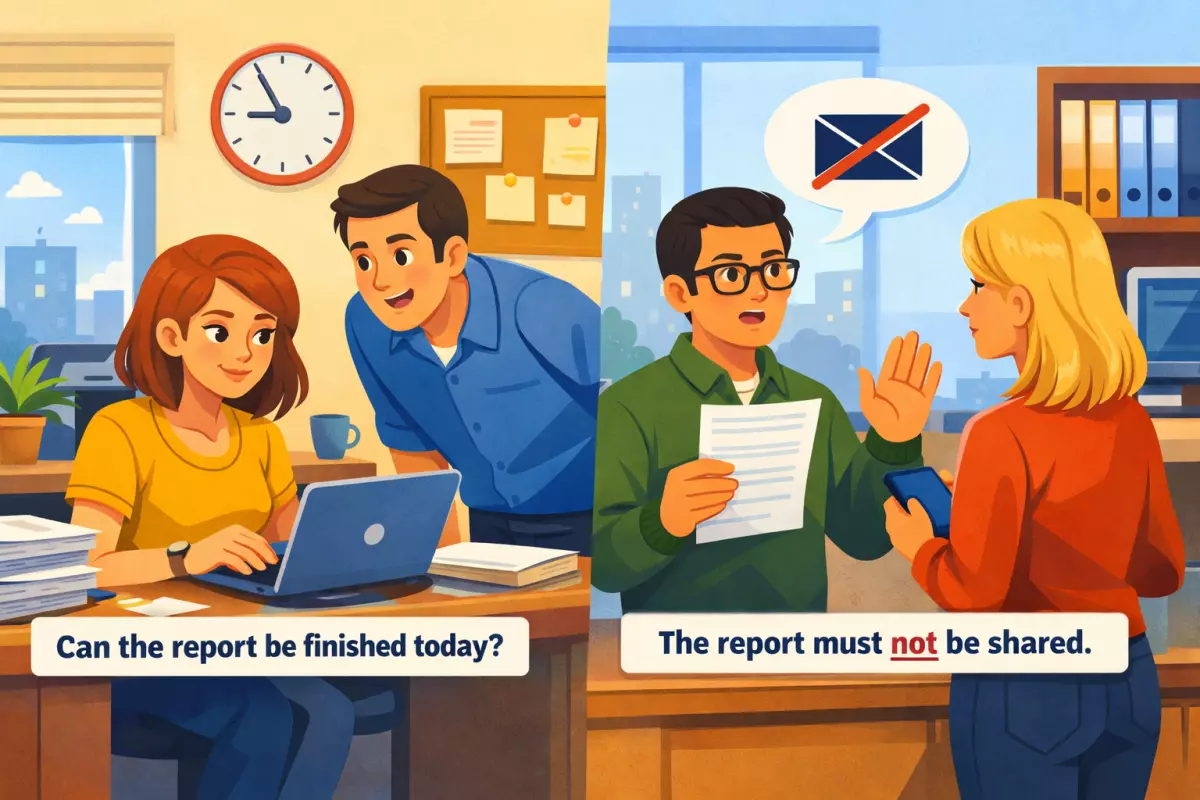
In modal passive structures, the word order stays predictable: the modal comes first, then be, then the past participle. To form questions, you invert the modal and the subject. To form negatives, you place not after the modal (or use a negative modal like can’t).
Core patterns
- Statement: Subject + modal + be + past participle → “The report must be finished today.”
- Negative: Subject + modal + not + be + past participle → “The report must not be shared.”
- Yes/No question: Modal + subject + be + past participle? → “Must the report be finished today?”
- Wh-question: Wh-word + modal + subject + be + past participle? → “When must the report be finished?”
Negatives: where “not” goes (and what it changes)
- Place not directly after the modal: “The files should not be deleted.”
- With contractions in informal writing: “The files shouldn’t be deleted.”
- Negative meaning can be different with some modals:
- “It must not be opened.” (prohibition)
- “It doesn’t have to be opened.” (no necessity)
- ❌ “It mustn’t be opened” is not the same as “It doesn’t have to be opened.”
- For impossibility, common choices include: “can’t be + past participle” and “couldn’t be + past participle.”
- With may/might, negatives often express uncertainty about a passive result: “The package may not be delivered today.”
Questions: inversion with the modal
- Invert only the modal and the subject; keep be after the subject: ✅ “Should the form be signed?” → ❌ “Should be the form signed?”
- Yes/No questions are common for rules and procedures: “Can this device be repaired?”
- Wh-questions ask about time, place, reason, agent, or method:
- “When must the payment be made?”
- “Where should the boxes be stored?”
- “Why can’t the account be verified?”
- “How can the error be fixed?”
- “By whom should the contract be signed?” (formal)
Common example set (useful patterns to copy)
- “Can the meeting be moved to Friday?”
- “The meeting can’t be moved to Friday.”
- “Should the password be changed regularly?”
- “The password should not be shared.”
- “Must the ID be shown at the entrance?”
- “The ID must be shown at the entrance.”
- “May the form be submitted online?”
- “The form may not be accepted without a signature.”
- “Could the issue be resolved today?”
- “The issue couldn’t be resolved today.”
- “Might the results be affected by the temperature?”
- “The results might not be affected at all.”
- “When should the materials be delivered?”
- “Where can the equipment be returned?”
- “Why must the document be translated?”
Agent phrases and when to omit them
In passive clauses with modal verbs, the doer can be added with a by-phrase (or another agent marker), but it is often left out because the focus is on the action, result, rule, or requirement. The decision depends on whether the agent is important, known, or useful for clarity.
How to form the agent phrase with modals
- Basic pattern: modal + be + past participle (+ by + agent)
Example: The report must be submitted by Friday (time) and by the team lead (agent). - Agent marker: most commonly by + noun/pronoun
Example: The decision should be approved by the committee. - When the “agent” is an organization: use a clear noun phrase rather than “them/they”
Example: The policy will be updated by HR (clearer than “by them”). - Don’t confuse agent with instrument: “by” = doer; “with” = tool/material
✅ The lock can be opened by a locksmith.
✅ The lock can be opened with a key.
When to include the agent
- Responsibility matters: when the reader needs to know who is accountable.
Example: The error must be corrected by the vendor. - To avoid ambiguity: when more than one possible doer exists.
Example: The samples should be tested by the lab (not by the clinic). - To compare roles: when the sentence contrasts who does what.
Example: The draft may be revised by the editor, but it must be approved by legal. - To add authority: when the strength of the statement depends on the source.
Example: The medication should be taken as directed by your doctor. - To specify a required performer: when rules demand a qualified person.
Example: The wiring must be installed by a licensed electrician. - To clarify permission: when “can/may” depends on who grants it.
Example: Access may be granted by the administrator. - To show enforcement: when consequences come from a specific authority.
Example: Fines can be issued by the city.
When it’s better to omit the agent
- The doer is obvious or already mentioned:
Example: (In a company handbook) Expenses must be approved before reimbursement. - The agent is unknown:
Example: The files may have been deleted (agent not identified). - The agent is unimportant: when the result is what matters.
Example: The forms should be completed before arrival. - The sentence expresses a general rule:
Example: Seat belts must be worn at all times. - You want a neutral, impersonal tone: common in formal notices and procedures.
Example: Payment must be received by the 15th. - You want to avoid blaming: useful in diplomatic or careful writing.
Example: The deadline may have been missed. - The agent would be vague: “by someone/by people” often adds little.
Example: The issue should be addressed (better than “by someone”).
Common patterns and example set
- The application must be signed by the applicant.
- The application must be signed before submission. (agent not needed)
- The equipment should be inspected by a technician.
- The equipment should be inspected regularly. (focus on routine)
- The contract may be terminated by either party.
- The contract may be terminated early under certain conditions.
- The data can be accessed by authorized users only.
- The data can be accessed after verification. (process-focused)
- The report will be reviewed by the supervisor.
- The report will be reviewed within two business days.
- The prescription must be renewed by a physician.
- The prescription must be renewed annually.
- The request should be handled by customer support.
- The request should be handled promptly.
Placement and pronoun choices
- Default position: put the by-phrase after the past participle.
Example: The meeting can be rescheduled by the organizer. - Keep it close to the verb: avoid separating the verb and agent with long inserts unless needed for clarity.
✅ The device must be repaired by an authorized service center within 30 days.
❌ The device must be repaired within 30 days by an authorized service center. (can sound awkward) - Pronouns: “by me/us/him/her/them” is fine when the referent is clear.
Example: The package should be picked up by us at noon.
Typical learner mistakes and fixes
Errors with modal passives usually come from mixing up the auxiliary order, choosing the wrong past participle, or forgetting that the passive focuses on the receiver of the action. Use the patterns below to self-check quickly.
- Wrong word order after a modal
❌ The report must be submit today.
✅ The report must be submitted today.
Fix: Use modal + be + past participle (must be done, can be seen, should be checked). - Using “to be” after a modal
❌ The forms must to be signed.
✅ The forms must be signed.
Fix: After modals, use the base form: must be, should be, can be (not to be). - Using the -ing form instead of the past participle
❌ The issue should be fixing soon.
✅ The issue should be fixed soon.
Fix: Passive needs the past participle (fixed, repaired, approved), not the -ing form. - Confusing passive with adjective “be + adjective”
❌ The door should be open by security at 8. (unclear: state vs action)
✅ The door should be opened by security at 8. (action)
Fix: If you mean an action performed by someone, use the participle of the verb (opened). If you mean a state, “be + adjective” may be fine (The door should be open). - Forgetting that “by + agent” is optional
❌ The package must be delivered by.
✅ The package must be delivered. / The package must be delivered by the courier.
Fix: Add “by + doer” only when it matters; otherwise omit it. - Using an active object pronoun as the subject
❌ Him should be invited to the meeting.
✅ He should be invited to the meeting.
Fix: Passive subjects use subject pronouns (he, she, they), not object forms (him, her, them). - Mixing up tense/time: present modal passive vs perfect modal passive
❌ The email should be sent yesterday. (possible, but often the meaning is “it was a mistake”)
✅ The email should have been sent yesterday. (clear past expectation not met)
Fix: Use modal + have been + past participle to talk about missed obligations/expectations in the past. - Omitting “been” in perfect forms
❌ The files might have be deleted.
✅ The files might have been deleted.
Fix: Perfect passive needs “been”: might have been, should have been, must have been. - Using “have” when you need “be” (or the reverse)
❌ The forms must have signed today.
✅ The forms must be signed today. / The forms must have been signed by now.
Fix: “must be signed” = requirement now/future; “must have been signed” = logical conclusion about the past. - Choosing the wrong modal for meaning (ability vs permission vs advice)
❌ Visitors can’t be seated here. (sounds like inability, not a rule)
✅ Visitors mustn’t be seated here. (rule/prohibition) / Visitors can’t be seated here. (also possible if context is “it’s not possible”)
Fix: Match the modal to the function: can/could (ability/possibility), may/might (possibility/permission), must (strong necessity), should (advice/expectation). - Using “will be” when you mean “must be”
❌ The ID will be shown at the entrance. (sounds like a prediction)
✅ The ID must be shown at the entrance. (rule)
Fix: “will” often predicts; “must” sets a requirement. - Overusing passive when the agent is important
❌ A decision should be made tomorrow. (unclear who is responsible)
✅ The committee should make a decision tomorrow. / A decision should be made by the committee tomorrow.
Fix: If responsibility matters, use active voice or include the agent with “by”. - Trying to form a passive with intransitive verbs
❌ The accident must be happened at noon.
✅ The accident must have happened at noon. (active perfect, not passive)
Fix: Only transitive verbs (with an object) can be passive: “deliver a package” → “The package can be delivered.” Verbs like happen, arrive, occur do not take a passive. - Not checking irregular past participles
❌ The results should be send by email.
✅ The results should be sent by email.
Fix: Learn common irregular forms used in formal notices: sent, made, built, written, paid, kept, shown, taken.
Quick pattern checks
- Present/future requirement: must/should/can + be + past participle (must be completed, should be checked).
- Past expectation or past possibility: should/might/must + have been + past participle (should have been delivered, might have been lost).
- If you can add “by someone” naturally, passive is likely correct; if not, consider active voice or a different verb.
Homework: passive modal practice tasks
These exercises focus on choosing the correct passive form after a modal (or a modal-like verb) and keeping the meaning the same. Pay attention to two patterns:
- Modal + be + past participle (present/future meaning): must be done, can be seen, should be checked
- Modal + have been + past participle (past meaning): must have been done, could have been seen, should have been checked
Task 1: Rewrite as passive (keep the same meaning)
- They must submit the report by 5 p.m.
- Someone should clean the lab every evening.
- People can download the form from the portal.
- They may cancel the flight due to fog.
- Someone ought to inform the residents about the water cut.
- They have to replace the broken window.
- People need to store these chemicals in a cool place.
- They are going to announce the results tomorrow.
- Someone is supposed to lock the doors at night.
- They might delay the meeting.
Show answers
- The report must be submitted by 5 p.m.
- The lab should be cleaned every evening.
- The form can be downloaded from the portal.
- The flight may be cancelled due to fog.
- The residents ought to be informed about the water cut.
- The broken window has to be replaced.
- These chemicals need to be stored in a cool place.
- The results are going to be announced tomorrow.
- The doors are supposed to be locked at night.
- The meeting might be delayed.
Task 2: Choose the correct option (present vs. past passive)
- The documents (must be / must have been) signed before we can process the request.
- The documents (must be / must have been) signed yesterday; otherwise the courier would not have collected them.
- The lights (should be / should have been) turned off when the office is empty.
- The lights (should be / should have been) turned off last night, but they were left on.
- The package (can be / could have been) delivered to reception during office hours.
- The package (can be / could have been) delivered earlier, but the address label was missing.
- The results (may be / may have been) announced this afternoon, depending on the final check.
- The results (may be / may have been) announced already; I saw a notification.
- The device (might be / might have been) damaged if it was dropped.
- The device (might be / might have been) damaged during shipping; the box was crushed.
Show answers
- must be
- must have been
- should be
- should have been
- can be
- could have been
- may be
- may have been
- might be
- might have been
Task 3: Correct the mistakes (write the corrected sentence)
- ❌ The meeting must been postponed.
- ❌ This form can downloaded online.
- ❌ The keys should be return to reception.
- ❌ The door must be locked yesterday.
- ❌ The files might have been delete by accident.
- ❌ The report must be submit by noon.
- ❌ The tickets may been sent to your email.
- ❌ The equipment should have be checked before use.
- ❌ The bill has to paid within ten days.
- ❌ The instructions are supposed being followed.
Show answers
- ✅ The meeting must have been postponed.
- ✅ This form can be downloaded online.
- ✅ The keys should be returned to reception.
- ✅ The door must have been locked yesterday.
- ✅ The files might have been deleted by accident.
- ✅ The report must be submitted by noon.
- ✅ The tickets may have been sent to your email.
- ✅ The equipment should have been checked before use.
- ✅ The bill has to be paid within ten days.
- ✅ The instructions are supposed to be followed.
Task 4: Write two versions (active and passive) from the prompt
For each item, write (a) an active sentence and (b) a passive sentence using the modal given. Keep the tense and meaning consistent.
- Prompt: “safety goggles / wear / in the lab” (must)
- Prompt: “identity / verify / before entry” (has to)
- Prompt: “photos / share / without permission” (must not)
- Prompt: “the heating / repair / this week” (needs to)
- Prompt: “the schedule / change / at short notice” (may)
- Prompt: “the data / back up / regularly” (should)
- Prompt: “the room / use / for exams” (can)
- Prompt: “the invoice / pay / by Friday” (is supposed to)
Show answers
- Active: Students must wear safety goggles in the lab. Passive: Safety goggles must be worn in the lab.
- Active: Staff have to verify identity before entry. Passive: Identity has to be verified before entry.
- Active: You must not share photos without permission. Passive: Photos must not be shared without permission.
- Active: The landlord needs to repair the heating this week. Passive: The heating needs to be repaired this week.
- Active: They may change the schedule at short notice. Passive: The schedule may be changed at short notice.
- Active: IT should back up the data regularly. Passive: The data should be backed up regularly.
- Active: We can use the room for exams. Passive: The room can be used for exams.
- Active: Accounts is supposed to pay the invoice by Friday. Passive: The invoice is supposed to be paid by Friday.