Using Should for Advice and Suggestions

 This article explains when to use should for giving advice, how to form positive and negative sentences, and introduces common expressions like you should try. It also includes practice exercises for giving advice with should in daily English.
When giving advice or making recommendations in English, using the word "should" is a straightforward way to keep your suggestions clear and polite. Learning how to use "should" properly allows you to express your ideas in a friendly, respectful manner, making conversations smoother and more effective. For example, you might say, "You should try this restaurant," or "You should see a doctor if you're not feeling well." By mastering this simple word, you can offer guidance that sounds both helpful and considerate.
When to Use Should
The modal verb should is commonly used for giving advice, making suggestions, or recommending actions. It often introduces ideas that are not obligations, but rather opinions about what is best or preferable in a situation. This modal is softer than “must” or “have to,” signaling a recommendation rather than a strict rule.
Typical Contexts for Using "Should"
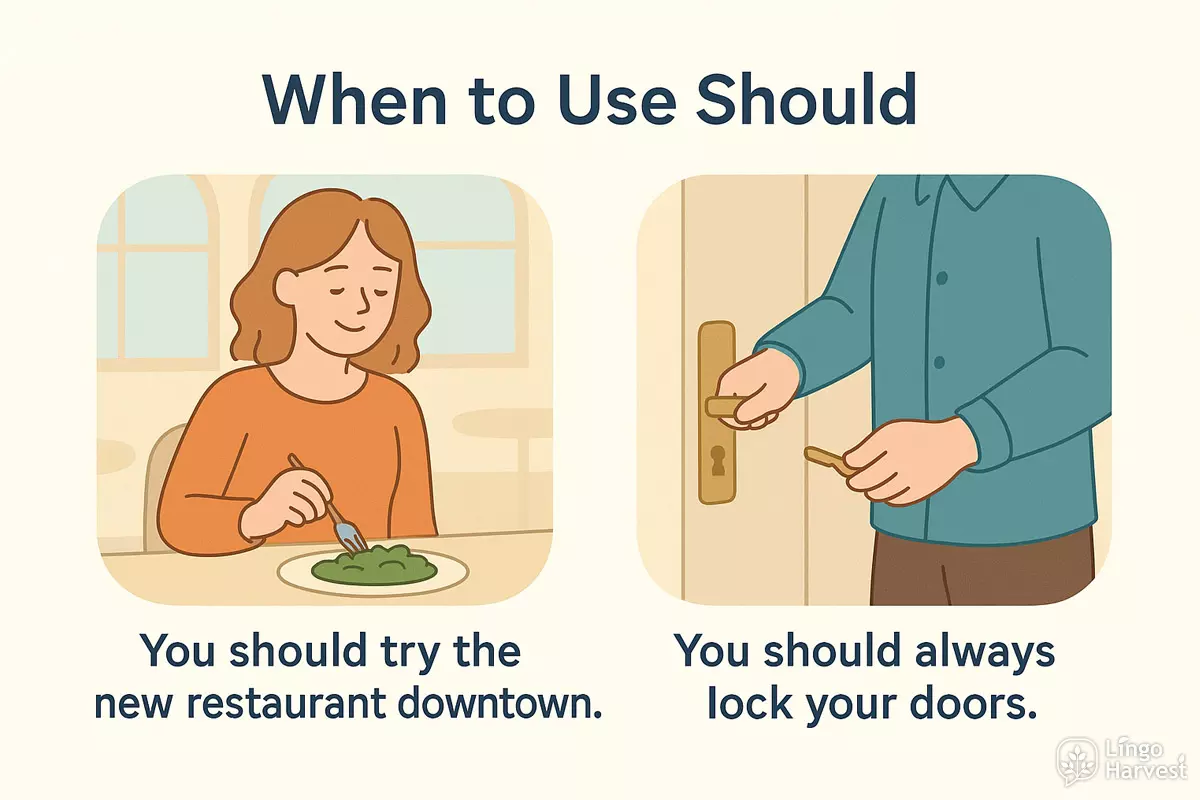
You’ll often hear should in everyday conversations, especially when people want to help, guide, or offer polite direction. Here are some typical situations:
- Offering advice: “You should try the new restaurant downtown.”
- Suggesting solutions: “If you’re tired, you should go to bed early.”
- Expressing expectations: “The train should arrive on time.”
- Giving recommendations: “Students should review their notes before an exam.”
- Proposing actions: “We should leave soon to avoid traffic.”
- Predicting likely actions: “He should be home by now.”
- Sharing opinions: “I think you should apologize.”
- Highlighting best practices: “You should always lock your doors.”
- Expressing mild obligation: “You should finish your homework before playing.”
- Making polite requests: “Should I open the window?”
Comparing "Should" to Other Modals
It’s helpful to see how should differs from other modal verbs. Must expresses strong necessity, while ought to is very similar to should but slightly more formal. The table below highlights the differences:
| Modal Verb | Use & Example |
|---|---|
| Should | Advice, suggestion, expectation You should see a doctor. |
| Must | Strong necessity, obligation You must wear a seatbelt. |
| Ought to | Advice, recommendation (formal) You ought to be more careful. |
| Could | Polite suggestion, possibility You could try restarting your computer. |
Tips for Effective Use
Use should when your goal is to help or guide someone without sounding too forceful. In formal writing, it can express recommendations, while in conversation, it softens instructions. Remember, it’s not about imposing rules, but about offering insight or encouragement.
Positive and Negative Sentences
When giving advice or making suggestions with "should," it's important to know how to form both affirmative and negative statements. The structure is straightforward: "should" remains the same for all subjects, followed by the base form of the verb. For negative forms, simply add "not" after "should." This helps speakers clearly express recommendations or warnings in a variety of situations.
Affirmative Forms
To suggest what someone ought to do, use "should" with the subject and the base verb. For example:
- You should drink more water.
- He should call his parents.
- We should try that new restaurant.
- They should arrive on time.
- I should finish my homework.
- She should take a break.
Negative Forms
To advise against an action, use "should not" (or the contraction "shouldn't") before the verb. This softens the advice and makes it less direct than commands.
- You should not skip breakfast.
- He shouldn't drive so fast.
- We shouldn't ignore the problem.
- They should not be late.
- I shouldn't spend so much money.
- She should not stay up too late.
Comparison Table: Affirmative vs. Negative Advice
| Affirmative Advice | Negative Advice |
|---|---|
| You should eat more vegetables. | You shouldn't eat too much sugar. |
| He should study for the test. | He shouldn't stay up all night. |
| We should listen to each other. | We shouldn't argue about everything. |
| They should check the weather. | They shouldn't forget their umbrellas. |
| I should get some rest. | I shouldn't work without breaks. |
Common Patterns and Usage Notes
- Should is used for recommendations, not obligations (use "must" or "have to" for stronger necessity).
- Contractions ("shouldn't") are more frequent in spoken English.
- For questions, invert the subject and "should": Should I call her?
- Adding reasons makes advice clearer: You should see a doctor because you look tired.
By mastering both forms, you can give helpful advice in a friendly and natural way.
Advice in Daily English
Understanding how to use “should” for offering suggestions is essential for clear and polite communication. In everyday conversations, “should” helps express recommendations, point out better choices, or gently warn someone about possible consequences. Its tone is softer than direct commands, making it suitable for both friends and colleagues.
Common Ways to Offer Suggestions
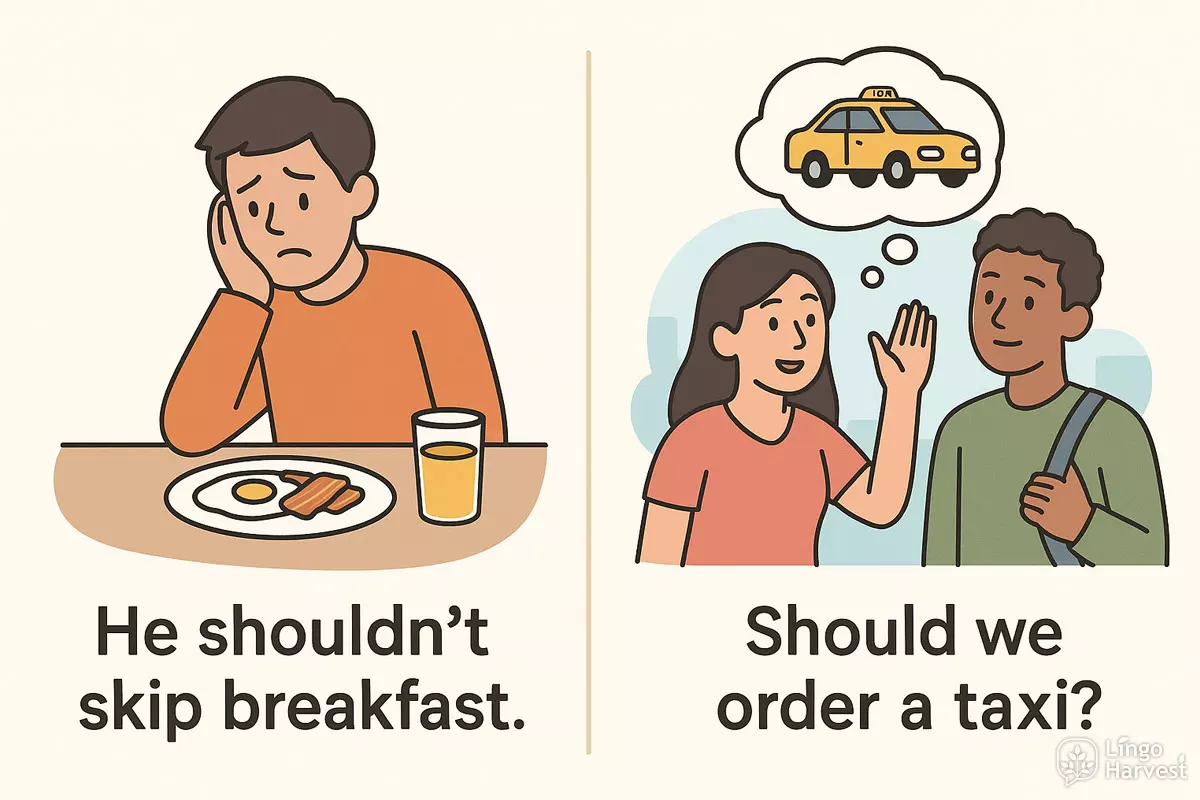
People often use “should” to give advice in a variety of situations—from daily routines to bigger life decisions. Here are some natural patterns:
- You should try this new restaurant.
- Maybe you should talk to your manager.
- I think you should get some rest.
- Should I call her now?
- He shouldn’t skip breakfast.
- Do you think I should bring an umbrella?
- We should leave earlier to avoid traffic.
- Should we order a taxi?
- You shouldn’t worry too much.
- Perhaps you should check your email.
- She should see a doctor about that cough.
- Should they join us for dinner?
Politeness and Tone
Using “should” makes your suggestions sound considerate rather than forceful. For example, “You should rest” is more polite than “Rest now.” Adding words like “maybe,” “perhaps,” or “I think” can soften advice further, making it easier for the listener to accept or refuse without feeling pressured.
Positive and Negative Advice
“Should” can suggest both actions to take and actions to avoid. For negative suggestions, simply add “not” after “should”:
- You shouldn’t drive so fast.
- She shouldn’t skip her medication.
- They shouldn’t ignore the warning signs.
Comparing Advice Structures
The structure of giving advice in English often varies. Here’s a comparison of common forms:
| Pattern | Example Sentence |
|---|---|
| Should + base verb | You should see the doctor. |
| Shouldn’t + base verb | You shouldn’t eat so late. |
| Question form | Should I bring my laptop? |
| Softening phrases | I think you should call her. |
Quick Tips for Everyday Use
- Use “should” for helpful suggestions, not strong orders.
- Soften advice with polite words for sensitive topics.
- Turn advice into a question to invite opinions: “Should we leave now?”
- Remember that “should” is followed by the base form of the verb (not “to” + verb).
Guidance using “should” is a simple way to sound both friendly and helpful in real-life interactions. With practice, you’ll notice how natural these patterns become in your conversations.
Common Expressions (You should try…)
When giving advice or making suggestions in English, certain phrases are especially common. These expressions help speakers sound polite, helpful, or encouraging. Understanding them can make your advice sound more natural and easy to follow.
Useful Patterns for Making Suggestions
The word "should" is often paired with verbs to recommend actions. Here are some typical ways people use it to guide others:
- You should try talking to your teacher.
- You should consider taking a break.
- You should eat more vegetables.
- You should call your parents.
- You should see a doctor.
- You should check your work before submitting it.
- You should save your progress often.
- You should ask for help if you’re unsure.
- You should listen carefully.
- You should plan ahead.
- You should apologize if you made a mistake.
- You should try to relax.
- You should get some rest.
- You should read the instructions first.
- You should write down important dates.
- You should be honest about your feelings.
- You should try new activities.
- You should keep practicing.
- You should compare your options.
- You should avoid making quick decisions.
Alternative Ways to Suggest
While "should" is direct and clear, other phrases can soften your advice or make it sound more tentative:
- Maybe you could try…
- Have you thought about…?
- It might be a good idea to…
- If I were you, I would…
- Why don’t you…?
- How about…?
Positive vs. Negative Recommendations
"Should" can also be used to warn against certain actions. Here’s a quick comparison:
| Positive Advice | Negative Advice |
|---|---|
| You should try to relax. | You shouldn’t worry too much. |
| You should exercise regularly. | You shouldn’t skip breakfast. |
| You should speak up in meetings. | You shouldn’t interrupt others. |
| You should ask questions if confused. | You shouldn’t guess the answers. |
Learning these standard phrases and their variations will help you give advice more effectively and naturally in English conversations.
Practice: Give Advice with Should
Giving advice in English often involves using the modal verb "should." This word helps us suggest what is best in a situation, without sounding too direct or forceful. Below, you'll find a variety of exercises and examples to help you become more comfortable with this useful form of guidance.
Common Patterns for Using "Should"
- You should + base verb (e.g., You should study more.)
- Should I + base verb...? (e.g., Should I call her?)
- People should not (shouldn't) + base verb (e.g., People shouldn't smoke inside.)
- What should I do? (asking for advice)
- If you want to..., you should + base verb (e.g., If you want to improve, you should practice daily.)
Practice: Give Advice for These Situations
Read each situation and write an appropriate suggestion using "should." Try to use different verbs and be specific in your advice.
- Anna always feels tired in the morning.
- Tom forgot his friend's birthday.
- It's raining, and you don't have an umbrella.
- Your friend wants to learn English quickly.
- Mark has a headache.
- Lucy wants to save more money.
- Your classmate is nervous about a test tomorrow.
- Someone lost their keys.
- Your brother wants to eat healthier meals.
- A friend is new in town and feels lonely.
Show answers
- She should go to bed earlier.
- He should apologize and maybe give a small gift.
- You should wait until the rain stops or buy a raincoat.
- He should practice every day and speak with native speakers.
- He should rest and drink plenty of water.
- She should make a budget and avoid unnecessary shopping.
- They should review their notes and get a good night's sleep.
- They should check all their pockets and ask at the lost and found.
- He should eat more vegetables and cook at home.
- They should join local clubs or attend community events.
Choosing the Right Advice: Which "Should" Suggestion Fits?
Match each problem with the best advice. Write the letter of the advice next to the correct number.
| Problem | Advice |
|---|---|
| 1. I want to get better at English. | A. You should practice speaking every day. |
| 2. My computer is very slow. | B. You should restart it or delete old files. |
| 3. I'm always late for work. | C. You should set your alarm earlier. |
| 4. I feel lonely in my new city. | D. You should join a club or meetup group. |
| 5. I have a toothache. | E. You should visit a dentist soon. |
Show answers
- 1 – A
- 2 – B
- 3 – C
- 4 – D
- 5 – E
Quick Practice: Correct or Incorrect?
Decide if these sentences use "should" correctly. Write ✅ for correct and ❌ for incorrect.
- You should to eat more fruit.
- Should I bring my laptop?
- He should studies harder.
- We should leave now.
- They should not be late.
Show answers
- ❌ (Incorrect: "should eat" not "should to eat")
- ✅
- ❌ (Incorrect: "should study" not "should studies")
- ✅
- ✅
Regular practice with these forms helps you sound natural and polite when offering recommendations. Try to use "should" in your daily conversations for both giving and asking for suggestions.