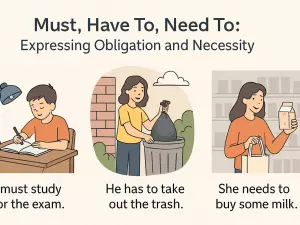
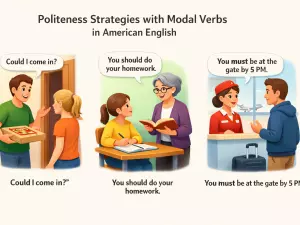
Have to vs Must: Simple Beginner Grammar

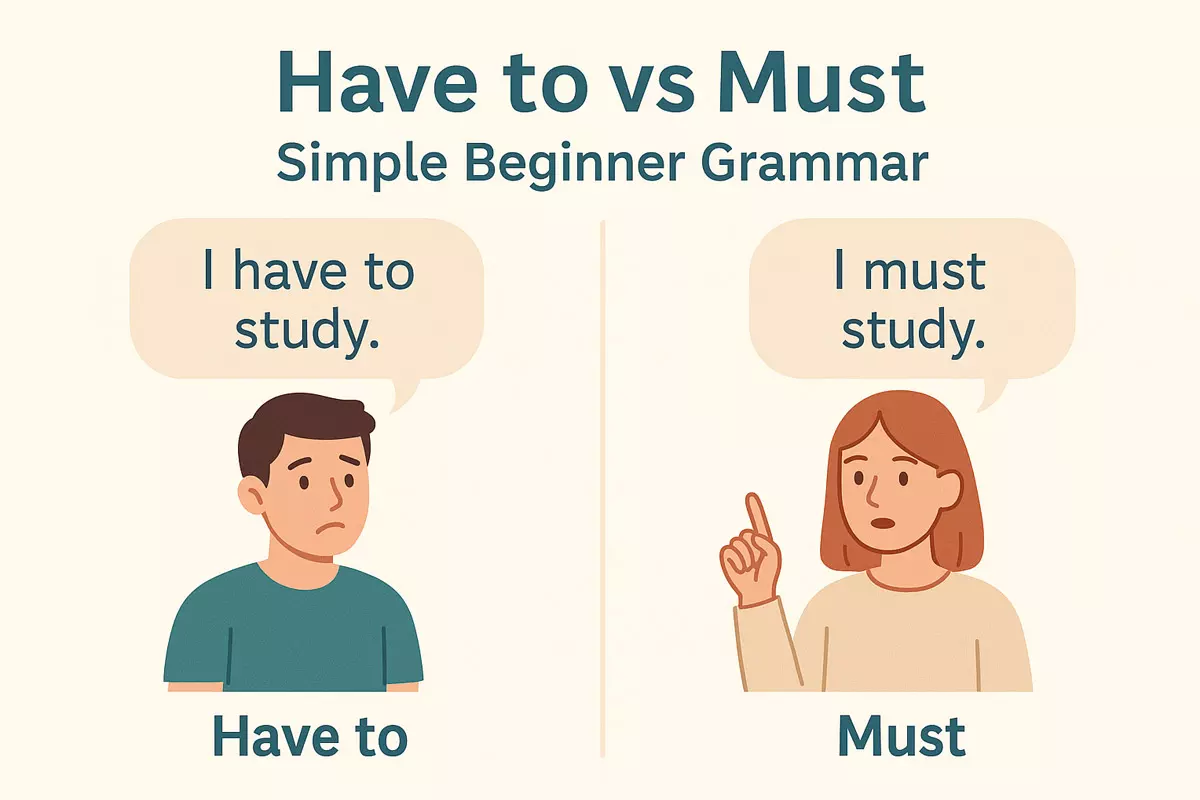 Here we the meaning and strength of obligation, explains when to use have to and must in both spoken and written English, highlights common confusions, and provides practice to help you select the correct form.
Learning when to use words that express necessity or obligation in English can be challenging for beginners, but understanding these differences is essential for clear communication. This article will guide you in distinguishing between two key ways to talk about things you must do or are required to do, helping you choose the right words in different situations. By mastering these expressions, you will be able to express your needs and obligations more accurately and confidently in everyday conversations.
Meaning and Strength of Obligation
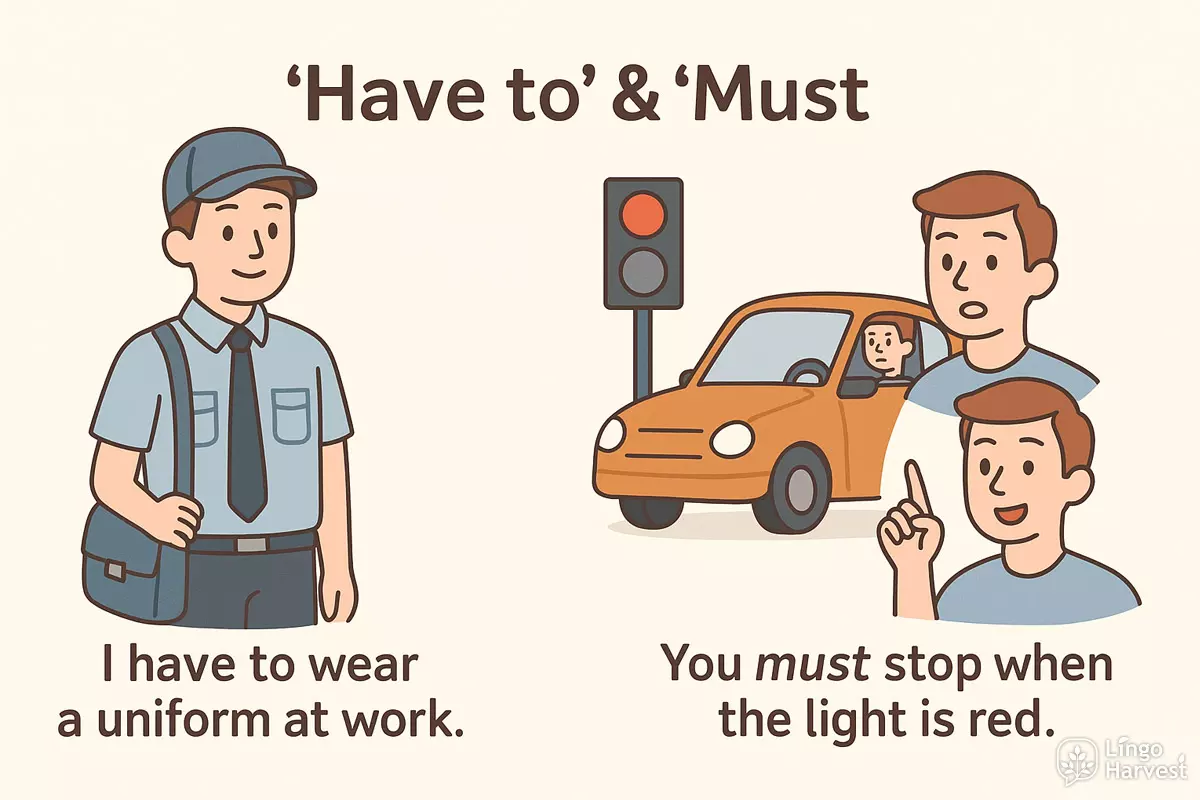
Understanding the difference between "have to" and "must" helps learners express necessity or rules more accurately. Both words show that something is required, but there are subtle differences in how strong or personal the requirement feels.
How "Have to" Works
"Have to" usually describes obligations that come from outside sources—such as laws, rules, or other people. It often communicates things that are necessary because of external circumstances, not personal choice. For example, you might say, "I have to wear a uniform at work," because your employer requires it.
How "Must" Works
"Must" is a bit stronger and more formal. It often shows that the speaker personally feels something is important, or is giving a strong recommendation or command. For example, "You must stop when the light is red" is a rule, but "You must see this movie!" is a strong suggestion from the speaker.
Comparing Strength and Use
When deciding which word to use, consider both the source of the requirement and how strong you want your statement to be. "Must" can sound stricter or more urgent, while "have to" is common in everyday speech and sounds more neutral.
| Expression | Typical Use | Strength |
|---|---|---|
| have to | Obligation from rules, laws, or outside circumstances | Medium |
| must | Personal authority, strong advice, or formal rules | High |
| don’t have to | No necessity; it’s not required | None |
| must not (mustn’t) | Prohibition; something is not allowed | Very strong |
Examples in Everyday Contexts
- You have to finish your homework before playing games. ✅
- Visitors must wear ID badges at all times. ✅
- Employees don’t have to work on public holidays. → It’s optional.
- You mustn’t use your phone during the test. ❌
- I have to leave early today—my manager told me.
- We must remember to lock the door.
- She has to take medicine every morning.
- Students must not enter the lab without permission.
- You don’t have to bring food; snacks will be provided.
- People must drive on the left in the UK.
- He has to travel for work every month.
- You must try this dessert!
Choosing between these words depends on who is making the rule and how urgent or strict the requirement is. This distinction helps you sound more natural and clear in English conversations.
When to Use Have to
"Have to" is a common way to express necessity or obligation in English, especially in informal speech and writing. It often replaces "must" when talking about rules, external requirements, or things that are not the speaker’s personal decision. This phrase is used for present, past, and future situations, making it more flexible than "must," which is mostly limited to the present.
Situations That Call for "Have to"
- External rules: When a rule, law, or authority requires something.
Example: Students have to wear uniforms at this school. - Everyday obligations: Talking about daily routines or chores that are necessary.
Example: I have to get up early for work. - Past and future needs: Describing obligations in different tenses.
Example (past): She had to leave early yesterday.
Example (future): You will have to finish this by Friday. - Third person statements: Using "has to" for he, she, it.
Example: He has to study for his exams. - Asking about necessity: Making questions about rules or requirements.
Example: Do we have to bring our own lunch? - Negative form: Expressing that something is not necessary.
Example: You don’t have to come if you’re busy. - Talking about other people’s rules: Not the speaker’s personal opinion.
Example: My parents say I have to be home by 10. - Describing logical necessity: Sometimes used for things that are logically necessary.
Example: There has to be a reason for this mistake. - Routine requirements: Things people regularly need to do.
Example: We have to take out the trash every night. - Indirect obligation: When someone else decides, not the speaker.
Example: She has to follow the company policies.
Forms of "Have to"
The verb form changes depending on the subject and tense. Here are some common patterns:
| Subject | Affirmative | Negative | Question |
|---|---|---|---|
| I/You/We/They | I have to go. | I don’t have to go. | Do I have to go? |
| He/She/It | She has to work. | She doesn’t have to work. | Does she have to work? |
| Past | He had to leave. | He didn’t have to leave. | Did he have to leave? |
| Future | You will have to wait. | You won’t have to wait. | Will you have to wait? |
Remember, "have to" is widely used for describing requirements that come from outside the speaker—like laws, schedules, or instructions. It is the practical choice for most day-to-day obligations, especially when you need to use different tenses or talk about other people’s rules.
When to Use Must
The modal verb must is typically chosen when expressing strong necessity, personal obligation, or rules that come from the speaker. It’s often used when the speaker feels that something is very important, or when giving instructions or recommendations that sound strong or urgent. Unlike "have to," which can suggest an external requirement, "must" usually signals that the necessity comes from within or from the speaker’s authority.
Situations for Using "Must"
- Giving strong advice: “You must see this movie—it’s amazing.”
- Expressing personal obligation: “I must remember to call my grandmother.”
- Stating logical conclusions: “You must be tired after such a long trip.”
- Imposing rules (often by the speaker): “Students must not use phones in class.”
- Instructions or directions: “You must turn off your phone during the exam.”
- Strong necessity or requirement: “All visitors must sign in at the front desk.”
- Formal written rules and notices: “Applications must be submitted by June 1.”
- Prohibitions (with must not / mustn’t): “You mustn’t park here.”
- Expressing urgency: “I must finish this today.”
- Self-imposed rules: “I must get more sleep.”
- Assumptions based on evidence: “That must be her bag; it has her name on it.”
- Expressing inevitability: “Everything must end someday.”
Common Patterns with "Must"
"Must" is always followed by the base form of a verb. It does not change for person or number, and it does not have a past form (use "had to" for past necessity).
- Affirmative: Subject + must + base verb (“You must study.”)
- Negative: Subject + must not (mustn’t) + base verb (“You mustn’t be late.”)
- Question: Must + subject + base verb? (“Must I do it now?”)
Comparing "Must" and "Have to"
The main difference is the source of necessity. "Must" is more subjective, reflecting the speaker’s view or decision, while "have to" often refers to outside requirements or rules. Here are some typical contrasts:
| Use | Example with "Must" | Example with "Have to" |
|---|---|---|
| Personal obligation | I must call my friend. | I have to call my friend (my mom told me to). |
| External rule | (Rarely used) | You have to wear a uniform at this school. |
| Logical conclusion | He must be at home (I see his car). | (Not used for this meaning) |
| Giving strong advice | You must try this cake! | (Often less strong: You have to try this cake.) |
In summary, use "must" when you want to emphasize necessity coming from you, a strong recommendation, or a logical deduction. For past obligations or external requirements, "have to" is usually more appropriate.
Spoken vs Written English
People often use "have to" and "must" differently depending on whether they are speaking or writing. In conversations, "have to" is much more common. It sounds more natural and is used for daily obligations or rules. On the other hand, "must" appears more frequently in formal writing, instructions, or official notices. This difference helps English sound friendlier and less strict in speech.
Common Usage Differences
- "Have to" is popular in everyday speech for expressing necessity or obligation.
- "Must" is stronger and often used in official contexts, like rules, warnings, or written instructions.
- In spoken English, "must" can sound very formal or even impolite, so people usually prefer "have to."
- Questions and negatives are usually formed with "have to" in conversation.
- Written English, especially academic or legal texts, often prefers "must" to show importance or strictness.
Examples in Everyday Contexts
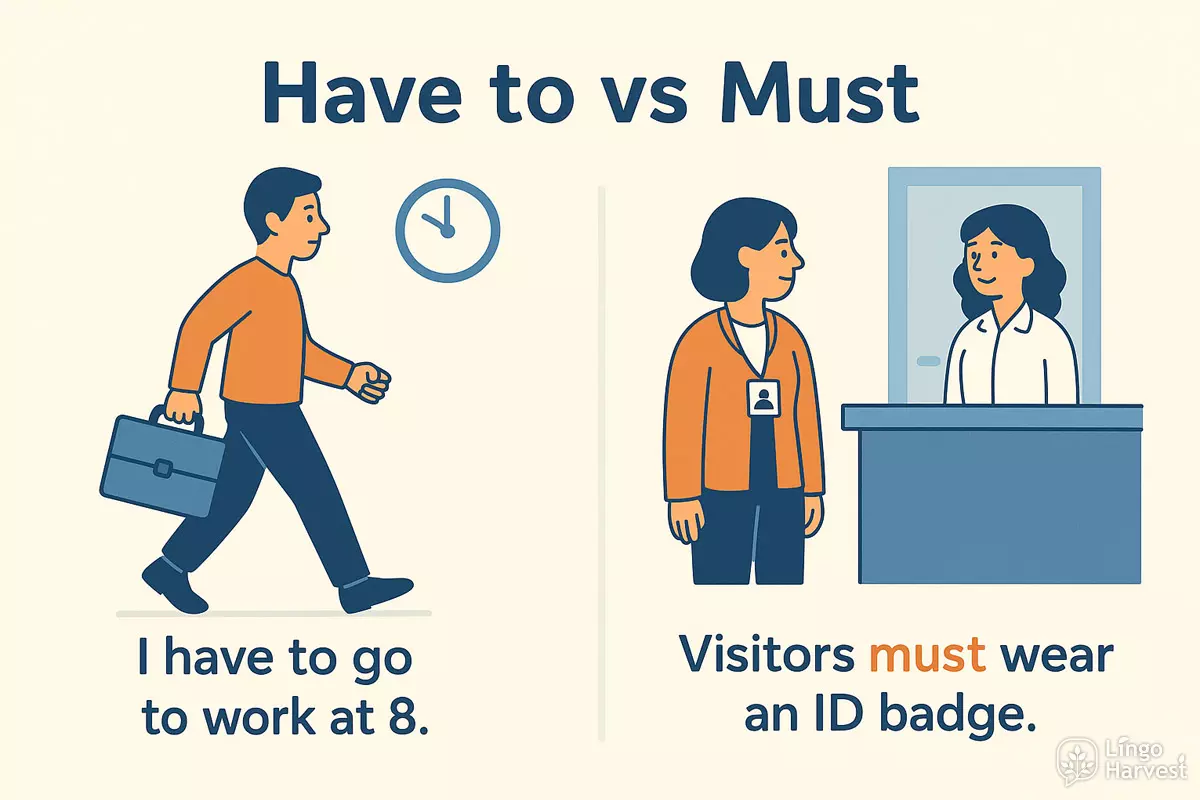
| Situation | Common Expression | Example Sentence |
|---|---|---|
| Everyday Conversation | have to | I have to go to work at 8. |
| Rules/Notices | must | Visitors must wear an ID badge. |
| Giving Advice (spoken) | have to | You have to try this cake! |
| Formal Writing | must | All applications must be submitted by June 1. |
| Making Offers/Invitations | must | You must come to my party! |
| Talking About Past | had to | She had to leave early yesterday. |
Key Points for Learners
- Use "have to" for most spoken situations, especially when talking about daily life or personal obligations.
- Reserve "must" for formal documents, rules, or strong advice in writing.
- Switching between these forms helps you sound more natural and polite in English.
- Remember, both forms show necessity, but the tone and context can change the feeling of your sentence.
Common Confusions
Learners often mix up "have to" and "must" because both can express necessity or obligation, but their use varies depending on context, formality, and speaker intention. Let's look at where these mix-ups usually happen and how to avoid them.
Obligation: Who Decides?
One main difference is the source of the obligation. "Must" often shows that the speaker personally feels something is necessary, while "have to" usually refers to rules, laws, or external requirements.
- Must: I must finish my homework. (The speaker thinks this is important.)
- Have to: I have to wear a uniform at school. (The school requires it.)
Past and Future Forms
Another area of confusion is verb tense. "Must" does not have a true past form. For the past, "had to" is used, and for the future, "will have to" is common.
- I had to go to the doctor yesterday. ✅
- I musted go to the doctor yesterday. ❌
- You will have to call him tomorrow. ✅
- You must call him tomorrow. (Possible, but more formal/urgent.)
Negative Forms: Different Meanings
Saying "must not" and "do not have to" gives different messages. This is a frequent source of error.
| Form | Meaning / Example |
|---|---|
| must not (mustn’t) | Prohibited. Example: You mustn’t smoke here. (It’s not allowed.) |
| do not have to (don’t have to) | Not necessary. Example: You don’t have to come early. (It’s optional.) |
| have to | Obligation from outside. Example: I have to pay taxes. |
| must | Personal or formal necessity. Example: I must remember her birthday. |
Spoken vs. Written English
In conversation, "have to" is more common, while "must" often sounds formal or urgent. For example, "I have to go now" is everyday English, but "I must go now" feels more serious or polite.
Summary of Frequent Mix-Ups
- Using "must" in the past: I musted leave ❌ (use "had to")
- Confusing "must not" (prohibited) with "do not have to" (optional)
- Choosing "must" when talking about rules/laws (should be "have to")
- Making questions with "must": Must you go? (possible, but rare; prefer "Do you have to go?")
- Using "must" for general habits (wrong—use "have to" or "usually")
- Forgetting to change "have to" for third person: He have to ❌ (should be "He has to")
- Using "must to": I must to go ❌ (no "to" after "must")
- Replacing "must" with "have to" in strong recommendations (sometimes "should" is better)
- Direct translation from native language causing wrong usage
- Overusing "must" in casual conversations (sounds unnatural)
Understanding these patterns can help you choose the right form more confidently and avoid typical errors.
Practice: Choose Correct Option
Understanding when to use "have to" or "must" can be tricky for beginners. Both express necessity or obligation, but they are used differently depending on the context. The following exercises will help you practice choosing the correct word for each sentence. Read each statement carefully and select the best option.
Multiple Choice Sentences
Choose the correct word ("have to" or "must") to complete each sentence:
- You ________ finish your homework before you go out.
- We ________ wear a uniform at this school. It’s the rule.
- I ________ visit my grandmother this weekend; she is not feeling well.
- All passengers ________ show their tickets at the gate.
- You ________ be quiet in the library. It’s important.
- My doctor says I ________ take this medicine every day.
- Drivers ________ stop at red lights.
- You ________ call me when you arrive.
- Employees ________ arrive at work before 9 a.m.
- To stay healthy, you ________ eat vegetables every day.
Show answers
- have to
- have to
- have to
- have to
- must
- have to
- have to
- must
- have to
- have to
Identify the Meaning
For each sentence below, decide whether the obligation is from the speaker (personal) or from outside (a rule or law).
- You must finish this report today.
- Students have to bring their books to class.
- She must remember to call her mom.
- People have to pay taxes.
Show answers
- Personal (speaker’s strong advice or decision)
- Rule (external requirement)
- Personal (speaker’s strong advice or decision)
- Rule (external requirement)
Quick Reference: When to Use "Have to" vs "Must"
Here is a summary of the typical uses for each form:
| Use | Example |
|---|---|
| External rules or laws (obligation from outside) |
You have to wear a seatbelt. Employees have to arrive on time. |
| Personal necessity or strong advice (speaker’s opinion) |
You must see this movie! I must call my friend now. |
| Negative forms | You don’t have to come if you’re busy. You mustn’t touch that! |
| Questions | Do we have to wear a tie? (“Must” is rare in questions) |
Practice these structures in your writing and speaking to build confidence using both "have to" and "must" correctly in real situations.