Adding Place Words to Sentences: In, At, On, Here, There

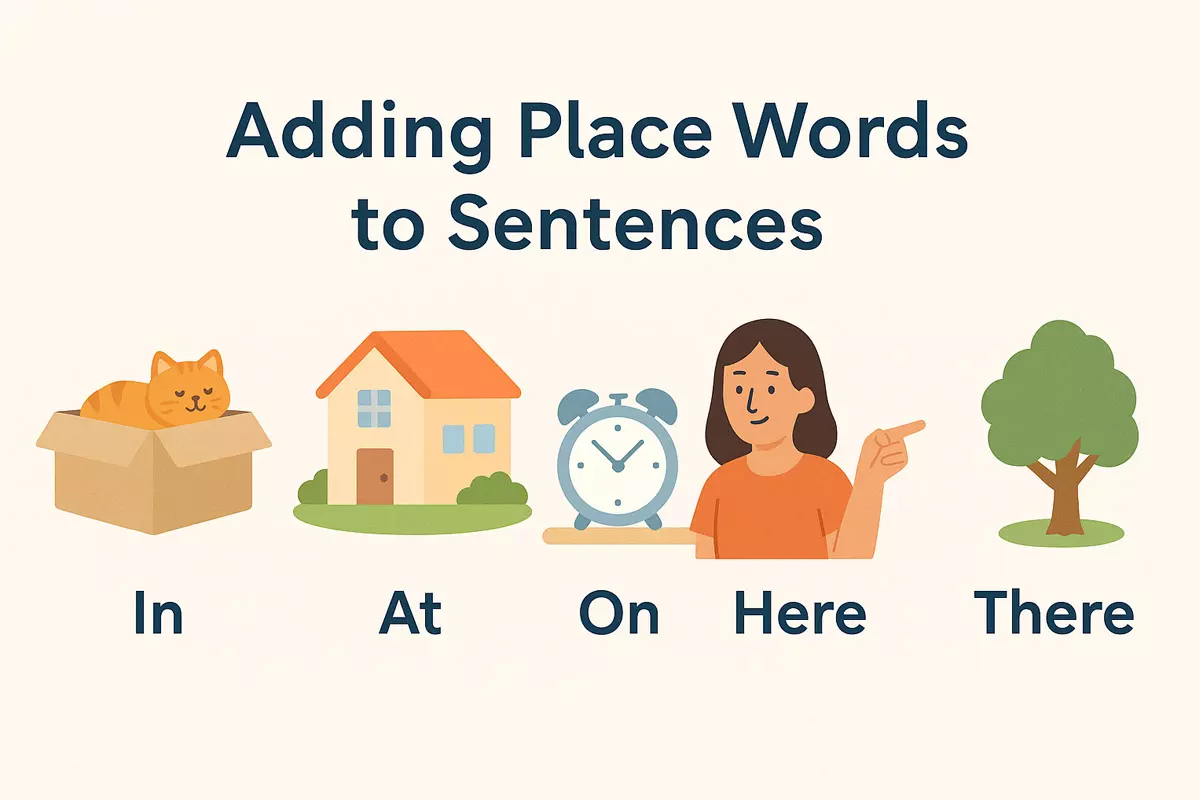 This article explains how to use prepositions for place, like in, at, and on, to describe locations. It covers their differences, gives real examples, and includes practice exercises to help you use them correctly in sentences.
Understanding how to use location words such as in, at, on, here, and there can significantly improve the clarity of your sentences when describing where something happens. These words help specify places and positions, allowing you to communicate your ideas more accurately and confidently. For example, use in for enclosed spaces like in the room, at for specific points like at the corner, and on for surfaces like on the table. Practicing these distinctions will make your descriptions more precise and easier for others to understand.
Prepositions for Place Overview
Understanding how to use words like "in," "at," "on," "here," and "there" helps clarify where something happens or where someone or something is located. These terms are called prepositions of place, and each has its own specific role in a sentence. Getting them right can make your descriptions much clearer and more natural.
Common Place Prepositions
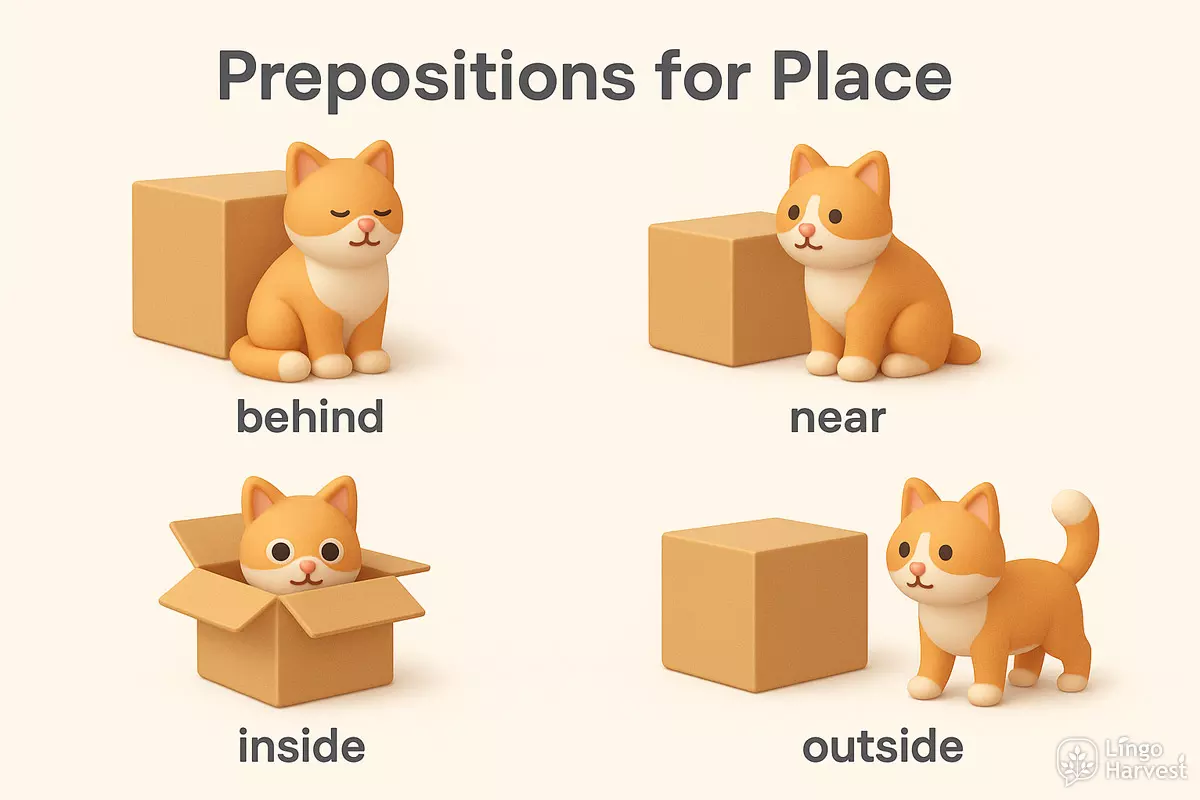
Here are some of the most frequently used prepositions and adverbs for indicating location:
- in – used for enclosed spaces or areas (e.g., in the room, in the city, in a box)
- at – for specific points or places (e.g., at the door, at the bus stop, at home)
- on – for surfaces and streets (e.g., on the table, on Main Street, on the wall)
- here – refers to the speaker’s current location (e.g., I am here, Come here!)
- there – refers to a different, often distant, place (e.g., She is there, Put it there)
- between – in the space separating two things (e.g., between the chairs)
- under – below something (e.g., under the bed)
- over – above or across something (e.g., over the bridge)
- next to – beside or close to something (e.g., next to the window)
- behind – at the back of something (e.g., behind the curtain)
- in front of – before or ahead of something (e.g., in front of the school)
- above – higher than something else (e.g., above the shelf)
- below – lower than something else (e.g., below the picture)
- near – close to something (e.g., near the station)
- inside – within the interior of something (e.g., inside the box)
- outside – not within, on the exterior (e.g., outside the house)
Choosing the Right Preposition
Selecting which word to use depends on the relationship between the object and its location. For example, "in" is correct for large areas or enclosed spaces, while "on" is preferred for surfaces. "At" pinpoints a precise spot. Misusing these can make your sentences sound unnatural or confusing.
Examples in Sentences
- The keys are on the table.
- I live in New York.
- She is waiting at the station.
- Please sit here.
- Your bag is there, on the chair.
- The cat is under the sofa.
- We stood behind the fence.
- He parked his car in front of the shop.
- The school is near the library.
- There is a bird above the tree.
Comparing "In", "At", and "On"
It can be tricky to decide between these three. Here’s a quick comparison to help:
| Preposition | Typical Use | Example |
|---|---|---|
| in | Enclosed spaces, countries, cities | I live in London. |
| at | Specific points or places | He is at the door. |
| on | Surfaces, streets, floors | The book is on the shelf. |
Mastering these prepositions and adverbs helps you give clear directions, describe locations, and make your English sound more natural.
How to Describe Location
Talking about where things or people are often means using words like “in,” “at,” “on,” “here,” and “there.” These place words help make sentences clear and specific. Let’s look at how to use them to explain positions and places in everyday situations.
Choosing the Right Preposition
“In,” “at,” and “on” are the most common prepositions for indicating where something or someone is. Each one has its own rules:
- In: Used for spaces with boundaries (in a room, in a city, in a car).
- At: Used for points or general locations (at the bus stop, at home, at school).
- On: Refers to surfaces or specific lines (on the table, on the wall, on Main Street).
Using “Here” and “There”
“These two words show if something is near or far from the speaker. “Here” means close; “there” means farther away.
- The book is here on my desk.
- Your shoes are there by the door.
Common Patterns for Place Words
Adding place words to sentences often follows a simple pattern: subject + verb + place word + location. Here are some example sentences:
- She is in the kitchen.
- The keys are on the table.
- We met at the park.
- The cat is under the chair.
- I am here now.
- They live in Tokyo.
- My phone is on the bed.
- He is waiting at the corner.
- The picture is on the wall.
- Your bag is there behind you.
- She sat next to me.
- The dog is outside.
- We are inside the building.
- Meet me at the station.
- There’s a note on the fridge.
- He’s in his office.
- The shoes are under the bed.
- The children are in the playground.
- Let’s wait here.
- The bus stops there every hour.
Comparing “In,” “At,” and “On”
Sometimes it’s tricky to pick the right preposition. Here’s a quick comparison to help you decide:
| Preposition | Typical Use/Examples |
|---|---|
| in | Used for enclosed spaces or areas: “in the box,” “in the city,” “in the car” |
| at | Used for specific points or places: “at the door,” “at school,” “at the airport” |
| on | Used for surfaces or lines: “on the table,” “on the floor,” “on the bus” |
| here/there | Show proximity: “here” (close), “there” (farther away): “Come here,” “Put it there” |
These words make your descriptions more precise, letting listeners or readers know exactly where something is. Practice using them in sentences to become more comfortable describing places and locations in English.
In vs At vs On Simplified
Understanding how to choose between "in," "at," and "on" for places makes English sentences clearer. Each of these words helps describe where something happens, but the rules can feel tricky at first. The main difference comes down to how specific the location is and the type of place being described.
General Uses
- In is used for enclosed spaces or areas with boundaries (countries, rooms, cities).
- At points to a specific spot or precise location (an address, an event, a point).
- On is for surfaces or lines (a table, a street, a wall).
Quick Reference Table
| Preposition | Common Usage Examples |
|---|---|
| In | in a room in a country in a box in a park in a car in a photo in a book |
| At | at the door at the station at school at home at a party at 123 Main Street at the bus stop |
| On | on the table on the wall on the floor on the bus on the street on a page on the map |
How to Decide Which to Use
Start by considering the type of place:
- If it’s a larger area or something with boundaries, choose in.
- If it’s a specific point or address, use at.
- If you’re talking about a surface or a line, pick on.
For example, you say "in the kitchen" because the kitchen is an enclosed space, but "at the kitchen door" because you mean a specific spot.
Common Mistakes
It’s easy to confuse these words, especially with public places or transport:
- We say "in a car" but "on a bus" or "on a train."
- Use "at home," not "in home."
- "On the street" (surface), but "in the city" (area).
Remember: context matters. With practice and by noticing which preposition native speakers use, you’ll start to feel which word fits naturally in each situation.
Examples in Context
Understanding how to use place words such as "in," "at," "on," "here," and "there" is essential for clear and accurate communication. The following examples show how these prepositions and adverbs function in everyday sentences. Notice how each word helps pinpoint location, whether general or specific, and how context affects their use.
Sample Sentences with "In," "At," and "On"
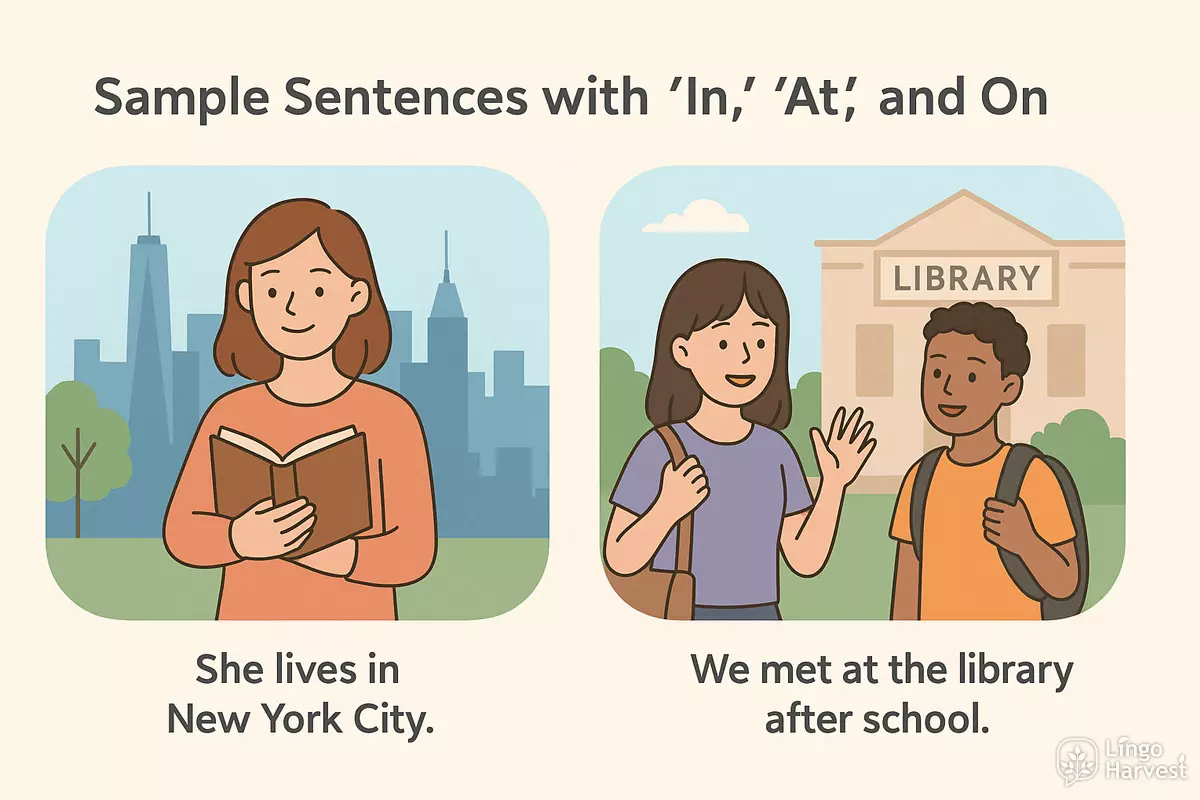
- She lives in New York City.
- We met at the library after school.
- The book is on the table.
- There are flowers in the garden.
- He is waiting at the bus stop.
- Your keys are on the kitchen counter.
- I found the answer in the article.
- They arrived at 8 o’clock.
- Let’s sit on the bench.
- We stayed in a hotel by the beach.
Using "Here" and "There" for Position
- Come here and look at this!
- The remote is there on the sofa.
- Is anyone here today?
- Your shoes are over there.
- Please wait here.
- The park is right there across the street.
Comparing Place Words in Different Contexts
| Preposition/Adverb | Usage Example | Type of Location |
|---|---|---|
| in | She is in the room. | Enclosed space |
| at | Meet me at the corner. | Specific point |
| on | The coffee is on the desk. | Surface |
| here | Stand here, please. | Speaker’s location |
| there | Put it there by the door. | Other location |
As you can see, the choice of word depends on whether you are talking about a general area, a specific point, a surface, or indicating presence or absence. Practicing with real-life situations will help you use these location words naturally and confidently.
Practice: Complete Sentences with Place Words
Understanding how to use words that describe locations—such as in, at, on, here, and there—helps make your sentences clearer. Try the following exercises to strengthen your ability to add these words correctly.
Fill in the Blanks
Read each sentence and choose the correct place word (in, at, on, here, there) to complete it. Each blank needs one word.
- The keys are ___ the table.
- She is waiting ___ the bus stop.
- Is your brother ___ home now?
- We met ___ the park yesterday.
- My phone is ___ my bag.
- He lives ___ New York City.
- Please sit ___ next to me.
- The book is ___ the shelf.
- Can you see the cat ___ the window?
- They are ___ school today.
Show answers
- on
- at
- at
- in
- in
- in
- here
- on
- at
- at
Choose the Correct Place Word
For each sentence, pick the best option to make the meaning clear.
- I left my bag (in/at/on) the classroom.
- Are you (here/there) right now?
- Let’s meet (in/at) the café.
- The picture hangs (on/in) the wall.
- He is (in/at) the office every morning.
Show answers
- in
- there
- at
- on
- in
Common Place Word Patterns
Below is a quick reference showing typical sentence structures using these words. Review the examples and notice the usual combinations.
| Place Word | Typical Use Example |
|---|---|
| in | in the room, in a city, in the car |
| at | at the door, at school, at the station |
| on | on the table, on the wall, on the bus |
| here | Come here, Stay here |
| there | Go there, I was there |
Write Your Own Sentences
Challenge yourself by creating sentences with each place word. Try to use each word at least twice, describing different locations or situations.
- Write a sentence with in.
- Write a sentence with at.
- Write a sentence with on.
- Write a sentence with here.
- Write a sentence with there.
Show answers
- She is in the kitchen.
- We met at the cinema.
- The keys are on the desk.
- Please come here.
- I want to go there.