Fill-in-the-Blank English Practice for Beginners

 This article explains how fill-in-the-blank exercises help improve grammar by focusing on missing verbs, articles, and prepositions. It offers context clue tips, practical examples, and short practice texts on everyday topics.
Learning English becomes enjoyable and effective when you use activities that involve completing sentences by filling in missing words. This interactive method not only helps beginners expand their vocabulary but also builds confidence and gradually enhances overall language skills. By practicing in this way, learners can reinforce what they have learned, making progress in a supportive and motivating environment while developing a stronger foundation in English.
How Fill-in Exercises Improve Grammar
Practicing with gap-fill activities is a practical way for beginners to become comfortable with English sentence structure and word forms. These exercises encourage learners to focus carefully on how words fit together, making it easier to spot grammar patterns and avoid common mistakes. By actively choosing the correct word or phrase, students reinforce their understanding of grammar rules in context, rather than just memorizing them.
Benefits of Fill-in-the-Blank Practice
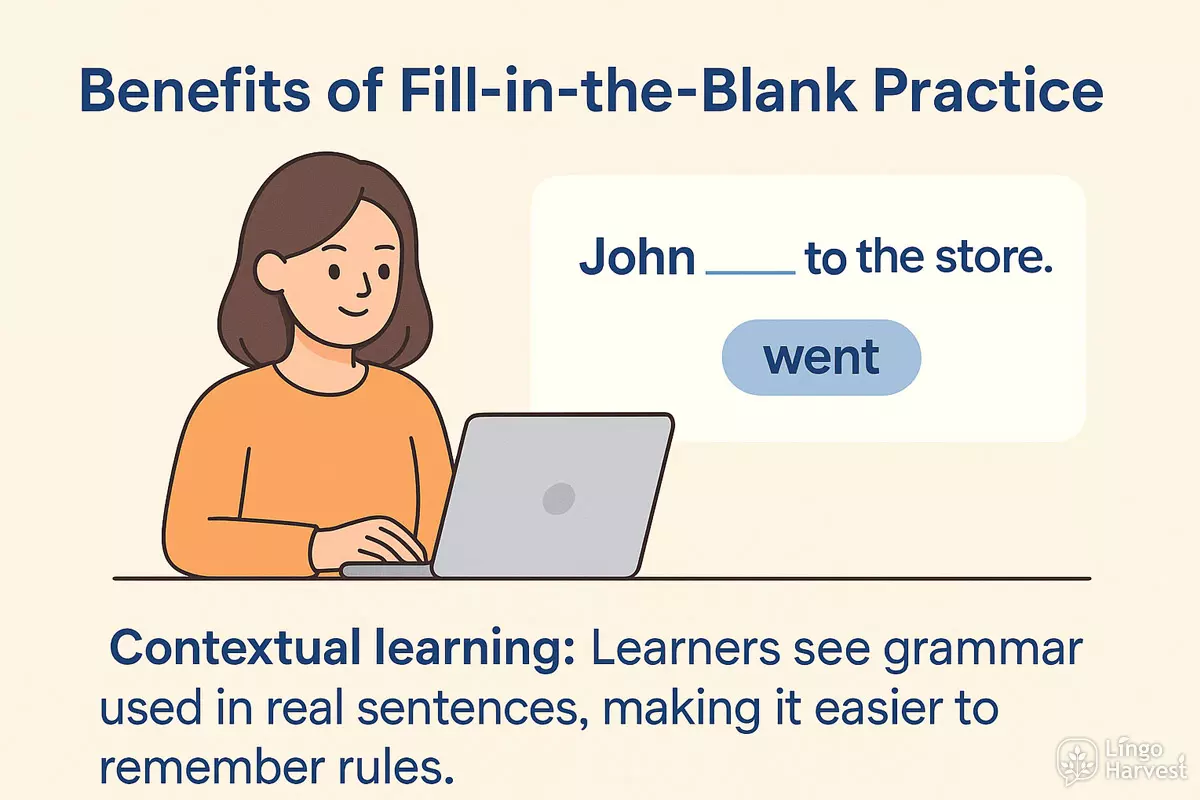
- Contextual learning: Learners see grammar used in real sentences, making it easier to remember rules.
- Error awareness: Filling in blanks highlights mistakes, so learners can instantly see which grammar points need more review.
- Active recall: Choosing the right answer from memory strengthens retention, compared to passive reading.
- Vocabulary building: Students encounter new words in meaningful contexts, supporting both grammar and word knowledge.
- Immediate feedback: Many fill-in exercises come with answers, allowing for self-correction and faster improvement.
Common Grammar Points Practiced with Fill-in Exercises
- Verb tenses (present, past, future)
- Subject-verb agreement
- Articles (a, an, the)
- Prepositions (in, on, at, to, for, etc.)
- Pronouns (he, she, it, they, etc.)
- Modal verbs (can, must, should, etc.)
- Comparatives and superlatives (bigger, the most interesting)
- Conjunctions (and, but, because, or)
- Question formation
- Negatives (not, never, nothing, etc.)
- Adjective and adverb use
- Countable and uncountable nouns
- Possessive forms ('s, of)
- Word order in sentences
- Conditional sentences (if… then…)
Examples: Spotting the Correct Form
Let’s look at a few typical fill-in-the-gap sentences that target different areas of beginner grammar:
- She _____ (to be) my sister.
- We _____ (go) to school every day.
- I have _____ apple.
- They _____ (not like) coffee.
- He is taller _____ his brother.
Show answers
- is
- go
- an
- do not like / don't like
- than
Comparing Fill-in Practice with Other Methods
| Practice Type | Main Benefit | Example Activity |
|---|---|---|
| Fill-in-the-blank | Targets specific grammar forms in context | Complete: "She ____ (to have) a cat." |
| Multiple choice | Builds recognition of correct forms | Choose: "He _____ tall." (is/are) |
| Sentence writing | Encourages production and creativity | Write a sentence using "because" |
| Reading | Develops understanding of grammar in text | Read a short story and find all past tense verbs |
Using a mix of these activities is helpful, but fill-in-the-gap practice stands out for its focus on targeted grammar review. It helps learners pay close attention to word forms and sentence structure, building confidence for speaking and writing in English.
Common Missing Words: Verbs, Articles, Prepositions
Understanding which words are often left out in beginner English exercises can help you focus your practice. Most fill-in-the-blank activities target specific word types that are essential for sentence structure and meaning. Let’s look at the categories that frequently appear as gaps in these exercises, and why they are important for clear communication.
Verbs: The Action Words
Verbs are at the heart of sentences, showing what the subject does or experiences. Beginners often leave out verbs, especially when practicing with simple present or past tense. Missing the verb can make sentences incomplete or confusing.
- (She) runs every morning.
- (They) are happy today.
- (He) went to school yesterday.
- (I) like apples.
- (The dog) barked loudly.
Articles: a, an, the
Articles are short but important. They tell us if we are talking about something specific or general. Many learners forget to include them, especially when translating from languages that don’t use articles.
- I saw a cat in the garden.
- She is an engineer.
- The book is on the table.
- He found an old coin.
- Let’s go to the park.
Prepositions: Linking Words
Prepositions connect words and show relationships like place, time, or direction. These are commonly omitted or confused in beginner exercises.
- The pen is on the table.
- We will meet at 6 o’clock.
- She walked to school.
- The picture is above the sofa.
- I live in London.
Quick Reference: Common English Gaps
Many exercises use the same patterns. Here’s a handy table to compare how missing verbs, articles, and prepositions change the meaning of a sentence:
| Sentence with Blank | Type of Missing Word | Correct Example |
|---|---|---|
| She ___ reading a book. | Verb | She is reading a book. |
| I saw ___ elephant at the zoo. | Article | I saw an elephant at the zoo. |
| The cat is ___ the box. | Preposition | The cat is in the box. |
| We went ___ the store. | Preposition | We went to the store. |
| ___ apple a day keeps the doctor away. | Article | An apple a day keeps the doctor away. |
| They ___ friends. | Verb | They are friends. |
By practicing with different types of missing words—such as action words, linking words, and short helpers—you build a stronger foundation for English communication. Focus on these patterns, and you'll start noticing them in everyday language.
Tips for Context Clues
Understanding how to use hints from the surrounding words can make fill-in-the-blank exercises much easier for beginners. Instead of guessing randomly, look for information around the blank that helps you choose the correct answer. This method relies on logic and pattern recognition, not just memorization.
Start with the Basics
When you see a missing word, first identify what kind of word fits: is it likely to be a noun, verb, adjective, or something else? Often, the sentence structure gives you clues. For instance, if the sentence is "She ___ to school every day," the blank needs a verb.
Look for Signal Words
Certain words in a sentence can steer you toward the answer. Here are some common types of context clues to watch for:
- Definition clues: Sometimes, the word’s meaning is explained nearby.
- Example clues: The blank might be followed by examples that hint at the missing word.
- Contrast clues: Words like "but," "however," or "although" suggest the blank is a contrast to something else.
- Restatement clues: The idea is repeated in simpler terms elsewhere in the sentence.
- Grammar clues: Verb tense, singular/plural, and articles (a/an/the) help narrow down choices.
Common Patterns in Fill-in-the-Blank Practice
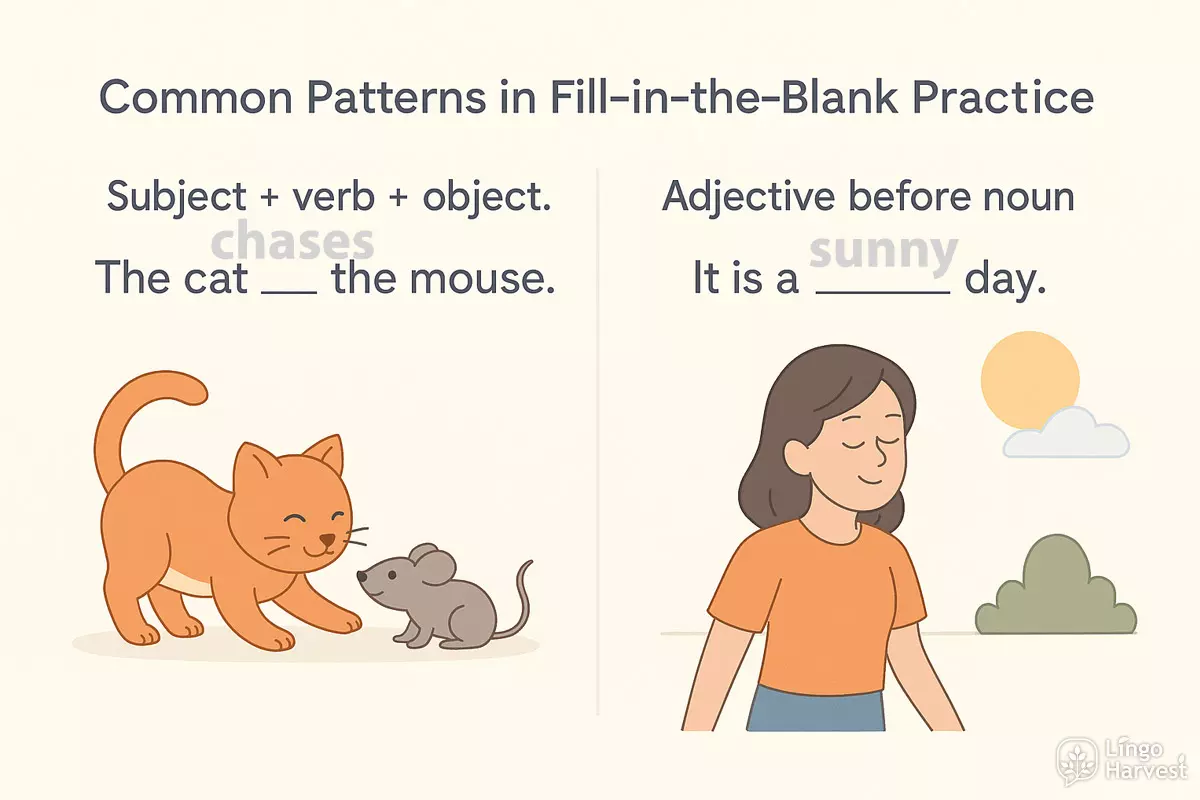
Beginners often see the same sentence patterns in fill-in-the-blank tasks. Recognizing these structures helps learners choose the correct words more easily. Here are the most common patterns with sample answers:
- Subject + verb + object: "The cat ___ the mouse."
- Adjective before noun: "It is a ___ day."
- Prepositions of place: "She is ___ the house."
- Pronouns: "___ is my friend."
- Question words: "___ are you?"
- Time phrases: "I wake up ___ 7 o’clock."
- Modal verbs: "He ___ swim."
- Negatives with do/does: "I do ___ like coffee."
- Comparisons: "She is ___ than her brother."
- Linking verbs: "They ___ happy."
- Articles: "She bought ___ apple."
- Verb tense choice: "He ___ to school yesterday."
- Countable vs uncountable: "I need ___ water."
- Conjunctions: "I stayed home ___ it was raining."
- Possessive forms: "This is my ___ book."
Show answers
- chases
- sunny
- in / near / behind
- He / She / This
- How / Where
- at
- can
- not
- taller / kinder
- are
- an
- went
- some
- because
- brother’s
Practical Examples of Context Clues
Here is a table showing several types of clues with example sentences and what they suggest:
| Type of Clue | Example Sentence | What to Look For |
|---|---|---|
| Definition | He is an optimist, which means he always expects good things. | Look for explanations or restatements. |
| Contrast | It was cold, but she felt ___. | Use "but" to expect an opposite idea (e.g., "warm"). |
| Example | He likes fruit, such as apples, oranges, and ___. | Find words that fit the category (e.g., "bananas"). |
| Grammar | She ___ playing now. | Check tense and form (e.g., "is"). |
| Collocation | He made a ___ mistake. | Think of common word pairs (e.g., "big," "serious"). |
Quick Strategies to Practice
- Read the whole sentence before choosing your answer.
- Underline or note key words that give away the meaning.
- Try to predict the answer before looking at options.
- Check if the answer sounds natural when you read the sentence aloud.
- Don’t be afraid to guess, but use the clues around the blank to improve your chances.
By practicing these techniques, you’ll develop a sharper eye for clues and become more confident in fill-in-the-blank English exercises.
Everyday Topic Examples with Practice Exercises
Practicing fill-in-the-blank sentences with familiar, daily-life subjects helps beginners connect new vocabulary to real situations. Here are some sample contexts and sentences that use common words, making practice more meaningful and practical.
Daily Activities
- I ____ breakfast every morning. (eat/drink)
- She ____ to school by bus. (goes/walks)
- We ____ TV in the evening. (watch/see)
- He ____ his teeth before bed. (brushes/cleans)
- They ____ soccer after class. (play/like)
- I ____ up at 7 o’clock. (wake/get)
- She ____ her homework in the afternoon. (does/makes)
- We ____ to music after school. (listen/talk)
Show answers
- eat
- goes
- watch
- brushes
- play
- wake
- does
- listen
Food and Shopping
- I would like a ____ of water, please. (glass/bottle)
- My mother ____ apples at the market. (buys/sells)
- Can you ____ me the salt? (pass/give)
- We need to ____ bread and milk. (buy/get)
- The soup is too ____. (hot/cold)
- He ____ coffee every morning. (drinks/eats)
- They ____ lunch at a café. (have/cook)
- The bananas are very ____. (fresh/old)
Show answers
- glass
- buys
- pass
- buy
- hot
- drinks
- have
- fresh
Family and Friends
- This is my ____. (brother/sister)
- My best friend ____ in a big city. (lives/works)
- Our parents ____ dinner together. (cook/eat)
- I ____ my grandparents on Sundays. (visit/call)
- She ____ a birthday in July. (has/celebrates)
- My cousin ____ in our house. (stays/lives)
- They ____ games together at the weekend. (play/watch)
- I always ____ my friends on their birthdays. (call/write)
Show answers
- brother / sister (both possible)
- lives
- eat
- visit
- has
- stays
- play
- call
Weather and Seasons
| Sentence with Blank | Possible Answers |
|---|---|
| It is ____ today. | sunny, raining, cloudy |
| In winter, I ____ a coat. | wear, need |
| The trees are ____ in autumn. | yellow, orange, red |
| Summer is ____ than spring. | hotter, warmer |
| We ____ snow in December. | see, get, have |
Using blanks in short, everyday sentences like these allows beginners to practice selecting the right word or verb form. The topics reflect real communication needs, so learners build both confidence and useful language skills.
Practice: Fill the Blanks in Short Texts
Filling in missing words in short passages helps new learners build confidence in using English naturally. By reading and completing these short texts, you’ll practice vocabulary, grammar, and sentence structure all at once. This method is especially useful for beginners who want to see how words fit into real-life situations.
How to Approach Fill-in-the-Blank Exercises
Start by reading the entire passage to understand the context. Then, look at the blank spaces and consider which type of word is needed (noun, verb, adjective, etc.). Use clues from surrounding words to make your best guess. Don’t worry about making mistakes; each attempt helps you learn.
Beginner Fill-in-the-Blank Tasks
Try these sample exercises. Read each short text and fill in the missing word. Focus on common situations and beginner-level vocabulary.
-
Hello! My name is ______. I am from Brazil.
-
This is my ______. Her name is Anna. She is my sister.
-
I have a ______. It is black and white. It likes to play with a ball.
-
I go to school by ______ every day.
-
My favorite color is ______. I like to wear it.
-
We eat lunch at ______. I like sandwiches and juice.
-
It is ______ outside. I need my umbrella.
-
My father is a ______. He works in a hospital.
-
On weekends, I ______ soccer with my friends.
-
Every morning, I brush my ______ before breakfast.
Show answers
- Maria (any name is possible)
- family / sister / friend (context: sister is best)
- dog (cat is possible, but "play with a ball" suggests dog)
- bus
- blue (any color is possible, but blue is common)
- noon / school / home (noon is most logical)
- raining / wet / rainy (raining is best)
- doctor / nurse (doctor fits best)
- play
- teeth
Common Words for Fill-in-the-Blank Practice
These words often appear in beginner exercises. Review them to prepare for more gap-filling activities:
- name
- age
- city
- family
- friend
- school
- color
- food
- animal
- weather
- job
- play
- read
- write
- walk
- run
- brush
- eat
- drink
- sleep
Tips for Success
- Read the whole sentence before guessing the word.
- Think about what makes sense in the context.
- Practice with different types of short texts, such as greetings, daily routines, and simple stories.
- Check your answers to learn from mistakes and improve.