Preposition Practice Quiz: In, On, At and More

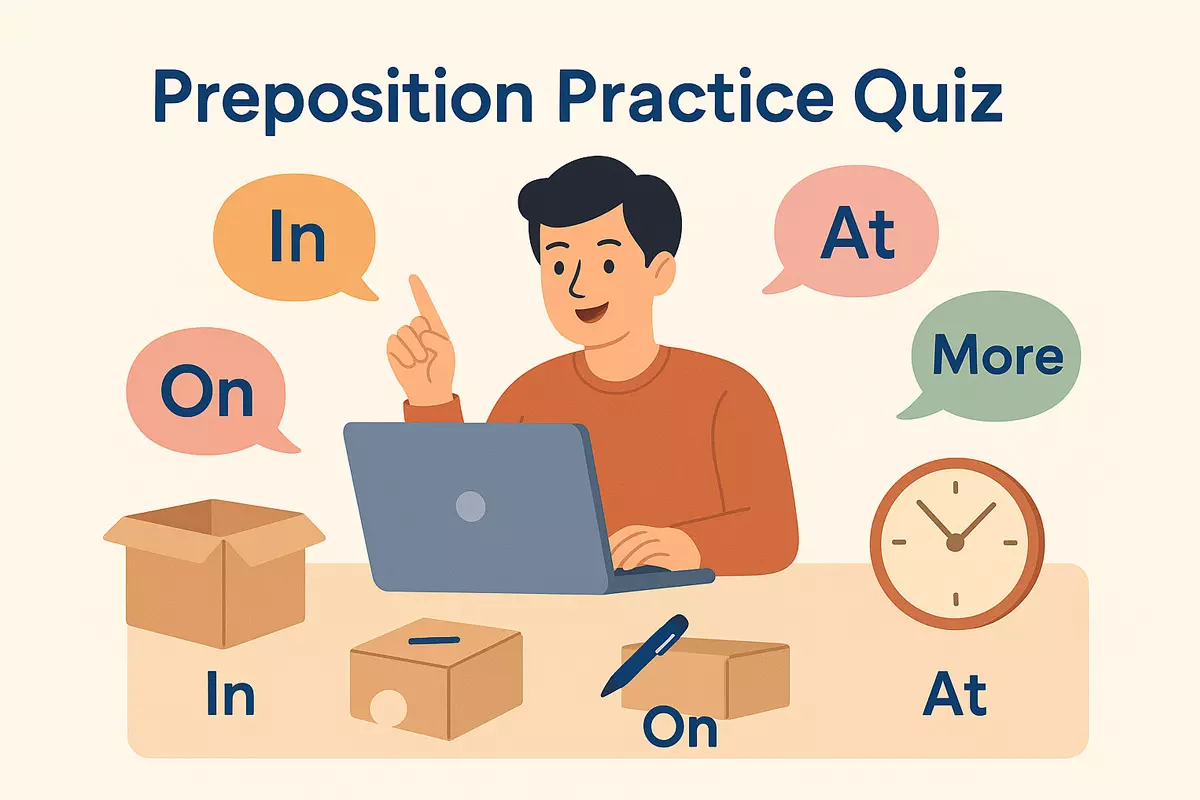 The article explains how prepositions work for place, time, and direction, highlights tricky pairs, and provides exercises and a mini quiz so you can practice and test your grammar understanding.
Mastering small connecting words in English, such as in, on, and at, can be challenging for learners, as their correct usage often depends on context and subtle differences in meaning. This quiz provides an engaging opportunity to practice and improve your understanding of these essential prepositions, helping you use them more accurately and confidently in everyday communication. By working through various examples, you can build a stronger foundation in English grammar and enhance your overall language skills.
Quick Recap of Prepositions
Understanding prepositions is essential for building clear and natural sentences in English. These small words help describe relationships between objects, places, and times. Some of the most common prepositions include "in," "on," and "at," but there are many others you might encounter. Here's a short overview of how these words function and how you can use them correctly.
What Are Prepositions?
Prepositions are words that connect nouns, pronouns, or phrases to other words in a sentence. They typically indicate direction, place, time, or method. Learning the right preposition for each situation can sometimes be tricky, as many have specific uses.
Common Uses and Examples
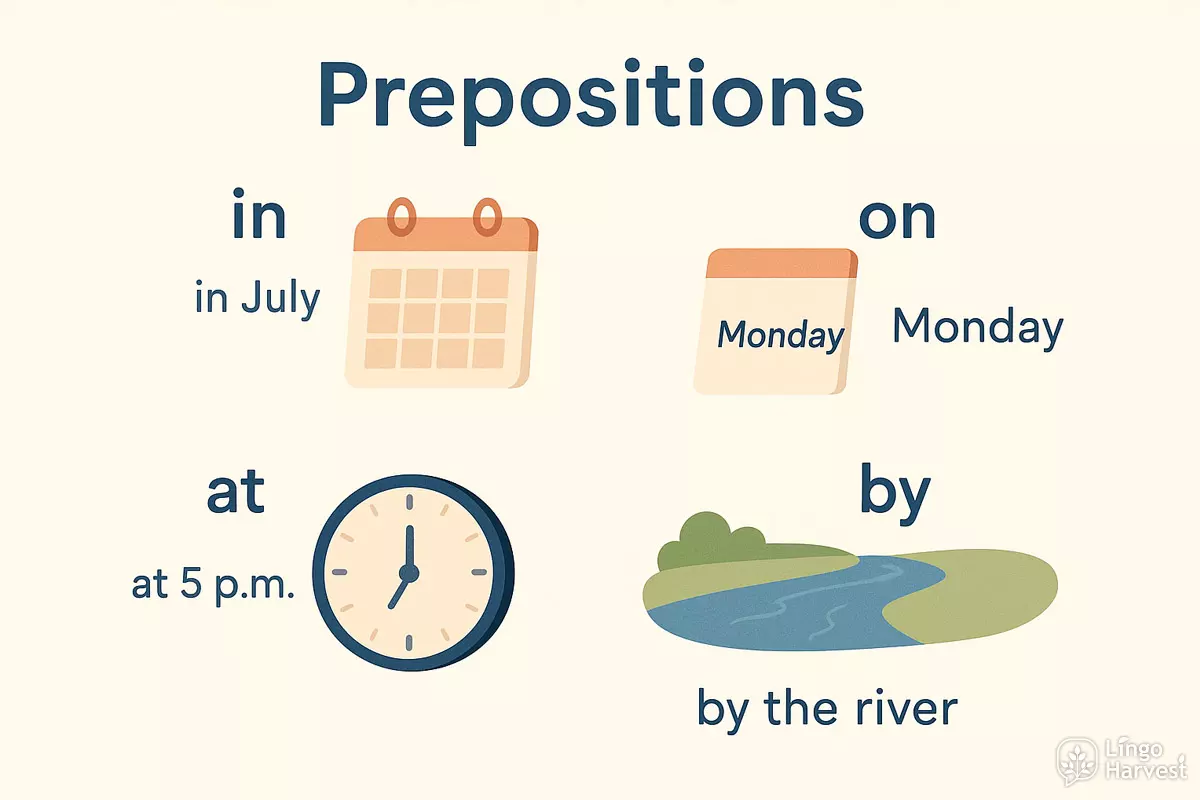
Let’s look at some frequently used prepositions and their typical uses:
- In — used for months, years, seasons, cities, countries, and enclosed spaces.
Examples: in July, in 2023, in summer, in Paris, in a box - On — used for days, dates, surfaces, and certain public transport.
Examples: on Monday, on July 4th, on the table, on the bus - At — used for specific times, addresses, and some events.
Examples: at 5 p.m., at 123 Main St., at the party - By — indicates the agent in passive sentences, or proximity.
Examples: by the river, a book by J.K. Rowling - To — shows direction or movement.
Examples: go to school, walk to the park - From — indicates the starting point.
Examples: from home, from January to March - With — shows accompaniment or tool.
Examples: with my friend, write with a pen - About — used to indicate topic.
Examples: talk about sports, a book about history - For — shows purpose, duration, or recipient.
Examples: for two hours, for you, study for an exam - Over — indicates movement above or covering.
Examples: jump over the fence, a blanket over the bed - Under — shows position below something.
Examples: under the table, under the bridge - Between — used for two items.
Examples: between the chairs, between Monday and Friday - Among — used for more than two.
Examples: among friends, among the trees - Across — shows movement from one side to another.
Examples: across the street, travel across the country - Behind — indicates position at the back.
Examples: behind the curtain, behind the house - Beside — means next to.
Examples: beside the window, sit beside me - During — refers to time within an event.
Examples: during the meeting, during winter - Without — shows absence.
Examples: without money, without help
Comparing “In”, “On”, and “At” for Place and Time
Sometimes, it’s easy to confuse which preposition to use. Here’s a quick side-by-side look to clarify their typical roles:
| Preposition | Place | Time |
|---|---|---|
| In | in a room, in a city, in a box | in 2020, in June, in the morning |
| On | on the wall, on the table, on a bus | on Monday, on July 4th, on the weekend |
| At | at the door, at the station, at home | at 5 p.m., at noon, at night |
Getting comfortable with these basic patterns will help you make fewer mistakes and communicate more precisely. Remember that some expressions are unique and must be memorized, but with practice, using prepositions will become much more intuitive.
Prepositions of Place, Time, and Direction
Understanding how to use words like in, on, and at is key for clear communication in English. These short words help describe where and when something happens, or how someone or something moves. Each preposition has its own typical uses, and knowing the common patterns makes sentences more precise.
Location: Where?
To talk about position, English speakers rely on certain prepositions. Here are some of the most common ones and their usual contexts:
- in – inside an area or volume (in a room, in the city, in the box)
- on – on a surface or line (on the table, on the wall, on Main Street)
- at – at a point or specific place (at the door, at the bus stop, at work)
- between – in the space separating two things (between the chairs)
- under – below something (under the bridge)
- above – higher than something else (above the clouds)
- next to – beside or adjacent (next to the window)
- behind – at the back of (behind the curtain)
- in front of – before or ahead of (in front of the house)
- over – directly above, sometimes covering (over the table)
Time: When?
Talking about time also requires careful choice of prepositions. Here are some standard uses:
- at – for precise times (at 3 o’clock, at midnight, at lunchtime)
- on – for days and dates (on Monday, on July 4th, on my birthday)
- in – for longer periods (in June, in 2022, in the morning, in winter)
- before – earlier than a time (before noon)
- after – later than a time (after dinner)
- during – throughout a period (during the meeting)
- since – from a point in the past until now (since 2010)
- by – not later than (by Friday)
- until – up to a certain time (until sunset)
Movement and Direction
Describing how someone or something moves from one place to another often requires directional prepositions. Some common ones include:
- to – movement toward a place (to the park)
- into – entering an enclosed space (into the room)
- onto – moving to a surface (onto the stage)
- from – starting point (from the airport)
- out of – leaving an enclosed space (out of the car)
- off – leaving a surface (off the table)
- through – moving inside and then out (through the tunnel)
- along – following a line (along the river)
- across – from one side to another (across the street)
- past – going by (past the bank)
| Place | Time | Direction |
|---|---|---|
| in the kitchen | in March | into the store |
| on the shelf | on Friday | onto the roof |
| at school | at 8 a.m. | to the station |
| under the table | before noon | across the park |
| between the trees | after work | along the road |
| next to the bank | during the show | through the tunnel |
Choosing the right word for place, time, or movement helps avoid confusion and makes your English sound natural. Practice these patterns for smoother conversations and clearer writing.
Common Confusing Pairs
Understanding which preposition to use can be tricky, especially when words like “in,” “on,” and “at” seem interchangeable. However, each one fits specific situations, and mixing them up can change the meaning of a sentence or make it sound unnatural. Below, you’ll find explanations and examples to help clarify these frequent points of confusion.
When to Use “In,” “On,” and “At” for Place
These three often cause uncertainty because they all indicate location, but the context determines which is correct:
- In – Used for enclosed spaces or areas (e.g., in the room, in London, in a car).
- On – Used for surfaces or specific lines (e.g., on the table, on the wall, on Main Street).
- At – Used for specific points or places (e.g., at the door, at work, at 123 Main St).
Time Prepositions: “In,” “On,” or “At”?
Choosing the right word for time expressions is another common challenge. Here’s a comparison to make it easier:
| Preposition | Typical Use (Time) | Examples |
|---|---|---|
| In | Months, years, periods, parts of day | in July, in 2023, in the morning |
| On | Days, dates, specific days | on Monday, on June 5th, on my birthday |
| At | Clock times, mealtimes, holidays | at 5 PM, at noon, at Christmas |
Other Tricky Pairs
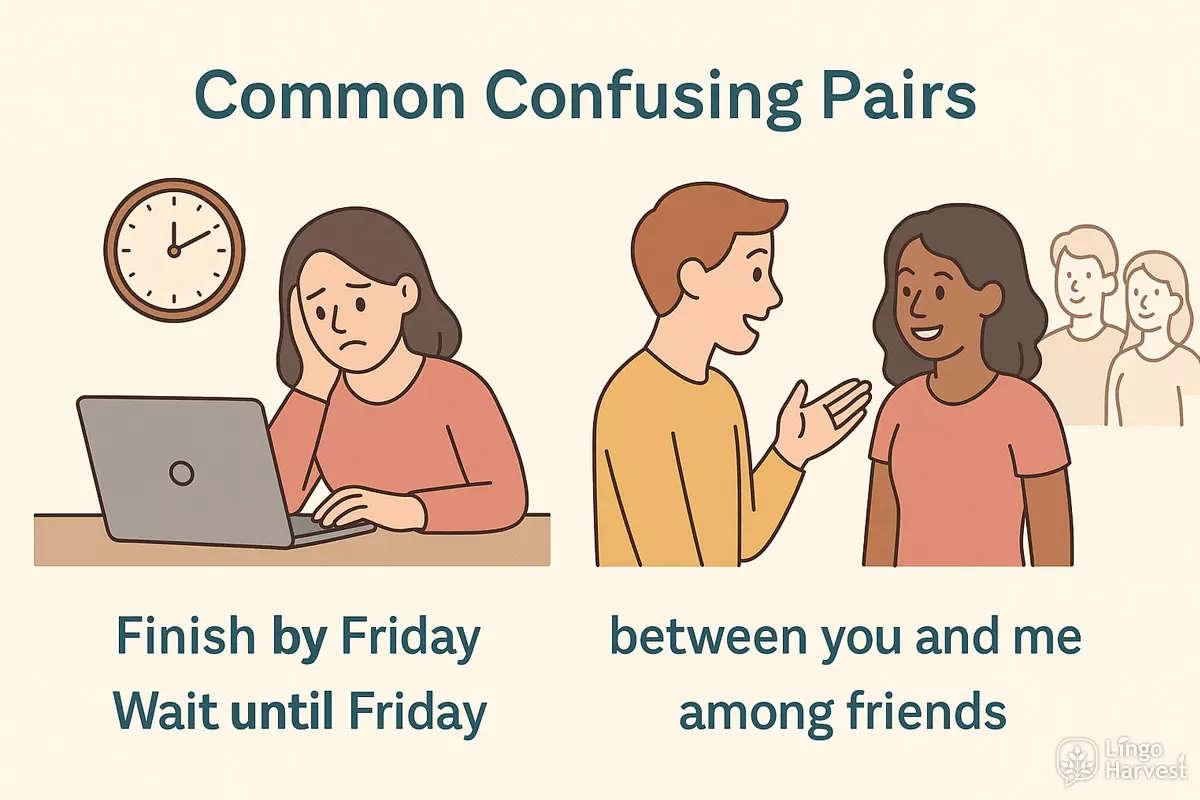
Some pairs are especially easy to mix up. Here are examples with explanations:
- By vs. Until: By shows a deadline (“Finish by Friday.”), while until means up to a point in time (“Wait until Friday.”).
- Between vs. Among: Use between for two items (“between you and me”), among for more than two (“among friends”).
- For vs. Since: For is used with durations (“for two years”), since with starting points (“since 2021”).
- To vs. Into: To shows direction (“go to the store”), into shows movement inside (“walk into the room”).
- Over vs. Above: Over often suggests movement or covering (“jump over the fence”), above is static (“the light above the table”).
- Under vs. Below: Under is for direct vertical relationships (“under the table”), below can be more general (“temperatures below zero”).
- At vs. To: At is a location (“at the park”), to is movement (“go to the park”).
- On vs. Over: On is contact with a surface (“on the floor”), over is above something but not touching (“the lamp over the desk”).
- By vs. With: By shows the agent or method (“written by John”), with shows an instrument (“cut with a knife”).
- About vs. Of: About means “concerning” (“talk about the news”), of shows possession or relation (“the end of the movie”).
Practice and attention to context are key to mastering these nuances. If you notice a sentence doesn’t sound quite right, try swapping the preposition and see if it fits the situation more naturally.
Practice: Choose the Right Preposition
Working with prepositions can be tricky, especially when similar words like "in," "on," and "at" are involved. Try the exercises below to sharpen your sense of which preposition fits in different situations.
Fill in the Blank
Read each sentence and decide which preposition (in, on, at, or another) correctly completes the meaning. Some sentences may have more than one possible answer, but choose the most natural one.
- We will meet ___ the library ___ 3:00 PM.
- The cat is sleeping ___ the sofa.
- She lives ___ Paris.
- My birthday is ___ July.
- They arrived ___ Monday morning.
- He put the keys ___ his pocket.
- I saw that movie ___ last weekend.
- Please wait ___ the corner of the street.
- There’s a big sale ___ the mall this week.
- He stood ___ front of the mirror.
Show answers
- at the library, at 3:00 PM
- on the sofa
- in Paris
- in July
- on Monday morning
- in his pocket
- on last weekend (but simply "last weekend" is more idiomatic without a preposition)
- at the corner of the street
- at the mall
- in front of the mirror
Common Preposition Patterns
Some phrases are usually used with a specific preposition. Review these typical combinations for reference:
- on Monday / on the weekend / on a holiday
- in the morning / in July / in 2022 / in Paris
- at 5 o’clock / at the station / at home
- on the table / on the bus / on the wall
- in the car / in a building / in a photo
- at the door / at the top / at the bottom
- on the Internet / on TV / on the radio
- in time / on time / at the same time
- in a hurry / in trouble / in love
- at lunch / at a party / at work
Quick Challenge: Pick the Correct Preposition
Choose the best preposition for each phrase:
- ___ the bus
- ___ school
- ___ the picture
- ___ the evening
- ___ the weekend
Show answers
- on the bus
- at school
- in the picture
- in the evening
- on the weekend
Compare Usage: In, On, At
To help visualize the differences, here’s a summary table comparing typical uses of these three prepositions for time and place.
| Preposition | Time Examples | Place Examples |
|---|---|---|
| in | in July, in 2023, in the evening | in the city, in a box, in the garden |
| on | on Monday, on my birthday, on the weekend | on the table, on a bus, on the wall |
| at | at 5:00, at noon, at night | at home, at school, at the corner |
Tips for Mastery
- Think about the level of specificity: "at" is usually most specific, "on" is for surfaces or days/dates, "in" is for enclosed spaces or longer periods.
- Practice by making your own sentences, then check which preposition sounds most natural by comparing with native examples.
- Notice which prepositions come with common phrases—they’re often fixed combinations.
Mini Quiz: Test Your Grammar
Ready to see how well you understand prepositions like in, on, at, and others? Try these practice questions to check your knowledge of everyday usage. Each sentence below is missing a preposition—choose the correct one to complete it. Take your time, and think about the context!
Fill in the Blanks
- I usually wake up ____ 7 o’clock.
- The book is ____ the table.
- We met ____ the weekend.
- She lives ____ Paris.
- The cat is hiding ____ the bed.
- My birthday is ____ July.
- He arrived ____ Monday morning.
- Let’s meet ____ the bus stop.
- They went ____ holiday last month.
- The painting is hanging ____ the wall.
Show answers
- at
- on
- at
- in
- under
- in
- on
- at
- on
- on
Common Prepositions: Usage Patterns
Here’s a quick comparison of how in, on, and at are often used with time and place:
| Preposition | Typical Usage | Examples |
|---|---|---|
| in | Months, years, seasons, countries, cities, inside spaces | in July, in 2023, in summer, in France, in a box |
| on | Days, dates, surfaces, streets, public transport | on Monday, on June 5th, on the table, on Main Street, on the bus |
| at | Exact times, addresses, specific places, events | at 5pm, at 10 Downing Street, at the door, at a party |
| under / over / between / next to | Spatial relations | under the bed, over the hill, between the houses, next to the school |
Quick Challenge: Choose the Correct Preposition
- She put the keys ____ her bag.
- We’ll see you ____ the cinema.
- He studies ____ the morning.
- The dog jumped ____ the fence.
- They sat ____ the grass.
Show answers
- in
- at
- in
- over
- on
Reviewing these examples can help you notice patterns and avoid common mistakes. Practice regularly to make choosing the right preposition feel natural in your writing and conversation.