Preposition Collocations by Topic (Work/Finance/Health/Opinion)

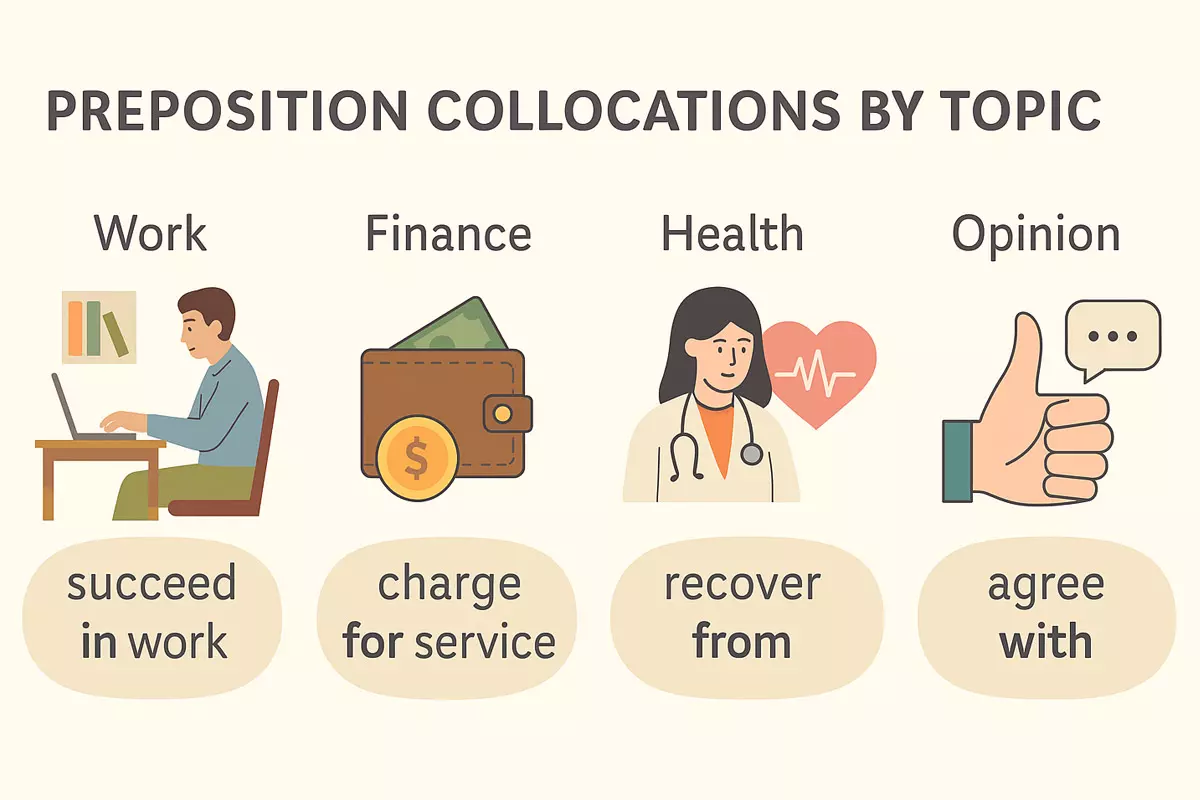 The article defines preposition collocations and explains how they make your English more natural. It covers patterns for work, finance, health, and opinions, highlights common errors, and provides practice sentences to use correct prepositions.
- What Preposition Collocations Are
- Why Collocations Improve Natural English
- Work-Related Preposition Patterns
- Finance Preposition Collocations
- Health and Wellness Preposition Use
- Opinion and Attitude Collocations
- Common Errors with Preposition Choice
- Practice: Complete Sentences with Correct Prepositions
Navigating everyday English can be challenging, particularly because certain words commonly go together in specific situations, such as discussing work, handling finances, talking about health, or sharing opinions. Learning and practicing these typical word combinations helps you sound more natural and ensures your meaning is clear to others. As you become familiar with these patterns, your confidence in speaking and understanding English will grow, making conversations smoother and more effective in various real-life contexts.
What Preposition Collocations Are
Preposition collocations are common combinations where certain prepositions regularly appear with specific words—nouns, verbs, or adjectives. These patterns are a key part of fluent English use because they often don’t follow obvious rules and can’t always be translated word-for-word from other languages. Mastering these combinations helps your speech and writing sound more natural and avoids awkward phrasing.
Why Do These Combinations Matter?
Native speakers intuitively know which preposition fits with a particular word, but for learners, these pairings can be tricky. For example, we say "interested in," not "interested on," and "responsible for," not "responsible of." Using the wrong preposition can change the meaning or make your sentence confusing.
Types of Words That Form Collocations with Prepositions
Several types of words frequently combine with prepositions in set ways. Common categories include:
- Nouns (e.g., "solution to," "impact on")
- Verbs (e.g., "depend on," "believe in")
- Adjectives (e.g., "afraid of," "good at")
Examples of Typical Pairings
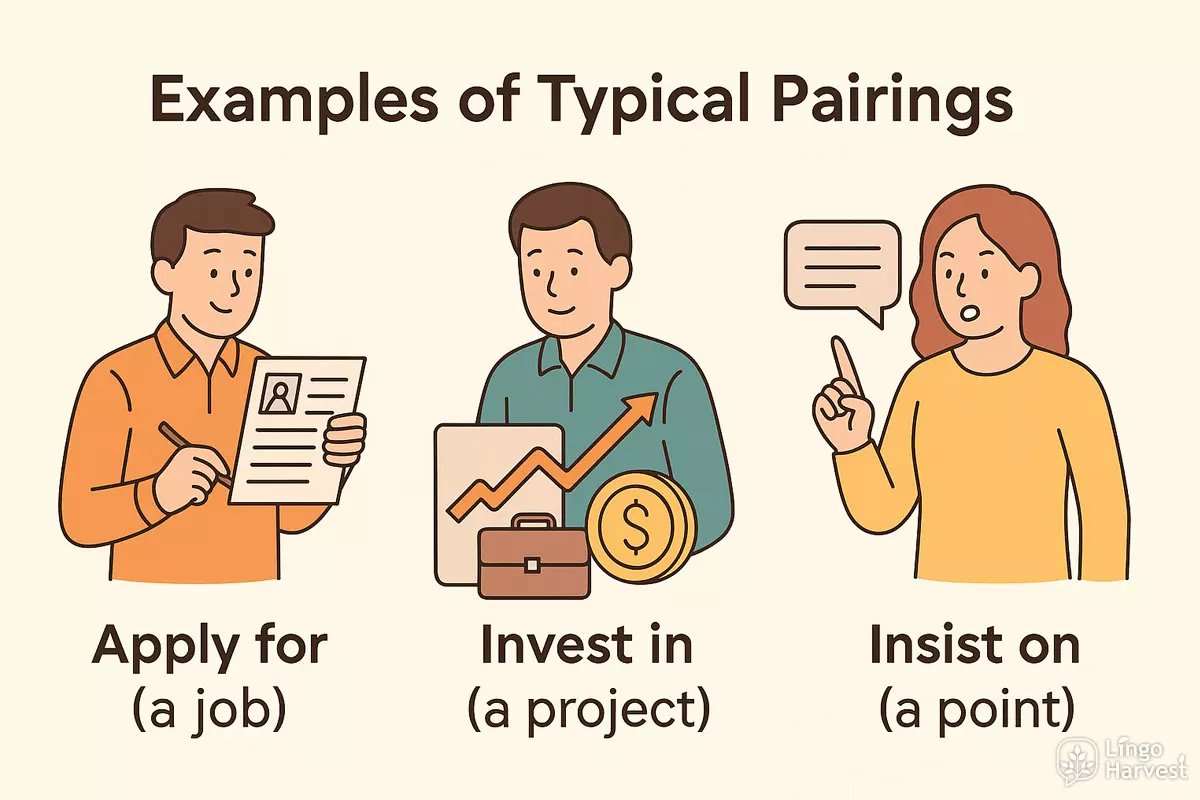
Here are some frequent preposition combinations used in everyday English, especially in areas like work, finance, health, and expressing opinions:
- Apply for (a job)
- Invest in (a project)
- Recover from (an illness)
- Agree with (a person)
- Insist on (a point)
- Deal with (a problem)
- Rely on (support)
- Concerned about (an issue)
- Benefit from (experience)
- Account for (differences)
- Participate in (an event)
- Responsible for (a task)
- Focus on (results)
- Complain about (service)
- Contribute to (a discussion)
- React to (news)
- Involved in (a project)
- Opposed to (an idea)
How Collocations Differ from Grammar Rules
Unlike strict grammar rules, these word-preposition pairings are based on convention and frequent usage. They’re not always logical or predictable, so memorizing common examples is essential. For instance, in business English, you "pay for" goods but "pay attention to" details.
Comparison: Correct vs. Incorrect Usage
| Correct Pairing | Incorrect Pairing |
|---|---|
| interested in science | interested on science |
| responsible for the budget | responsible of the budget |
| focus on results | focus at results |
| recover from illness | recover of illness |
Recognizing and practicing these set expressions builds confidence and clarity in English communication, especially in professional and academic contexts. Regular exposure to authentic examples is the most effective way to internalize these natural patterns.
Why Collocations Improve Natural English
Mastering groups of words that naturally go together helps English sound more fluent and understandable. In real-life conversations, native speakers rely on familiar word pairings, especially with prepositions, to express ideas clearly and efficiently. When learners use these common combinations, their speech and writing feel less forced and more authentic.
How Collocations Build Confidence and Clarity
Using the right preposition with a specific noun or verb reduces hesitation and uncertainty. For instance, saying "interested in finance" or "responsible for health policy" comes across as smooth and natural. This familiarity also makes it easier for listeners to grasp meaning quickly, since these patterns are expected and widely recognized.
Common Benefits for Learners
- Better comprehension: Recognizing word partners helps you understand native speakers faster.
- Fewer mistakes: Collocations reduce awkward or incorrect preposition choices.
- Improved writing: Using set phrases makes formal and informal writing more effective.
- Natural rhythm: Sentences flow better when built with familiar patterns.
- Efficient learning: Focusing on groups of words saves time compared to memorizing single terms.
Examples: Typical Preposition Collocations
Below are some frequent combinations by topic. Notice how these pairings clarify meaning and make your English sound more like a native speaker’s:
- Apply for a job
- Invest in stocks
- Recover from illness
- Depend on experience
- Suffer from stress
- Benefit from exercise
- Agree with an opinion
- Focus on results
- Be responsible for a project
- Pay for services
- Insist on quality
- Complain about delays
- Rely on support
- Participate in meetings
- Worry about deadlines
- Specialize in finance
- React to news
- Be involved in negotiations
Comparing Natural vs. Unnatural Usage
| Natural Collocation ✅ | Unnatural/Incorrect ❌ |
|---|---|
| Apply for a loan | Apply to a loan |
| Interested in health | Interested on health |
| Depend on support | Depend from support |
| Pay for advice | Pay of advice |
| Recover from illness | Recover of illness |
Grasping these combinations not only boosts your confidence but also helps you avoid errors that make speech sound awkward. The more you practice with real collocations, the more your English will feel comfortable and effective in any situation—from work emails to expressing opinions in discussions.
Work-Related Preposition Patterns
Understanding how prepositions function in professional English is essential for clarity and accuracy. Common combinations often appear in business emails, meetings, job interviews, and daily office communication. These collocations can sometimes be unpredictable, so getting familiar with typical patterns is especially helpful for learners and professionals alike.
Frequent Prepositional Collocations in the Workplace
Some verbs and nouns naturally pair with certain prepositions in business contexts. Here are widely used examples:
- apply for (a job/position)
- responsible for (a task/project)
- focus on (a goal/result)
- deal with (clients/problems)
- participate in (a meeting/training)
- collaborate with (a team/colleagues)
- invest in (technology/resources)
- approve of (a proposal/idea)
- contribute to (a project/solution)
- report to (a manager/supervisor)
- specialize in (marketing/IT)
- promote to (a position/role)
- be involved in (a process/initiative)
- provide with (information/resources)
- agree on (a plan/strategy)
- be absent from (work/meeting)
- compete with (other companies)
- work on (a task/project)
- refer to (a document/policy)
Comparing Similar Work Expressions
Sometimes, similar verbs or nouns take different prepositions, which can be confusing. The table below highlights a few key distinctions:
| Expression | Typical Preposition & Example |
|---|---|
| apply | apply for a job |
| apply | apply to a company/university |
| responsible | responsible for a department |
| in charge | in charge of a project |
| work | work in finance/marketing |
| work | work for a company |
| work | work on a project |
| meet | meet with a client |
Tips for Mastering Prepositions in Professional English
To build confidence, notice recurring combinations in your reading and writing at work. Pay attention to how prepositions change the meaning of expressions, and practice using them in context. Over time, these patterns will become more intuitive and help you communicate more precisely in professional situations.
Finance Preposition Collocations
Understanding the way prepositions interact with financial terms helps you express ideas about money, transactions, and economic situations more precisely. In business English, certain combinations are so common that they sound natural to native speakers, while others may seem awkward or unclear. Mastering these typical pairings can boost your confidence in both written and spoken communication about financial matters.
Common Preposition Combinations in Financial Contexts
Below are some frequently used expressions involving money, banking, and investment. These combinations often appear in news, reports, and professional correspondence:
- invest in (e.g., invest in stocks)
- pay for (e.g., pay for services)
- spend on (e.g., spend money on equipment)
- borrow from (e.g., borrow money from the bank)
- lend to (e.g., lend money to a friend)
- profit from (e.g., profit from investment)
- charge for (e.g., charge for delivery)
- owe to (e.g., owe money to a supplier)
- withdraw from (e.g., withdraw cash from an ATM)
- deposit into (e.g., deposit funds into an account)
- benefit from (e.g., benefit from tax breaks)
- contribute to (e.g., contribute to a pension fund)
- return on (e.g., return on investment)
- apply for (e.g., apply for a loan)
- investigate into (e.g., investigate into financial fraud)
- pay off (e.g., pay off a mortgage)
- fall into debt (e.g., fall into debt after a crisis)
- write off (e.g., write off bad debts)
- default on (e.g., default on a payment)
- recover from (e.g., recover from a financial loss)
Typical Patterns: Preposition Usage in Finance
Some financial verbs change meaning depending on the preposition used. Here’s a structured comparison:
| Verb + Preposition | Meaning / Example |
|---|---|
| pay for | To give money for something received She paid for the meal. |
| pay off | To finish repaying a debt He paid off his credit card. |
| invest in | To put money into something for profit They invest in real estate. |
| borrow from | To receive money temporarily We borrowed from the bank. |
| lend to | To give money temporarily The bank lends to businesses. |
| owe to | To be in debt to someone I owe money to my friend. |
| charge for | To ask for payment They charge for shipping. |
| profit from | To gain benefit or money She profited from investments. |
Tips for Using Prepositions with Financial Terms
- Always check which preposition is standard with a particular verb or noun; small changes can alter meaning.
- Listen for these combinations in business meetings, financial news, and reports.
- Practice using these patterns in real-life scenarios, such as writing emails or discussing budgets.
Getting comfortable with these collocation patterns can help you sound more fluent and professional when discussing finances in English.
Health and Wellness Preposition Use
Choosing the right preposition is essential when discussing topics like illness, exercise, nutrition, or mental health. Many common phrases in this area rely on fixed preposition collocations, which are worth learning for clear, natural communication.
Typical Prepositions in Medical and Lifestyle Contexts
When talking about symptoms, treatments, and healthy habits, certain prepositions frequently appear. Here are some frequent patterns and how they’re used:
- Recover from an illness
- Suffer from headaches or stress
- Allergic to peanuts or pollen
- Benefit from regular exercise
- At risk of heart disease
- Concerned about weight gain
- Good for your health
- In need of medical attention
- Depend on medication
- React to a vaccine
- Engage in physical activity
- Complain of back pain
- Prescribed for high blood pressure
- Diagnosed with diabetes
- Admitted to hospital
- Recovering from surgery
- Advice on healthy eating
- Prevent against infection (less common, but sometimes seen)
Comparing Preposition Use in Health Phrases
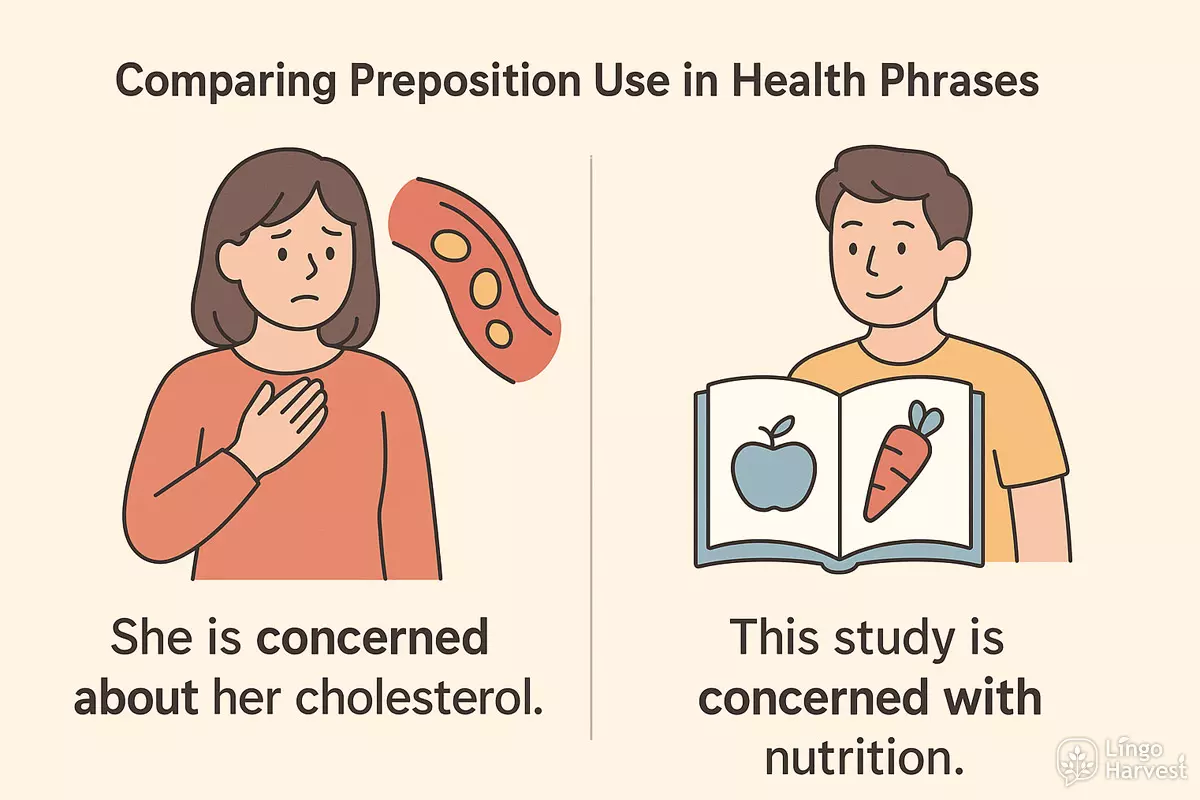
Some verbs and adjectives pair with more than one preposition, but the meaning can shift. Here’s a quick comparison:
| Phrase | Typical Meaning/Usage |
|---|---|
| Concerned about | Worried or anxious regarding a health issue “She is concerned about her cholesterol.” |
| Concerned with | Involved in or focused on (less emotional) “This study is concerned with nutrition.” |
| Recover from | To get better after (an illness, injury, etc.) “He is recovering from the flu.” |
| Recover by | Describes the means or method (rare) “She recovered by resting.” |
Notes on Preposition Choice
The right preposition can depend on the verb, the noun, or even the region. For example, you might hear “on medication” (currently using medicine) or “under treatment” (receiving care). Using the correct form helps avoid misunderstandings and sounds more natural in both spoken and written English. Understanding these collocations improves clarity when discussing well-being, medical advice, or personal health routines. Pay attention to how prepositions shape meaning—small words can make a big difference.
Opinion and Attitude Collocations
When expressing beliefs, feelings, or judgments, certain prepositions naturally combine with specific nouns, verbs, or adjectives. Mastering these combinations helps your English sound more natural and nuanced, especially in discussions, debates, or formal writing.
Common Preposition Patterns with Opinions and Attitudes
Some verbs and adjectives require particular prepositions to convey the right meaning. For example, we say "agree with someone" but "agree on a topic." Choosing the correct preposition is essential for clarity.
- approve of (She doesn’t approve of smoking.)
- believe in (He doesn’t believe in miracles.)
- insist on (They insist on coming early.)
- object to (Do you object to this proposal?)
- be opposed to (She is opposed to the plan.)
- be interested in (Are you interested in politics?)
- be critical of (He’s critical of the decision.)
- complain about (They complain about the noise.)
- comment on (Can you comment on this issue?)
- be indifferent to (She’s indifferent to criticism.)
- confide in (He confides in his friend.)
- be responsible for (Who is responsible for this?)
- be famous for (He is famous for his honesty.)
- be passionate about (She’s passionate about music.)
- be committed to (They’re committed to change.)
- be concerned about (I’m concerned about the results.)
- be tolerant of (Try to be tolerant of differences.)
- be prejudiced against (He’s prejudiced against newcomers.)
- be sure of (Are you sure of that fact?)
- be doubtful about (She’s doubtful about the outcome.)
Comparing Attitude Collocations
Sometimes, similar verbs or adjectives take different prepositions, which can be confusing. Here’s a structured comparison to highlight some of these patterns:
| Expression | Typical Preposition & Example |
|---|---|
| agree | with (a person): I agree with you. on (a topic): We agree on the solution. |
| argue | about (a topic): They argued about money. with (a person): She argued with her boss. |
| be angry | about (a situation): He’s angry about the delay. with (a person): She’s angry with him. |
| be grateful | for (something): I’m grateful for your help. to (someone): She’s grateful to her parents. |
Tips for Using Attitude and Opinion Collocations
Pay attention to how native speakers use these combinations in context. When writing or speaking, double-check the preposition, especially with less familiar expressions. Over time, these patterns will become more intuitive, helping you communicate your views more precisely and naturally.
Common Errors with Preposition Choice
Misusing prepositions is a frequent source of confusion for English learners, especially when dealing with collocations in areas like work, finance, health, or expressing opinions. Many prepositions don’t translate directly from other languages, leading to mistakes that can make speech or writing sound unnatural.
Typical Preposition Confusion by Topic
Sometimes, the wrong preposition changes the meaning or makes a sentence unclear. Below are common mismatches observed in each topic area:
- Work: say “responsible for” (not “responsible of”), “apply for a job” (not “apply to a job”).
- Finance: “invest in stocks,” “pay for goods,” and “spend on travel.”
- Health: “recover from illness,” “suffer from stress,” “allergic to nuts.”
- Opinion: “agree with someone,” “agree on a plan,” “believe in something.”
Commonly Confused Prepositions
Learners often swap prepositions that seem similar but aren’t interchangeable. Here are some frequent mix-ups:
- Discuss with (not “discuss about”)
- Depend on (not “depend of”)
- Interested in (not “interested on”)
- Good at (not “good in” when talking about skills)
- Focus on (not “focus in”)
- Worried about (not “worried for”)
- Participate in (not “participate at”)
- Benefit from (not “benefit of”)
- Complain about (not “complain on”)
- Apply for a job (not “apply on a job”)
- Insist on (not “insist in”)
- Rely on (not “rely in”)
Side-by-Side Examples
To clarify the differences, here’s a comparison of correct and incorrect patterns frequently seen in professional and everyday contexts:
| Incorrect Usage ❌ | Correct Usage ✅ |
|---|---|
| She is responsible of the team. | She is responsible for the team. |
| He invested on technology. | He invested in technology. |
| I’m interested on finance. | I’m interested in finance. |
| They suffer of stress. | They suffer from stress. |
| We discussed about the project. | We discussed the project or discussed it with the team. |
| He agreed to my opinion. | He agreed with my opinion. |
Why These Mistakes Happen
Errors in preposition selection often result from translating directly from a native language or from overgeneralizing patterns. English prepositions are especially context-sensitive; memorizing frequent pairings (collocations) can help reduce these slips. Reviewing topic-specific examples and practicing them in sentences can reinforce correct usage.
Practice: Complete Sentences with Correct Prepositions
Understanding how prepositions work with common collocations is essential for sounding natural in English, especially when discussing work, finance, health, or opinions. Below, you'll find practical exercises to help reinforce your knowledge of these typical prepositional pairings. Read each sentence and choose the correct preposition to complete it.
Fill in the Blanks: Work & Finance Collocations
- She specializes ___ international marketing strategies.
- The company invested heavily ___ new technology last year.
- We are responsible ___ meeting all project deadlines.
- He was promoted ___ manager after only six months.
- They succeeded ___ reducing costs by 20%.
Show answers
- in
- in
- for
- to
- in
Health & Wellbeing: Choose the Right Preposition
- She recovered ___ her illness quickly.
- Doctors warned him ___ the dangers of smoking.
- He suffers ___ chronic headaches.
- Many people are allergic ___ nuts.
- They are concerned ___ the rise in obesity.
Show answers
- from
- about
- from
- to
- about
Expressing Opinion: Typical Collocation Patterns
It’s common to use certain prepositions when stating your views or agreeing/disagreeing with others. Here are some patterns to practice:
- agree ___ someone / something
- object ___ an idea
- believe ___ (something)
- be opposed ___ a plan
- approve ___ the proposal
- insist ___ doing something
- be in favor ___ stricter laws
- be indifferent ___ the outcome
- complain ___ the decision
- argue ___ a topic
Show answers
- with / to
- to
- in
- to
- of
- on
- of
- to
- about
- about
Comparison Table: Prepositions by Topic
| Topic | Common Prepositional Collocations |
|---|---|
| Work/Finance | responsible for, invest in, succeed in, focus on, apply for |
| Health | recover from, suffer from, allergic to, warn about, benefit from |
| Opinion | agree with, object to, believe in, approve of, insist on |
| General | depend on, result in, rely on, participate in, complain about |
Practicing these collocations in context will help you remember which prepositions are most natural for each topic. Try writing your own sentences using the patterns above to deepen your understanding.