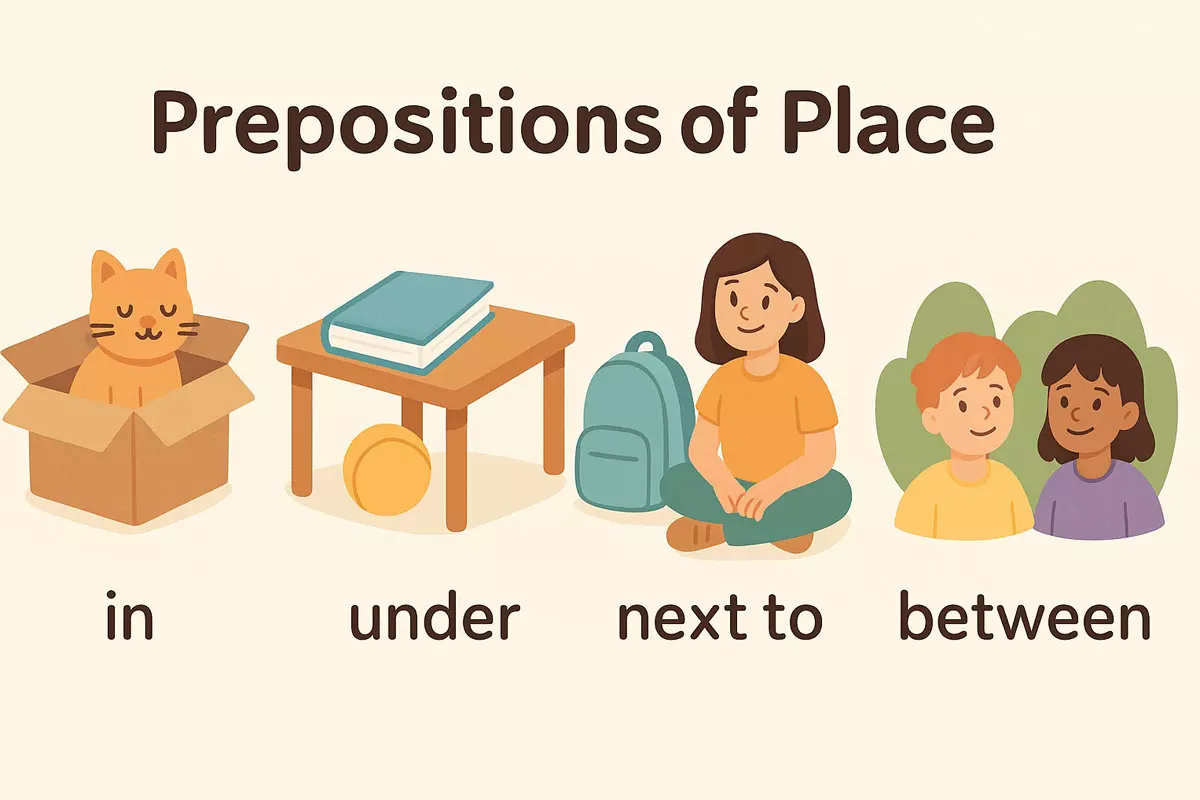
Prepositions of Place: in, on, under, next to, between

 Here we using English prepositions to map locations, explains the difference between single and compound prepositions, and provides practice describing rooms and pictures.
Mastering small words that indicate location is essential for clear and effective everyday English communication. Knowing how to describe where objects or people are positioned helps conversations flow smoothly and minimizes misunderstandings. Whether you are giving directions, explaining where something is, or telling a story, using the right words to show position makes your meaning clear. Improving your ability to use these words will boost your confidence and help you interact more naturally in a variety of situations.
Mapping Where Things Are
Understanding how to describe the position of objects is essential for clear communication. Prepositions like "in," "on," "under," "next to," and "between" help us explain where things are located in relation to each other. These small words can change the meaning of a sentence and make your descriptions much more precise.
Common Ways to Express Location
You can use prepositions of place to give directions, describe a scene, or tell someone where to find something. Here are some typical situations where these prepositions are useful:
- Describing where furniture is in a room
- Explaining where people are in a photo
- Giving directions in a building or city
- Telling someone where to look for an item
Examples with Everyday Objects
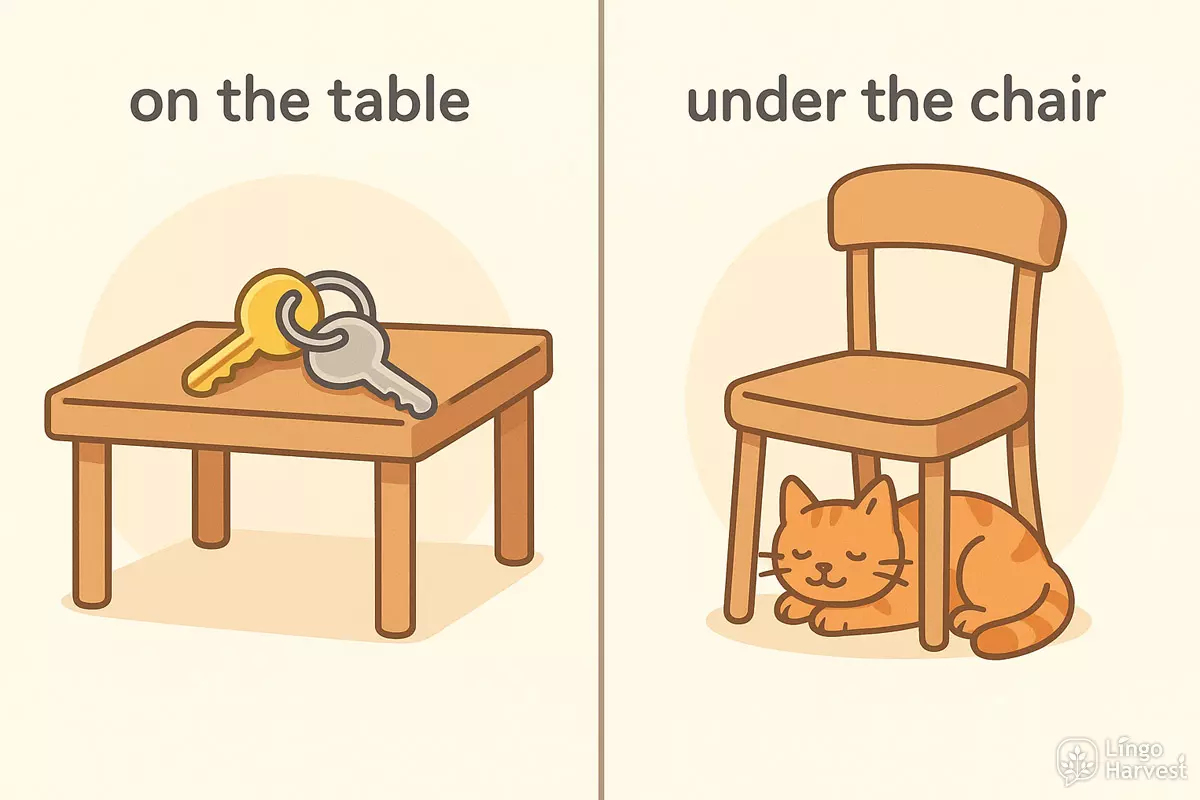
These examples show how each preposition helps clarify the position of one object compared to another:
- The keys are on the table.
- The cat is under the chair.
- The shoes are next to the door.
- The lamp is between the sofa and the armchair.
- The book is in the backpack.
- The clock is on the wall.
- The toys are under the bed.
- The phone is in my pocket.
- The picture is between the window and the bookshelf.
- The umbrella is next to the coat rack.
- The food is on the plate.
- The notebook is in the drawer.
Visualizing Spatial Relationships
To clarify how these prepositions work, here is a comparison of their typical uses:
| Preposition | Typical Use/Example |
|---|---|
| in | Inside an enclosed space (The apple is in the bowl.) |
| on | Touching a surface (The book is on the desk.) |
| under | Below something else (The dog is under the table.) |
| next to | Beside, at the side of (The bag is next to the chair.) |
| between | In the middle of two objects (The shop is between the bank and the café.) |
Tips for Using Prepositions of Place
Using the right preposition depends on what you want to express. "In" is best for enclosed spaces, "on" for surfaces, and "under" for anything beneath another object. "Next to" indicates proximity, while "between" refers to a position in the middle of two things. Remember, small changes in prepositions can make a big difference in meaning. Practicing with real-life objects can help you become more confident and accurate in your descriptions.
Single vs Compound Prepositions
When talking about location, English uses both basic one-word forms and more complex multi-word expressions to show relationships between objects. The difference comes down to whether the word stands alone or combines with others to form a phrase.
What Are Single Prepositions?
Single prepositions are the most common type. They are made up of just one word. Examples include in, on, under, between, and next to. These are used to show where something is in relation to something else. For instance, “The book is on the table” clearly indicates the book's position.
- in – The cat is in the box.
- on – The picture is on the wall.
- under – The shoes are under the bed.
- between – The lamp is between the chairs.
- over – The plane is over the city.
- behind – The dog is behind the door.
- beside – The phone is beside the notebook.
- inside – The keys are inside the drawer.
- outside – The car is outside the garage.
- above – The clock is above the window.
How Compound Prepositions Work
Compound prepositions, also called complex or phrasal prepositions, consist of two or more words working together as a single unit. Typically, these are made by combining simple prepositions with other words, such as next to, in front of, or on top of. They help express more specific or nuanced spatial relationships.
- next to – The chair is next to the desk.
- in front of – The car is in front of the house.
- on top of – The cat is on top of the fridge.
- to the left of – The window is to the left of the door.
- to the right of – The lamp is to the right of the sofa.
- in the middle of – The fountain is in the middle of the square.
- at the back of – The garden is at the back of the house.
- at the top of – The flag is at the top of the pole.
- at the bottom of – The shoes are at the bottom of the stairs.
- close to – The school is close to the park.
Comparing Single and Compound Forms
Single and compound prepositions both help describe where things are, but compound forms often give more detail. Here’s a quick comparison:
| Type | Examples | Typical Use |
|---|---|---|
| Single | in, on, under, between, behind, above | Direct, basic location |
| Compound | next to, in front of, on top of, at the back of, close to | Specific or complex position |
In everyday conversation, both types are essential for clear and precise communication about where objects or people are found. Choosing the right form depends on how much detail you want to provide.
Picture Descriptions
When learning how to use "in," "on," "under," "next to," and "between," visual examples can be especially helpful. Imagine different scenes where objects relate to each other in space. Describing these images helps clarify each preposition’s meaning and typical usage.
Common Scene Descriptions
- The cat is on the table. (The cat is resting on the surface.)
- The dog is under the chair. (The dog is below the seat.)
- The book is in the bag. (The book is inside the bag.)
- The lamp is next to the sofa. (The lamp is beside the sofa.)
- The ball is between the shoes. (The ball is in the middle of the shoes.)
- The clock is on the wall. (The clock is attached to the wall’s surface.)
- The keys are in the drawer. (The keys are contained inside.)
- The shoes are under the bed. (The shoes are beneath the bed.)
- The picture is next to the window. (The picture is close to the window.)
- The playground is between the school and the park. (It is located in the middle of both places.)
- The pencil case is on the desk. (It is on top of the desk.)
- The cat is in the box. (The cat is inside the box.)
- The bag is under the table. (The bag is below the table.)
- The chair is next to the door. (The chair is beside the door.)
- The statue is between two trees. (It stands in the middle of them.)
Comparing Prepositions in Scenes
| Preposition | Example Description |
|---|---|
| in | The apples are in the basket. (They are inside the basket.) |
| on | The vase is on the shelf. (It rests on the surface.) |
| under | The puppy is under the blanket. (It is below the blanket.) |
| next to | The notebook is next to the pen. (They are side by side.) |
| between | The car is between two trucks. (It is in the middle.) |
Asking and Answering “Where?” Questions
Locating objects or people is a common need in daily conversation. To do this, we often use prepositions of place such as in, on, under, next to, and between. These small but powerful words help describe positions and spatial relationships clearly.
How to Form Questions about Location
The basic structure for location questions is: Where + is/are + subject? For example:
- Where is the book?
- Where are the keys?
You can also add more detail if needed, such as, “Where is the cat in the room?”
Typical Answers Using Prepositions of Place
Answers usually start with the subject, followed by the verb, and then the preposition phrase. For example:
- The book is on the table.
- The dog is under the chair.
- The cat is next to the window.
- The ball is between the boxes.
- The keys are in my bag.
Common Patterns and Examples
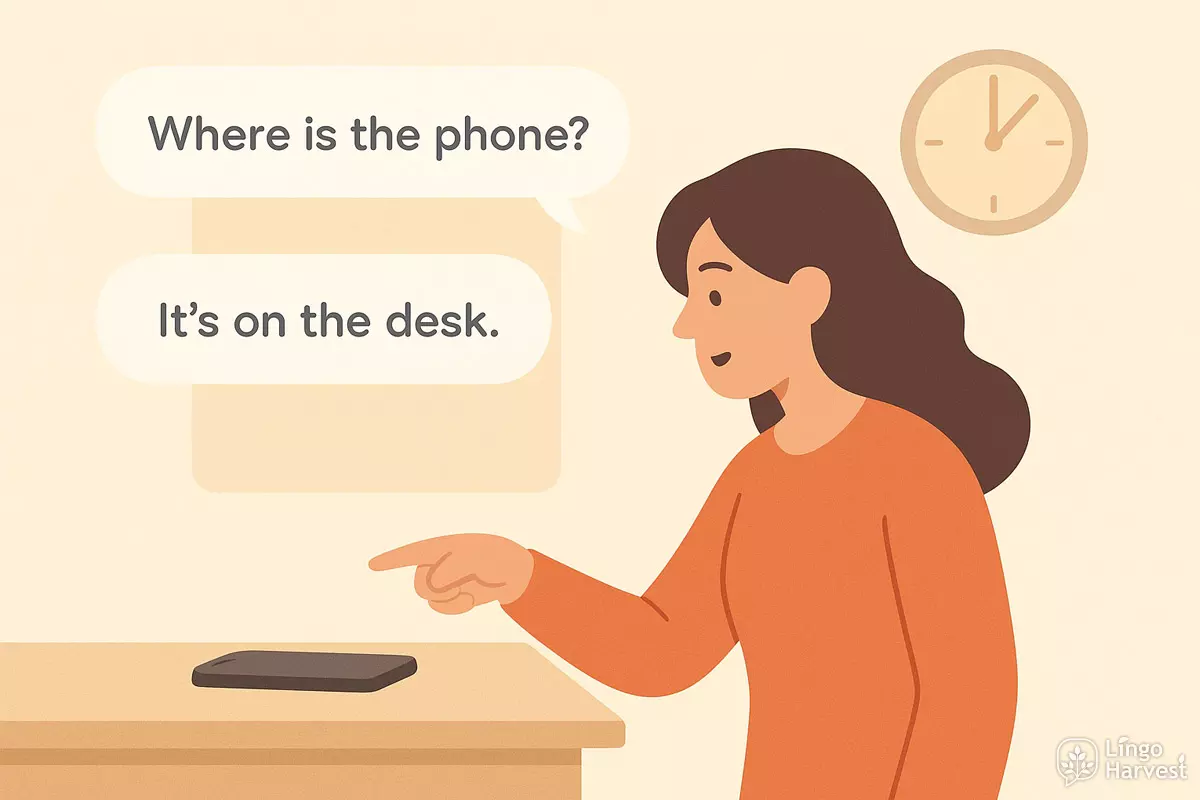
Here are some common question and answer pairs to help you get comfortable with this topic:
- Where is the phone? → It’s on the desk.
- Where are your shoes? → They’re under the bed.
- Where is the lamp? → It’s next to the sofa.
- Where are the apples? → They’re in the bowl.
- Where is the bus stop? → It’s between the bank and the post office.
- Where is my pencil? → It’s on your notebook.
- Where are the cats? → They’re under the table.
- Where is the picture? → It’s on the wall.
- Where is your bag? → It’s next to the chair.
- Where are the children? → They’re in the garden.
- Where is the clock? → It’s on the shelf.
- Where is the mouse? → It’s between the boxes.
- Where are my glasses? → They’re on your head!
- Where is the teacher? → She’s in the classroom.
- Where is the restaurant? → It’s next to the cinema.
Overview: Prepositions of Place in Questions and Answers
| Question | Example Answer | Preposition Used |
|---|---|---|
| Where is the cat? | The cat is on the sofa. | on |
| Where are the shoes? | The shoes are under the bed. | under |
| Where is the clock? | The clock is in the kitchen. | in |
| Where is the bank? | The bank is next to the supermarket. | next to |
| Where is the park? | The park is between the library and the school. | between |
Tips for Practice
To get better at these types of questions and answers, try describing your surroundings. Look at objects and ask yourself or a friend where they are, using different prepositions. This will help you become more confident and accurate when talking about locations.
Common Classroom Instructions
Understanding how prepositions like "in," "on," "under," "next to," and "between" are used can be much easier when students hear them in real classroom situations. Teachers often give directions that involve these words, helping learners connect language to actions and objects around them.
Typical Teacher Directions Using Place Prepositions
Many activities in lessons use these prepositions to guide students. Here are some practical instructions you might hear or use:
- Put your book on the table.
- Sit in your chair.
- Place your pencil under your notebook.
- Stand next to the door.
- Put the eraser between the two books.
- Hang your bag on the hook.
- Look under your desk.
- Move your chair next to your friend.
- Keep your hands on your lap.
- Write your name in the top corner.
- Place the marker between the pens.
- Stand between the board and the window.
- Leave your shoes by the door (note: "by" is related and often used next to "next to").
- Put your worksheet on the teacher’s desk.
- Find the picture in your book.
- Place your cup on the tray.
- Look for your partner in the classroom.
- Stand under the clock.
Comparing Prepositions of Place in Classroom Contexts
To clarify the differences, here’s a comparison of how these prepositions are used with objects and locations commonly found in learning spaces:
| Preposition | Sample Instruction |
|---|---|
| in | Put your crayons in the box. |
| on | Place your homework on my desk. |
| under | Look under your chair. |
| next to | Stand next to the window. |
| between | Put the ball between the boxes. |
Tips for Practicing with Directions
Giving and following instructions with these prepositions can be turned into interactive activities. For example, teachers might ask students to move objects or themselves according to a command. This helps reinforce both understanding and correct usage. Try role-playing as the teacher and giving directions to classmates, or create a classroom scavenger hunt using these location words.
Practice: Describe a Room
Let’s put prepositions of place into action by describing what you see in a typical room. This exercise will help you get comfortable using “in,” “on,” “under,” “next to,” and “between” in real sentences. Look at the following example and then try to describe your own room or a room you imagine.
Example Sentences
- The lamp is on the table.
- There is a carpet under the sofa.
- The bookshelf is next to the window.
- The clock is between the two paintings.
- My shoes are in the closet.
- The cat is under the chair.
- The pillows are on the sofa.
- The desk is in the corner of the room.
- A backpack is next to the bed.
- There is a rug between the bed and the wardrobe.
- The remote control is on the TV stand.
- Books are in the drawer.
- The shoes are under the bed.
- The plant is next to the door.
- The armchair is between the lamp and the window.
Practice Task
- Look around your room or imagine one in your mind.
- Write five sentences using at least three different prepositions from this lesson.
- Try to vary the objects and their locations.
Here are some useful nouns and phrases to help you:
- table, chair, lamp, window, bed, closet, carpet, pillow, desk, bookshelf, plant, door, wardrobe, sofa, TV, rug, remote control, drawer, backpack, armchair
Quiz: Which Preposition?
Choose the correct preposition (“in,” “on,” “under,” “next to,” or “between”) for each blank.
- The cat is ___ the sofa.
- The books are ___ the shelf.
- The lamp is ___ the bed and the desk.
- The keys are ___ the drawer.
- The chair is ___ the table.
Show answers
- under
- on
- between
- in
- next to
Challenge: Describe This Room
Imagine the following scene and write three sentences about it using prepositions of place:
- A bed is in the middle of the room.
- There is a lamp on the bedside table.
- A rug is under the bed.
- A plant is next to the window.
- A wardrobe stands between the bed and the door.
Show answers
- The lamp is on the bedside table.
- The rug is under the bed.
- The wardrobe is between the bed and the door.
Practicing these patterns will help you describe spaces more naturally and accurately. Try mixing up the objects and positions, and use different prepositions to make your descriptions more interesting.