Common Adjective + Preposition Rules: Clear A1–B1 Guide

 Here we what adjective plus preposition patterns are, common pairs for A1–B1 learners, how prepositions change adjective meanings, differences between similar patterns like good at and good for, typical mistakes, and short practice ideas.
- What adjective + preposition patterns are
- High-frequency adjective + preposition pairs for A1–B1
- How prepositions change the meaning of an adjective
- Distinguishing similar patterns: good at, good for, good with
- Typical learner mistakes and how to correct them
- Short practice ideas to remember common patterns
Are you finding it difficult to pair adjectives with the correct prepositions in English? This concise guide explains the key rules for matching common adjectives with their appropriate prepositions, helping beginner and intermediate learners avoid common mistakes and express themselves more accurately. With clear explanations and useful examples, you will gain confidence in your English skills and be able to communicate your thoughts more effectively in both spoken and written contexts.
What adjective + preposition patterns are
When we talk about adjective + preposition patterns, we mean specific combinations where certain adjectives are regularly followed by particular prepositions. These combinations are not always logical, and often they must be learned as fixed expressions. For English learners at A1–B1 levels, recognizing and using these patterns helps your sentences sound natural and clear.
Why do these combinations matter?
Some adjectives simply require a preposition to complete their meaning. The choice of preposition can even change the meaning of the adjective. For example, "good at" and "good for" are both correct, but they mean different things. Learning these patterns helps you avoid common mistakes and communicate more effectively.
Common examples of adjective + preposition pairings
Here are some widely used combinations you will encounter:
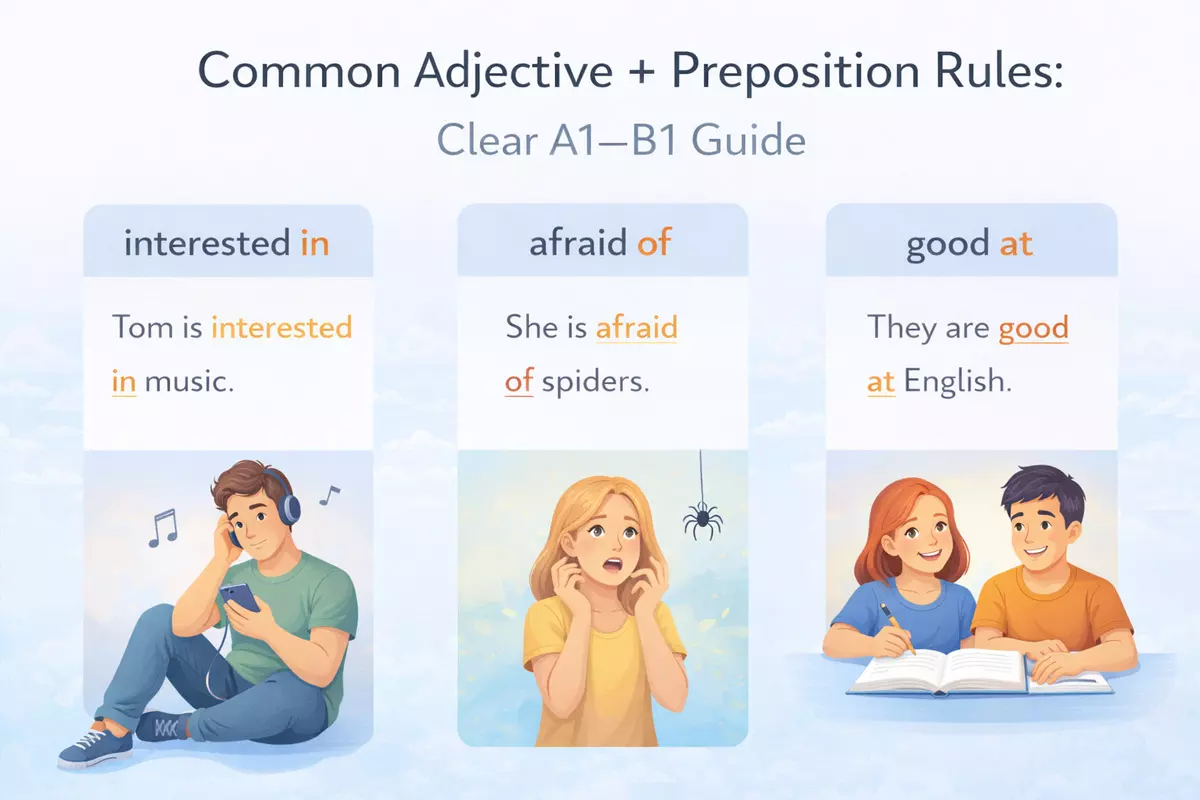
- afraid of → She is afraid of spiders.
- angry about → He was angry about the delay.
- interested in → She is interested in history.
- good at → He is good at playing chess.
- famous for → The city is famous for its museums.
- proud of → They are proud of their children.
- different from → This version is different from the original.
- similar to → Your idea is similar to mine.
- excited about → She is excited about the trip.
- worried about → I’m worried about the exam.
- responsible for → She is responsible for the project.
- tired of → I’m tired of waiting.
- keen on → He is keen on photography.
- married to → She is married to a doctor.
- close to → I feel very close to my sister.
- full of → The box is full of toys.
- kind to → Please be kind to your classmates.
- bad at → I am bad at remembering names.
- famous for → This restaurant is famous for its seafood.
- afraid of → He is afraid of flying.
How do you use these patterns in sentences?
The adjective is followed directly by the preposition, then usually by a noun or gerund (verb+ing). For example:
- She is afraid of spiders.
- He is good at playing chess.
- They are interested in music.
Remember, you cannot always guess the correct preposition. It is important to learn the combinations as a pair.
Comparing different combinations
Sometimes, the same adjective can take different prepositions, each changing the meaning. Here are some examples:
| Adjective + Preposition | Meaning / Example |
|---|---|
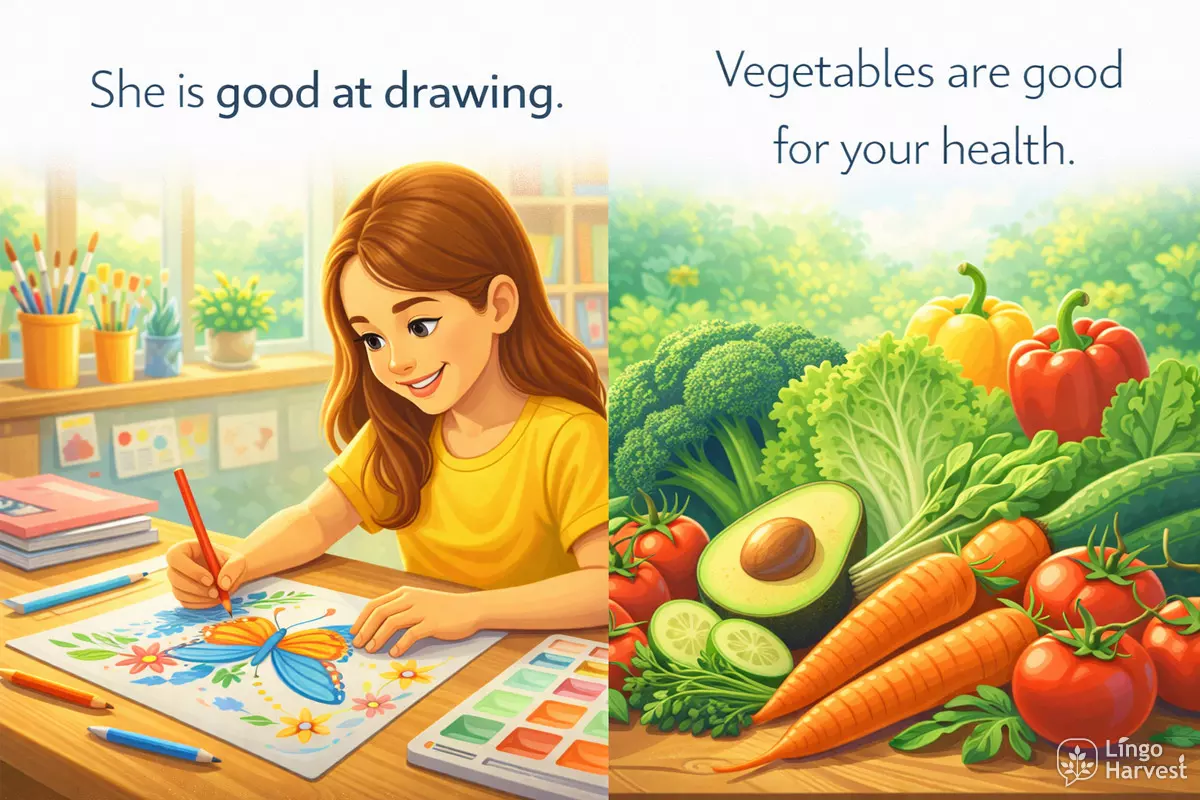
| good at | Skilled in an activity She is good at drawing. |
| good for | Beneficial Vegetables are good for your health. |
| angry about | Annoyed regarding a situation He is angry about the delay. |
| angry with | Upset with a person I am angry with my brother. |
| interested in | Having curiosity or enthusiasm They are interested in art. |
| interested by | Affected or attracted (less common) He was interested by her story. |
Tips for learning these pairs
- Focus on learning the combination, not just the adjective.
- Notice patterns in reading and listening practice.
- Make your own example sentences.
- Review and use them in conversation for better memory.
By understanding and practicing these adjective-preposition combinations, you will improve your ability to express ideas clearly and naturally in English.
High-frequency adjective + preposition pairs for A1–B1
Knowing which adjectives often pair with certain prepositions can make everyday English communication smoother and more natural. At beginner and intermediate levels, you’ll frequently see some combinations in textbooks, conversations, and listening exercises. These pairs often follow set patterns, so learning them early gives you an advantage.
Common adjective + preposition patterns
Many adjectives are regularly used with particular prepositions. For example, we say “good at” but “interested in.” Recognizing these patterns helps avoid common mistakes and builds confidence when speaking or writing.
- ashamed of (ashamed of his behaviour) → He felt ashamed of his behaviour.
- annoyed about (annoyed about the mess) → She was annoyed about the mess in the kitchen.
- angry with (angry with his friend) → He is angry with his friend.
- hopeless at (hopeless at dancing) → I’m hopeless at dancing.
- separate from (separate from the group) → He stayed separate from the group.
- crazy about (crazy about football) → She is crazy about football.
- well known for (well known for its parks) → The city is well known for its parks.
- brilliant at (brilliant at maths) → She is brilliant at maths.
- successful in (successful in business) → He is successful in business.
- polite to (polite to strangers) → You should be polite to strangers.
- engaged to (engaged to a doctor) → She is engaged to a doctor.
- pleased with (pleased with the results) → We are pleased with the results.
- jealous of (jealous of his brother) → She is jealous of her brother.
- scared of (scared of thunder) → The dog is scared of thunder.
- opposite to (opposite to this idea) → His opinion is opposite to this idea.
- sorry about (sorry about the delay) → I’m sorry about the delay.
- bored with (bored with this show) → I’m bored with this show.
- nervous about (nervous about the test) → The students are nervous about the test.
How these pairs are used in context
You’ll often hear and read these combinations in everyday English. For instance, “She’s good at swimming,” or “He’s interested in science.” Notice how the preposition after the adjective is fixed—changing it usually sounds unnatural.
| Adjective + Preposition | Example Sentence |
|---|---|
| afraid of | I am afraid of dogs. |
| good at | She is good at tennis. |
| interested in | They are interested in art. |
| famous for | This city is famous for its food. |
| tired of | He is tired of the rain. |
| kind to | Be kind to your friends. |
Learning these adjective-preposition pairs is an essential step for clear and correct English at beginner and pre-intermediate levels. Practice with real-life examples, and soon these combinations will feel natural in your speech and writing.
How prepositions change the meaning of an adjective
Choosing the right preposition after an adjective is important because it can completely alter what you want to say. In English, different prepositions can give the same adjective a new context or shade of meaning. This is why it’s useful to learn common adjective + preposition combinations as fixed phrases, especially at beginner and intermediate levels.
Why prepositions matter with adjectives
When you use an adjective with a certain preposition, you often express a specific relationship or feeling. For example, “interested in” means you want to know more about something, while “interested by” is less common and can suggest you are affected by something in a passive way. Using the wrong preposition can confuse your listener or even change your meaning.
Common adjective + preposition patterns
Many adjectives are usually followed by particular prepositions. Here are some frequent combinations and their typical meanings:
- accustomed to (used to something): accustomed to city life → She is accustomed to city life.
- addicted to (dependent on): addicted to sugar → He is addicted to sugar.
- allergic to (medical reaction): allergic to peanuts → She is allergic to peanuts.
- annoyed with (irritated by a person): annoyed with her boss → He is annoyed with his boss.
- aware of (having knowledge): aware of the problem → They are aware of the problem.
- capable of (ability): capable of great work → She is capable of great work.
- dependent on (relying): dependent on parents → He is dependent on his parents.
- fascinated by (very interested): fascinated by space → She is fascinated by space.
- famous as (role/identity): famous as a writer → He is famous as a writer.
- grateful for (thankful): grateful for your help → I’m grateful for your help.
- jealous of (envy): jealous of success → He is jealous of their success.
- known for (recognised because of): known for kindness → She is known for kindness.
- popular with (liked by): popular with students → The teacher is popular with students.
- ready for (prepared): ready for the exam → We are ready for the exam.
- satisfied with (happy about result): satisfied with progress → I’m satisfied with my progress.
- shocked by (strong surprise): shocked by the news → They were shocked by the news.
- similar in (specific aspect): similar in shape → The boxes are similar in shape.
- strict with (discipline to someone): strict with children → She is strict with her children.
- thankful for (gratitude): thankful for support → We are thankful for your support.
- upset about (sad/concerned): upset about losing → He is upset about losing.
How meaning changes with different prepositions
Sometimes, changing the preposition changes the focus or creates a new meaning. Compare these examples:
| Adjective + Preposition | Meaning / Example |
|---|---|
| angry with (someone) | Annoyed at a person I'm angry with Tom. |
| angry about (something) | Upset about a situation She's angry about the decision. |
| good at (activity) | Skilled in something He’s good at tennis. |
| good for (purpose) | Beneficial Vegetables are good for you. |
| afraid of (object/situation) | Fears something She's afraid of spiders. |
| afraid for (person) | Worried about someone’s safety He’s afraid for his brother. |
| excited about (event) | Looking forward to They’re excited about the concert. |
| excited by (cause) | Stimulated by something The children were excited by the story. |
Tips for learning adjective + preposition pairs
- Remember these combinations as “chunks” or fixed phrases.
- Practice with real sentences, not just single words.
- Notice patterns when reading or listening to English.
- Check a dictionary if you’re not sure which preposition to use.
Mastering adjective + preposition pairs will help you sound more natural and avoid confusion. Pay attention to these patterns, as small changes can make a big difference in meaning.
Distinguishing similar patterns: good at, good for, good with
Understanding how to use “good at,” “good for,” and “good with” helps learners avoid common mistakes in English. While all three patterns begin with “good,” each is followed by a different preposition and is used in a specific context. Knowing which structure to choose depends on what you want to express: a skill, a benefit, or successful interaction.
When to Use Each Pattern
- Good at describes someone’s skill or ability in an activity or subject. Use it to talk about talents or things people can do well.
- Good for points to something that is beneficial or healthy. It’s used for talking about positive effects on people, situations, or things.
- Good with indicates ease or success in dealing with people, animals, tools, or things. It often highlights interpersonal or practical skills.
Common Examples and Usage
Here are typical situations where each phrase fits:
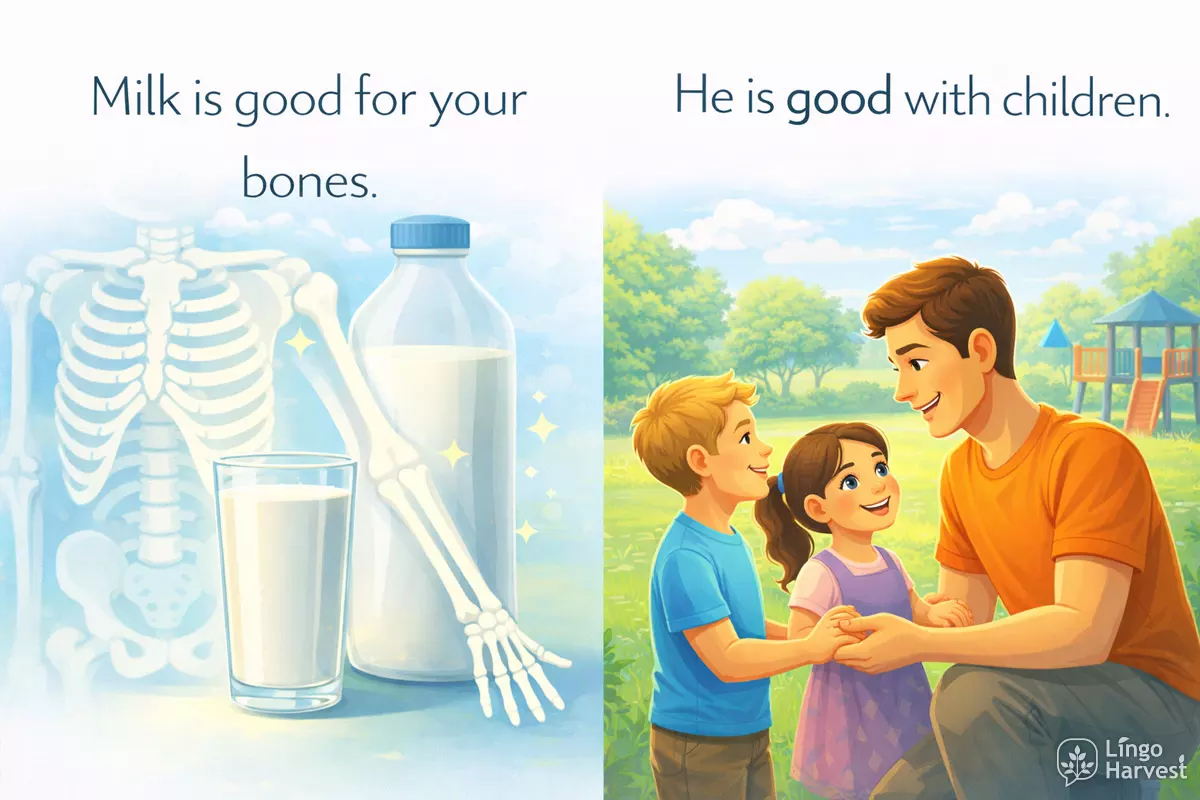
- She is good at drawing. (She has artistic skills.)
- Milk is good for your bones. (It has a health benefit.)
- He is good with children. (He interacts well with them.)
- I’m good at solving puzzles.
- Walking daily is good for your heart.
- Are you good with computers?
- The new rule is good for the team.
- She’s good at languages.
- My brother is good with animals.
- Vegetables are good for you.
- He’s good at math.
- They are good with tools.
- This weather is good for skiing.
- Are you good at cooking?
- She’s good with money.
- Yoga is good for stress relief.
Quick Comparison Table
| Pattern | Typical Meaning / Example |
|---|---|
| Good at | Skill or ability He is good at chess. |
| Good for | Benefit or positive effect Fruit is good for you. |
| Good with | Handling people/things well She is good with children. |
Tips for Learners
Practice by matching each phrase to the correct context. If you’re talking about a person’s talent, use “good at.” For health or usefulness, choose “good for.” If the focus is on interaction or managing something, “good with” is best. Noticing these patterns in real conversations or reading will help reinforce the right usage.
Typical learner mistakes and how to correct them
Learners at A1–B1 levels often mix up adjective-preposition combinations or use the wrong preposition entirely. This usually happens because their native language uses different structures, or because some adjectives in English can take more than one preposition with a change in meaning. Being aware of the most common pitfalls helps you avoid fossilizing these errors.
Frequent errors with adjective + preposition pairs
One classic challenge is remembering which preposition goes with which adjective. The following is a list of common mismatches and tips to correct them:
- Interested in ❌ ("interested on" or "interested about")
- Good at ❌ ("good in" or "good on")
- Afraid of ❌ ("afraid from")
- Famous for ❌ ("famous of" or "famous by")
- Angry with (a person), angry about (a situation) ❌ ("angry to")
- Different from ❌ ("different than" or "different with")
- Married to ❌ ("married with")
- Close to ❌ ("close with" for places or relationships)
- Good for (beneficial), good at (skill) ❌ ("good in" for both)
- Bad at (skill), bad for (harmful) ❌ ("bad in")
- Sorry for (sympathy), sorry about (regret) ❌ ("sorry of")
- Responsible for ❌ ("responsible of" or "responsible to")
- Familiar with ❌ ("familiar to" unless describing something well-known by others)
- Proud of ❌ ("proud for")
- Similar to ❌ ("similar with" or "similar as")
- Accustomed to ❌ ("accustomed with")
- Dependent on ❌ ("dependent of")
- Surprised by/at ❌ ("surprised of")
- Kind to (a person), kind of (type) ❌ ("kind with")
How to avoid and fix these mistakes
- Memorize adjective + preposition pairs as set phrases, not as individual words.
- Practice with example sentences, focusing on context.
- Notice patterns in reading and listening tasks; make a personal list of confusing pairs.
- Test yourself by covering one side of your notes and recalling the correct preposition.
- Use spaced repetition to review tricky combinations regularly.
Visual comparison: Correct vs. Incorrect Use
| Incorrect | Correct |
|---|---|
| She is good in tennis. | She is good at tennis. |
| I am interested on art. | I am interested in art. |
| He is married with Anna. | He is married to Anna. |
| This is different than my idea. | This is different from my idea. |
| She is afraid from spiders. | She is afraid of spiders. |
| He is responsible of the project. | He is responsible for the project. |
Staying alert to these common mix-ups and practicing in context will help you build confidence and accuracy with adjective + preposition rules. Over time, using the correct combinations will become more natural.
Short practice ideas to remember common patterns
Mastering adjective + preposition combinations is easier with regular, focused exercises. Here are some practical activities and memory tricks to help you internalize the most frequent patterns from A1 to B1 levels. These ideas can be used alone or in class, and are designed to make the rules more memorable and automatic.
1. Make your own example sentences
Personalize each pair by writing sentences that relate to your daily life. This makes the connection between adjective and preposition stronger. For instance, try sentences like:
- She’s afraid of dogs.
- I’m interested in science fiction.
- We’re good at drawing.
2. Matching activity: adjectives and prepositions
Practice by matching adjectives to their correct prepositions. Mix and match for extra challenge.
- afraid ___
- proud ___
- famous ___
- angry ___
- different ___
- keen ___
- similar ___
- interested ___
- good ___
- married ___
- responsible ___
- tired ___
- worried ___
- bad ___
- excited ___
- fond ___
- pleased ___
- ready ___
- famous ___
- jealous ___
Show answers
- afraid of
- proud of
- famous for
- angry about/with
- different from
- keen on
- similar to
- interested in
- good at
- married to
- responsible for
- tired of
- worried about
- bad at
- excited about
- fond of
- pleased with
- ready for
- famous for
- jealous of
3. Spot the mistake
Identify and correct the wrong prepositions in these sentences:
- He’s interested on football.
- They are proud for their son.
- She’s good in singing.
- I’m afraid from spiders.
- We’re excited in the trip.
- She is married with a doctor.
- I am bad on maths.
- They are worried for the exam.
- He is responsible of the budget.
- The village is famous about wine.
Show answers
- interested in football
- proud of their son
- good at singing
- afraid of spiders
- excited about the trip
- married to a doctor
- bad at maths
- worried about the exam
- responsible for the budget
- famous for wine
4. Quick reference table: typical adjective + preposition pairs
| Adjective | Common Preposition |
|---|---|
| afraid | of |
| good/bad | at |
| interested | in |
| responsible | for |
| keen | on |
| similar | to |
| proud | of |
| excited/worried | about |
| married | to |
| famous | for |
5. Use memory tricks
Try to group adjectives with the same preposition (for example, afraid of, proud of, jealous of). Make up a “story” or a rhyme using several together. Visualization can also help: imagine a picture for each phrase (someone afraid of a spider, proud of a trophy, etc.).
6. Fast oral drills
Say or write as many correct adjective + preposition pairs as you can in one minute. Challenge a partner or use a timer for extra motivation. This reinforces recall and helps build automaticity.