How Common Nouns Combine with Prepositions: Full Usage Guide

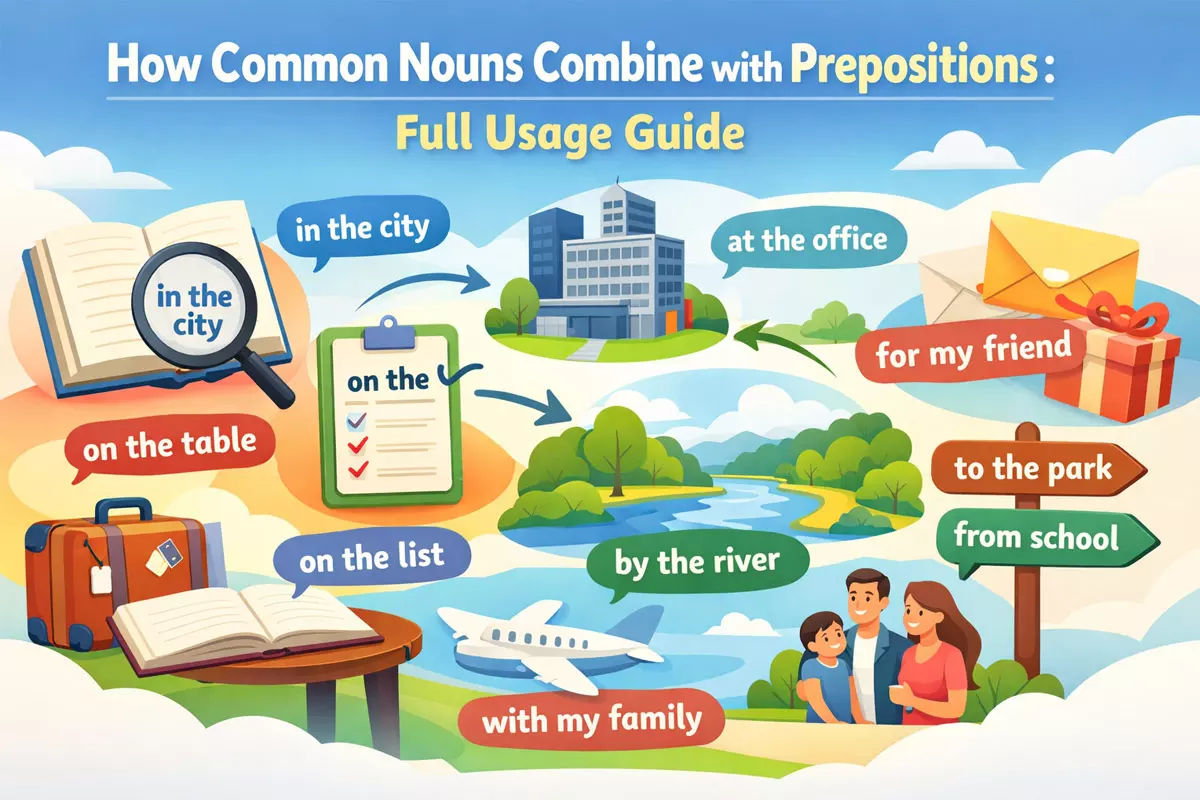 The article explains why many nouns require fixed prepositions, highlights everyday collocations like problem with and interest in, compares abstract and concrete patterns, shows how to spot these chunks in texts, addresses common mistakes, and offers practice tasks.
Have you ever wondered how everyday words such as idea, interest, or problem connect smoothly with other parts of a sentence? Learning to pair these common terms with the correct prepositions is essential for clear and natural English communication. For example, we say an idea about something, an interest in something, or a problem with something. Using the right prepositions not only helps you express your thoughts more accurately but also makes your English sound more fluent and confident in both writing and conversation.
Why many nouns need fixed prepositions
Many nouns in English are commonly paired with specific prepositions due to patterns established over centuries of language use. These combinations, often called "collocations," help clarify meaning and create phrases that sound natural to native speakers. For instance, "interest in," "advantage of," and "reason for" are all examples where the noun and preposition form a set phrase.
How fixed prepositions shape meaning
The choice of preposition after a noun can change or specify the relationship between ideas. Prepositions act as bridges, connecting nouns to other parts of a sentence—often indicating relationships like cause, possession, topic, or direction. Using the wrong preposition can make an expression sound awkward or even alter its meaning.
Why these combinations exist
There are several reasons why certain nouns are paired with particular prepositions:
- Historical usage: Some pairings have become standard over time, even if the logic is not obvious.
- Semantic relationships: The preposition clarifies the type of connection (e.g., "increase in price" vs. "increase of price").
- Language influence: Borrowings from other languages often bring their own patterns.
- Idiom and convention: Native usage has solidified some combinations, regardless of literal meaning.
Common noun + preposition pairings
Learning typical pairings is essential for natural-sounding English. Here are some of the most frequent collocations:
- Advantage of → One advantage of online learning is flexibility.
- Awareness of → There is growing awareness of climate change.
- Cause of → The police are investigating the cause of the accident.
- Change in → We noticed a change in his attitude.
- Connection with → She has a strong connection with her hometown.
- Difference between → What is the difference between these two options?
- Effect on → The new law had a big effect on small businesses.
- Experience in → He has ten years of experience in marketing.
- Hope for → We still have hope for a better future.
- Interest in → She showed great interest in the project.
- Knowledge of → He has good knowledge of European history.
- Reason for → What is the reason for the delay?
- Respect for → She has deep respect for her teachers.
- Solution to → They are looking for a solution to the problem.
- Threat to → Pollution is a serious threat to wildlife.
- Understanding of → He has a clear understanding of the rules.
- Influence on → Social media has a strong influence on teenagers.
- Response to → She gave a quick response to the email.
- Participation in → Student participation in class is encouraged.
- Access to → Not everyone has access to clean water.
Comparing similar nouns with different prepositions
Some nouns with similar meanings use different prepositions, which can be confusing for learners. Here’s a structured look at a few such cases:
| Noun | Typical Preposition | Example |
|---|---|---|
| Reason | for | reason for the delay |
| Solution | to | solution to the problem |
| Influence | on | influence on the outcome |
| Interest | in | interest in science |
| Connection | with / between | connection with the project / connection between ideas |
| Difference | between | difference between two systems |
| Attitude | toward(s) | attitude toward change |
| Experience | in / with | experience in teaching / experience with software |
Understanding these patterns helps learners avoid common mistakes and express ideas more precisely. Memorizing typical noun-preposition pairs, along with their contexts, is a practical step toward more fluent and accurate English.
Everyday collocations: problem with, reason for, interest in
Common nouns frequently pair with specific prepositions to express clear relationships and ideas in English. Knowing which preposition to use with certain nouns can make your speech and writing more natural and precise. Let's explore some of the most widely used combinations and how they function in everyday language.
Patterns and Meaning
Some nouns almost always take a particular preposition. For example, "problem" is typically followed by "with" to indicate what the issue concerns, while "reason" pairs with "for" to explain causes or motivations. "Interest" often combines with "in" to show what someone is curious about or enjoys. Using the correct preposition avoids confusion and helps your message come across smoothly.
Examples of Common Noun + Preposition Combinations

- problem with → There is a serious problem with the car.
- reason for → Nobody knows the reason for the delay.
- interest in → She has a strong interest in modern art.
- solution to → We finally found a solution to the problem.
- advantage of → One advantage of this method is its simplicity.
- damage to → The storm caused major damage to the roof.
- increase in → There has been a sharp increase in prices.
- key to → Hard work is the key to success.
- cause of → Smoking was the main cause of the illness.
- effect on → The decision had a huge effect on the team.
- difference between → Can you explain the difference between these two options?
- access to → Students have access to the online library.
- need for → There is a growing need for better education.
- reaction to → His reaction to the news was unexpected.
- opinion of/about → What is your opinion about the new policy?
- relationship with/between → She has a good relationship with her manager.
- preference for → I have a clear preference for tea over coffee.
- experience with/in → She has extensive experience in marketing.
Usage in Context
Here are some sample sentences to show how these patterns work in real communication:
- She has a problem with her laptop battery.
- The reason for his absence was illness.
- My interest in photography started at school.
- They found a solution to the issue quickly.
Quick Reference Table
| Noun | Typical Preposition | Example |
|---|---|---|
| problem | with | There is a problem with the software. |
| reason | for | What's the reason for your call? |
| interest | in | He has a strong interest in science. |
| solution | to | We need a solution to this problem. |
| effect | on | The new law has an effect on businesses. |
| preference | for | She has a preference for quiet places. |
Mastering these everyday pairings helps you sound more fluent and confident, whether you’re writing or speaking. If you’re unsure which preposition to use, looking at real examples or consulting reference materials can clarify the correct choice.
Abstract vs concrete noun + preposition patterns
When pairing nouns with prepositions, a key distinction emerges between abstract and concrete nouns. Abstract terms—like “idea,” “belief,” or “interest”—often require different prepositions than physical, tangible nouns such as “table,” “door,” or “book.” Recognizing these tendencies helps avoid awkward phrasing and clarifies your meaning.
Common prepositions with abstract nouns
Abstract nouns, which name intangible concepts or states, tend to pair with prepositions that convey relationships, reasons, or qualities. Here are some frequent patterns:
- interest in → She has a strong interest in science.
- belief in → His belief in justice has never changed.
- effect on → Lack of sleep has a negative effect on productivity.
- reason for → There is no reason for concern.
- awareness of → Public awareness of the danger is increasing.
- solution to → Engineers are working on a solution to the problem.
- influence on → Social media has a strong influence on youth.
- responsibility for → She takes full responsibility for the results.
- attitude towards → He has a positive attitude towards work.
- difficulty in → Many students have difficulty in understanding this topic.
- confidence in → She has great confidence in her ability.
- access to → Everyone should have access to information.
- fear of → His fear of heights prevents him from climbing.
- preference for → I have a clear preference for tea.
- transition from/to → The transition from school to work can be challenging.
Prepositions with concrete nouns
Concrete nouns, referring to objects or physically defined spaces, often use prepositions indicating location, direction, or possession. Some typical combinations include:
- book on the table → There is a book on the table.
- key to the door → I can’t find the key to the door.
- picture on the wall → There is a picture on the wall.
- water in the glass → There is cold water in the glass.
- person at the door → Someone is standing at the door.
- cat under the chair → The cat is sleeping under the chair.
- shoes by the bed → Her shoes are by the bed.
- bag beside the desk → I left my bag beside the desk.
- letter from a friend → I received a letter from a friend.
- path through the forest → We followed a path through the forest.
- car in the garage → The car is parked in the garage.
- painting over the fireplace → There is a painting over the fireplace.
- window of the house → One window of the house is broken.
- doorway into the kitchen → She walked through the doorway into the kitchen.
- stairs to the basement → The stairs to the basement are very steep.
Comparing abstract and concrete patterns
While both types of nouns take prepositions, the patterns differ in focus: abstract pairings emphasize relationships and causes, while concrete ones highlight spatial or physical connections. The table below summarizes some of the most common patterns for each type:
| Abstract Noun + Preposition | Concrete Noun + Preposition |
|---|---|
| interest in (interest in art) | book on the table |
| effect on (effect on mood) | key to the door |
| reason for (reason for change) | cat under the chair |
| confidence in (confidence in success) | shoes by the bed |
| solution to (solution to a puzzle) | painting over the fireplace |
Understanding these pairing tendencies makes your English sound more natural and precise. When in doubt, consult example sentences or trusted usage guides to confirm the best preposition for your noun.
Spotting noun + preposition chunks in real texts
Understanding how nouns and prepositions work together in authentic language helps you read and write more naturally. These combinations—sometimes called "noun + preposition chunks"—frequently appear in news articles, fiction, and everyday speech. Recognizing them is key for grasping meaning and using them correctly in your own sentences.
How to Identify Noun + Preposition Patterns

Look for nouns that are immediately followed by a preposition, often forming a predictable phrase. These chunks typically indicate relationships, reasons, or attributes. The preposition often connects the noun to more information, clarifying context or detail.
- awareness of → Public awareness of climate change is growing.
- interest in → She showed great interest in learning languages.
- reason for → There is no clear reason for his decision.
- access to → Students have access to online resources.
- solution to → Scientists are searching for a solution to the problem.
- impact on → The policy had a strong impact on small businesses.
- control over → He has full control over the project.
- increase in → There has been a sharp increase in prices.
- reduction in → The company reported a reduction in costs.
- attitude towards → Her attitude towards work is very professional.
- response to → The team issued a quick response to the complaint.
- protection from → Sunscreen provides protection from UV rays.
- change in → We noticed a change in his behavior.
- advantage of → One advantage of remote work is flexibility.
- responsibility for → She accepted responsibility for the mistake.
- preference for → I have a clear preference for coffee.
- effect on → Stress can have a negative effect on health.
- belief in → His belief in equality is strong.
- concern about → There is growing concern about safety.
- contribution to → Her research made a valuable contribution to science.
Real-World Examples
Writers and speakers use these noun-preposition links to convey precise ideas:
- "Her interest in linguistics led to a career in research."
- "The solution to the problem was simple."
- "He has a strong preference for early morning meetings."
- "There is growing concern about climate change."
Common Prepositions with Nouns
Some prepositions are much more likely to appear after nouns. Here’s a structured look at which prepositions commonly follow certain nouns, and examples from real usage:
| Noun | Typical Preposition & Example |
|---|---|
| reason | for — "The reason for the delay was traffic." |
| advantage | of — "The advantage of this method is speed." |
| impact | on — "The impact on the environment is huge." |
| response | to — "The response to the new policy was mixed." |
| access | to — "They have access to the archives." |
| protection | from — "Protection from UV rays is important." |
| responsibility | for — "She took responsibility for the error." |
| belief | in — "His belief in fairness is strong." |
Tips for Noticing These Chunks
- Pay attention to fixed phrases in articles and conversations.
- Practice highlighting or underlining noun + preposition pairs as you read.
- Listen for these patterns in podcasts or news broadcasts—they often signal important details.
- Try creating your own sentences by swapping in different nouns or prepositions to see how the meaning shifts.
Mastering these patterns will make your language more fluent and precise, whether you’re writing essays or engaging in conversation.
Common mistakes with noun + preposition choice
Choosing the right preposition to go with a noun can be unexpectedly tricky, even for advanced learners. Many errors stem from translating directly from another language or overgeneralizing from familiar patterns. In English, some nouns just “go with” certain prepositions, and using the wrong one can make your sentence sound odd or even change the meaning entirely.
Frequent pitfalls and confusion sources
Some nouns are linked to very specific prepositions, while others can take more than one depending on context. For example, “reason for” and “reason of” do not mean the same thing, but it’s easy to mix them up. Similarly, “increase in” and “increase of” are not always interchangeable. The confusion is often worse with abstract nouns or set phrases.
Typical noun + preposition mismatches
- Advantage of vs. advantage over
- Need for vs. need of
- Influence on vs. influence over
- Cause of vs. cause for
- Effect on vs. effect of
- Connection with vs. connection to
- Solution to vs. solution for
- Difference between vs. difference of
- Increase in vs. increase of
- Request for vs. request to
- Reason for vs. reason of
- Attitude to vs. attitude toward
- Response to vs. response for
- Respect for vs. respect to
- Experience in vs. experience of
- Participation in vs. participation to
- Access to vs. access of
- Concern about vs. concern for
- Interest in vs. interest on
- Preference for vs. preference to
When small words change the meaning
Swapping just one preposition can affect what you’re actually saying. For example, “respect for someone” means you admire them, but “respect to someone” (rare in standard English) does not carry the same meaning. Similarly, “difference between” compares two things, while “difference of opinion” refers to disagreement.
Comparison of similar noun + preposition pairs
| Incorrect Pair ❌ | Correct Usage ✅ |
|---|---|
| advantage in something | advantage of something advantage over someone |
| solution of a problem | solution to a problem |
| increase of prices | increase in prices |
| reason of something | reason for something |
| request to more time | request for more time |
| interest on music | interest in music |
| concern for the weather (when worried) | concern about the weather |
| experience of teaching (general) | experience in teaching (general) |
Tips to avoid common errors
- Check collocations in a reliable dictionary if unsure.
- Pay attention to set phrases—memorize them as chunks.
- Notice how prepositions change with context or meaning.
- Practice with authentic examples to reinforce correct patterns.
Mastering these combinations takes time, but careful attention to detail will help you avoid the most frequent mistakes and sound more natural in English.
Practice tasks for building your own collocation bank
Developing a strong grasp of how everyday nouns interact with prepositions starts with hands-on exploration. Below you'll find a variety of activities designed to help you notice and record natural word combinations, spot patterns, and apply them in context. Take your time with each task and revisit as needed to reinforce your understanding.
1. Identify Common Noun + Preposition Pairings
Read the sentences below. Underline or write out the noun–preposition combinations you find. Pay attention to which prepositions follow each noun.
- She has an interest in languages.
- The key to success is hard work.
- There was a rise in prices last year.
- He showed respect for his teacher.
- We need a solution to the problem.
- There is growing awareness of climate change.
- She took responsibility for the mistake.
- He has access to confidential information.
- The policy had a strong effect on the economy.
- They expressed concern about the situation.
Show answers
- interest in
- key to
- rise in
- respect for
- solution to
- awareness of
- responsibility for
- access to
- effect on
- concern about
2. Expand Your Collocation Bank
Below is a set of nouns. For each, write two prepositions that commonly follow it, then create a phrase or short sentence for each combination. Use a dictionary or your reading experience if you’re unsure.
- reason
- advantage
- attitude
- change
- connection
- difference
- effect
- experience
- interest
- access
Show answers
- reason for (reason for the delay), why (the reason why it happened)
- advantage of (advantage of exercise), over (advantage over competitors)
- attitude towards (attitude towards work), to (attitude to learning)
- change in (change in policy), of (change of address)
- connection between (connection between events), with (connection with the company)
- difference between (difference between two ideas), in (difference in quality)
- effect on (effect on health), of (the effect of stress)
- experience in (experience in teaching), with (experience with children)
- interest in (interest in music), for (interest for young audiences)
- access to (access to information)
3. Spot the Odd One Out
In each group, one noun–preposition pairing is incorrect or unnatural. Select the one that does not fit.
- answer to, answer on, answer for
- effect of, effect on, effect at
- demand for, demand in, demand of
- increase in, increase of, increase at
- solution to, solution for, solution on
- reason for, reason of, reason on
- interest in, interest on, interest for
- access to, access for, access of
- impact on, impact in, impact to
- change in, change of, change on
Show answers
- answer to
- effect on
- demand for
- increase in
- solution to
- reason for
- interest in
- access to
- impact on
- change in
4. Collocation Patterns Table
Some nouns can combine with more than one preposition, each slightly shifting the meaning. The table below summarizes several common paradigms for your reference.
| Noun | Common Prepositions | Example Phrase |
|---|---|---|
| difference | between, in | difference between two options; difference in quality |
| increase | in, of | increase in sales; increase of 10% |
| solution | to | solution to a problem |
| influence | on, over | influence on children; influence over policy |
| relationship | with, between | relationship with a friend; relationship between two ideas |
5. Create Your Own Collocation Log
Start a personal notebook or digital file. As you read or listen in English, jot down new noun–preposition pairs you notice. Aim to collect at least 15–20 over a week. Try to write a sample sentence for each, and review them regularly.
6. Challenge: Fill in the Gaps
Complete each sentence with the correct preposition. Focus on what sounds natural for the noun given.
- There is a lack ___ evidence.
- He has no control ___ the situation.
- We need information ___ the project.
- Her reaction ___ the news was surprising.
- They have a reputation ___ honesty.
- She has great confidence ___ her team.
- There is growing concern ___ safety.
- He showed respect ___ his colleagues.
- The company has access ___ new markets.
- We are looking for a solution ___ the problem.
Show answers
- of
- over
- about / on
- to
- for
- in
- about
- for
- to
- to
By engaging with these varied exercises, you'll steadily build a useful collection of noun–preposition collocations and internalize the patterns that native speakers rely on for fluent expression.