Verb + Preposition Patterns for Everyday English Communication

 Here we how prepositions complete verb meanings, presents key patterns like talk to and depend on, explains how different prepositions change meanings, discusses common learner errors, and provides practice tasks to help remember correct patterns.
- How prepositions complete the meaning of verbs
- Key everyday patterns: talk to, look at, listen to, depend on
- Similar verbs with different prepositions and meanings
- Using verb + preposition patterns in questions
- Typical learner errors with missing or wrong prepositions
- Mini speaking and writing tasks to fix patterns in memory
Mastering how action words work together with small connecting words is essential for sounding more fluent in everyday conversations. These combinations, often called phrasal verbs, can be confusing for learners because their meanings are not always obvious from the individual words. However, becoming familiar with them allows you to express your thoughts more naturally and clearly, making interactions smoother and helping you understand native speakers more easily in a variety of situations.
How prepositions complete the meaning of verbs
Verbs in English frequently require prepositions to make their meaning clear and specific. Without the right connecting word, sentences can sound incomplete or confusing. Prepositions often indicate direction, place, time, or the relationship between ideas, and they help verbs express more than just an action—they clarify who is involved, what is acted upon, and in what context.
Why prepositions matter with verbs
Many common verbs change their meaning entirely depending on which preposition follows. For example, "look" by itself is general, but "look at," "look after," and "look for" each have distinct meanings. Learners need to pay attention to these combinations to avoid misunderstandings.
Examples of verb + preposition combinations
Here are some frequently used verb and preposition pairings. Notice how the preposition changes the sense of the verb:
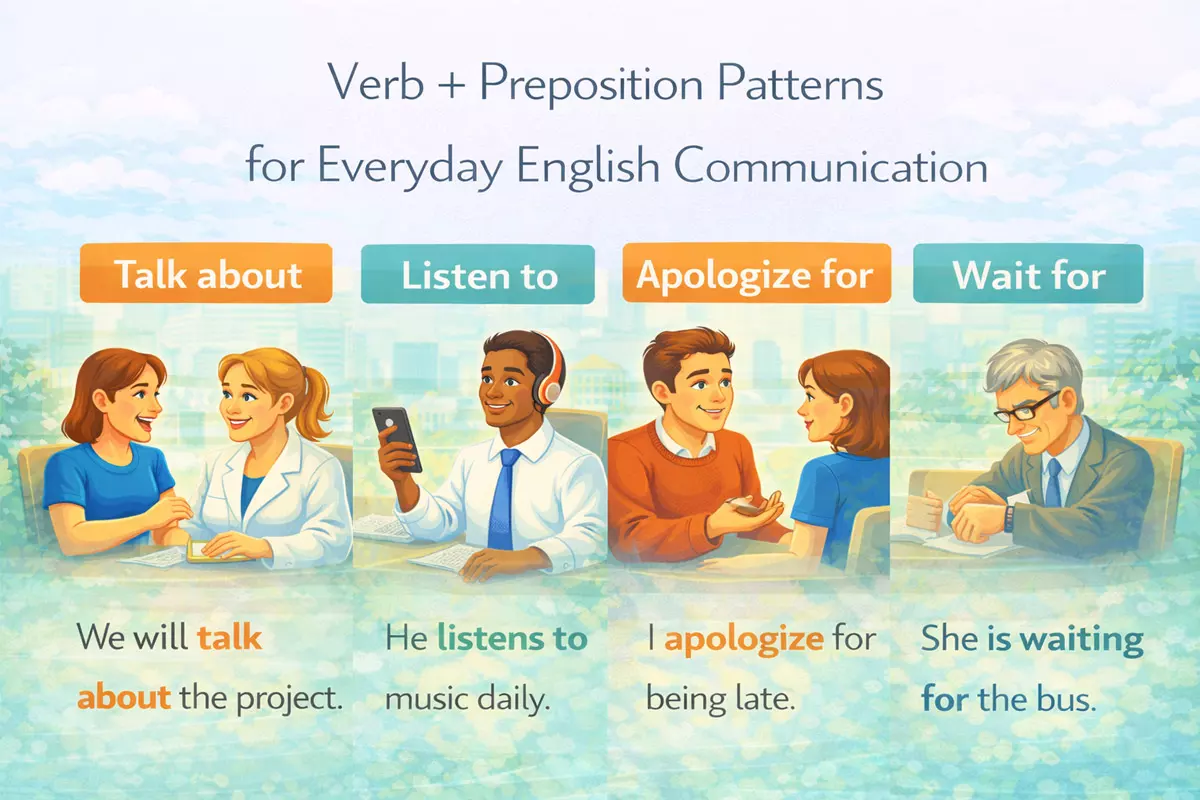
- Depend on (rely on something or someone)
- Listen to (pay attention to sound)
- Wait for (stay until someone or something arrives)
- Look after (take care of)
- Believe in (have faith in)
- Talk about (discuss a topic)
- Apologize for (say sorry about)
- Focus on (concentrate on)
- Apply for (submit a request, e.g., for a job)
- Agree with (share the same opinion)
- Belong to (be owned by)
- Participate in (take part in)
- Worry about (be concerned about)
- Pay for (give money for something)
- Laugh at (find funny or ridicule)
- Complain about (express dissatisfaction)
- Object to (oppose something)
- Dream of (imagine or desire)
- Think about (consider or reflect on)
- Recover from (get better after something)
When practicing verb–preposition combinations in example sentences or short dialogues, it’s helpful to keep the text length balanced so patterns stay easy to process. You can check reading duration for practice examples to keep your study focused and natural.
Shifts in meaning with different prepositions

Sometimes, using a different preposition after a verb creates a new meaning. Here’s a comparison:
| Verb + Preposition | Meaning / Example |
|---|---|
| Look at | Direct your eyes towards something She looked at the painting. |
| Look for | Try to find something He is looking for his keys. |
| Look after | Take care of Can you look after my cat? |
| Look forward to | Anticipate with pleasure I look forward to meeting you. |
Tips for mastering verb-preposition patterns
- Pay attention to common pairings in reading and listening.
- Practice using combinations in your own sentences.
- Remember that some patterns are fixed and cannot be changed without altering meaning.
- When in doubt, check a reliable dictionary for typical usage.
Understanding which preposition to use after a verb is essential for accurate and natural English. The right combination not only completes the sentence but also ensures your message is clear and effective in everyday communication.
Key everyday patterns: talk to, look at, listen to, depend on
Understanding common verb + preposition combinations is essential for clear English conversation. Some of the most frequently used patterns—such as "talk to," "look at," "listen to," and "depend on"—help you express actions and relationships in daily life. These combinations are not always logical if you translate word-for-word from another language, so it’s important to learn them as fixed phrases.
How these patterns work in real life
Everyday English relies on these combinations for simple, direct communication. For example, you “talk to” people, “look at” objects or scenes, “listen to” music or advice, and “depend on” friends or services. Using the correct preposition is key; using the wrong one can make your meaning unclear or sound unnatural.
Examples in context
Here are some practical examples to illustrate how each pattern is used:
- Can I talk to you for a minute?
- Please look at this photo.
- I always listen to podcasts on my way to work.
- Many people depend on public transport every day.
- She wants to talk to the manager about her order.
- Don’t look at your phone during dinner.
- Children often listen to their parents.
- We all depend on clean water.
- I need to talk to my teacher after class.
- Take a moment to look at the instructions.
- He likes to listen to classical music.
- Small businesses depend on loyal customers.
- You should talk to your doctor about these symptoms.
- They looked at each other and laughed.
- We listen to the news every morning.
- The project depends on everyone’s effort.
Why prepositions matter
Choosing the right preposition after a verb can completely change the meaning. For example, “listen at” is not correct in standard English, but “listen to” is. Similarly, “look for” means to search, while “look at” means to direct your eyes toward something.
Quick reference: patterns and meanings
| Verb + Preposition | Usual Meaning |
|---|---|
| talk to | to speak with someone |
| look at | to direct your eyes toward something |
| listen to | to pay attention to sounds or advice |
| depend on | to rely on someone or something |
Practice these combinations to sound more natural in conversation and avoid common mistakes. Over time, recognizing and using these patterns will become second nature.
Similar verbs with different prepositions and meanings
Understanding how small changes in prepositions can completely shift the meaning of a verb is crucial for clear, natural English. Many verbs pair with more than one preposition, and each combination can express something quite different. Paying attention to these patterns helps avoid confusion and improves your fluency in everyday conversations.
Common verbs with multiple preposition pairings
Here are several verbs that change meaning depending on the preposition they use. Notice how these changes can be subtle or significant:
- Look at (to direct your eyes to something): Look at the board.
- Look for (to search): I'm looking for my keys.
- Look after (to take care of): She looks after her grandmother.
- Think of (to have an idea or opinion): What do you think of this movie?
- Think about (to consider or reflect): I'm thinking about moving abroad.
- Speak to (to talk to someone): I need to speak to the manager.
- Speak about (to discuss a topic): We spoke about our plans.
- Hear of (to know about the existence): I've never heard of that band.
- Hear from (to receive communication): I hope to hear from you soon.
- Care for (to look after or have affection for): Do you care for animals?
- Care about (to be concerned or interested): They care about the environment.
- Apply for (to request something, e.g., a job): She applied for the scholarship.
- Apply to (to be relevant or send an application to): This rule applies to everyone.
- Live in (to reside in a place): He lives in Paris.
- Live on (to survive using something): They live on a small income.
- Talk to (to have a conversation with): Can I talk to you?
- Talk about (to discuss): Let's talk about your project.
- Wait for (to stay until something happens): Wait for the bus.
- Wait on (to serve): She waits on customers at the cafe.
- Depend on (to rely): It depends on the weather.
- Depend upon (formal version of "depend on"): Success depends upon effort.
Comparison of verb + preposition patterns
Sometimes, the difference is subtle but important. Here’s a comparison of some commonly confused patterns:
| Verb + Preposition | Meaning & Example |
|---|---|
| Look for | To search for something I’m looking for my phone. |
| Look after | To take care of someone/something Please look after the kids. |
| Hear from | To receive a message I heard from John yesterday. |
| Hear of | To know that something exists Have you ever heard of this place? |
| Care for | To look after or have affection She cares for her dog. |
| Care about | To be concerned about I care about your happiness. |
Practical tips
When learning new verbs, notice which prepositions are commonly used with them and pay attention to how the meaning changes. Practicing these combinations in context will help you remember the correct usage and avoid misunderstandings in daily English communication.
Using verb + preposition patterns in questions
Formulating questions that include verb and preposition combinations is a common feature of spoken and written English. Mastering these structures helps you sound more natural and ensures your meaning is clear. The preposition often comes at the end of the question, especially in informal situations, but it can also appear before the question word for more formal or precise speech.
How verb + preposition combinations appear in questions
Many frequently used English verbs require specific prepositions to complete their meaning. When turning such statements into questions, it’s important to keep the right preposition with its verb. For example, the statement “She is waiting for her friend” becomes “Who is she waiting for?” in question form. Notice that the preposition “for” stays with the verb “waiting,” even though the sentence structure changes.
Common patterns and examples

Here are some everyday examples of how these combinations work in questions:
| Question | Beginner Answer |
|---|---|
| What are you looking at? | I am looking at the screen. |
| Who are you talking to? | I am talking to my friend. |
| Which city do you come from? | I come from London. |
| Who did you go out with? | I went out with my sister. |
| What are you interested in? | I am interested in music. |
| Who is she waiting for? | She is waiting for her brother. |
| What are you thinking about? | I am thinking about my homework. |
| Who are you laughing at? | I am laughing at the joke. |
| What are you worried about? | I am worried about the test. |
| Who do you depend on? | I depend on my family. |
| Who are you listening to? | I am listening to the teacher. |
| What are you dreaming about? | I am dreaming about my future. |
| Who did you borrow it from? | I borrowed it from my friend. |
| What are you apologizing for? | I am apologizing for the mistake. |
| Who are you angry with? | I am angry with my brother. |
| What are you afraid of? | I am afraid of spiders. |
| Who do you agree with? | I agree with you. |
| What are you searching for? | I am searching for my keys. |
Preposition placement: formal vs. informal questions
The position of the preposition can signal formality. In everyday speech, ending the question with a preposition is normal and widely accepted. For formal writing or more precise speech, the preposition may come before the question word:
- Informal: Who are you talking to?
- Formal: To whom are you speaking?
Both forms are grammatically correct, but the choice sets the tone of your communication.
Comparing questions and statements
It’s helpful to see how a sentence changes from a statement to a question while keeping the verb-preposition link intact:
| Statement | Question |
|---|---|
| She is looking at the painting. | What is she looking at? |
| They are waiting for the bus. | What are they waiting for? |
| He is talking to his friend. | Who is he talking to? |
| I am listening to music. | What are you listening to? |
| We depend on our parents. | Who do you depend on? |
Tips for accurate question formation
- Always keep the preposition with the verb it belongs to, even when the word order changes.
- If unsure, check if the verb naturally requires a preposition (e.g., “listen to,” “wait for,” “depend on”).
- Practice by changing statements to questions, focusing on keeping the preposition in the correct place.
- Remember that both “Who are you talking to?” and “To whom are you talking?” are correct, but the first is more common in modern English.
Mastering these question forms will help you communicate more fluently and understand native speakers in everyday interactions.
Typical learner errors with missing or wrong prepositions
Many English learners find prepositions challenging, especially when certain verbs always require specific prepositions that may not exist in their native language. Omitting these prepositions, or choosing the wrong one, can lead to confusion or unnatural-sounding sentences. Recognizing these patterns can help you avoid frequent mistakes and communicate more clearly.
Common mistakes with verb + preposition patterns
English verbs often “collocate” with certain prepositions. If you use the wrong one, or leave it out, the meaning can change or become unclear. Here are some frequent errors:
- Say “listen to” (not “listen music”, but “listen to music”)
- Ask “depend on” (not “depend the weather”, but “depend on the weather”)
- Use “wait for” (not “wait the bus”, but “wait for the bus”)
- Write “think about” (not “think your idea”, but “think about your idea”)
- Say “apologize for” (not “apologize my mistake”, but “apologize for my mistake”)
- Use “believe in” (not “believe ghosts”, but “believe in ghosts”)
- Say “agree with” (not “agree you”, but “agree with you”)
- Use “laugh at” (not “laugh me”, but “laugh at me”)
- Say “belong to” (not “belong me”, but “belong to me”)
- Use “suffer from” (not “suffer headache”, but “suffer from a headache”)
- Say “pay for” (not “pay the meal”, but “pay for the meal”)
- Use “apply for” (not “apply the job”, but “apply for the job”)
- Say “concentrate on” (not “concentrate your work”, but “concentrate on your work”)
- Use “complain about” (not “complain the noise”, but “complain about the noise”)
- Say “worry about” (not “worry your exams”, but “worry about your exams”)
- Use “consist of” (not “consist three parts”, but “consist of three parts”)
- Say “remind of” (not “remind my childhood”, but “remind me of my childhood”)
- Use “result in” (not “result a problem”, but “result in a problem”)
- Say “succeed in” (not “succeed passing”, but “succeed in passing”)
- Use “believe in” (not “believe yourself”, but “believe in yourself”)
Mixing up prepositions: Typical confusion
Some verbs can take multiple prepositions, but with different meanings. Learners often confuse these:
- “Look at” (focus your eyes) vs. “look for” (search for something)
- “Speak to” (address someone) vs. “speak about” (discuss a topic)
- “Ask for” (request something) vs. “ask about” (inquire information)
- “Think about” (consider) vs. “think of” (have an opinion or idea)
Quick reference: Correct vs. incorrect usage
| Incorrect | Correct |
|---|---|
| I’m waiting the bus. | I’m waiting for the bus. |
| She depends her parents. | She depends on her parents. |
| They laughed me. | They laughed at me. |
| He apologized his mistake. | He apologized for his mistake. |
| We believe ghosts. | We believe in ghosts. |
| She paid the coffee. | She paid for the coffee. |
| I’m looking my keys. | I’m looking for my keys. |
| Please concentrate your work. | Please concentrate on your work. |
| This book consists three parts. | This book consists of three parts. |
| She succeeded passing the test. | She succeeded in passing the test. |
Tips for mastering verb + preposition combinations
Patterns often need to be memorized, since literal translation from your first language can cause errors. Reading and listening to native English, and noting these combinations in context, will help you internalize them. When unsure, check a reliable dictionary or example sentences, and always practice using the full phrase.
Mini speaking and writing tasks to fix patterns in memory
Building strong habits with verb + preposition combinations is much easier when you use practical exercises. The following mini-tasks are designed to help you notice, recall, and use these patterns fluently in daily conversations and writing.
Quick speaking prompts
- Describe your last weekend using at least three verb + preposition combinations (e.g., “looked after,” “waited for,” “apologized for”).
- Tell a partner about something you are interested in. Try to use: “interested in,” “good at,” “worried about.”
- Make up a short story using: “believe in,” “agree with,” “talk about,” and “depend on.”
- Role-play a phone call where you ask for help and explain what you are looking for.
- Explain a recent problem and how you dealt with it, using: “deal with,” “complain about,” “think about.”
Targeted writing tasks 1: Write 5 sentences
Write five original sentences using different verb + preposition pairs.
Show example answers
- I listen to music every morning.
- She waits for the bus at 8 a.m.
- They talked about the new plan.
- He depends on his family.
- We complained about the noise outside.
Task 2: Complete the sentences
- I apologized _____ being late.
- She is afraid _____ spiders.
- We talked _____ our plans.
- He depends _____ his friends.
- They complained _____ the noise.
- She agreed _____ the idea.
- I paid _____ the tickets yesterday.
- They listened _____ the teacher.
- We worry _____ our exams.
- He believes _____ hard work.
Show answers
- for
- of
- about
- on
- about
- with
- for
- to
- about
- in
Common verb + preposition pairs to practice
- apologize for → I apologize for my mistake.
- believe in → I believe in hard work.
- depend on → I depend on my parents.
- wait for → We are waiting for the bus.
- look after → She looks after her little sister.
- complain about → He complained about the noise.
- agree with → I agree with you.
- focus on → They need to focus on the task.
- pay for → She paid for the meal.
- belong to → This bag belongs to Anna.
- listen to → We listened to the teacher.
- think about → I am thinking about my holiday.
- worry about → He worries about his future.
- remind of/about → This song reminds me of summer.
- concentrate on → Please concentrate on your work.
- take care of → Nurses take care of patients.
- participate in → Many students participate in sports.
- refer to → The article refers to recent studies.
- object to → They objected to the new rule.
- approve of → My parents do not approve of smoking.
Task 3: Pattern transformation practice
Change the subject or tense of each sentence while keeping the verb + preposition structure correct:
- She is waiting for her friend.
- They complained about the service.
- I am interested in learning English.
- We depend on our teachers.
- He apologized for the mistake.
- I listened to the teacher.
- They worry about the exam.
- She agreed with the idea.
- He pays for his lunch.
- We talked about the plan.
Show example transformations
- He is waiting for the bus.
- She complained about the noise.
- They are interested in traveling.
- I depend on my friends.
- We apologized for being late.
- The students listened to the instructions.
- She worries about her future.
- I agreed with you.
- She pays for her coffee.
- They talked about the weekend.
Task 4: Mix and match challenge
Match the verbs with the correct prepositions:
- believe ___
- pay ___
- object ___
- agree ___
- listen ___
- apologize ___
- depend ___
- wait ___
- worry ___
- talk ___
- concentrate ___
- participate ___
Show answers
- believe in
- pay for
- object to
- agree with
- listen to
- apologize for
- depend on
- wait for
- worry about
- talk about
- concentrate on
- participate in
Table: Sample verb + preposition combinations in context
| Verb + Preposition | Example Sentence |
|---|---|
| look after | Can you look after my cat while I’m away? |
| wait for | I waited for the bus for 20 minutes. |
| focus on | Let’s focus on finishing this project. |
| participate in | She wants to participate in the competition. |
| approve of | My parents don’t approve of my decision. |
Use these activities regularly to reinforce your control of everyday verb + preposition forms, making them second nature in your English communication.