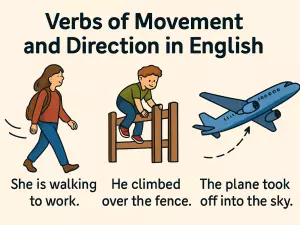
Prepositions with Movement: up, down, across, through

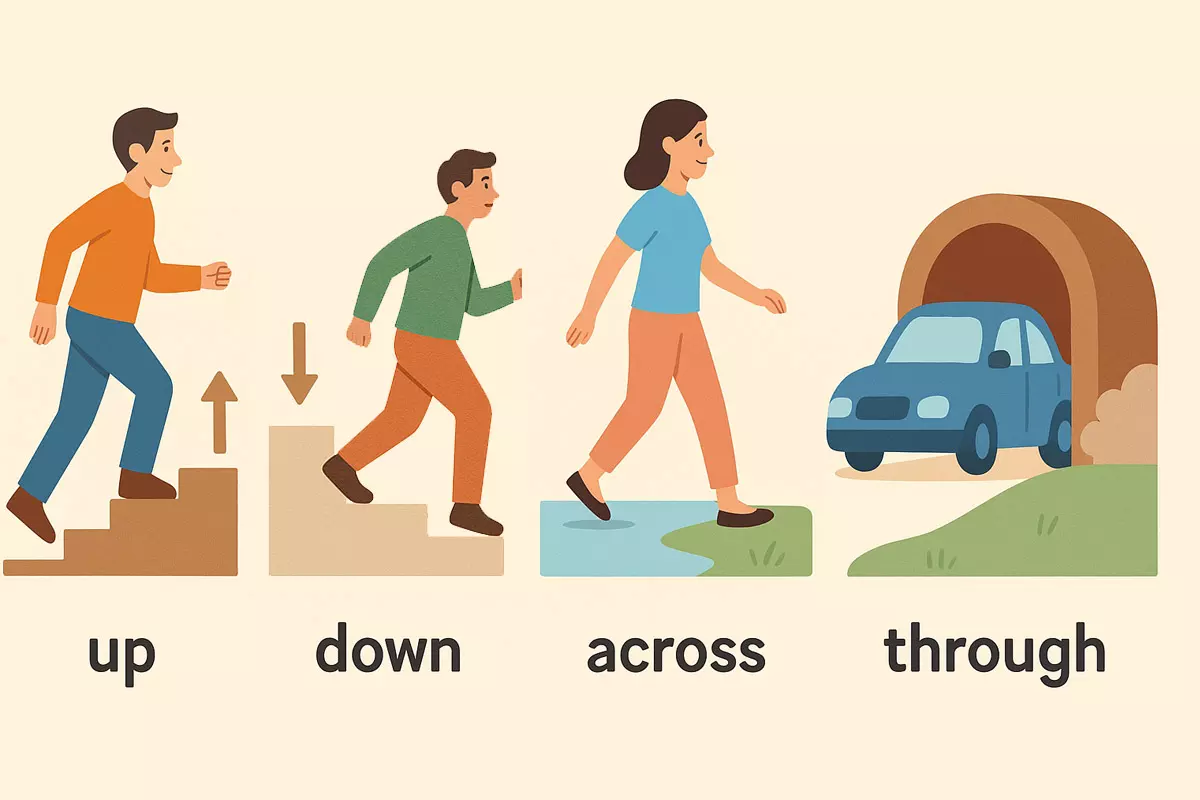 The article clarifies direction versus location, demonstrates across and through in real situations, and briefly compares past, along, and over. It also provides step-by-step direction instructions, travel vocabulary, and map-guiding practice.
Mastering the English language involves learning how to accurately describe direction and motion, such as climbing up a hill, moving across a room, or traveling through a tunnel. Using precise words for movement helps make your descriptions clearer and more engaging, allowing listeners or readers to better visualize the actions you are describing. Whether you are telling a story or giving instructions, knowing how to express direction and motion is essential for effective communication in English.
Direction vs Location Meaning
When using prepositions like "up," "down," "across," and "through," it’s important to understand whether they describe motion or a static position. These words often indicate movement from one point to another, rather than simply telling us where something is located. For example, saying "walk up the hill" involves motion, while "on the hill" describes a fixed position.
How Directional Prepositions Work
Prepositions of movement show a path or route. They answer questions like "Where to?" or "How?" rather than "Where?" alone. This distinction is key for clear communication, especially when giving instructions or describing actions.
- Up – shows movement to a higher place (e.g., climb up the ladder).
- Down – movement to a lower place (e.g., run down the stairs).
- Across – from one side to another (e.g., swim across the river).
- Through – from one side and out the other, usually inside something (e.g., walk through the tunnel).
Comparing Movement and Position
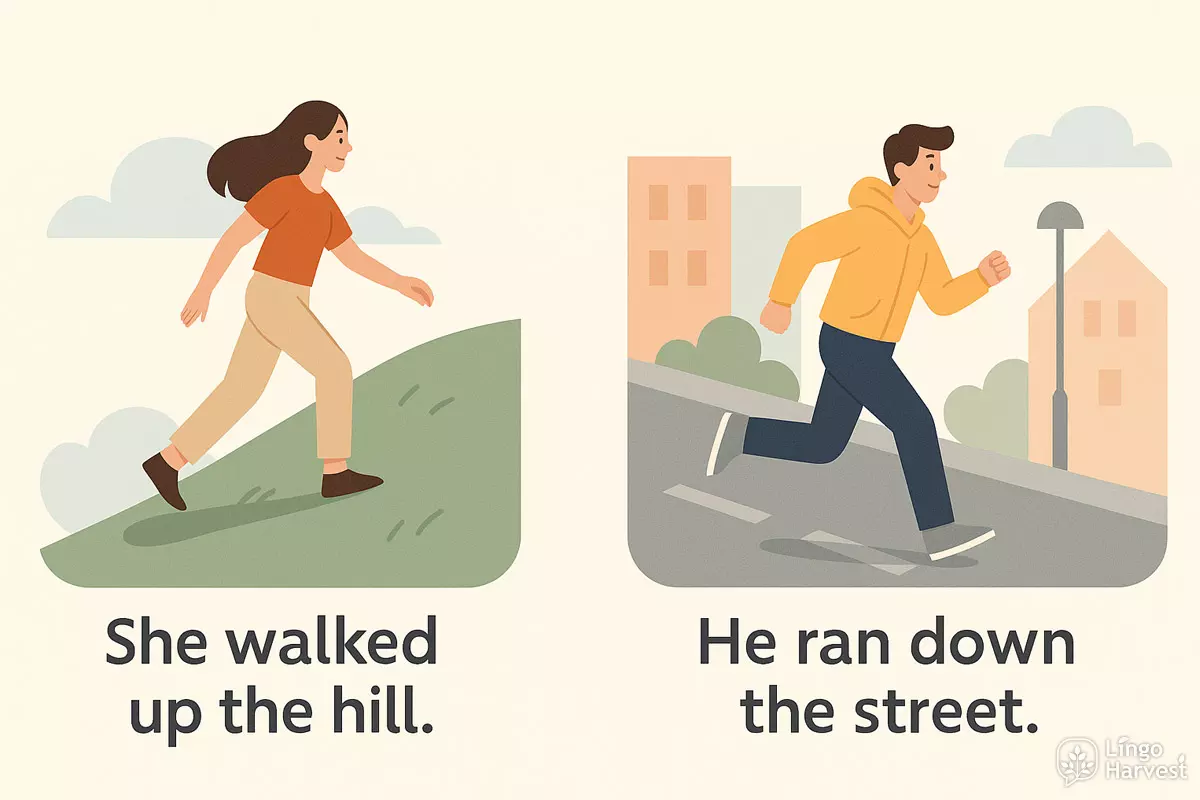
Sometimes, the same preposition can be used for both movement and position, but the meaning changes with the verb. Here’s a quick comparison:
| Movement Example | Position Example |
|---|---|
| She walked up the hill. → | The house is up the hill. |
| He ran down the street. → | The shop is down the street. |
| They rowed across the lake. → | The cabin is across the lake. |
| The dog jumped through the hoop. → | The tunnel goes through the mountain. |
Key Takeaways
- Prepositions like "up," "down," "across," and "through" often express movement or direction, not just position.
- Pair these prepositions with verbs of motion to indicate action.
- When used with verbs of being (like "is" or "are"), they can describe location, but the nuance changes.
- Understanding this difference helps you describe actions and places more precisely.
Recognizing whether a preposition is used for action or location is essential for clear English communication. This distinction influences how your sentences are understood and helps avoid confusion.
Across vs Through in Real Scenes
Both "across" and "through" describe movement, but they suggest different paths and experiences. In everyday situations, choosing between these prepositions depends on the kind of space being crossed and whether there is an inside or an outside involved. Understanding the contrast helps in describing actions more precisely.
When to Use "Across"
"Across" is used when the movement happens from one side of a flat or open area to the other side. It emphasizes crossing a surface or open space, not passing inside something. Common settings include roads, bridges, fields, and plazas. For example, if you walk from one side of a street to the other, you walk across the street.
When to Use "Through"
"Through" describes movement inside an enclosed space or along a path surrounded by boundaries. It implies entering, passing inside, and then exiting. Typical scenes include forests, tunnels, crowds, or buildings. If you move inside a tunnel from one end to the other, you go through the tunnel.
Comparing Real-Life Contexts
| Situation | Correct Preposition & Example |
|---|---|
| Open field | across She ran across the field. |
| Tunnel | through They drove through the tunnel. |
| Crowd of people | through He pushed through the crowd. |
| River (by swimming) | across We swam across the river. |
| Forest | through She walked through the forest. |
| Road | across He ran across the road. |
| Room | through The cat ran through the room. |
| Bridge | across We walked across the bridge. |
| Window (opening) | through The ball flew through the window. |
| Square/plaza | across She hurried across the square. |
Quick Tips for Accurate Usage
- Choose across for flat, open, or surface-like spaces.
- Use through for enclosed, surrounded, or three-dimensional spaces.
- If you must enter and exit an area, "through" is usually best.
- For simple side-to-side movement with no enclosure, "across" fits.
Visualizing the environment helps: If you imagine a line drawn from one edge to the other, it’s likely "across." If you picture moving inside or among things, "through" is your choice. This distinction is key for clear descriptions in English.
Past / Along / Over – quick differences
Understanding how to use "past," "along," and "over" with verbs of movement helps you describe actions and directions more accurately. These words might seem similar, but they highlight different aspects of motion and position in relation to objects or paths.
Core meanings and usage
- Past indicates movement that goes by or beyond a specific point or object. It focuses on passing something.
- Along describes movement following the length or direction of something, like a road or a river. It emphasizes following a path.
- Over means movement above and across something, usually with the idea of crossing from one side to the other.
Examples in context
- She walked past the bakery. (She went by it, not stopping.)
- They strolled along the beach. (They followed the edge of the beach.)
- The cat jumped over the fence. (It moved from one side to the other, going above the fence.)
- We drove past the old school on our way home.
- The parade moved along Main Street.
- A bird flew over the lake.
- She ran past her friends without noticing them.
- He cycled along the river bank every morning.
- The ball sailed over the wall into the neighbor’s yard.
- Tourists wandered along the ancient city walls.
- The runner dashed past the finish line.
- Clouds drifted over the mountains.
- We hiked along the forest trail.
- The train sped past small villages.
- Children leaped over puddles after the rain.
Quick comparison
| Preposition | What it shows | Example |
|---|---|---|
| Past | Movement by or beyond a point | He walked past the door. |
| Along | Movement following a path/line | She walked along the river. |
| Over | Movement above and across something | The dog jumped over the fence. |
Summary tips
Choose past to show you pass something, along for moving with a path or edge, and over when you cross above an obstacle. Each preposition adds a different nuance to your description of movement.
Giving Directions Step-by-Step
When you want to help someone find a place or navigate an area, using clear movement prepositions is essential. Words like "up," "down," "across," and "through" help listeners understand the exact path to take. To make your instructions accurate and easy to follow, break the route into small, logical steps. This way, each movement or turn is clear, and confusion is minimized.
Common Structure for Directions
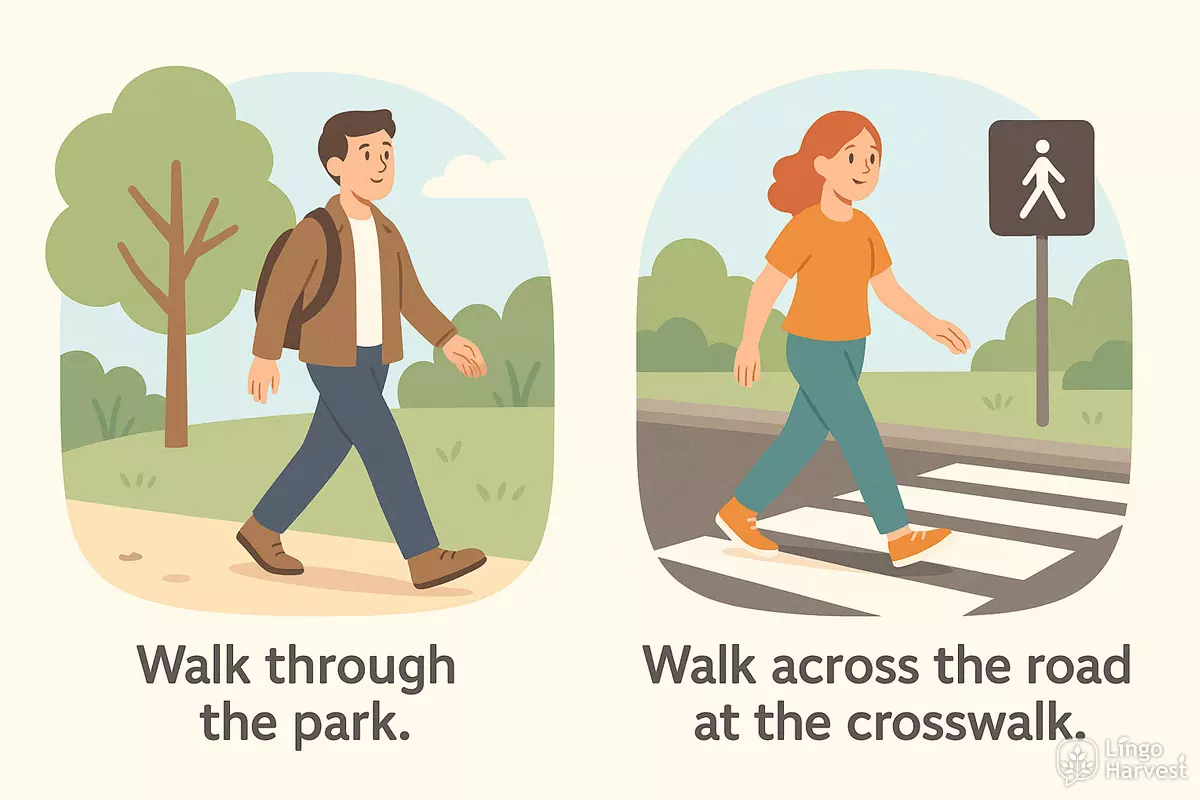
Giving directions often follows a pattern: start with the current position, use a movement preposition, and describe the next landmark or intersection. This keeps the sequence logical and easy to visualize.
- Go up the street until you reach the post office.
- Walk down the hill to the river.
- Go across the bridge.
- Walk through the park.
- Turn left at the traffic lights.
- Continue straight for two blocks.
- Take the stairs up to the second floor.
- Go down the escalator.
- Walk across the road at the crosswalk.
- Pass through the gate.
- Go up the path towards the monument.
- Walk down the alleyway until you see the bakery.
- Head across the square to the fountain.
- Move through the tunnel.
- Climb up the stairs near the entrance.
- Go down the ramp next to the parking lot.
- Walk across the courtyard.
- Go through the revolving doors.
Tips for Clarity
Always mention landmarks, street names, or visible features. Use short sentences and pause after each step if giving spoken instructions. Repeat or rephrase if the listener seems confused.
Comparing Prepositions in Context
| Preposition | How It’s Used in Directions |
|---|---|
| Up | Indicates movement to a higher place or along a street in the direction away from the speaker: “Go up the stairs.” |
| Down | Shows movement to a lower place or along a street in the direction towards the speaker or downhill: “Walk down Main Street.” |
| Across | Used for moving from one side to the other of something flat (street, bridge, field): “Go across the road.” |
| Through | Describes movement inside and then out of an enclosed space: “Walk through the tunnel.” |
By organizing your instructions with these prepositions, you make it easier for others to visualize and follow the route. Practice with different locations and scenarios to become more confident in giving step-by-step guidance.
Useful Travel and City Vocabulary
When talking about movement in a city or while traveling, it's helpful to know the right words for places, directions, and actions. Whether you’re giving directions, asking for help, or following a map, these terms will make communication smoother and more precise.
Common Places and Landmarks
- intersection
- crosswalk
- roundabout
- sidewalk
- alley
- boulevard
- square (plaza)
- pedestrian zone
- bus stop
- train station
- bridge
- tunnel
- park
- museum
- shopping mall
- market
- embankment
- skyscraper
- cathedral
- embassy
Movement Verbs and Phrases
- turn left / right
- go straight
- walk along
- cross (the street / bridge)
- go up (the hill / stairs)
- go down (the street / escalator)
- pass by (the post office)
- walk through (the park / tunnel)
- go past (the cinema)
- take the first/second street
- head towards
- follow (the signs / this road)
- exit (the station / roundabout)
Prepositions in Use: Examples
Understanding how to use prepositions with these words is crucial for clear directions. Here are some examples:
| Phrase | Example Sentence |
|---|---|
| up the stairs | Walk up the stairs to reach the second floor. |
| down the street | The café is just down the street on your left. |
| across the bridge | Go across the bridge to get to the old town. |
| through the park | You can walk through the park for a shortcut. |
| along the river | Stroll along the river for beautiful views. |
| around the corner | The pharmacy is just around the corner. |
Useful Questions for Travelers
- How do I get to the nearest metro station?
- Is it far from here?
- Can I walk there, or should I take a bus?
- Which way to the city center?
- Is it safe to go through this area at night?
With these travel-related terms and example phrases, you’ll be equipped to navigate cities and ask for directions with confidence. Knowing how to combine movement prepositions with essential city vocabulary will help you both understand and give directions effectively.
Practice: Guide Someone Across a Map
Understanding how to give clear directions using prepositions of movement is essential for effective communication, especially when describing routes or guiding someone through unfamiliar places. Let's explore how to apply phrases like "up," "down," "across," and "through" when navigating a map.
Common Direction Phrases
When explaining a route, use movement prepositions to describe the path. Here are examples of phrases you might use:
- Go up Main Street until you reach the library.
- Walk down the hill to the bus stop.
- Go across the bridge to the other side of the river.
- Walk through the park to reach the museum.
- Turn left after you go up the stairs.
- Head down the avenue and look for the bakery on your right.
- Move across the crosswalk at the intersection.
- Go through the tunnel under the railway.
- Continue up the street past the traffic lights.
- Walk down the path until you see the lake.
- Go across the square to the statue.
- Walk through the archway into the courtyard.
- Go up the escalator to the second floor.
- Head down the stairs to the subway entrance.
- Move across the street at the zebra crossing.
- Walk through the shopping mall to the exit.
- Go up the road until the end.
- Head down the boulevard to the riverbank.
- Travel across the old stone bridge.
- Go through the alley to reach the café.
Sample Task: Giving Directions
Try to guide someone from Point A (the train station) to Point B (the art gallery) using movement prepositions. Imagine this map:
- Start at the train station.
- Walk up King Street for two blocks.
- Go across the main square.
- Walk through the park entrance.
- The art gallery is on your left after you pass through the park.
Now, create your own set of directions from one place to another, making sure to use at least three different movement prepositions.
Show answers
- Sample answer: "From the library, go down Oak Avenue, then across the footbridge, and through the market to reach the cinema."
- For the map task: "Walk up King Street, go across the main square, and walk through the park to find the art gallery on your left."
Quick Quiz: Which Preposition?
Choose the correct preposition for each situation:
- Go ______ the tunnel to get to the stadium.
- Walk ______ the bridge to reach the island.
- Travel ______ the hill to see the view.
- Head ______ the street to the next block.
Show answers
- through
- across
- up
- down
Tips for Giving Clear Directions
- Always mention landmarks to make navigation easier.
- Use simple, direct sentences.
- Combine prepositions for complex routes: "Go up the stairs and through the door."
- Repeat the destination at the end to confirm understanding.