In vs Within vs Inside: Space Limits and Usage Differences

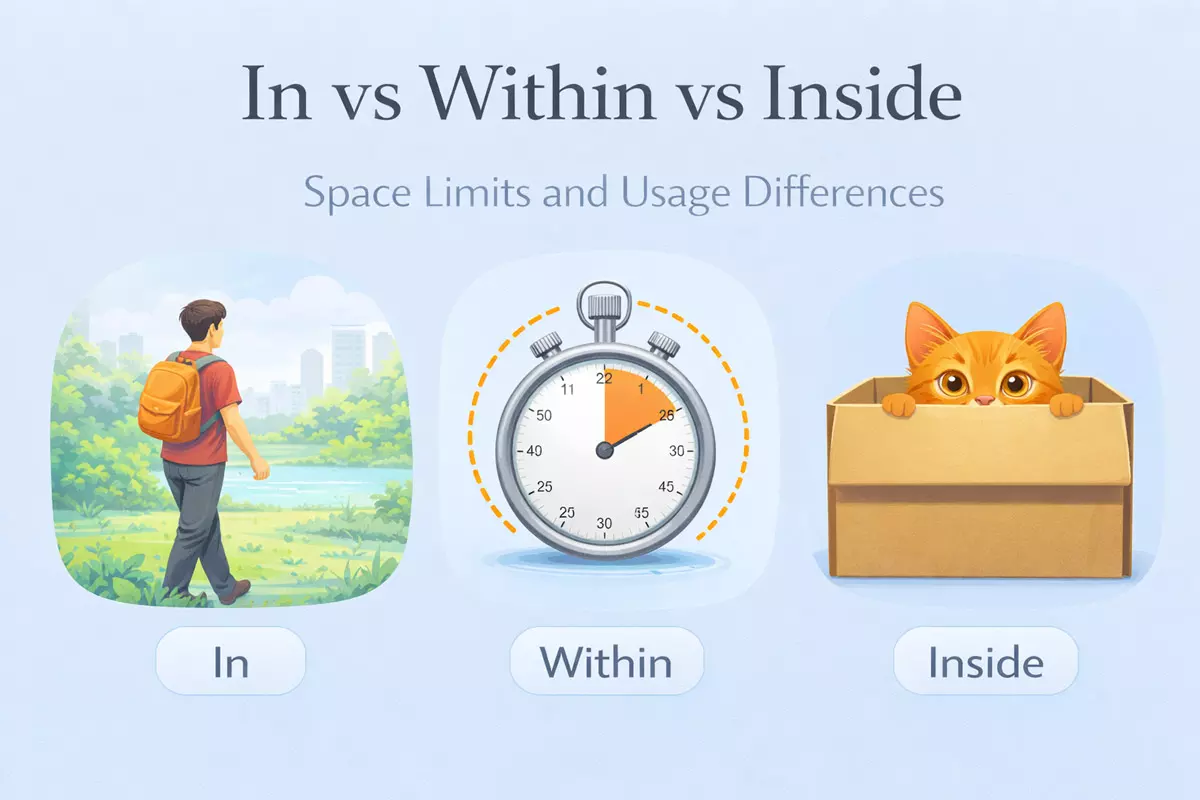 The article details the main spatial meanings of in, within, and inside, explains how within can imply boundaries, compares their physical and abstract uses, discusses common phrases and formality levels, and offers short exercises for practice.
- Core spatial meanings of in, within and inside
- When within adds a sense of limit or boundary
- Physical vs abstract uses of these three prepositions
- Typical expressions with each form in modern English
- Formality differences between within and the others
- Short exercises to choose the best option in context
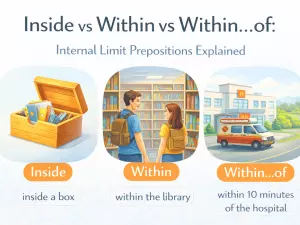
Choosing the right word to describe location can be challenging, especially when deciding between terms such as in, within, and inside, since each one implies a slightly different relationship to space and boundaries. For example, in is often used for general placement, as in "the keys are in the drawer," while within suggests something is contained by limits or boundaries, as in "within the city limits." Inside typically emphasizes being enclosed or surrounded, such as "inside the box." Understanding these subtle differences helps ensure precise and effective communication.
Core spatial meanings of in, within and inside
When dealing with physical space, each of these prepositions—“in,” “within,” and “inside”—has its own nuance. “In” is the most general: it simply places something as being enclosed or surrounded by something else. “Within” suggests being not just enclosed but somewhere deeper, often implying boundaries or limits that cannot be crossed. “Inside” is more specific than “in,” and it typically focuses on being contained or enclosed, sometimes with an added sense of depth or being completely surrounded.
Comparing spatial uses
To better understand how these terms differ when describing space, consider how they are used in everyday sentences:
- in: The keys are in the drawer. (General location; the keys are somewhere inside the boundaries of the drawer.)
- within: Please stay within the lines. (Emphasizes boundaries; do not cross them.)
- inside: There’s a note inside the envelope. (Focuses on being contained, often with a sense of depth or security.)
Subtle Differences in Connotation
While all three can describe something being enclosed, they are not always interchangeable. “In” is flexible and widely used for both concrete and abstract spaces. “Within” often highlights limits or restrictions and is slightly more formal. “Inside” draws attention to the interior part of something, and can evoke a sense of being deep or hidden away.
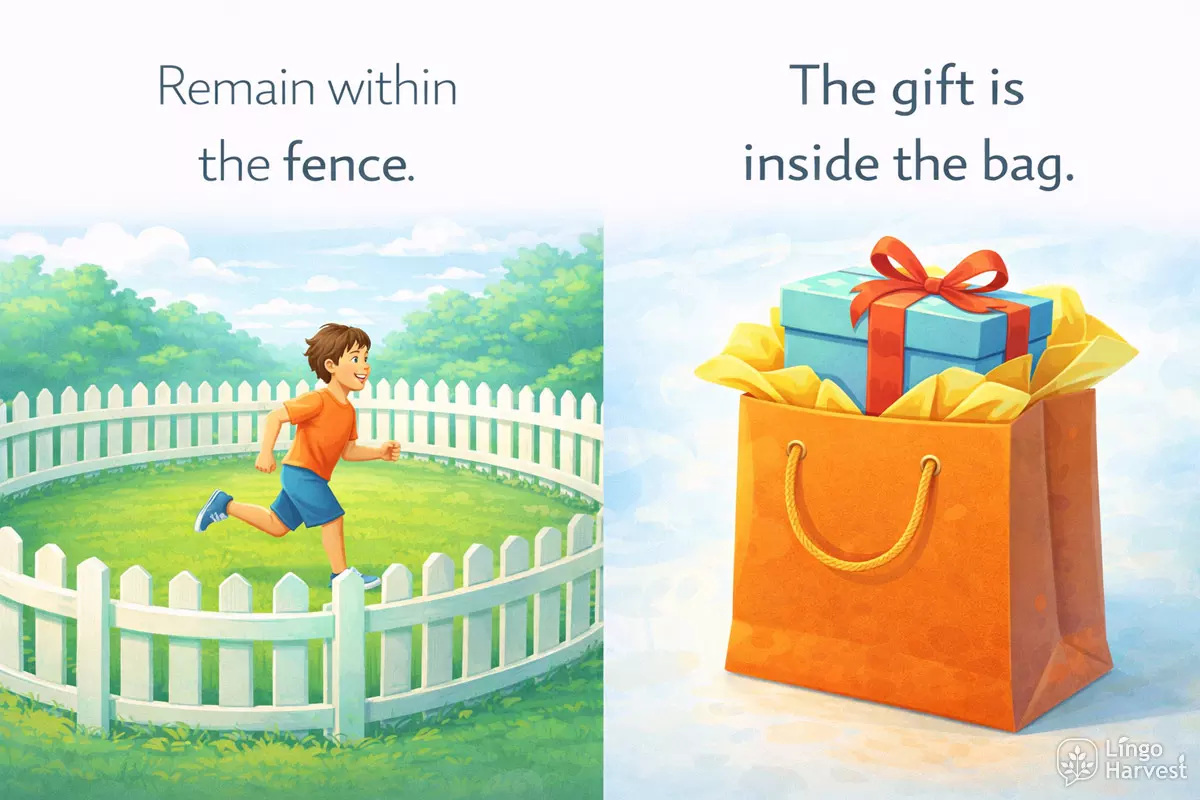
| Word | Typical Use | Spatial Emphasis | Example |
|---|---|---|---|
| in | General location or position | Enclosed or surrounded, but not always strictly limited | The cat is in the box. |
| within | Emphasizing boundaries or limits | Stresses staying inside a defined area | Remain within the fence. |
| inside | Focus on the interior or deepest part | Completely contained, sometimes hidden or secure | The gift is inside the bag. |
Common spatial contexts for each word
- in a room, in a car, in a city
- within the city limits, within walking distance, within the walls
- inside a building, inside the cabinet, inside the tunnel
Choosing the right word depends on how much emphasis you want to place on boundaries, containment, or simply being located somewhere. “In” works for most general uses, “within” is best when boundaries matter, and “inside” highlights being deep or fully contained. This distinction helps make your descriptions of space more precise and natural.
When within adds a sense of limit or boundary
The word within is often used to indicate a clear limit, boundary, or range. Unlike in or inside, which might only refer to location, within suggests that something happens or exists not just somewhere, but specifically inside a defined area or timeframe. This subtle distinction can affect both the meaning and tone of your sentence.
How "within" sets boundaries
Using within helps to create a sense of restriction or containment. It’s common in formal writing, instructions, and situations where a rule or limit is being described. For example, saying “You must finish the test within one hour” emphasizes that one hour is the absolute maximum allowed. Similarly, “Keep all items within the marked area” highlights a physical boundary that must not be crossed.
Typical contexts for "within"
- Time limits: “Submit your application within 7 days.”
- Physical boundaries: “Please remain within the designated zone.”
- Ranges or quantities: “Stay within your budget.”
- Rules and requirements: “Operate within the law.”
- Distance: “The shop is within walking distance.”
- Groups or categories: “There is diversity within the team.”
- Scope of influence: “The decision lies within your authority.”
- Expectations: “Keep your comments within reason.”
- Documents or parts: “The answer is found within the report.”
- Protective limits: “Shelter within these walls.”
Comparing "within" to "in" and "inside"
To clarify how within conveys boundaries compared to in and inside, consider the following structured comparison:
| Expression | Implication | Example |
|---|---|---|
| in | General presence or location | He is in the room. |
| inside | Physical enclosure, often tangible | The cat is inside the box. |
| within | Presence with a sense of limit or maximum boundary | Finish the task within 24 hours. |
As shown, within stands out when you want to set a clear perimeter, whether it’s about time, space, or rules. This makes it especially useful for instructions, formal writing, and situations where clarity about boundaries matters.
Physical vs abstract uses of these three prepositions
Understanding the distinction between physical and abstract meanings for “in,” “within,” and “inside” is key to mastering their usage. Each preposition can refer to literal, spatial relationships or to more figurative, conceptual boundaries, but the nuances differ.
Physical (Literal) Usage
When describing actual locations or positions, these prepositions help specify where something exists relative to another object or space:
- In: Used for being enclosed or surrounded (e.g., “The book is in the bag”).
- Within: Emphasizes being contained by limits or boundaries, often with a sense of area or range (e.g., “Stay within the lines”).
- Inside: Stresses the interior of something, often for objects with clear insides and outsides (e.g., “The cat is inside the house”).
Abstract (Figurative) Usage
Beyond tangible spaces, all three can describe ideas, timeframes, or non-physical boundaries:
- In: Used for time periods, conditions, groups, or states (e.g., “in trouble,” “in 2024,” “in a team”).
- Within: Refers to limits that are less physical—rules, abilities, or time (e.g., “within reason,” “within 10 days,” “within your rights”).
- Inside: Often tied to feelings, thoughts, or non-physical interiors (e.g., “feel something inside,” “inside information”).
Comparison: Physical vs Abstract Uses
Below is a structured comparison of how these prepositions function in both contexts:
| Preposition | Physical Example | Abstract Example |
|---|---|---|
| In | She is in the room. | He is in a good mood. |
| Within | All students must stay within the playground. | Please reply within 24 hours. |
| Inside | The keys are inside the drawer. | She felt nervous inside. |
Quick Reference: Usage Patterns
To further clarify, here are common scenarios for each word:
- in a city, in a box, in love, in danger, in a picture
- within the area, within the law, within five minutes, within budget, within your control
- inside the car, inside the envelope, inside your mind, inside knowledge, inside the organization
Choosing the right preposition depends on whether you mean a concrete location, a conceptual limit, or an internal state. Noticing these patterns will help you sound more natural and precise.
Typical expressions with each form in modern English
Understanding how “in,” “within,” and “inside” are used in everyday English helps clarify their differences in nuance and context. Each word commonly appears in certain phrases, patterns, and idiomatic expressions.
Common uses of "in"

The preposition “in” is very versatile and widely used for general location, time periods, and abstract spaces. Some frequent combinations include:
- in the room (location) → She is waiting in the room.
- in the morning (time) → I usually exercise in the morning.
- in trouble (state or condition) → He realized he was in trouble.
- in a box (physical container) → The old photos are in a box.
- in line (position/order) → We stood in line for tickets.
- in a meeting → She is in a meeting right now.
- in the news → The story was in the news yesterday.
- in love → They are deeply in love.
- in a moment → I’ll be ready in a moment.
- in the city → He works in the city.
Typical phrases with "within"
“Within” emphasizes limits, boundaries, or a sense of being inside a range—often time, distance, or abstract limits. It suggests a more formal or precise boundary than “in.”
- within an hour (time limit) → The package will arrive within an hour.
- within reach (distance) → Keep the phone within reach.
- within the law (rules/boundaries) → The action was within the law.
- within reason (acceptable limits) → Your request is within reason.
- within the company → The issue was discussed within the company.
- within these walls → Everything said within these walls stays private.
- within your rights → You are well within your rights to refuse.
- within budget → The project was completed within budget.
- within a few miles → There is a gas station within a few miles.
- within seconds → The system responded within seconds.
Frequent patterns with "inside"
“Inside” usually refers to the interior of a physical object or place, but can also describe abstract or metaphorical interiors. It often highlights being completely enclosed.
- inside the box (enclosed space) → The cat is sleeping inside the box.
- inside the house → Everyone stayed inside the house during the storm.
- inside information (exclusive knowledge) → She had inside information about the deal.
- look inside → Please look inside the drawer.
- inside your heart (figurative) → He felt calm inside his heart.
- inside the car → Leave the bag inside the car.
- what’s inside? → What’s inside the package?
- inside a minute (less common than “within”) → He’ll be back inside a minute.
- feel inside → Think about how you feel inside.
- inside the system → The problem exists inside the system.
Comparing usage at a glance
Below is a comparison of how each word typically fits into common expressions and what kind of spatial or figurative boundary it suggests:
| Form | Typical Context or Example | Nuance/Boundary |
|---|---|---|
| in | in the garden, in trouble, in 2024 | General location, state, or time |
| within | within 10 minutes, within reach, within reason | Inside a limit or boundary (often time, distance, or rules) |
| inside | inside the box, inside information | Enclosed or internal space (physical or figurative) |
When choosing between these forms, consider whether you’re talking about a simple location (“in”), a defined limit (“within”), or something entirely enclosed (“inside”). Each term brings a slightly different shade of meaning, which is reflected in the expressions where they most often appear.
Formality differences between within and the others
The choice between “in,” “within,” and “inside” often reflects the level of formality in English writing or speech. “Within” is typically considered the most formal of the three, appearing frequently in legal, academic, and official contexts. In contrast, “in” is neutral and used in both casual and formal situations, while “inside” tends to be more conversational and direct.
How “within” elevates tone
Using “within” can make statements sound more polished or precise. For instance, in official documents or professional emails, you might encounter phrases like “within 24 hours” or “within the company.” The word suggests boundaries or limits in a measured, often abstract sense.
Common settings and tone
- Formal writing: “within” (e.g., legal, academic, technical)
- Everyday speech: “in” or “inside” (e.g., conversations, storytelling)
- Instructions or policies: Both “in” and “within” may appear, but “within” highlights a time or space boundary.
- Creative writing: “inside” for vivid imagery, “in” for simplicity, “within” for emphasis or mood.
Comparing usage in sentences
- Submit the report within two days. ✅ (formal, precise)
- Put the letter in the box. ✅ (neutral, everyday)
- The cat is inside the house. ✅ (casual, descriptive)
- All documents must stay within company premises. ✅ (official)
- There’s a surprise inside the package. ✅ (informal, engaging)
Summary Table: Formality and Usage
| Word | Typical Formality | Common Contexts | Example Phrase |
|---|---|---|---|
| within | High | Legal, academic, policies | within 30 days |
| in | Neutral | General writing, speech | in the room |
| inside | Low | Casual, descriptive, storytelling | inside the bag |
In summary, “within” is your go-to for formal or official language, “in” fits almost any situation, and “inside” feels most at home in everyday conversation or when you want to paint a clear picture. The tone you want to set will guide your choice.
Short exercises to choose the best option in context
Understanding when to use “in”, “within”, or “inside” often comes down to the specific situation and the nuance you want to express. The following practice tasks will help you recognize which word fits best in different contexts. Read each sentence, then pick the most suitable preposition or adverb. Some tasks include explanations to clarify why one option is preferable.
Choose the correct word: in, within, or inside
- The documents are stored ___ the safe.
- All applications must be submitted ___ two weeks.
- There’s a strange noise coming from ___ the wall.
- I left my keys ___ my bag.
- Please reply ___ 24 hours.
- She lives ___ the city center.
- He found a secret passage ___ the castle.
- All guests must arrive ___ the building before noon.
- The answer is hidden ___ the text.
- The cat is ___ the box.
Show answers
- inside
- within
- inside
- in
- within
- in
- inside
- inside
- within
- in / inside (both acceptable, but “inside” emphasizes enclosure)
Identify the space nuance
For each sentence, decide if the preposition emphasizes a strict boundary, a loose area, or a time limit.
- “All employees must stay within the building during work hours.”
- “The book is in the library.”
- “There is a hidden message inside the envelope.”
- “Call me within an hour.”
- “The keys are inside the drawer.”
- “She lives in the city.”
- “Keep the discussion within the topic.”
- “The children are playing in the yard.”
- “The package arrived within two days.”
- “There was a note inside the box.”
Show answers
- within – strict boundary
- in – general area
- inside – physical enclosure
- within – time limit
- inside – physical enclosure
- in – general area
- within – abstract boundary
- in – loose area
- within – time limit
- inside – physical enclosure
Quick reference table: Usage patterns
| Word | Typical Use | Example |
|---|---|---|
| in | General location or time | The dog is in the garden. |
| within | Limits or boundaries (space/time) | Finish the task within an hour. |
| inside | Physical enclosure; more literal | The gift is inside the box. |
| within | Non-physical boundaries | Remain within the rules. |
Fill in the blanks: More practice
Insert “in”, “within”, or “inside” to complete each sentence correctly.
- The letter is hidden ___ the drawer.
- You must finish your meal ___ 30 minutes.
- He lives ___ a small town near the coast.
- Please deposit your shoes ___ the locker before entering.
- The keys are ___ reach.
- The children stayed ___ the building during the storm.
- There is a note ___ the envelope.
- The project must be completed ___ budget.
- She felt calm ___ the room.
- The answer is ___ the text.
- Please respond ___ two days.
- The documents are stored ___ the folder.
Show answers
- inside
- within
- in
- inside
- within
- within
- inside
- within
- in
- in
- within
- inside