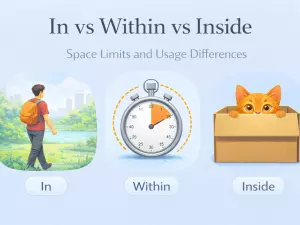
Inside vs Within vs Within…of: Internal Limit Prepositions Explained

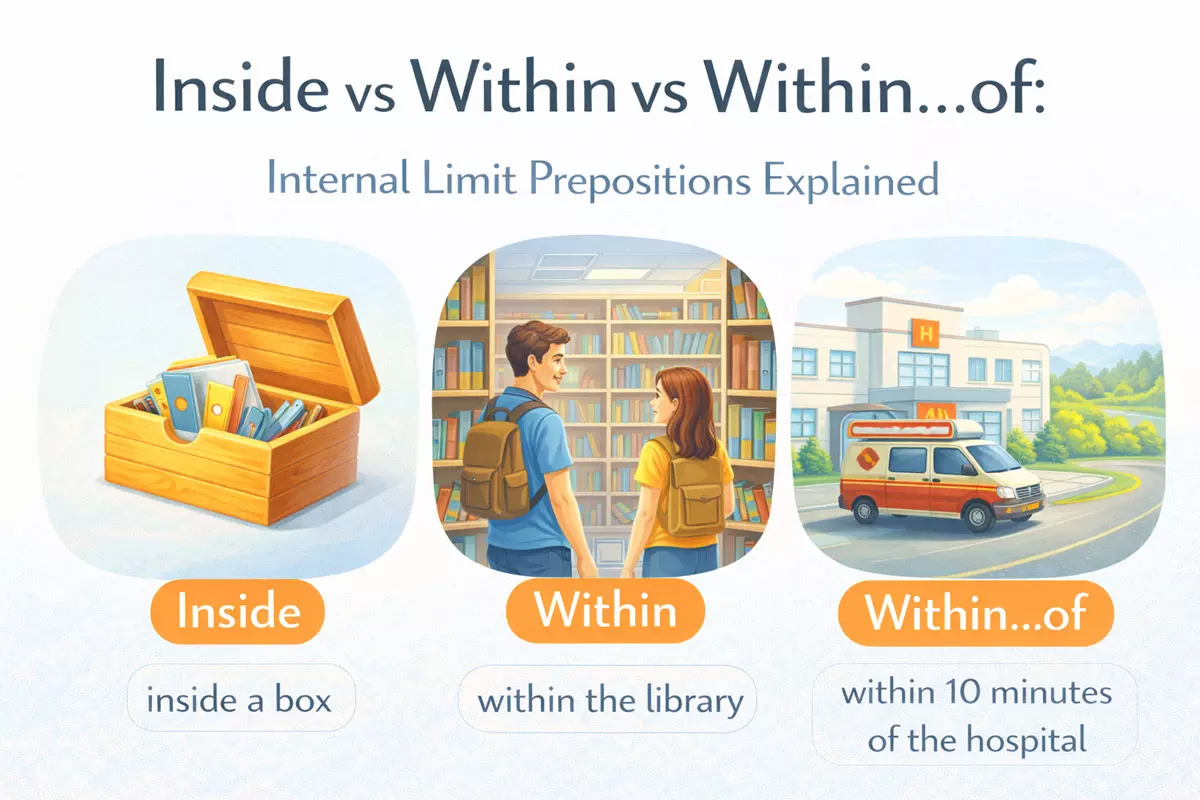 This article explains when to use inside, within, and within...of by comparing their roles in physical spaces, timeframes, legal and academic contexts, technical limits, descriptive writing, and logistical instructions, with clear examples and…
- Literal vs. Abstract Boundaries: 'Inside' for physical containers vs. 'Within' for systemic limits
- Temporal and Organizational scope: Using 'Within' for deadlines, budgets, and institutional rules
- Proximity markers: Mastering the 'Within... of' pattern for distance and time precision (e.g., 'within a mile of')
- Legal and Formal register: 'Within' in contracts, regulations, and academic definitions
- Spatial containment: Differentiating 'Inside' from 'In' and 'Into' in descriptive writing
- Quantitative limits: Specifying ranges and tolerances in technical and scientific reporting
- Practice: Selecting internal limit markers for logistical instructions and spatial descriptions
Have you ever wondered why we say something hides inside a box, exists within a group, or falls within the range of possibilities? Prepositions that express boundaries and internal limits can be challenging, even for native speakers. By learning how these subtle words influence meaning, you can make your writing and speech clearer, more precise, and more natural. Mastering the use of prepositions like in, within, and inside will help you communicate your ideas more effectively and avoid common misunderstandings.
Literal vs. Abstract Boundaries: 'Inside' for physical containers vs. 'Within' for systemic limits
Understanding how we talk about internal limits in English often comes down to choosing between words like "inside" and "within." The distinction depends on whether we're describing something tangible or referring to more abstract frameworks.
Physical Containment: When to Use "Inside"
"Inside" is used when discussing objects or people located in a real, physical space. It implies clear, touchable boundaries—think of walls, boxes, or rooms. If you can open, enter, or see the edges of a container, "inside" is usually the natural choice.
- The cat is inside the box.
- Keys are inside my pocket.
- Water is inside the bottle.
- There's a note inside the envelope.
- She waited inside the car.
- Food is inside the fridge.
- He hid inside the closet.
- Books are inside the drawer.
- The bird flew inside the house.
- There's dust inside the lamp.
Abstract or Systemic Boundaries: "Within" for Non-Physical Limits

"Within" is more abstract, often used for invisible or conceptual boundaries—rules, timeframes, abilities, or groups. It signals something functioning or existing inside a set of limits that aren't physical objects.
- Stay within the law.
- Finish the task within an hour.
- Your answer should be within 250 words.
- The solution lies within our reach.
- He acted within his rights.
- Keep your spending within budget.
- Stay within the boundaries of the game.
- She remained within the group.
- The truth is within the story.
- All votes are counted within the system.
Comparing Usage at a Glance
| "Inside" | "Within" |
|---|---|
| Physical spaces or containers | Abstract boundaries, limits, or systems |
| Can be seen, touched, or entered | Cannot be physically entered; conceptual |
| The ball is inside the box | Stay within the rules |
| Literal, spatial reference | Figurative, systemic or temporal reference |
Quick Tips for Choosing
- Use inside for anything you can physically enter or open.
- Use within for time frames, rules, concepts, or groups.
- If you’re unsure, ask: Is this a real, touchable space? Choose inside. If not, within is likely correct.
- This distinction helps keep your language precise and natural, especially in both everyday and formal contexts.
Temporal and Organizational scope: Using 'Within' for deadlines, budgets, and institutional rules
When it comes to describing time limits, financial boundaries, or compliance with official policies, the preposition within is the standard choice. It signals that something happens or must happen inside a specific period, amount, or set of guidelines—not exceeding the stated limit. This makes within especially common in settings involving schedules, financial controls, and institutional frameworks.
Deadlines and Timeframes
Using within to specify a temporal boundary is straightforward. It means something must occur before the end of a given period. For example:
- Submit your application within two weeks.
- The package should arrive within 3–5 business days.
- Complete the task within the allotted time.
- All complaints must be filed within 30 days of purchase.
- Repairs will be finished within 24 hours.
Here, within guarantees that the action is finished before the deadline, not after.
Budgets and Quantitative Limits
In financial contexts, within is used to ensure spending or measurement does not go beyond a set figure. Consider these examples:
- Stay within your budget for the project.
- The event was organized within the allocated funds.
- The speed limit must be observed within city boundaries.
- Production costs remained within expectations.
- Keep the number of participants within the permitted range.
This use of within ensures that a boundary—whether financial or numerical—is not crossed.
Institutional and Procedural Rules
Organizations rely on within to communicate compliance with policies or frameworks. Here are common patterns:
- Act within the law.
- Stay within company guidelines.
- All changes must be approved within the department.
- Decisions must occur within the committee's authority.
- Remain within the scope of your role.
- All discussions should happen within the official forum.
- Work within union rules.
Patterns and Contrasts
It's useful to see within compared with other prepositions that might seem similar in form but signal different meanings. The table below summarizes core distinctions:
| Preposition | Scope/Typical Use | Example |
|---|---|---|
| within | Inside a limit (time, amount, rules) | Finish the report within three days. |
| inside | Physical interior or location | The keys are inside the drawer. |
| within...of | Proximity or distance from a point | The school is within walking distance of my house. |
| by | Deadline or latest time | Please reply by Friday. |
Understanding how within sets boundaries in time, quantity, and institutional rules is vital for clear, precise communication—especially in professional or formal settings. When you want to make sure nothing exceeds a specified limit, within is almost always your best option.
Proximity markers: Mastering the 'Within... of' pattern for distance and time precision (e.g., 'within a mile of')
Understanding how to pinpoint nearness or limits is easier with the "within... of" structure. This pattern lets you express a specific range—whether for distance, time, or even quantity—measured from a reference point. While "inside" and "within" alone suggest something is enclosed or contained, adding "of" after "within" clarifies the boundary relative to something else.
How the 'within... of' construction works
Use this form when you want to highlight a precise range from a particular place, moment, or value. It’s a favorite in both everyday conversation and formal writing for its clarity about limits.
- within a mile of the city center
- within ten minutes of the deadline
- within two blocks of the station
- within an hour of sunset
- within five points of the high score
- within walking distance of the museum
- within sight of the coast
- within reach of the shelf
- within a year of graduation
- within 100 meters of the finish line
- within a few seconds of breaking the record
- within a degree of freezing
- within hearing distance of the announcement
- within a hair’s breadth of disaster
- within a fraction of the original cost
- within a stone’s throw of the river
- within a fraction of a second of each other
- within one vote of a majority
Comparing 'within', 'inside', and 'within... of'
When you drop "of," saying simply "within" or "inside," the meaning changes. "Inside" is strictly about being contained, while "within" often refers to being inside boundaries but doesn’t tie you to a distance or time from something else. The "within... of" form, in contrast, always measures from a reference point.
| Form | Typical Context & Example |
|---|---|
| inside | Physical enclosure She is inside the house. |
| within | Enclosed or bounded, often abstract Stay within the boundaries. |
| within... of | Measuring distance, time, or value from a reference The café is within 300 meters of the library. |
Precision and flexibility
This pattern is ideal for making language about nearness or deadlines more precise. Whether you’re talking about being "within a five-minute walk of the office" or "within two points of the lead," it’s all about anchoring the boundary to a specific reference. In summary, using "within... of" adds clarity and precision to your descriptions—whether you’re measuring physical space, time intervals, or even abstract quantities. It’s a subtle but powerful tool for expressing proximity and limits.
Legal and Formal register: 'Within' in contracts, regulations, and academic definitions
The preposition within plays a crucial role in formal documents, especially in legal contexts, regulatory texts, and academic definitions. It serves to set precise boundaries—whether in time, space, or scope—ensuring that obligations, rights, or definitions are unambiguous. Unlike the more general "inside," "within" is favored for its clarity and lack of ambiguity in official writing.
Why "within" is preferred in formal language
Legal and regulatory texts require terms that minimize misinterpretation. "Within" is consistently chosen over alternatives because it:
- Clearly denotes a limit or deadline (e.g., "within 30 days").
- Indicates inclusion in a defined area or category (e.g., "within the jurisdiction").
- Specifies conditions or parameters in statutes and contracts (e.g., "within the meaning of Section 2").
Common patterns and examples in legal, regulatory, and academic use

Here are some typical ways in which "within" appears in formal registers:
- Complete the task within five business days.
- All actions must occur within the boundaries of the law.
- Submit your appeal within 14 days of notification.
- The agreement is enforceable within the state.
- Payments must be made within the specified period.
- Research was conducted within established ethical guidelines.
- The company operates within the European Union.
- All parties, within the meaning of this contract, are bound by its terms.
- Applicants must reside within city limits.
- Results fall within the expected margin of error.
- Projects must be completed within budget.
- Defined within the context of this regulation.
- Action is required within 24 hours of incident.
- Data was collected within the prescribed timeframe.
- Valid within the meaning assigned by law.
- Limitations apply within the contract’s scope.
- Services available within designated areas.
- Decisions made within the department.
Comparison: "Within" vs. "Inside" and "Within...of" in Formal Texts
To highlight the precision of "within" in formal settings, compare its usage with other internal prepositions:
| Expression | Typical Formal Usage |
|---|---|
| Within | Used for temporal, spatial, or conceptual boundaries (e.g., "within 10 days," "within the law," "within this agreement"). |
| Inside | Rarely used in legal writing for deadlines or definitions; more physical or literal (e.g., "inside the building"). |
| Within...of | Less common in legal texts; more often seen in spatial proximity ("within 5 miles of the city") but not for deadlines or definitions. |
| In | General inclusion but lacks the precision or limiting sense of "within" (e.g., "in the contract" vs. "within the contract"). |
Summary
In summary, "within" is indispensable in legal, regulatory, and academic registers for its ability to set exact parameters and avoid ambiguity. Its use is a marker of formal precision, distinguishing it from less specific or more conversational alternatives.
Spatial containment: Differentiating 'Inside' from 'In' and 'Into' in descriptive writing
Understanding how to clearly express where something is located—or how it moves—depends on choosing the right preposition. English offers several options for conveying internal limits, and picking between 'inside', 'in', and 'into' can notably affect the precision and feel of your descriptions. Each term signals a slightly different relationship between objects and spaces, especially when you want to show whether something is contained, simply present, or moving.
Key distinctions: 'Inside', 'In', and 'Into'
- 'Inside' emphasizes a sense of full enclosure or being completely surrounded by boundaries. It’s often used when the limits of the space are clear and relevant.
- 'In' is more general, indicating presence or location within an area, but not stressing the boundaries as much as 'inside' does.
- 'Into' focuses on movement, describing the action of entering or passing from outside to within a space.
When to use each preposition
- Use 'inside' when you want to highlight containment: "The cat is inside the box."
- Choose 'in' for broader presence: "She lives in the city."
- Select 'into' for movement: "He walked into the room."
Common descriptive writing scenarios
Writers often face subtle choices between these prepositions. Here are examples showing the nuances:
- The document is inside the envelope. (fully surrounded)
- The letter is in my bag. (present somewhere within)
- She slipped into her coat. (action of entering)
- The fish swam inside the cave. (enclosure emphasized)
- He works in an office. (within a general area)
- Water poured into the glass. (movement from outside to in)
- They hid inside the closet. (complete containment)
- The key is in the drawer. (somewhere within)
- She ran into the building. (motion)
- The bird flew inside the house. (boundaries matter)
- There is sugar in the jar. (location, not boundaries)
- He jumped into the pool. (action)
Comparing spatial containment
| Preposition | Typical Use & Example |
|---|---|
| Inside | Focuses on full enclosure or boundaries. “The puppy is inside the basket.” |
| In | General presence within a space. “There’s milk in the fridge.” |
| Into | Movement from outside to within. “She walked into the garden.” |
Tips for descriptive writing
- Use 'inside' to highlight separation or protection.
- Reserve 'in' for broader, less bounded spaces.
- Apply 'into' when describing an action or transition.
- Visualize the scene: are the boundaries important? If yes, 'inside' may be best.
- For static presence, 'in' is often sufficient.
Choosing the right preposition clarifies your scene and helps readers visualize spatial relationships with greater accuracy.
Quantitative limits: Specifying ranges and tolerances in technical and scientific reporting
Defining boundaries with precision is essential in technical and scientific writing. Whether setting acceptable temperature ranges, specifying allowable measurement errors, or clarifying the scope of experimental results, prepositions such as inside, within, and within…of play a crucial role. The choice between these terms often signals subtle but important distinctions in how limits and tolerances are communicated.
Choosing the Right Preposition for Limits
Writers must select prepositions that accurately describe the relationship between a value and its permissible bounds. Here’s how each option is commonly used:
- Inside: Used for strict, physical containment (e.g., “inside the chamber” means physically enclosed).
- Within: Indicates inclusion anywhere in a specified range or tolerance (e.g., “within 5°C of the setpoint”).
- Within…of: Specifies a margin relative to a reference point (e.g., “within 0.1 mm of the nominal value”).
Patterns for Expressing Ranges and Tolerances
Quantitative constraints are often described using set phrases and numeric intervals. Here are some common patterns and their implications:
- “within ±X units” (e.g., within ±2 mg) → value can deviate up to X units above or below a target
- “within X to Y” (e.g., within 10 to 20 psi) → value must fall between X and Y
- “inside the range X–Y” (e.g., inside the range 100–200 nm)
- “within a tolerance of X” (e.g., within a tolerance of 0.05 mm)
- “no more than X from Y” (e.g., no more than 3% from baseline)
- “not exceeding X” (e.g., not exceeding 80 dB)
- “minimum of X, maximum of Y” (e.g., minimum of 10°C, maximum of 50°C)
- “kept inside limits” (e.g., kept inside limits specified by regulation)
- “must remain within X of Y” (e.g., must remain within 2 volts of the reference)
- “error inside acceptable range”
- “all results within the expected interval”
- “drift limited to within X”
- “variation inside control boundaries”
Comparing Prepositional Usage in Scientific Reporting
The table below highlights how these prepositions differ when specifying quantitative boundaries in technical contexts:
| Preposition/Pattern | Typical Use in Reporting | Example |
|---|---|---|
| inside | Physical or strict containment; often spatial or mechanical | “The sample must remain inside the containment vessel.” |
| within | Inclusion anywhere in a numeric interval or tolerance | “The readings are within the specified range.” |
| within…of | Margin or distance from a reference value | “Keep the output within 0.5% of the target.” |
| between…and… | Clearly defined lower and upper limits | “Temperatures must be between 20°C and 30°C.” |
Clear expression of permissible ranges prevents misinterpretation and ensures that data, procedures, and results can be reliably compared and reproduced. Selecting the most appropriate preposition and pattern for the intended quantitative meaning is a hallmark of precise technical communication.
Practice: Selecting internal limit markers for logistical instructions and spatial descriptions
Understanding when to use "inside," "within," or "within...of" can be challenging, especially in contexts involving spatial relations and step-by-step directions. Let’s work through targeted activities that help clarify how these prepositions function as internal limit markers in real-world instructions and descriptive scenarios.
Identifying the Appropriate Preposition
Read each sentence and choose the most suitable internal limit marker: inside, within, or within...of.
- The emergency kit is stored ____ the cabinet.
- All employees must remain ____ the designated area during breaks.
- The charging station is located ____ 10 meters of the entrance.
- Keep your phone ____ your bag while in class.
- The files are ____ the folder labeled ‘Reports.’
- Please stay ____ arm’s reach of your partner at all times.
- The conference room is ____ the main building.
- All deliveries should be made ____ business hours.
- There is a recycling bin ____ the kitchen.
- Guests must remain ____ the marked path for safety.
Show answers
- inside
- within
- within...of
- inside
- inside
- within...of
- inside
- within
- inside
- within
Common Usage Patterns: Quick Reference Table
| Preposition | Typical Contexts/Examples |
|---|---|
| inside | Physical enclosure or container e.g. “The documents are inside the envelope.” |
| within | Abstract boundaries, time limits, or larger spaces e.g. “Complete the assignment within an hour.” |
| within...of | Relative spatial proximity or range e.g. “The playground is within 100 meters of the school.” |
Expanded List: Internal Limit Marker Examples
- inside a box
- within walking distance
- within the city limits
- inside the theater
- within the allowed time frame
- inside the main compartment
- within a radius of 5 km
- within reach
- inside the vehicle
- within the fenced area
- within moments of arrival
- within the team
- inside the password-protected section
- within 24 hours
- within the guidelines
- within the scope of the project
- inside the secure zone
- within the bounds of reason
Task: Rewrite for Precision
Rewrite each sentence using the correct internal limit preposition to clarify the spatial or logistical relationship.
- The files are the cabinet. → (add the most accurate marker)
- Please stay the marked area. → (add the most accurate marker)
- The printer is 5 meters the main desk. → (add the most accurate marker)
- Keep the medicine reach of children. → (add the most accurate marker)
- The cat is the box. → (add the most accurate marker)
- Visitors must remain the building at all times. → (add the most accurate marker)
- Please keep your phone your bag during the exam. → (add the most accurate marker)
- The café is a short walk the station. → (add the most accurate marker)
- The error is the first line of the code. → (add the most accurate marker)
- Stay arm’s reach of the guide in the museum. → (add the most accurate marker)
Show answers
- The files are inside the cabinet.
- Please stay within the marked area.
- The printer is within 5 meters of the main desk.
- Keep the medicine out of reach of children.
- The cat is inside the box.
- Visitors must remain inside the building at all times.
- Please keep your phone inside your bag during the exam.
- The café is within a short walk of the station.
- The error is within the first line of the code.
- Stay within arm’s reach of the guide in the museum.
Practicing with these varied examples helps reinforce when to use each preposition for describing internal limits in both spatial and procedural contexts. Notice how the nuances shift depending on whether the boundary is physical, abstract, or relative.