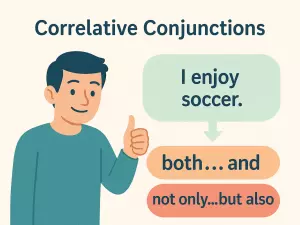
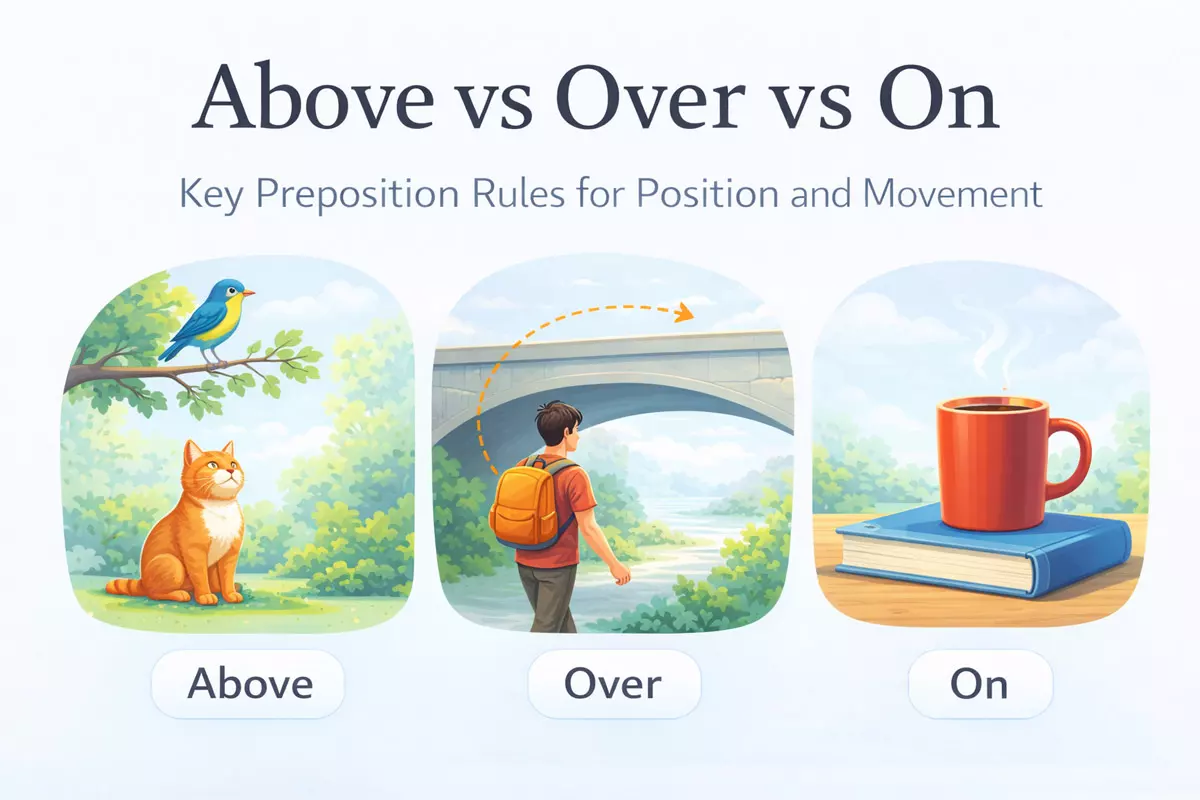
Above vs Over vs On: Key Preposition Rules for Position and Movement

 Here we how static position and movement differ when something is above another object, explains when on and above are used, lists common collocations with over, compares spatial and abstract meanings, and provides visual examples and practice tasks.
- Static position vs movement above another object
- When on requires contact and when above does not
- Common collocations with over in everyday English
- Differences in use in spatial vs abstract meanings
- Visual examples to picture height and coverage
- Practice tasks: fix incorrect uses in sample sentences
Understanding the subtle differences between prepositions that describe location or movement can be challenging for English learners, but mastering words like on, over, and above is essential for clear communication. These prepositions may seem similar, yet they often convey distinct meanings; for example, on suggests direct contact, over implies movement or position higher than something else, and above indicates a higher level without direct contact. Practicing these distinctions will help you express ideas more precisely and avoid confusion in everyday conversations.
Static position vs movement above another object
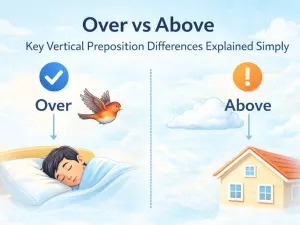
Understanding how English prepositions express whether something is at rest or in motion in relation to another object is essential for clarity. The choice between "above," "over," and "on" often hinges on whether we describe a fixed location or a movement that crosses or covers.
Describing a Fixed Location
When we want to express that something is located at a higher level but not touching, "above" is commonly used. For example, "The lamp hangs above the table." Here, the lamp is suspended at a higher point, with space in between. If an object is touching or in direct contact with the surface, "on" is the right choice: "The book is on the table." The relationship is physical and immediate. "Over" can also describe a fixed position, but it often implies a sense of covering or being directly in line with something below: "The roof is over our heads." This suggests the roof provides shelter or coverage.
Talking About Movement
When discussing motion, "over" typically refers to movement from one side to another across the top of something. For example, "The bird flew over the house." The bird moves above the house, crossing its space. "Above" is rarely used for movement; it's more about relative height. "On" rarely implies movement unless combined with a verb like "move" or "walk."
- above – higher than, not touching, static position (e.g., "The mirror is above the sink.")✅
- over – covering, or moving across the top (e.g., "The plane flew over the city.")✅
- on – touching the surface, static or with verbs of movement (e.g., "The keys are on the desk." / "She walked on the grass.")✅
Comparing Usage at a Glance
| Preposition | Typical Use (Position vs. Movement) | Example Sentence |
|---|---|---|
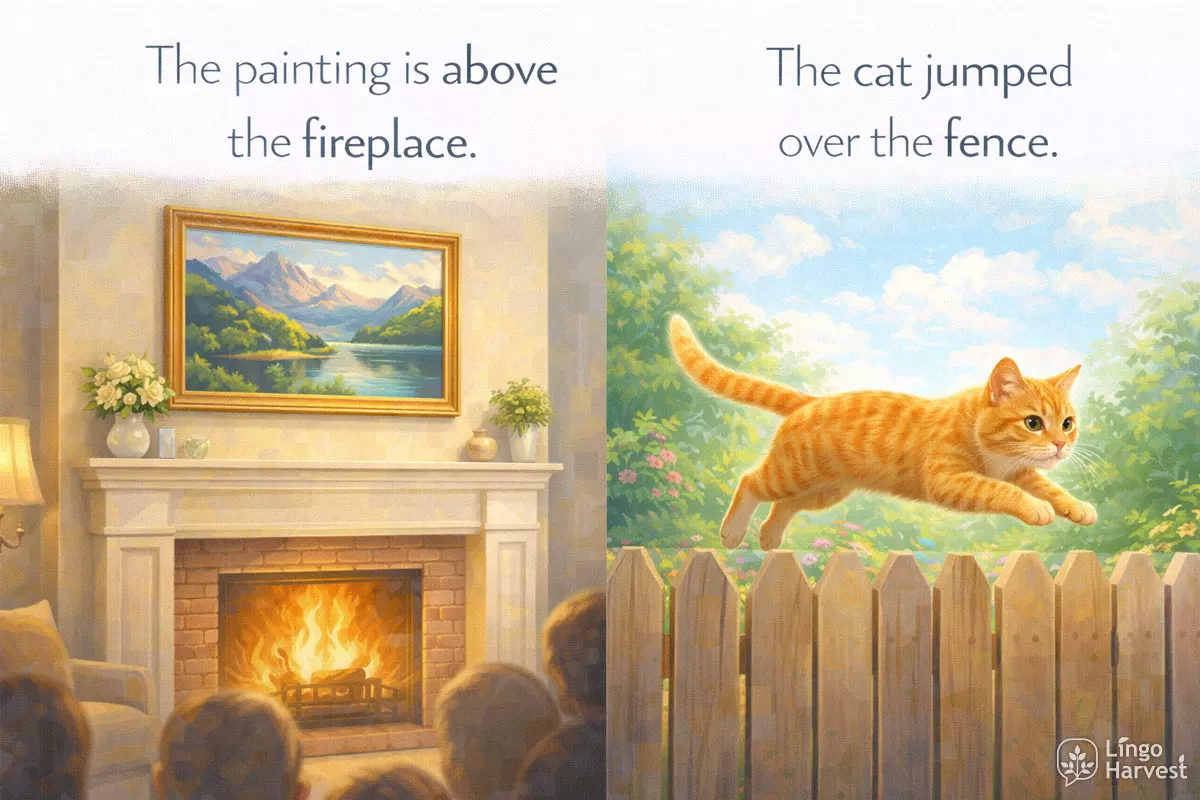
| above | Static position, not touching | The painting is above the fireplace. |
| over | Movement or coverage | The cat jumped over the fence. |
| on | Contact, usually static | The cup is on the saucer. |
Common Mistakes and Quick Tips
- Use "above" for vertical separation without contact.
- Choose "over" for movement across or direct coverage.
- Pick "on" when the subject is directly touching the surface.
- Avoid using "above" with physical contact; that's for "on."
- Remember that "over" can mean both position and movement, but context matters.
Grasping these subtle distinctions helps you communicate spatial relationships more precisely, whether you're describing the location of objects or the path of movement relative to something else.
When on requires contact and when above does not
Understanding the difference between on and above hinges on the idea of physical contact. Typically, on is used when something is in direct touch with a surface, while above is reserved for situations where one object is higher than another, but not necessarily touching it. This distinction is crucial for describing spatial relationships accurately in English.
Direct Contact vs. No Contact: The Core Principle
- On always involves physical contact.
- The book is on the table.
- A painting hangs on the wall.
- Above means “higher than,” but without contact.
- The clock is above the door.
- A lamp hangs above the dining table.
Common Situations and Examples
Here’s a list of everyday scenarios to help clarify when to use each preposition:
- Coffee cup on the desk
- Clouds above the mountains
- Poster on the noticeboard
- Ceiling fan above the bed
- Keys on the shelf
- Bird flying above the trees
- Sticker on the laptop
- Light fixture above the kitchen island
- Magazine on the sofa
- Helicopter hovering above the stadium
- Mirror on the bathroom wall
- Painting hanging above the fireplace
- Cat sleeping on the windowsill
- Chandelier above the dining area
- Hat on your head
- Smoke drifting above the chimney
Quick Reference: “On” vs. “Above”
| Use On When… | Use Above When… |
|---|---|
| There is direct physical contact between two objects. Examples: - The phone is on the charger. - Shoes on the floor. |
One object is higher than another, with space between them. Examples: - The bird flies above the lake. - The sign is above the doorway. |
| The object rests or is supported by a surface. Examples: - Papers on the desk. - Plate on the table. |
Something is suspended, floating, or positioned at a higher level. Examples: - Stars above the city. - Shelf above the bed. |
| You can physically touch both objects at their point of connection. ✅ Contact is clear. |
There is a visible gap or air between the two items. ❌ No contact. |
| Use for surfaces, coverings, or attachments. Examples: - Stickers on notebooks. - Paint on walls. |
Use for levels, layers, or positions in space. Examples: - Clouds above houses. - Lights above workstations. |
To sum up, on is all about contact, while above simply indicates a higher position. Recognizing this distinction will help you describe locations and movements more precisely in English.
Common collocations with over in everyday English
The preposition over is used in a wide variety of everyday phrases and idioms, often to describe movement, position, or metaphorical ideas like control and completion. Understanding these set expressions can help you sound more natural and fluent in English conversation.
Frequent expressions featuring "over"
- Over time – gradually, as time passes → Over time, her English became much more fluent.
- Over the moon – extremely happy → She was over the moon when she passed the exam.
- All over – everywhere → There were posters all over the city.
- Over and over – repeatedly → He watched the same movie over and over.
- Hand over – to pass something to someone → Please hand over your passport at the desk.
- Take over – to assume control or responsibility → She will take over the project next week.
- Look over – to examine or review quickly → Can you look over my report?
- Go over – to review or discuss in detail → Let’s go over the main points again.
- Turn over – to flip, rotate, or transfer → He turned over the page carefully.
- Get over – to recover from something → It took him weeks to get over the flu.
- Talk over – to discuss (often thoroughly) → We need to talk over the plan.
- All over again – to repeat from the beginning → The computer crashed and I had to start all over again.
- Over the years – during a long period → Over the years, the town has changed a lot.
- Over the top – excessive; more than necessary → His reaction was a bit over the top.
- Overdue – late, past the expected time → The library book is overdue.
- Over the phone – by telephone → We discussed the details over the phone.
- Over my head – too complex to understand → This legal document is completely over my head.
- Overnight – during the night or very quickly → The small business grew overnight.
- Overreact – to respond too strongly → Try not to overreact to minor problems.
- Overlook – to miss noticing something → He overlooked an important detail.
Typical meanings and uses
In these combinations, over can indicate movement across a surface (run over), a period of time (over the weekend), or abstract concepts such as control (take over). It’s also common in phrasal verbs, where the meaning can change significantly from the base verb.
Comparing "over" with similar prepositions
| Phrase with "over" | Similar phrase with "on" or "above" |
|---|---|
| Jump over the fence | Stand on the fence / Be above the fence |
| Look over the report | Write on the report / Information above the report |
| All over the city | On the city map / Above the city (in the sky) |
| Take over the project | Work on the project / Supervise above the project |
| Talk over the phone | Write on the phone / Speak above the phone (rare) |
Building your vocabulary with these set phrases and understanding their contexts will make your English more precise and flexible. Notice how over often signals transition, completion, or a sense of coverage that differs from the more static on or the vertical relationship of above.
Differences in use in spatial vs abstract meanings
When talking about position and movement, "above," "over," and "on" each have core spatial meanings, but their usage shifts in abstract or metaphorical situations. Understanding these shifts helps you choose the most natural-sounding phrase, especially as English often prefers certain prepositions for idiomatic or figurative expressions.
Spatial (physical) meanings
- On describes direct contact or support: "The book is on the table."
- Above means higher than but not touching: "The lamp hangs above the desk."
- Over can mean directly overhead or covering: "The bridge is over the river."
Abstract (figurative) uses
- Above often signals rank, value, or level: "She is above suspicion." / "Temperatures above average."
- Over can refer to control, duration, or topics: "He has control over the project." / "Over the years, things changed."
- On is used for topics, states, or conditions: "A lecture on biology." / "On duty." / "On sale."
Common patterns and idiomatic uses
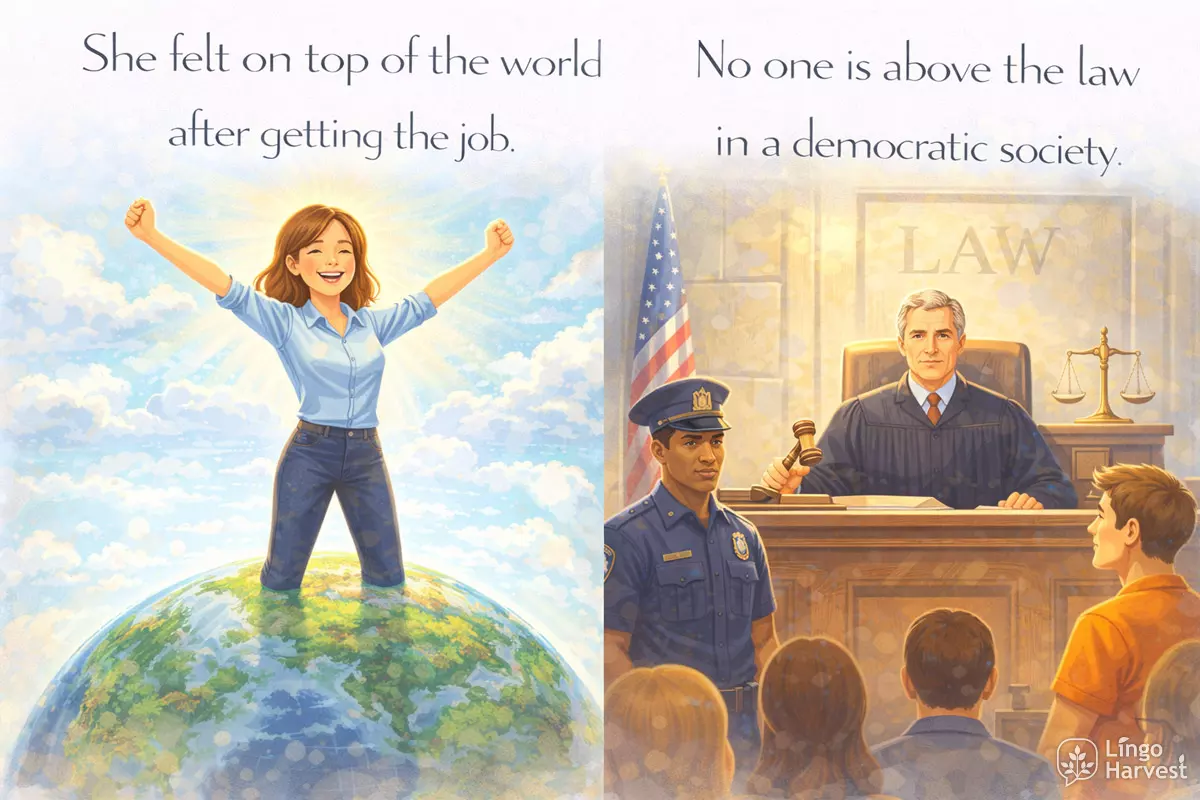
- On top of the world (very happy) → She felt on top of the world after getting the job.
- Above the law (not subject to law) → No one is above the law in a democratic society.
- Over the moon (extremely pleased) → He was over the moon when he heard the news.
- On edge (nervous) → Everyone was on edge before the final exam.
- Over one’s head (too difficult) → The math problem was completely over my head.
- Above average (better than most) → His test results were above average.
- On the rise (increasing) → Housing prices are on the rise this year.
- Over time (gradually, as time passes) → Her confidence improved over time.
- Above all (most importantly) → Above all, remember to stay honest.
- On the agenda (scheduled for discussion) → Budget planning is on the agenda today.
- Over the limit (exceeding allowed amount) → He was fined for driving over the limit.
- Above board (honest, open) → The deal was completely above board.
- On the line (at risk) → His career was on the line after the mistake.
- Over the years (during a long period) → She has gained a lot of experience over the years.
Quick comparison of spatial vs abstract usage
| Preposition | Physical Example | Abstract Example |
|---|---|---|
| On | The keys are on the shelf. | She’s on the team. |
| Above | The picture hangs above the sofa. | Grades above 90% get an A. |
| Over | The plane flew over the city. | He has authority over the staff. |
Choosing the right preposition depends on whether you mean a literal, spatial relationship or a more figurative connection. Practice with both types of contexts will make these distinctions clear and natural.
Visual examples to picture height and coverage
Understanding how "above," "over," and "on" relate to physical position and movement is much easier with clear, real-world scenarios. These words help describe where something is in relation to another object, focusing on aspects like vertical distance, direct contact, and how much area is covered.
Common situations to distinguish these prepositions
- Above: The lamp hangs above the table (not touching, higher up).
- Over: The plane flew over the city (movement across a space, not necessarily touching).
- On: The book is on the table (direct contact, resting on the surface).
- The clock is above the fireplace (mounted higher, not touching).
- The bridge goes over the river (crossing from one side to another).
- The picture is on the wall (attached and in contact).
- Clouds are above the mountains (higher in the sky, no contact).
- The blanket is on the bed (lying directly on top).
- A hat sits on your head (touching the surface).
- A helicopter hovers over the stadium (moving, not in contact, covering an area).
- Rain fell on my umbrella (drops make contact with the umbrella).
- Birds fly above the trees (higher, not necessarily directly over or touching).
- The cat jumped on the couch (movement resulting in contact).
- A shelf above the sink (higher, providing space below).
- The road goes over the hill (path crosses the top).
- The sticker is on the notebook (stuck directly onto the surface).
Comparing coverage and height: when to use each word
| Preposition | Typical Visual Example | Contact? | Movement or Position? | Coverage? |
|---|---|---|---|---|
| Above | A shelf mounted higher than a desk | No | Position | May or may not cover |
| Over | A bridge stretching across a river | No | Movement or Position | Usually covers an area |
| On | A cup placed on a saucer | Yes | Position (sometimes movement: "jumped on") | Directly above and touching |
Quick ways to visualize the differences
- Imagine a bird: If it’s flying higher than your head, it’s above you; if it passes from one side to the other, it’s flying over you; if it lands and sits, it’s on your head.
- Picture a painting: If it’s attached to the wall, it’s on the wall; if it’s hanging from the ceiling but not touching, it’s above your head; if it’s part of a mural stretching across a surface, it’s over the whole wall.
These visual cues and scenarios help clarify which preposition fits best, depending on whether you’re describing height, coverage, or physical touch.
Practice tasks: fix incorrect uses in sample sentences
Correct use of "above," "over," and "on" can be tricky, especially when describing spatial relationships or movement. Below, you'll find a series of practice activities designed to help you spot and fix mistakes in real sentences. Read each example carefully and decide which preposition works best for the context.
Identify and correct the mistakes
Each sentence below contains an incorrect use of "above," "over," or "on." Rewrite the sentence using the correct preposition.
- The lamp is over the table, so you can sit above the chair.
- The cat jumped on the fence and then sat over it.
- Hang the picture on the wall, not above the shelf.
- The helicopter is flying on the city.
- Put the vase over the table, not on it.
- The bird is sitting above the branch.
- She spread a blanket above the grass before sitting down.
- The bridge runs on the river.
- Please place the document over my desk.
- The plane flew on the clouds.
- He placed the hat above his head.
- The painting hangs over the fireplace.
- There’s a fly on the ceiling.
- The sun is directly on us now.
- We walked over the grass instead of on the path.
- The stars are on the sky tonight.
- She jumped above the puddle.
- He lives over the shop.
- The clock is on the door.
- The children are playing on the tree.
Show answers
- The lamp is above the table, so you can sit on the chair.
- The cat jumped over the fence and then sat on it.
- Hang the picture above the wall, not on the shelf. (Or: Hang the picture on the wall, not above the shelf, if the intention is to hang it attached to the wall.)
- The helicopter is flying over the city.
- Put the vase on the table, not over it.
- The bird is sitting on the branch.
- She spread a blanket on the grass before sitting down.
- The bridge runs over the river.
- Please place the document on my desk.
- The plane flew above/over the clouds.
- He placed the hat on his head.
- The painting hangs above the fireplace.
- There’s a fly on the ceiling. (This one is correct!)
- The sun is directly above us now.
- We walked on the grass instead of on the path.
- The stars are in the sky tonight.
- She jumped over the puddle.
- He lives above the shop.
- The clock is on the wall/door. ("on the door" is fine for a clock attached to a door, but more common is "on the wall")
- The children are playing in the tree. (If they are inside the branches; "on the tree" is incorrect unless they are literally on the surface.)
Common error patterns with "above," "over," and "on"
Review these frequent mistakes and see the correct forms side by side:
| Incorrect Example | Corrected Version |
|---|---|
| The book is over the table. | The book is on the table. |
| She lives on the shop. | She lives above the shop. |
| The bridge goes on the river. | The bridge goes over the river. |
| The bird is sitting above the branch. | The bird is sitting on the branch. |
| We walked over the grass. | We walked on the grass. |
| The helicopter is flying on the city. | The helicopter is flying over the city. |
| The sun is directly on us. | The sun is directly above us. |
| There are clouds on the sky. | There are clouds in the sky. |
Tips for choosing the right preposition
- Use on for surfaces and contact (e.g., "on the table," "on the wall").
- Use over for movement or when something covers or passes across (e.g., "jumped over the fence," "flew over the city").
- Use above for a higher position, without direct contact (e.g., "above the clouds," "above the fireplace").
Practicing these distinctions will help you master the subtle differences and avoid common errors in everyday English.