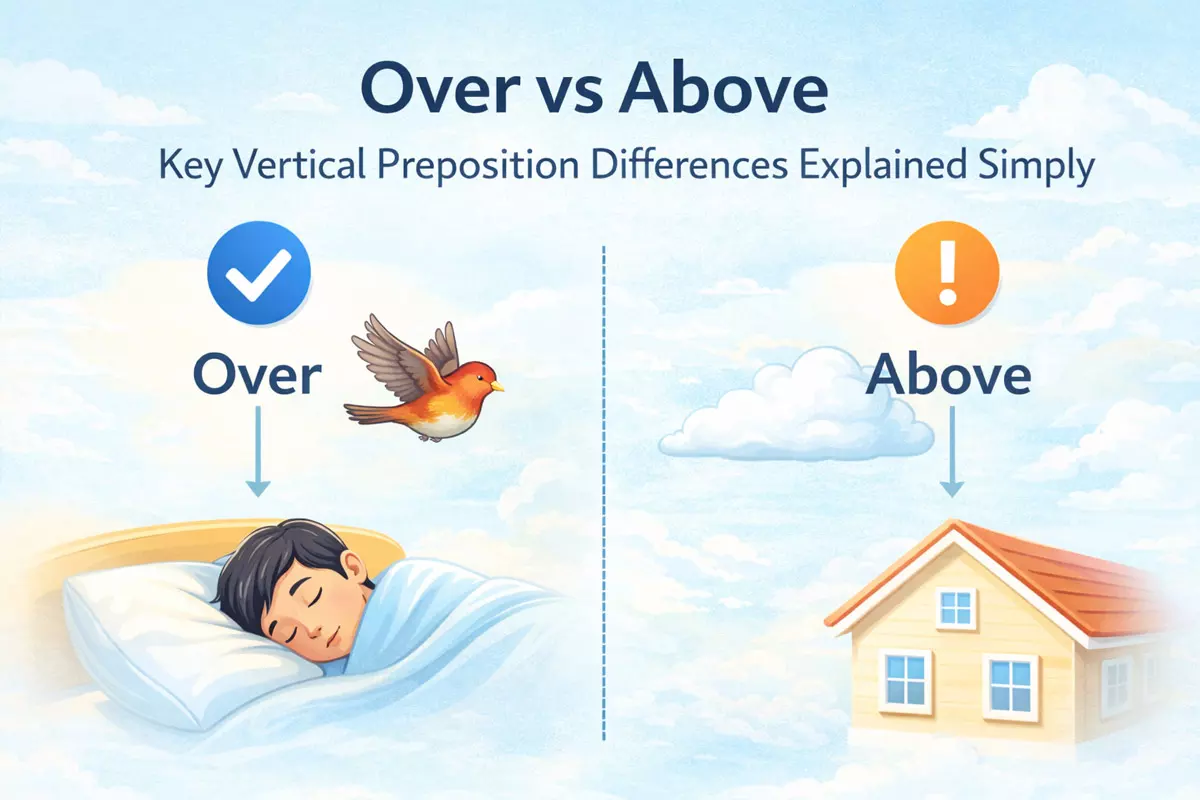
Over vs Above: Key Vertical Preposition Differences Explained Simply

 This article explains the difference between over and above, covering their meanings in physical position, control, authority, and improvement. It provides examples from daily and academic English, plus practice exercises with explanations.
Choosing the correct word to describe something that is higher than something else can be confusing, but understanding the differences between common vertical prepositions like above, over, on top of, and atop will help you communicate more clearly. Each preposition has its own nuance: for example, above suggests a higher position without direct contact, while on top of implies direct contact with the uppermost surface. By learning these subtle distinctions, you can express spatial relationships more accurately and confidently in English.
Shared idea of being higher than something
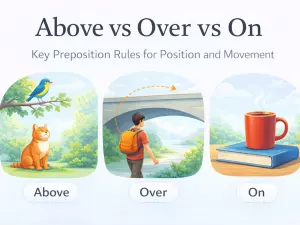
Both "over" and "above" describe a relationship where one object is at a greater vertical position compared to another. This basic meaning is at the core of both prepositions, and in many situations, they can be used interchangeably without a significant change in meaning. For instance, a bird can fly over a house or be above it, and the image created is quite similar: the bird is at a higher level than the house.
Typical scenarios using "over" and "above"
- A picture hanging over the fireplace
- A lamp above the table
- A bridge over the river
- Clouds above the mountains
- A plane flying over the city
- A shelf above the bed
- A sign over the door
- The sun above the horizon
- A blanket over a sleeping child
- Stars above the earth
- A roof over your head
- Smoke rising above the chimney
- A hat over his eyes
- A drone hovering above the crowd
- A net over the trampoline
- Leaves above the ground
- A curtain over the window
- The moon above the trees
The sense of being at a greater height or level is the core similarity. However, subtle differences in usage can arise, especially when considering coverage, directness, or figurative meanings (which are discussed elsewhere in the article). For most physical, vertical relationships, both words communicate the idea of one thing occupying a higher position relative to another.
Coverage meaning of over vs position meaning of above
Understanding how "over" and "above" differ often comes down to the nuances of coverage and position. "Over" is commonly used when something is covering or spanning across another object, while "above" simply indicates a higher position without necessarily touching or covering the object below.
How "over" expresses coverage

When "over" is used, the idea of covering, spanning, or being directly across from something is often present. This preposition suggests a relationship where one object is extending across the top surface of another, sometimes even touching it.
- The blanket is over the bed. (It covers the surface.)
- The bridge is over the river. (It spans across from one side to the other.)
- He put a coat over his shirt. (The coat covers the shirt.)
- A roof over our heads. (Provides coverage and protection.)
- Clouds formed over the city. (They cover the area from above.)
- She threw a cloth over the table. (The cloth lies on and covers the table.)
How "above" indicates position
In contrast, "above" is focused on vertical position. It means something is at a higher level or altitude, without implying that it covers or touches what’s below.
- The picture hangs above the fireplace. (Higher, but not covering.)
- There are shelves above the desk. (Located higher up.)
- The plane flew above the clouds. (At a greater height.)
- The lamp is above the table. (Not necessarily covering it.)
- Temperatures above 30°C. (Higher than a certain point.)
- The sun is above the horizon. (At a higher position in the sky.)
Comparing usage: coverage vs position
To make the distinction clearer, here’s a comparison of typical contexts:
| Usage | "Over" (Coverage) | "Above" (Position) |
|---|---|---|
| Physical coverage | The sheet is over the mattress. | ❌ (Not suitable) |
| Greater height | The helicopter hovered over the building. | The helicopter hovered above the building. |
| Measurement | Over 100 people attended. | Temperatures above average. |
| Non-contact vertical position | ❌ (Not suitable) | The lamp is above the desk. |
Summary tips
If you want to express the idea of something covering or extending across, "over" is usually the right choice. If you need to show that something is at a higher level or altitude without the sense of coverage, "above" is more appropriate. This subtle difference can change the meaning of your sentence and help you sound more natural in English.
When either preposition is acceptable
In some cases, both “over” and “above” can be used with little or no change in meaning. This usually happens when describing position in a vertical sense, but where the context doesn’t require a specific nuance such as movement, contact, or measurable distance. Native speakers often use these words interchangeably in such scenarios, and the difference is mostly stylistic or a matter of preference.
Common Situations Allowing Both Choices
When describing general vertical placement without emphasizing exact height, movement, or surface coverage, either word fits. Here are some typical contexts where you can freely choose:
- The lamp hangs over the table. / The lamp hangs above the table.
- Clouds drifted over the city. / Clouds drifted above the city.
- A picture is over the fireplace. / A picture is above the fireplace.
- He held an umbrella over his head. / He held an umbrella above his head.
- The helicopter hovered over the stadium. / The helicopter hovered above the stadium.
- There’s a shelf over the desk. / There’s a shelf above the desk.
- The stars twinkled over us. / The stars twinkled above us.
- The sign is over the door. / The sign is above the door.
- A plane flew over the mountains. / A plane flew above the mountains.
- The ceiling fan spins over the dining table. / The ceiling fan spins above the dining table.
What to Consider When Choosing
Although both prepositions work in these examples, subtle differences sometimes exist. “Over” can suggest direct coverage or movement, while “above” may feel more static or spatial. In daily conversation, though, this distinction is often ignored in the types of examples shown above.
Summary Table: Typical Interchangeable Uses
| Example Sentence | Correct usage |
|---|---|
| The lamp hangs above the table / over the table. | Both are correct here. |
| The helicopter hovered above the stadium / over the stadium. | Both are correct here. |
| A picture is above the fireplace / over the fireplace. | Both are correct (though “above the fireplace” is more common). |
| The sign is above the door / over the door. | Both are correct here. |
| Clouds drifted above the city / over the city. | Both are correct here. |
| The plane flew above the mountains / over the mountains. | Both are possible, but “over the mountains” is more natural. |
| The blanket is above the bed / over the bed. | Use “over the bed” (covering it); “above the bed” sounds like it is floating in the air. |
| The temperature is above zero / over zero. | Use “above zero”; “over zero” is not used. |
| The bathroom is above the kitchen / over the kitchen. | Use “above the kitchen” for floors in a building; “over the kitchen” is unnatural. |
In summary, when simply referring to vertical position with no added nuance, you can usually use either “over” or “above” and be understood perfectly. Context and personal preference guide the choice in these neutral situations.
Abstract uses: control, authority and improvement
When discussing "over" and "above" in a more figurative sense, both prepositions often relate to concepts such as supervision, dominance, or making things better. Instead of describing physical position, these words can represent relationships of power, influence, or responsibility. This is common in both spoken and written English, especially in formal or professional contexts.
Describing Control and Authority
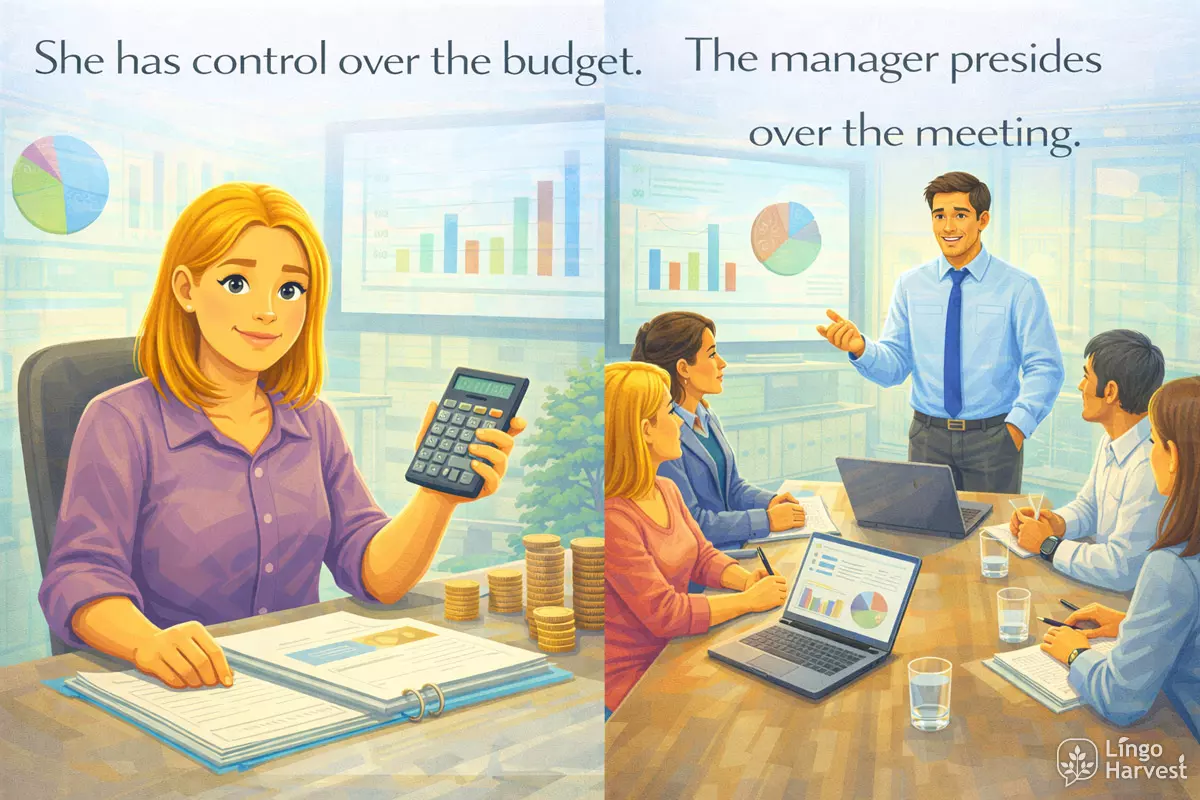
"Over" is frequently used to suggest direct control or command. For example, someone might have authority over a team or responsibility over a project. "Above" can also indicate a higher rank or status, but tends to be more about hierarchy than active management.
- She has control over the budget.
- The manager presides over the meeting.
- He is above me in the company hierarchy.
- The law stands above individual interests.
- They were placed over the new department.
- His rank is above mine.
- The supervisor watches over the process.
- Morality is considered above personal gain.
Talking About Improvement and Preference
Both "over" and "above" can express the idea of preference, improvement, or prioritization. The choice depends on nuance and the specific expression.
- I prefer tea over coffee.
- She values honesty above all else.
- They chose quality over quantity.
- Kindness ranks above intelligence, in her opinion.
- He puts his work over his hobbies.
- Safety is placed above convenience.
- They selected efficiency over tradition.
- Loyalty is held above all other virtues.
Comparison of Abstract Uses
| Usage | Example & Explanation |
|---|---|
| Authority (control) | She has authority over the staff. Direct power or management. |
| Hierarchy (status) | He is above me in rank. Higher level or position, not always direct control. |
| Preference or priority | I prefer this option over that one. Choosing one thing instead of another. |
| Value or principle | She places honesty above everything. Something is more important or valued. |
In summary, "over" usually relates to direct influence, decision-making, or preference, while "above" is more often used for status, ranking, or moral superiority. Understanding these nuances helps in using both prepositions effectively in abstract or figurative contexts.
Examples from everyday and academic English
Understanding when to use "over" or "above" becomes much easier by looking at practical sentences and academic usage. These two prepositions often appear in descriptions of position, movement, and measurement, but they’re not always interchangeable. Seeing how native speakers naturally choose one or the other can clarify the distinctions.
Common everyday contexts
- The lamp hangs over the dining table. (directly covering or spanning)
- The picture is above the sofa. (higher, not necessarily covering)
- Clouds gathered over the city. (covering the area)
- There’s a clock above the door. (higher in position)
- She held an umbrella over her head. (providing cover)
- Planes fly above the clouds. (at a higher altitude)
- He jumped over the fence. (movement from one side to another)
- The shelf is above the desk. (stationary, higher up)
- Spilled water ran over the floor. (across the surface)
- The moon rose above the horizon. (appeared higher than)
- Put a blanket over your legs. (covering)
- There’s a mirror above the sink. (fixed, higher position)
Academic and technical usage
In science, mathematics, and formal writing, these prepositions also show clear preferences:
- Temperatures above 30°C can be dangerous. (greater than a reference point)
- Pour the solution over the sample. (movement onto a surface)
- The graph shows values above the average. (higher than average)
- A bridge over the river connects the two towns. (spanning from one side to another)
- Pressure above normal levels may cause damage. (exceeding a threshold)
- The drone hovered over the field. (directly covering)
Quick comparison: "Over" vs. "Above"
| Usage | Example Sentence |
|---|---|
| Direct vertical cover or movement | The cat jumped over the wall. |
| Stationary, higher position (not touching) | The clock is above the fireplace. |
| Higher than a reference (numbers, levels) | The speed was above the limit. |
| Spanning or covering an area | The bridge goes over the river. |
Noticing these patterns helps you decide which preposition fits your meaning, whether you’re talking about physical position, movement, or abstract measurements. With practice, these differences become second nature in both casual and formal communication.
Practice items: choose over or above and justify the choice
Understanding when to use “over” versus “above” can be tricky, especially since both refer to position in relation to something else. Here are some practical exercises to help you decide which preposition fits best, along with explanations for each choice.
Fill in the blank: select the correct preposition
For each sentence, pick either "over" or "above" and briefly explain your choice.
- The lamp hangs ______ the dining table.
- The helicopter flew ______ the city.
- The painting is ______ the fireplace.
- Temperatures were ______ 40°C last summer.
- She put a blanket ______ the sleeping child.
- The mountain towers ______ the valley.
- There is a shelf ______ my desk.
- He held the umbrella ______ his head.
- The plane soared ______ the clouds.
- The score was ______ average this year.
- The bridge goes ______ the river.
- Clouds gathered ______ the stadium before the match.
- Her office is ______ mine on the next floor up.
- They hung a banner ______ the stage.
- The eagle circled ______ the field, searching for prey.
Show answers
- over – The lamp is directly above and possibly covering the table.
- over – Movement across an area (the city) is implied.
- above – The painting is higher than, but not necessarily covering, the fireplace.
- above – Refers to a level higher than a certain number (temperature).
- over – The blanket covers the child.
- above – The mountain is at a higher elevation than the valley.
- above – The shelf is located at a higher position than the desk.
- over – The umbrella covers and protects the head.
- above – The plane is at a higher altitude than the clouds.
- above – Used for numbers/statistics to mean “greater than.”
- over – The bridge crosses and covers the river.
- over – The clouds are directly covering the stadium.
- above – One office is on a higher floor than the other.
- over – The banner is suspended across the stage area.
- over – The eagle moves in a circular path above and across the field.
Quick reference: typical uses
- Over is common when something covers, moves across, or is in direct contact with the top of something.
- Above is used for higher positions without direct covering, or for abstract concepts like numbers and rankings.
Common patterns
Notice these frequent contexts:
- Movement across an area: “flew over the ocean”
- Physical covering: “a cloth over the table”
- Static higher position: “the clock above the door”
- Numbers and measurements: “above zero,” “above average”
Practice regularly with real examples to reinforce your understanding of which preposition best fits each context.