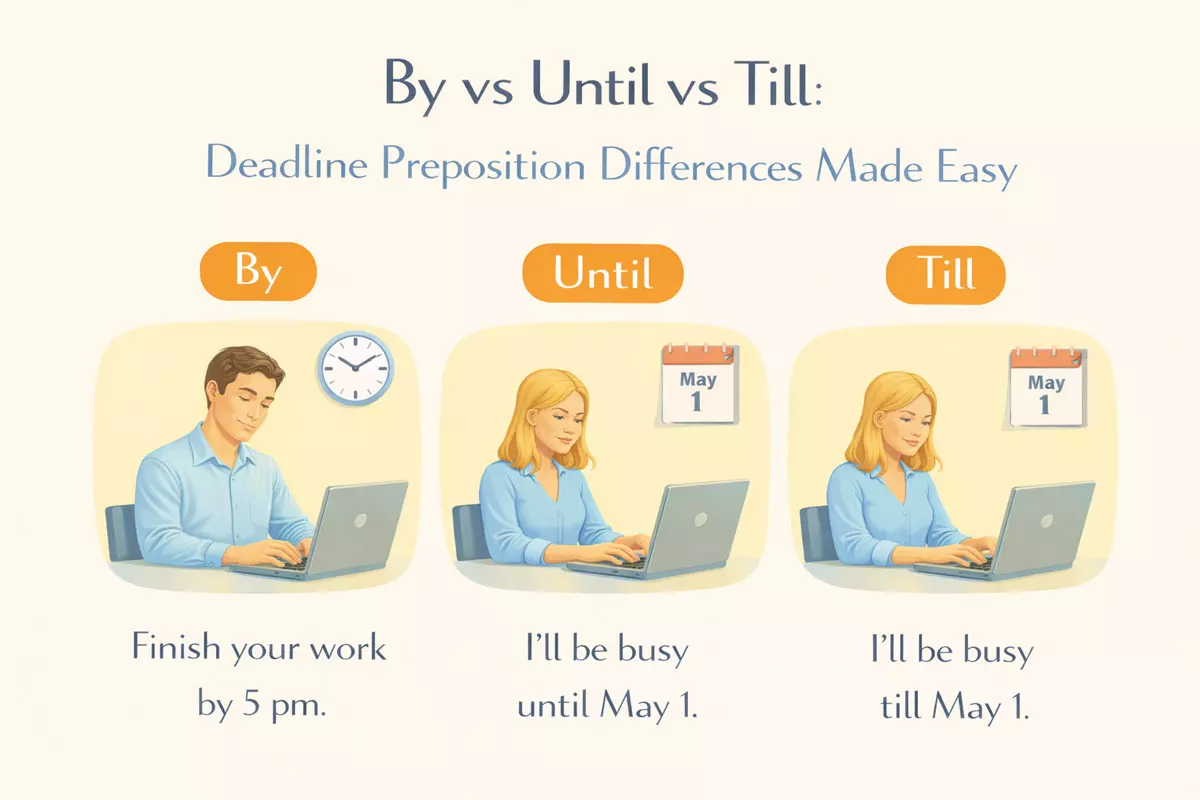
By vs Until vs Till: Deadline Preposition Differences Made Easy

 The article clarifies how by and until function as deadline markers, explains their grammatical pairing with different verb types, explores formal and informal usage, addresses common errors, and guides on drafting clear, deadline-focused business instructions.
- The Boundary Principle: 'By' as a fixed deadline vs. 'Until' as an ongoing state
- Grammatical Compatibility: Why 'until' requires durative verbs and 'by' requires achievement verbs
- Negative inversion and emphasis: Usage of 'not until' in formal sentence structures
- Informality vs. Formality: The stylistic decline of 'till' in professional and academic writing
- Contextual logic: Managing deadlines in project management and scheduling scenarios
- Common Error Correction: Fixing 'by' vs 'until' confusion in complex future perfect tenses
- Practice: Drafting and refining deadline-sensitive instructions for business and legal clarity
Selecting the correct preposition to talk about deadlines in English—such as "by," "until," and "till"—can be challenging for many learners. Each word has its own specific use: "by" indicates that something should happen before or at a certain time, while "until" and "till" suggest that something continues up to a particular moment. Understanding these subtle differences will help you communicate deadlines more clearly and accurately in both spoken and written English.
The Boundary Principle: 'By' as a fixed deadline vs. 'Until' as an ongoing state
Understanding how by and until mark boundaries in time is crucial for clear communication about deadlines and durations. By sets a specific endpoint for an action—it must happen any time before or at a stated moment, but not after. In contrast, until describes the ongoing nature of a situation or activity, which continues up to a given time, stopping exactly at that point.
When to use by: The fixed deadline
Use by when you want to set a cut-off. The action must be finished no later than a certain time. This is common for assignments, appointments, or obligations. Think of it as a time limit—after the deadline, it's too late.
- Please submit your report by Friday.
- Arrive by 8:00 AM.
- Pay the bill by the end of the month.
- Can you finish it by tomorrow?
- Return the book by next week.
- Finish the exam by noon.
- Let me know by Monday.
- I need your answer by tonight.
- Apply by June 30th.
- Get home by sunset.
When to use until: The ongoing state
Until focuses on the duration of a state or activity, highlighting that something continues and only ends at a certain time. The emphasis is on what happens up to a point, not on a deadline for completion.
- I will wait until you arrive.
- The store is open until 10 PM.
- She lived there until 2019.
- We talked until midnight.
- He stayed until the end of the meeting.
- Keep going until you see the sign.
- The offer lasts until Saturday.
- Don't eat until dinner.
- The rain lasted until morning.
- I’ll keep working until it’s done.
Comparing 'by' and 'until' in context
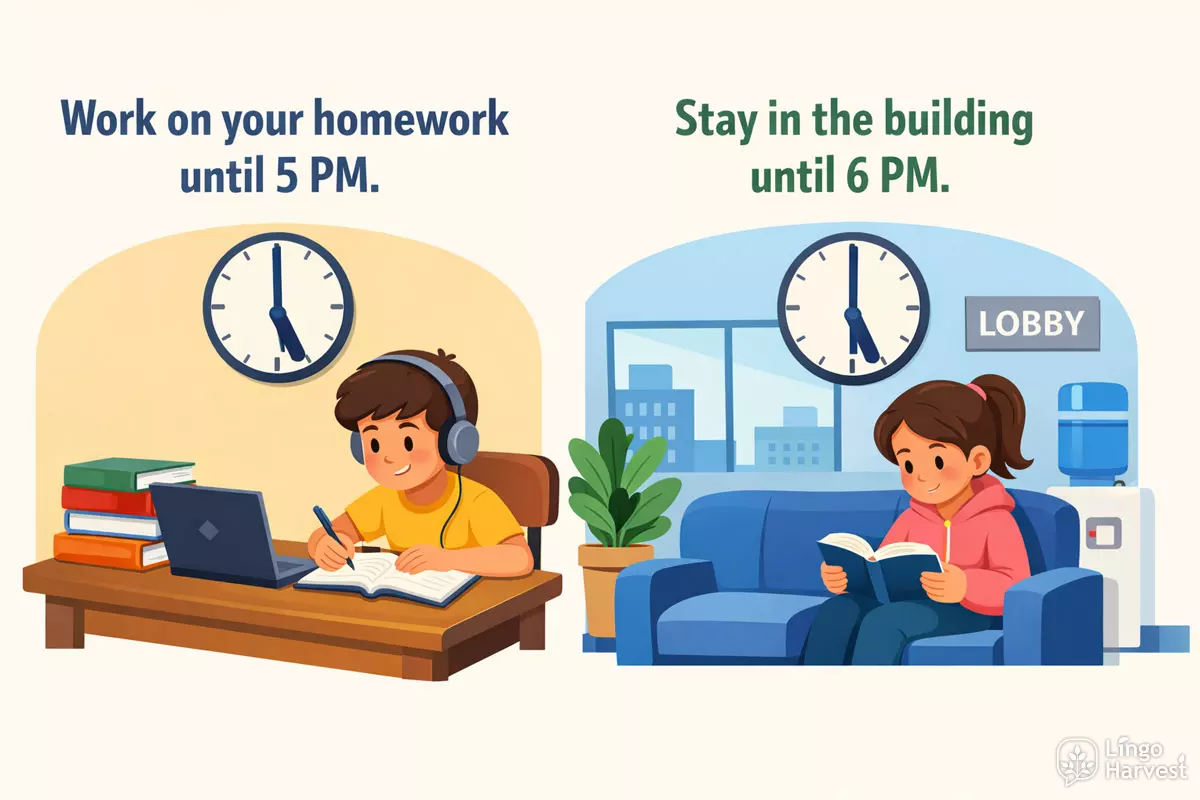
Sometimes, choosing between these prepositions changes the meaning of your sentence. Here are some examples to show how the choice affects interpretation:
| Sentence with 'by' | Sentence with 'until' |
|---|---|
| Hand in your homework by 5 PM. ✅ Must be finished before or at 5 PM. |
Work on your homework until 5 PM. ✅ Continue working, stop exactly at 5 PM. |
| Leave the building by 6 PM. ✅ Must exit before or at 6 PM. |
Stay in the building until 6 PM. ✅ Remain inside up to 6 PM, then leave. |
| Call me by noon. ✅ Make the call before or at 12:00. |
Wait until noon. ✅ Continue waiting, stop at 12:00. |
| Pay by the 10th. ✅ Payment must be made before or on the 10th. |
Stay until the 10th. ✅ Remain until that date, then leave or change. |
In summary, by highlights a deadline for action, while until focuses on the period something continues. Choosing the right preposition helps set clear expectations about timing and duration in English communication.
Grammatical Compatibility: Why 'until' requires durative verbs and 'by' requires achievement verbs
Understanding how “until” and “by” interact with different types of verbs is key to using these prepositions correctly. The main distinction lies in the nature of the verb: “until” pairs with verbs that describe ongoing states or actions (durative verbs), while “by” is used with verbs that signal a clear result or completion (achievement verbs).
What are Durative and Achievement Verbs?
Durative verbs describe actions or states that extend over a period of time. Examples include “wait,” “sleep,” “work,” and “stay.” In contrast, achievement verbs refer to actions that are completed in an instant or have a definite endpoint, such as “finish,” “arrive,” “submit,” or “leave.”
Why Does “Until” Need Durative Verbs?
“Until” focuses on the duration leading up to a certain point, so it naturally fits with actions or states that can last. For example, “She waited until noon” makes sense because “waiting” is an action that can continue over time. If you try to use “until” with an achievement verb, the sentence becomes awkward or illogical, since you can’t “finish” or “arrive” for a duration.
- wait until → Please wait until the manager arrives.
- stay until → We stayed until midnight to finish the work.
- sleep until → He slept until noon on Sunday.
- work until → She worked until late in the evening.
- sit until → The children sat quietly until the movie ended.
- remain until → The building will remain closed until further notice.
- continue until → The show will continue until the end of the month.
- study until → I studied until I understood the topic.
- live until → They lived there until the war ended.
- hold on until → Hold on until I get back.
Why Does “By” Work with Achievement Verbs?
“By” indicates a deadline or a latest possible moment for an action. It works with verbs that represent a change of state or a finished event. For instance, “Submit the report by Friday” is correct because “submit” is an action completed at a point in time. Using “by” with durative verbs usually produces ungrammatical or odd results.
- finish by → Please finish the report by Friday.
- arrive by → Make sure you arrive by 9 a.m.
- submit by → Submit your application by the deadline.
- leave by → We need to leave by noon.
- decide by → She will decide by the end of the week.
- complete by → The project must be completed by June.
- return by → Please return the keys by tomorrow.
- call by → I will call you by this evening.
- pay by → The bill must be paid by Monday.
- answer by → Please answer the email by the end of the day.
- respond by → Respond by Friday if you are interested.
- sign by → All documents must be signed by the client.
Comparing “Until” and “By” in Context
The best way to see the difference is in sentences. Notice how changing the verb type or preposition changes the meaning or even makes the sentence ungrammatical:
| Durative Verb Example | Achievement Verb Example |
|---|---|
| She waited until 6 PM. | She finished by 6 PM. |
| We stayed until midnight. | He arrived by noon. |
| They slept until sunrise. | The report was submitted by the deadline. |
| He worked until he was tired. | She left by 10 o’clock. |
Key Takeaways
In summary, “until” needs verbs that express something lasting, while “by” matches verbs that signal completion or result. Mixing them up can lead to sentences that sound unnatural or confusing, so it’s worth paying attention to verb type when choosing between these deadline prepositions.
Negative inversion and emphasis: Usage of 'not until' in formal sentence structures
When you want to stress that something happens only after a specific point, English often uses a structure called negative inversion with "not until." This construction is common in formal writing and speech, adding emphasis and clarity to deadlines or sequences of events. The phrase "not until" is typically placed at the beginning of the sentence, followed by an inversion of the subject and auxiliary verb.
How negative inversion with "not until" works
Instead of a standard word order, negative inversion flips the auxiliary verb and subject, creating a more emphatic effect. For example, compare:
- Standard: She left when the meeting ended.
- Inverted: Not until the meeting ended did she leave.
The inverted form highlights the timing, making it clear that the action did not happen before the specified moment.
Common patterns and variations
You’ll recognize this structure in both written and spoken English, especially when writers want to underline that an action was delayed until a particular time or condition. Here are some typical examples:
- Not until midnight did the fireworks start.
- Not until he apologized was she willing to speak to him.
- Not until you finish your homework can you watch TV.
- Not until the deadline had passed did they submit the form.
- Not until my phone rang did I realize the time.
- Not until the rain stopped were we able to go outside.
- Not until she explained did I understand the instructions.
- Not until the results arrived did they celebrate.
- Not until the contract was signed could work begin.
- Not until the last guest left did the hosts relax.
- Not until the bell rang were the students dismissed.
- Not until the final whistle did the team cheer.
- Not until the lights went out did we notice the power cut.
- Not until the alarm sounded did we wake up.
- Not until the book was published did she gain recognition.
Why use inversion with "not until"?
This structure is preferred in formal contexts or whenever you want to strongly emphasize that nothing happened before a certain deadline or trigger. It’s particularly useful for rules, instructions, or recounting events where the sequence matters.
Comparison: Standard order vs. negative inversion
See how meaning and emphasis shift with the two styles:
| Standard Order | Negative Inversion with "Not Until" |
|---|---|
| She didn’t leave until the meeting ended. | Not until the meeting ended did she leave. |
| He couldn’t enter until he showed his ID. | Not until he showed his ID could he enter. |
| They started eating only after everyone arrived. | Not until everyone arrived did they start eating. |
| We didn’t know the answer until the teacher explained. | Not until the teacher explained did we know the answer. |
This kind of sentence structure is a powerful tool for expressing deadlines, conditions, and sequences in a polished, formal way. It helps make your writing clearer and more engaging, especially when discussing time limits or rules.
Informality vs. Formality: The stylistic decline of 'till' in professional and academic writing
In professional and academic contexts, language choice often signals the level of formality and attention to convention. While “till” is perfectly correct and has a long history in English, it’s increasingly seen as informal or even colloquial when compared to “until” or “by.” Editors, professors, and business professionals tend to prefer alternatives that sound more polished or precise, which has contributed to the gradual reduction in “till” usage in serious writing.
The perception of “till” in modern writing
The word “till” is sometimes mistaken as a modern abbreviation of “until,” but it actually predates “until” by centuries. Despite its legitimacy, it often appears less formal, perhaps due to its shorter, more casual sound and its frequent use in spoken English. This perception influences style guides and editorial standards, which usually recommend “until” for formal documents.
Common scenarios where “till” is avoided
- Academic essays and research papers
- Business correspondence and reports
- Legal documents and contracts
- Grant proposals and applications
- Official notices and announcements
- Government publications
- Press releases and news articles
- Instructions and technical manuals
- Formal emails to supervisors or clients
- Conference presentations and slides
Comparing “till,” “until,” and “by” in formal writing
| Preposition | Typical Formality Level | Preferred Contexts |
|---|---|---|
| till | Informal to neutral | Conversation, informal writing, creative works |
| until | Neutral to formal | Academic, business, legal, technical documents |
| by | Neutral to formal | Deadlines, instructions, requirements |
Why “until” and “by” are favored
Writers gravitate toward “until” and “by” because they offer clarity and a sense of precision. “Until” emphasizes the duration up to a point, while “by” pinpoints a deadline. These distinctions are particularly important in academic and professional settings, where ambiguity can lead to misunderstandings or errors. The move away from “till” is less about correctness and more about maintaining a tone that matches the expectations of a formal audience.
Summary: When to avoid “till”
- When clarity and professionalism are paramount
- If following a style guide (e.g., APA, MLA, Chicago)
- To avoid the appearance of casualness or informality
- When writing for international or unfamiliar audiences
Ultimately, while “till” is not incorrect, choosing “until” or “by” in formal contexts helps ensure your writing is taken seriously and meets contemporary standards.
Contextual logic: Managing deadlines in project management and scheduling scenarios
In workplace environments where timelines are critical, choosing the right preposition—by, until, or till—helps clarify expectations and prevent misunderstandings. Each term triggers a different sense of urgency and defines the time frame for task completion in its own way. Knowing when to use each preposition is essential for clear communication among team members and stakeholders.
How deadline prepositions shape task expectations
Project managers and schedulers often face confusion when specifying due dates. The subtle distinctions between these prepositions can lead to missed deadlines or incomplete work if misused. Here’s how each typically functions:
- By sets a clear endpoint. Tasks must be completed any time up to and including the specified date or time. It’s ideal for deliverables and milestone tracking.
- Until (or till) focuses on the continuity of an action or state, emphasizing that something should persist throughout the period, stopping at the endpoint.
- Till is an informal synonym for until, used more in conversation and less in formal documentation.
Key scenarios and example sentences
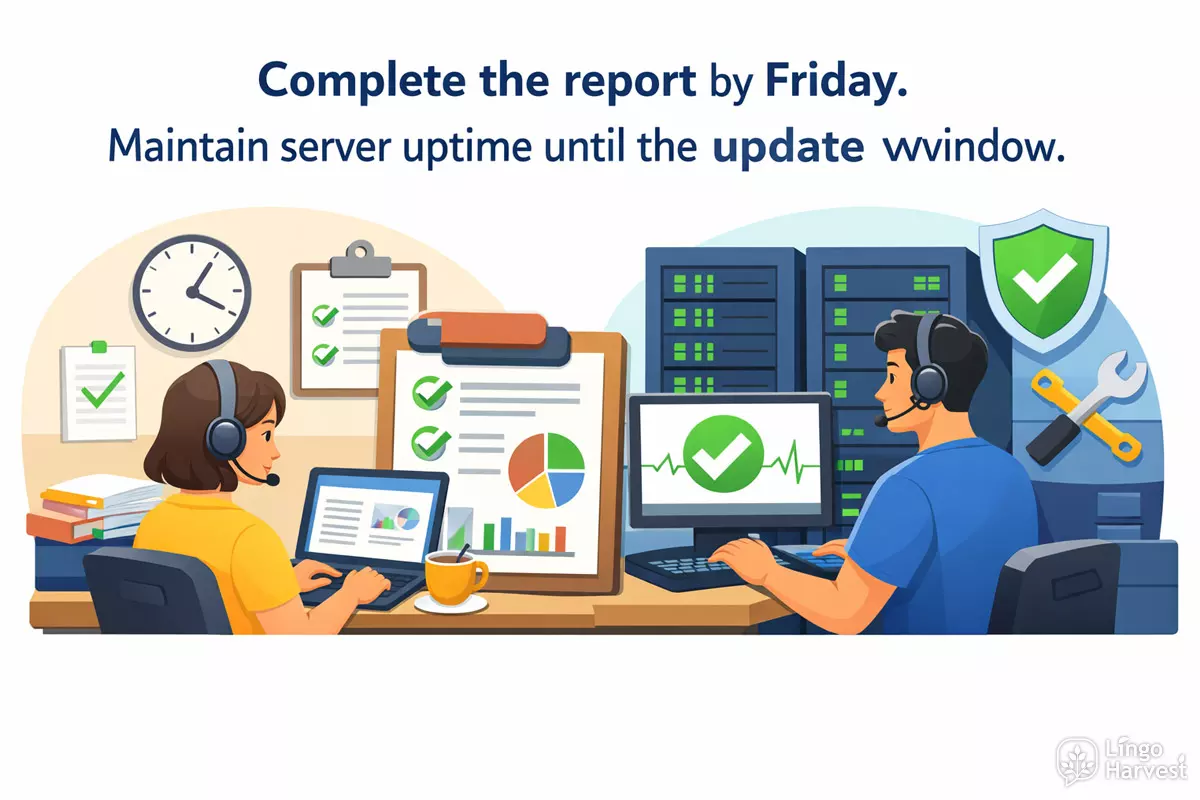
Below are practical examples showing how these prepositions clarify deadlines and ongoing actions in scheduling and project contexts:
- Complete the report by Friday. (Finish any time before or on Friday)
- Maintain server uptime until the update window. (Keep running up to the scheduled maintenance)
- Keep the registration form open till midnight. (Allow sign-ups through the evening)
- Submit feedback by 5 PM. (No submissions after 5 PM)
- Work remotely until further notice. (Continue indefinitely, endpoint unknown)
- Hold off on publishing till the announcement. (Wait for the official go-ahead)
- Send the agenda by Wednesday noon. (Deadline is noon on Wednesday)
- Keep the application running until all tests have passed. (Stop only after tests succeed)
- Leave the feedback form active till the event ends. (Deactivate after event concludes)
- All changes must be merged by release day. (Final cutoff is release day)
- Continue status meetings until the project wraps up. (Stop meetings at project end)
- Accept proposals till the end of the month. (No new proposals after that)
Comparison table: Prepositions in deadline management
| Preposition | Project Management Usage | Emphasis | Example |
|---|---|---|---|
| By | Sets a non-negotiable cutoff for deliverable completion | Deadline or due date | Submit the budget by Monday. |
| Until | Indicates continuous action or state up to a point | Ongoing process/period | Keep the portal open until midnight. |
| Till | Informal alternative to "until"; less common in formal documents | Ongoing or waiting period | Wait till you receive confirmation. |
Tips for clear deadline communication
- Use by for tasks with a strict due date or time.
- Choose until or till for ongoing tasks or states that should last up to a specific moment.
- In formal project documents, prefer by and until.
- Reserve till for informal notes or conversations.
- Always specify the exact date or time to avoid ambiguity.
Understanding these distinctions fosters accountability and ensures everyone is aligned on expectations, which is vital for smooth project execution and reliable scheduling.
Common Error Correction: Fixing 'by' vs 'until' confusion in complex future perfect tenses
Understanding when to use "by" and when to use "until" with the future perfect can be tricky, especially in sentences involving deadlines and ongoing actions. The confusion often comes from how these prepositions relate to time limits and the completion of activities.
Key Difference in Usage
"By" sets a deadline, indicating that an action will be finished before or at a specific point. "Until" (or "till") focuses on the duration, showing that something continues up to a point in time, but may not be completed before then. This distinction becomes especially important with the future perfect tense, which describes actions that will be completed before a certain moment.
Typical Mistakes to Watch For
- Saying "I will have finished the report until Friday" instead of "I will have finished the report by Friday." (Incorrect: ❌ / Correct: ✅)
- Using "by" when talking about ongoing states: "She will have been working here by 2025" should be "She will have been working here until 2025" if you mean she stops working in 2025.
- Mixing up the two in negative sentences: "He won't have left by 6 PM" means he is still there at 6 PM, but "He won't have left until 6 PM" means he leaves at 6 PM or after.
Future Perfect Examples: 'By' vs 'Until'
Below is a comparison to clarify which preposition matches which meaning:
| Sentence | Best Preposition | Explanation |
|---|---|---|
| I will have finished my homework ___ 8 PM. | by | Focus on completion before the deadline. |
| They will have lived here ___ next year. | until | Focus on the duration up to a point, not completion. |
| She will not have arrived ___ you leave. | by | The action (her arrival) won't be completed before you leave. |
| We will have stayed in the city ___ the festival ends. | until | Describes staying up to the ending moment, not after. |
| The guests will have left ___ midnight. | by | All guests leave before or at midnight. |
| He will have worked here ___ he retires. | until | Working continues up to the retirement moment. |
| You will have finished the course ___ September? | by | Asks if the action is complete before a date. |
| My subscription will have expired ___ I renew it. | by | Expiration happens before renewal. |
| The children will have slept ___ morning. | until | Sleeping continues up to morning, not before. |
| The team will have practiced ___ the match starts. | until | Practice continues up to the match, not after. |
Quick Tips for Mastery
- Use by for deadlines, completion, and finished results.
- Use until/till for ongoing actions up to a specific time.
- Check the verb: If it’s a result or achievement, "by" usually fits; if it’s a state or activity, "until" is often correct.
- For future perfect, ask: Is the action completed before the time (by), or lasting up to the time (until)?
Careful attention to these patterns will make choosing the right preposition in complex tenses much easier.
Practice: Drafting and refining deadline-sensitive instructions for business and legal clarity
Clear communication about deadlines is critical in business and legal contexts. Selecting the correct preposition—by, until, or till—can prevent confusion, avoid costly mistakes, and ensure all parties understand their obligations. Below, you'll find practical exercises and guidance to help you craft precise deadline instructions for contracts, policies, and workplace communications.
Common Scenarios: Choosing the Right Preposition
- By: Sets a latest possible time for completion. Use it when you want the task finished before or at a specific moment.
- Until/Till: Indicates that an action continues up to a certain point, but not after.
Instruction Refinement: Real-World Examples
Review and improve these common deadline-sensitive sentences. Decide which preposition best fits each scenario.
- Submit the expense report ___ Friday.
- The offer is valid ___ June 15th.
- You may edit the document ___ midnight.
- All payments must be received ___ April 30th.
- Access will be available ___ further notice.
- Please return the equipment ___ 5 p.m.
- The library is open ___ 8 p.m.
- We will wait here ___ you call us.
- Complete the training ___ the end of the month.
- The system will remain in maintenance mode ___ tomorrow morning.
Show answers
- by
- until/till
- until/till
- by
- until/till
- by
- until/till
- until/till
- by
- until/till
Key Phrases for Business and Legal Clarity
Here are frequently used deadline formulations. Adapt these to your own documents and communications:
- All proposals must be submitted by 5:00 PM on May 10.
- The contract remains in force until either party terminates with notice.
- Discount is available till the end of the month.
- Employees may enroll by the 1st of each month.
- Access will be granted until project completion.
- Invoices are due by the 15th of every month.
- Applications accepted till all positions are filled.
- Service available until further notice.
- Complaints must be filed by 30 days from delivery.
- Changes permitted until final approval.
- Submit requests by close of business Friday.
- Offer valid till stocks last.
- Provide feedback by next Wednesday.
- Work may continue until 6:00 PM daily.
- Opt out by written notice before renewal.
Comparison Table: Deadline Prepositions in Action
| Preposition | Example Instruction | Meaning / Best Use |
|---|---|---|
| By | Submit all deliverables by June 1. | Finish any time before or on June 1; after June 1 is late. |
| Until | Access is available until June 1. | You may access at any time up to, but not after, June 1. |
| Till | Store open till 8:00 PM. | Same meaning as "until"; slightly less formal. |
Refinement Task: Edit for Clarity
Rewrite the following to clarify deadlines and remove ambiguity. Use by, until, or till as appropriate.
- Employees can register for benefits Friday.
- The service will be available June 30th.
- Send your RSVP Monday at noon.
- You may request changes project completion.
- Please submit the application May 10th.
- The system will remain active further notice.
- All reports must be approved the end of the quarter.
- You can access the files midnight.
- Return the signed contract Friday afternoon.
- The offer is valid the end of the month.
Show answers
- Employees can register for benefits by Friday.
- The service will be available until June 30th.
- Send your RSVP by Monday at noon.
- You may request changes until project completion.
- Please submit the application by May 10th.
- The system will remain active until further notice.
- All reports must be approved by the end of the quarter.
- You can access the files until midnight.
- Return the signed contract by Friday afternoon.
- The offer is valid until the end of the month.
Mastering these distinctions helps ensure your instructions are interpreted as intended—reducing disputes and improving efficiency in business and legal environments.