In vs Into: Location vs Movement Differences Explained Clearly

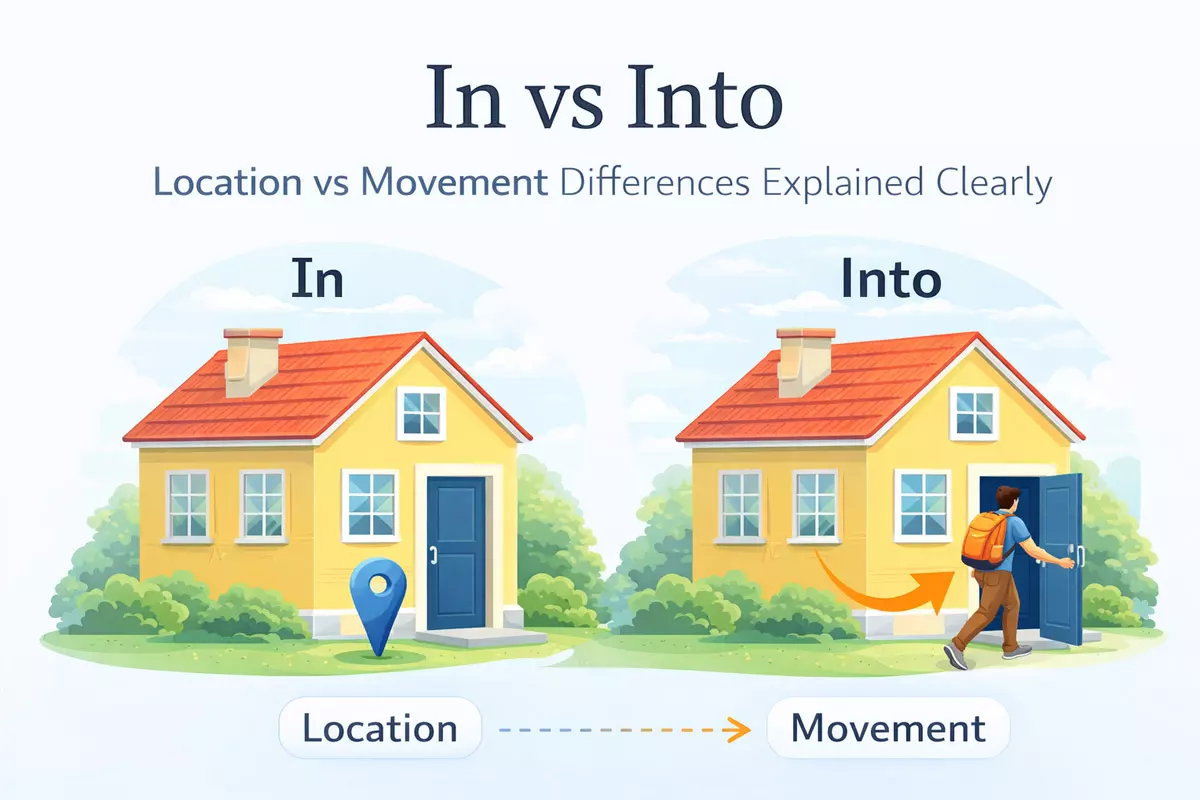 Here we how in is used for static locations and into for movement or direction, lists verbs that prefer into, explains when in can replace into in conversation, provides examples, and includes practice tasks to rewrite movement sentences.
Have you ever wondered why we say someone is sitting in the room, but they walk into the room? The difference lies in how English distinguishes between static position and movement. When we talk about someone sitting in the room, we are describing their current, unmoving state within that space. In contrast, saying someone walks into the room emphasizes the action of moving from outside to inside. Recognizing this distinction helps in understanding and using English more clearly and accurately, especially when describing locations and actions.
Static location meaning of in
When "in" is used to describe location, it emphasizes that something or someone is inside a defined space, area, or boundary—and not moving. This usage is about position, not motion. For example, if you say "The keys are in the drawer," you mean the keys are resting within the drawer, not entering or leaving it.
Understanding 'in' for place and position
"In" typically answers the question "Where?" rather than "Where to?" It highlights where something exists or remains, rather than how it got there. This is especially common with enclosed or surrounded spaces, but also applies to broader areas.
- The book is in my bag.
- She lives in London.
- There’s a spider in the bathtub.
- He works in an office.
- We’re sitting in the garden.
- The milk is in the fridge.
- They’re in the car.
- The picture is in the frame.
- I saw it in the newspaper.
- My phone is in my pocket.
- The cat is in the box.
- There’s a crack in the wall.
- The kids are in school.
- He’s in a meeting.
- The fish are in the pond.
- The shoes are in the closet.
Key characteristics of static 'in'
- Enclosure or boundaries: The object is within limits—physical or abstract.
- No movement implied: The item is at rest, not entering or leaving.
- Applies to various contexts: Rooms, cities, containers, abstract spaces (like "in trouble" or "in love").
Common mistakes to avoid
- Using "in" to mean movement—this is incorrect. For movement, "into" is needed.
- Choosing "on" or "at" when something is actually enclosed or surrounded (for example, "in a box" not "on a box").
Comparison: 'in' (location) vs 'into' (movement)
| Usage | Example Sentence |
|---|---|
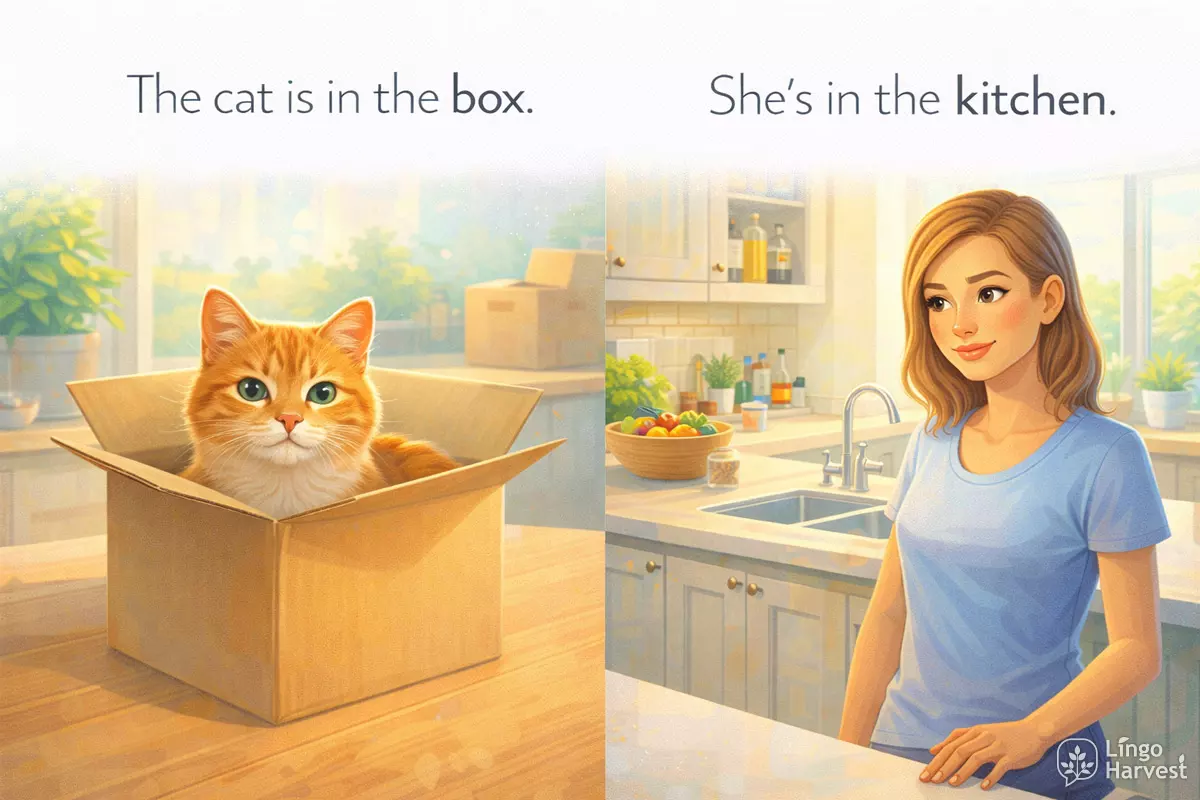
| ‘in’ for static position | The cat is in the box. ✅ |
| ‘into’ for movement | The cat jumped into the box. → |
| ‘in’ for general location | She’s in the kitchen. ✅ |
| ‘into’ for entering | She walked into the kitchen. → |
In summary, "in" is the right choice when describing where something is located, with no suggestion of entering or moving. This helps convey clear, precise information about position and setting.
Movement and direction meaning of into
When we use "into" in English, it emphasizes the idea of motion or a change from outside to inside. Unlike "in," which simply describes a static position, "into" is about entering or moving toward the interior of something. This distinction is crucial when you want to make it clear that something or someone is crossing a boundary or transitioning from one space to another.
How "into" shows movement
"Into" is almost always used when the subject is going from one place to another, not just staying in a location. It answers the question "where?" with a sense of travel or transformation. For example, if you say "She walked into the room," you’re describing her movement from outside the room to inside it.
Common ways "into" is used for direction
You’ll often see this preposition in sentences where there’s a clear action of entering, diving, or falling. Here are some typical uses:
- He jumped into the pool.
- The cat ran into the house.
- Pour the milk into the glass.
- She put the letter into her bag.
- The bird flew into the window.
- They drove into the city at night.
- The ball rolled into the street.
- She stepped into the elevator.
- We walked into the museum.
- The ice melted into water.
- He turned into the driveway.
- The caterpillar turned into a butterfly.
- She crashed into the fence.
- He got into trouble at school.
- Please put your phone into your pocket.
- The thief broke into the store.
- He dived into the river.
- The teacher divided the class into groups.
Comparing "in" and "into" for movement
To clarify the difference, here are some example sentences comparing the two words:
| Static Position ("in") | Movement/Direction ("into") |
|---|---|
| The kids are in the park. | The kids ran into the park. |
| The book is in the bag. | She put the book into the bag. |
| The cat is in the house. | The cat jumped into the house. |
| The water is in the glass. | He poured water into the glass. |
Understanding when to use "into" can help you express actions and directions more clearly, especially when you want to highlight the transition from one place or state to another.
Verbs that usually prefer into for motion
When describing movement from outside to inside, many English verbs naturally take "into" rather than just "in." This is because "into" emphasizes the transition or entry, rather than simply the location. Using "into" with these verbs helps clarify that something or someone is crossing a boundary or entering a new space.
Common verbs that take "into" for movement
Here are several verbs that typically pair with "into" to indicate motion or change of position:
- go (go into the room)
- walk (walk into the building)
- run (run into the yard)
- enter (enter into a contract / enter into a room)
- move (move into a new apartment)
- step (step into the water)
- jump (jump into the pool)
- fall (fall into a trap)
- drive (drive into town)
- get (get into the car)
- throw (throw into the bin)
- put (put into the box)
- drop (drop into the well)
- climb (climb into bed)
- break (break into a house)
- crash (crash into the fence)
- push (push into the crowd)
- pour (pour into a glass)
- sink (sink into the mud)
- slip (slip into a dress)
Why "into" is preferred with these verbs
The preposition "into" signals movement with a clear direction toward the inside or a change from outside to inside. For instance, "She walked into the office" makes it clear she crossed a boundary and is now inside. In contrast, "walked in" could simply mean she was already inside and walking around.
Quick comparison: "in" vs "into" with motion verbs
Some verbs can take both "in" and "into," but their meanings change. "In" often describes location, while "into" specifies movement. Here’s how they differ:
| Verb + In | Verb + Into |
|---|---|
| He is in the room. (location) |
He went into the room. (movement/entry) |
| The cat sits in the box. (already inside) |
The cat jumped into the box. (movement from outside to inside) |
| She is swimming in the pool. | She dived into the pool. |
| The keys are in my bag. | I put the keys into my bag. |
Using "into" with verbs of motion makes your statements more precise, especially when you want to highlight the action of entering, inserting, or moving inward. This helps avoid ambiguity, ensuring your meaning is clear to your listener or reader.
When in can replace into in spoken English
In casual conversation, speakers often use "in" instead of "into" when talking about movement or direction, especially if the meaning is clear from context. This is common in American and British English, where natural speech tends to simplify strict grammar rules. The distinction between location ("in") and movement ("into") sometimes gets blurred, particularly with verbs that already suggest motion.
Common situations where "in" is used for movement
- After verbs of motion, especially "go," "come," "walk," "run," "get," "jump," "put"
- When the result (being inside) is more important than the movement itself
- In quick, informal speech when speakers prioritize speed over precision
- With familiar locations or objects where the direction is obvious
Typical spoken examples

- "She got in the car." (instead of "into the car")
- "Come in the house!" (instead of "into the house")
- "He put the groceries in the fridge."
- "Jump in the pool!"
- "Throw it in the bin."
- "Let's get in bed."
- "Step in my office."
- "She ran in the store."
- "Put your phone in your pocket."
- "Move in the shade."
- "Place your hand in the box."
- "He dove in the lake."
- "Let’s climb in the treehouse."
- "Go in the room."
Why do speakers do this?
People often drop "into" for ease and speed, assuming the listener understands the movement from the verb and the object. As a result, "in" becomes a catch-all preposition for both location and movement in informal settings.
When should you avoid this?
While using "in" for movement is common in speech, it's less accepted in formal writing or situations where precision matters. If the difference between being inside and moving inside is important, it's best to use "into" to avoid confusion.
Summary of usage
- In formal writing: prefer "into" for movement.
- In everyday speech: "in" is often used instead of "into" without confusion.
- Context and the verb usually make the meaning clear.
Examples of literal and metaphorical uses
Understanding how “in” and “into” are used both literally (for physical position or movement) and metaphorically (for abstract concepts or states) is key to mastering their differences. Literal uses often relate to location versus direction, while metaphorical uses transfer these ideas to emotions, situations, or changes.
Literal usage in context
- In: She is in the kitchen. (Location—she’s already there.)
- Into: She walked into the kitchen. (Movement—she entered the kitchen.)
- In: The cat is in the box. (Static position)
- Into: The cat jumped into the box. (Action, change of place)
- In: The keys are in my bag.
- Into: He put the keys into his bag.
Metaphorical and abstract usage
The distinction also appears when describing changes in state, involvement in activities, or emotional shifts:
- She is in trouble. (State or condition)
- He got into trouble. (Process of entering a problematic state)
- I’m in love. (Current emotional condition)
- He fell into despair. (A shift into a new emotional state)
- She is in the movie industry. (Participation or membership)
- He broke into the music business. (Gaining entry or starting something new)
- They are in a meeting. (Present status)
- He walked into a difficult situation. (Became involved, often unexpectedly)
- She is in debt. (A fixed state)
- He slipped into unconsciousness. (Transition from one state to another)
Comparing literal vs. metaphorical patterns
| Literal example | Metaphorical example |
|---|---|
| She put the letter in the drawer. | She’s in a good mood. |
| He ran into the house. | He ran into trouble at work. |
| The bird is in the cage. | The idea is in his mind. |
| They poured water into the glass. | She poured her energy into the project. |
| The ball is in the goal. | He is in danger. |
| He climbed into bed. | He slipped into a deep sleep. |
Recognizing these patterns helps clarify when to use “in” for static situations or “into” for movement, whether you’re talking about physical spaces or more abstract ideas.
Practice tasks to rewrite movement sentences correctly
Understanding the distinction between “in” and “into” is easiest with real examples. Here, you'll find exercises to help you identify and correct mistakes related to expressing movement or static location. Focus on the use of “into” for movement towards the inside of a place, and “in” for describing a static position or state.
Rewrite the sentences below using the correct form: “in” or “into”
- The dog jumped in the car.
- She walked in the room.
- Put the groceries in the fridge.
- The ball rolled in the garden.
- He poured the water in the glass.
- They climbed in the mountain.
- I threw the letter in the mailbox.
- The cat ran in the house when it started raining.
- Drop your keys in the bowl by the door.
- She slipped in the pool by accident.
Show answers
- The dog jumped into the car.
- She walked into the room.
- Put the groceries into the fridge.
- The ball rolled into the garden.
- He poured the water into the glass.
- They climbed into the mountain. (Note: Usually “climbed up the mountain” is correct, but if entering a cave or interior, use “into”.)
- I threw the letter into the mailbox.
- The cat ran into the house when it started raining.
- Drop your keys into the bowl by the door.
- She slipped into the pool by accident.
Quick Reference: Location vs. Movement
To help clarify, here’s a side-by-side comparison of how “in” (location) and “into” (movement) are used with common nouns:
| Static Position (“in”) | Movement (“into”) |
|---|---|
| She is in the kitchen. | She walked into the kitchen. |
| The book is in the bag. | Put the book into the bag. |
| There’s water in the bottle. | Pour water into the bottle. |
| The kids are in the pool. | The kids jumped into the pool. |
| The cat is in the box. | The cat climbed into the box. |
| The painting is in the gallery. | They brought the painting into the gallery. |
Identify and Fix the Error
In each example below, decide if “in” or “into” is correct. If it’s wrong, rewrite the sentence.
- She drove in the garage.
- The bird flew in the open window.
- He put his phone in his pocket.
- The children ran in the playground.
- The dog jumped in the car.
- She walked in the room quietly.
- He threw the keys in the drawer.
- The cat climbed in the box.
- They poured water in the bottle.
- The man stepped in the elevator.
- The ball rolled in the goal.
- She pushed the chair in the corner.
- The mouse ran in the hole.
- He fell in the swimming pool.
- The train moved in the tunnel.
Show answers
- She drove into the garage.
- The bird flew into the open window.
- He put his phone into his pocket.
- The children ran into the playground. (If entering; if already playing there, “in” is correct.)
- The dog jumped into the car.
- She walked into the room quietly.
- He threw the keys into the drawer.
- The cat climbed into the box.
- They poured water into the bottle.
- The man stepped into the elevator.
- The ball rolled into the goal.
- She pushed the chair into the corner.
- The mouse ran into the hole.
- He fell into the swimming pool.
- The train moved into the tunnel.
Practice makes perfect. Always ask yourself: Does the action show movement from outside to inside? If yes, use “into.” If it describes where something or someone is, use “in.”