On vs Onto: Understanding Surface vs Motion Differences in Use

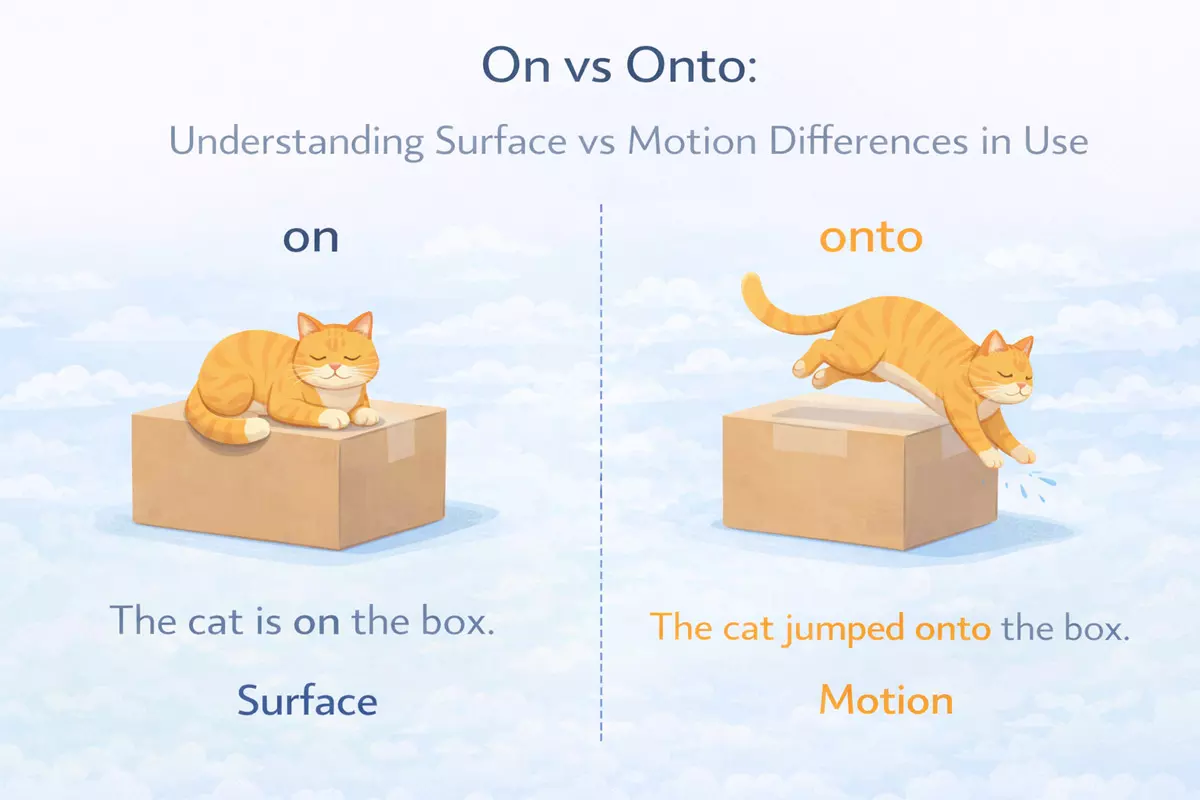 This article explains how on means contact with a surface, while onto shows movement or direction. It covers verbs that prefer onto, when on replaces onto in casual speech, formal versus informal use, and includes practice exercises.
Understanding the difference between describing something as resting on a surface and indicating movement toward a position can be challenging for English learners, as these subtle distinctions often change the meaning of a sentence. Knowing whether to use a word that implies something is stationary or one that suggests motion is essential, because context determines which term is appropriate. Mastering this aspect of English helps learners communicate more precisely and avoid misunderstandings in both spoken and written language.
Basic idea of on as contact with a surface
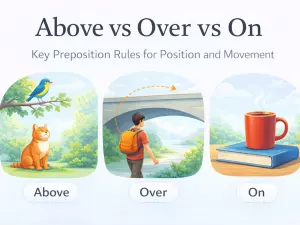
When we use the preposition on in English, it generally indicates that something is physically touching and supported by the exterior or upper part of another object. This relationship is about direct contact, where one object rests atop or against another, without necessarily involving any movement from one place to another. For example, a cup placed on a table is simply sitting there, making contact with the table’s surface.
Common scenarios for "on"
Here are typical situations where "on" is used to show placement or attachment involving surfaces:
- A picture hanging on the wall
- Books lying on the shelf
- A sticker stuck on your laptop
- Food sitting on a plate
- Your feet on the ground
- Writing on the board
- A fly resting on the ceiling
- Keys left on the counter
- Rain falling on the roof
- Paint on your hands
- Posters on the door
- A hat on your head
- Glasses on your face
- A cat sleeping on the sofa
- Snow on the ground
- Leaves on the tree
- Names written on the list
- A ring on your finger
Key points about using "on" with surfaces
"On" is chosen when the main focus is the position or presence of an object in contact with a surface, not how it got there. The concept does not imply movement or transfer; it simply describes the state of resting, attaching, or being supported. This contrasts with prepositions like "onto," which often suggest a change of position or motion toward a surface.
Visualizing the relationship: Examples and meaning

The following table summarizes common uses of "on" and what they express about surface contact:
| Example | What it shows |
|---|---|
| The lamp is on the desk | Direct contact with the desk’s top surface |
| There’s a mark on your shirt | Something attached or touching the shirt’s outside |
| He sat on the bench | Body supported by the bench’s surface |
| The poster is on the wall | Adhered to or placed against the wall |
| The bird landed on the branch | Contact with the branch after landing |
In summary, "on" is all about that physical link or support from a surface, making it the go-to preposition for describing objects that rest, lie, or are attached to another object’s exterior. It’s a simple but fundamental part of expressing relationships between objects and their environments in English.
How onto adds direction or movement to a surface
The word "onto" signals not just placement, but an action involving motion toward and contact with a surface. Unlike "on," which typically describes a static position, "onto" is dynamic: it tells us that something is moving and will end up resting atop something else. This subtle difference is crucial for clear communication, especially when describing events, instructions, or physical actions.
The sense of movement with "onto"
When you use "onto," you’re describing a process where one object transitions from another location and comes to rest above or on the surface of a second object. This often involves a sense of direction or trajectory, such as jumping, pouring, or climbing.
- She poured the sauce onto the pasta. → (The sauce moves and lands on the pasta.)
- The cat jumped onto the table. → (The cat wasn’t already on the table; it moved there.)
- He climbed onto the roof. → (He was somewhere else, then moved to be on the roof.)
- They spilled water onto the floor. → (Water transferred from a container to the floor.)
- I loaded the boxes onto the truck. → (Boxes were moved from one place to the truck’s surface.)
- The child crawled onto the bed.
- Snow fell onto the road overnight.
- She placed her bag onto the chair.
- Paint dripped onto the carpet.
- The bird landed onto the branch.
- Leaves blew onto the porch.
- He threw his jacket onto the couch.
- The ball bounced onto the grass.
- Sunlight streamed onto the desk.
- Dust settled onto the shelves.
- Coins dropped onto the counter.
- Rain splashed onto the window.
- The dog leapt onto the bed.
Comparing "on" and "onto" in context
The two prepositions are sometimes confused. "On" describes where something is; "onto" describes how it got there. Consider these differences:
| Example with "on" | Example with "onto" | What’s different? |
|---|---|---|
| The book is on the shelf. | She put the book onto the shelf. | Action vs. position: "onto" shows movement. |
| The cat sits on the mat. | The cat jumped onto the mat. | "Onto" indicates the cat moved to the mat. |
| There is paint on the wall. | He splashed paint onto the wall. | "Onto" describes the process of getting there. |
| The keys are on the table. | He tossed the keys onto the table. | "Onto" shows the keys were moved to the table. |
Summary
In summary, "onto" is essential for expressing movement or a change of position ending with contact on a surface. Using this preposition correctly adds clarity and precision when describing action and direction, emphasizing the transition from one place to another.
Common verbs that strongly prefer onto
Some English verbs almost always take "onto" to express movement, especially when emphasizing direction or a change of position onto a surface or target. Understanding which verbs naturally pair with "onto" helps learners avoid awkward phrasing and communicate intention more precisely.
Typical Verbs Used with "Onto"
Many action verbs imply motion toward a specific place, making "onto" the preferred preposition. Here are several verbs frequently found with "onto" in everyday speech and writing:
- Climb (climb onto the roof)
- Jump (jump onto the platform)
- Step (step onto the stage)
- Leap (leap onto the bed)
- Crawl (crawl onto the sofa)
- Pull (pull onto the highway)
- Load (load onto the truck)
- Drag (drag onto the table)
- Move (move onto the next topic)
- Transfer (transfer onto a new line)
- Get (get onto the bus)
- Slip (slip onto the ice)
- Fall (fall onto the floor)
- Place (place onto the shelf)
- Throw (throw onto the pile)
- Shift (shift onto another project)
- Spill (spill onto the carpet)
- Push (push onto the stack)
Why These Verbs Favor "Onto"
The verbs above often require "onto" because they describe an action where something or someone is moving and ending up on a new surface or area. For example, "jump on" and "jump onto" can both be correct, but "jump onto" clarifies the movement from one place to another, especially when there's a clear destination or change in position.
Comparing "On" vs. "Onto" with Typical Verbs
Some verbs can take both "on" and "onto," but the choice changes the meaning. When motion or transfer is involved, "onto" is usually the better fit. The table below compares usage with select verbs:
| Verb | Typical Use with "Onto" |
|---|---|
| Climb | She climbed onto the roof. ✅ (movement to a new position) |
| Load | They loaded the boxes onto the truck. ✅ (transfer to a surface) |
| Step | He stepped onto the stage. ✅ (entering a space) |
| Transfer | Transfer the data onto your computer. ✅ (moving from one place to another) |
| Get | Get onto the bus. ✅ (boarding a vehicle) |
Usage Tips
When in doubt, consider whether the verb expresses a transfer or movement to a new surface. If so, "onto" is likely the right choice. For static position or location, "on" is usually preferred. The verbs listed here almost always require "onto" when the focus is on motion or change of place.
Situations where onto is often reduced to on
In everyday English, speakers often choose “on” instead of “onto,” especially when the difference between static position and movement is clear from context or considered unimportant. While “onto” technically emphasizes motion or transfer to a surface, in casual conversation and even in some writing, “on” is widely accepted and often sounds more natural.
Everyday speech and informal writing

In spoken English, “on” tends to replace “onto” when the action’s direction is obvious. For instance, when someone says, “Put your bag on the table,” the listener understands the bag is being moved. This simplification is common in many routine instructions and descriptions.
- She jumped on the bed. (Movement implied; “onto” possible but “on” is common)
- Throw it on the pile.
- He climbed on the roof.
- Place your keys on the counter.
- The cat leaped on the sofa.
- Step on the mat.
- Drop your books on the desk.
- Pour the sauce on the pasta.
- Sprinkle sugar on the cake.
- Hang your coat on the hook.
- Lay the blanket on the bed.
- Put the groceries on the table.
When context makes the direction clear
Situations that describe movement or placement, but where the result (the object being atop something) is obvious, often use “on.” This is especially true if the verb already implies movement or transfer.
Summary of typical reductions
| Typical Context | Preferred Usage |
|---|---|
| Informal instructions | “on” replaces “onto” (e.g., “Put it on the shelf”) |
| Describing actions with obvious direction | “on” is sufficient (e.g., “Jump on the stage”) |
| Everyday conversation | “on” is much more common than “onto” |
| When the verb implies movement | “on” often used (e.g., “Climb on the ladder”) |
Exceptions and when “onto” is necessary
In contrast, formal or technical contexts, or situations where the distinction between movement and position matters, still favor “onto.” For example, “The data was uploaded onto the server” or “The bird flew onto the branch” may be preferred for clarity. However, for most daily interactions, simplifying to “on” is a common and natural choice.
Differences in formal writing vs everyday speech
When choosing between "on" and "onto," context often determines which preposition feels most natural. In everyday conversations, people tend to use "on" in a wide range of situations, sometimes even when "onto" would be more precise. Formal writing, however, usually calls for more careful differentiation, especially when describing movement or a change of position.
Usage tendencies in spoken and written language
- Speech often favors simplicity, so "on" is used for both static placement and movement (e.g., "Put it on the table" for both placing and moving).
- Written language, especially in academic or technical contexts, distinguishes "on" (for location or position) from "onto" (for movement toward a surface).
- Children and English learners may overuse "on" in speech because it’s more common and less formal.
- Writers may choose "onto" to be explicit about action or direction, making the sentence clearer.
Examples: How usage differs
| Spoken English | Formal/Academic Writing |
|---|---|
| He jumped on the bed. | He jumped onto the bed. |
| Put your books on the shelf. | She placed the books onto the shelf. |
| The cat got on the counter again. | The cat leapt onto the counter. |
| Throw it on the pile. | He tossed the paper onto the pile. |
| Get on the bus. | The passengers climbed onto the bus. |
Why the difference matters
Precision is key in formal settings. Using "onto" for movement clarifies that something is changing position, while "on" simply describes where something is. In casual speech, listeners can usually infer the meaning from context, so speakers rarely worry about the distinction. But in reports, instructions, or academic texts, choosing the right preposition helps avoid ambiguity.
Common patterns and preferences
- "On" is nearly universal in speech for both placement and movement.
- "Onto" appears more in writing—especially in instructions, narratives, and scientific descriptions.
- Some verbs naturally pair with "onto" in writing: "move onto," "step onto," "slide onto," "transfer onto."
- In informal contexts, "onto" can sound stiff or overly formal.
- Writers may use "onto" to highlight dynamic action; speakers often rely on tone and gesture instead.
- In American English, the distinction is more often observed in writing than in speech; British English is similar.
- Some fixed phrases always use "on" regardless of movement ("get on the train"), even in formal writing.
- Errors with "onto" are rare in speech because it’s less frequently used; in writing, misuse can distract readers.
Understanding these patterns helps writers and speakers choose the most appropriate preposition for their audience and purpose.
Practice items: fill gaps with on or onto in context
Understanding the difference between on and onto often comes down to recognizing whether the sentence describes a static position or an action of movement. Below, you'll find a variety of fill-in-the-blank sentences and exercises designed to reinforce the correct use of these prepositions in real-life contexts. Try each example and check your responses by revealing the answers provided.
Fill in the Blanks
- The cat jumped ______ the table and sat down.
- Please put your keys ______ the shelf when you come in.
- She spilled water ______ her notebook by accident.
- He climbed ______ the roof to fix the antenna.
- Throw your jacket ______ the bed before you leave.
- The bird landed ______ the branch after flying around.
- Can you pour the juice ______ the glass?
- He stepped ______ the bus just before it left.
- The painting hangs ______ the wall in the hallway.
- Place the cup carefully ______ the coaster.
Show answers
- onto
- on
- on
- onto
- onto
- on
- into (Note: "onto" could be used with some liquids, but "into" is more natural here.)
- onto
- on
- on
Common Contexts: Static vs. Motion
To help you distinguish between these two prepositions, consider the following structured examples. Each row contrasts a sentence describing a static position ("on") with one expressing movement ("onto").
| Static Position (on) | Movement to Surface (onto) |
|---|---|
| The book is on the desk. | She placed the book onto the desk. |
| The cat sleeps on my bed every night. | The cat jumped onto the bed. |
| There is a sticker on your shirt. | He stuck the sticker onto his shirt. |
| The cup is on the table. | She put the cup onto the table. |
| The poster hangs on the wall. | He taped the poster onto the wall. |
Quick Practice: Choose the Correct Option
- He spilled coffee [on / onto] his laptop.
- She climbed [on / onto] the stage to give her speech.
- Please set your bag [on / onto] the chair.
- The squirrel ran [on / onto] the roof.
- There are crumbs [on / onto] the floor.
- The cat jumped [on / onto] the table.
- They loaded boxes [on / onto] the truck.
- Put your hands [on / onto] the wheel.
- The children threw snowballs [on / onto] the porch.
- The bird landed [on / onto] the branch.
- She stepped [on / onto] the dance floor.
- Someone left paint [on / onto] the wall.
- The man slipped [on / onto] the sidewalk.
- The cat jumped [on / onto] the bed.
- I dropped my phone [on / onto] the carpet.
Show answers
- on
- onto
- on
- onto
- on
- onto
- onto
- on
- onto
- on
- onto
- on
- on
- onto
- on
Practicing with varied sentences helps you internalize the nuances between these two prepositions. Pay attention to whether the action involves movement toward a surface, or simply describes where something is.