By vs With: Agent vs Instrument Preposition Differences Explained

 This article explains how by shows the agent in passive voice and with signals tools or instruments. It covers their roles in action and transport phrases, common learner mistakes, and offers practice changing active to passive sentences.
Many English learners find it challenging to choose the correct prepositions, particularly when trying to indicate who performs an action or which tool is used. These subtle differences can lead to confusion, but learning to distinguish between them is essential for clear and accurate communication. By paying close attention to how native speakers use prepositions in context and practicing with real examples, you can gradually improve your understanding and make your writing and speech both clearer and more precise.
Agent and doer meaning of by in passive voice
In English passive sentences, the preposition by typically introduces the person or thing responsible for an action. This is known as the agent or doer of the verb. When you transform an active sentence into the passive voice, the subject of the active sentence becomes the agent, and is often added after by. This construction clarifies who performed the action, even though the focus of the sentence is now on the receiver or result of the action rather than the performer.
Understanding the role of "by"
Using by in passive structures answers the question "Who did it?" Here are some key points:
- By introduces the person, group, or sometimes thing that carries out the action.
- It’s only used when the agent is important or needs to be specified.
- If the doer is unknown, unimportant, or obvious, the phrase with by is usually omitted.
Examples of "by" showing the agent in passive voice
- The novel was written by George Orwell.
- The window was broken by the children.
- This cake was baked by my grandmother.
- The project was completed by a team of engineers.
- The announcement was made by the principal.
- The song was performed by a famous singer.
- The report was prepared by the assistant manager.
- The picture was painted by Leonardo da Vinci.
- The letter was sent by her friend.
- The house was built by local craftsmen.
- The law was passed by parliament.
- The story was told by an old sailor.
When not to use "by" for the agent
Sometimes, the person or thing doing the action isn’t important, is unknown, or is obvious from context. In such cases, the phrase with by is often left out. For example:
- The window was broken. (We don’t know or care who did it.)
- The cake was eaten. (The doer isn’t specified.)
Agent vs. Instrument: "by" vs. "with"
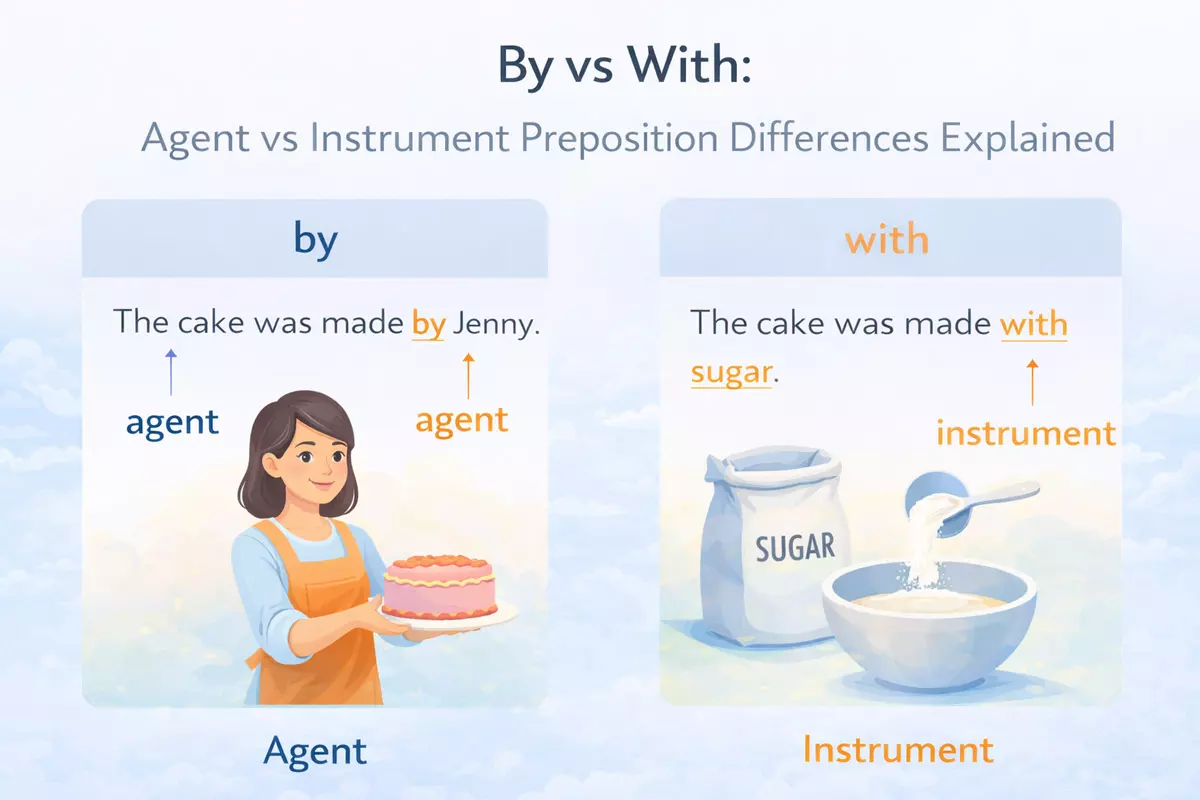
It’s important to distinguish by (for agents/doers) from with (for instruments/tools). For example, in “The letter was written by Sam with a pen,” by introduces the person who did the writing, while with introduces the object used to do it.
| Agent (by) | Instrument (with) |
|---|---|
| Written by the author | Written with a fountain pen |
| Painted by the artist | Painted with a brush |
| Opened by the manager | Opened with a key |
| Cut by the chef | Cut with a sharp knife |
| Composed by Mozart | Composed with a piano |
To sum up, by in passive sentences introduces the agent or doer, while with points to the tool or means used. Recognizing this difference helps you construct clear, natural passive sentences in English.
Instrument and tool meaning of with
In English, the preposition with is commonly used to indicate the tool, instrument, or means by which an action is performed. This use is distinct from indicating the agent of an action (often marked by by), and it helps clarify what physical object or method was involved in carrying out the event. When you see with in this context, it usually answers the question "What did you use?" rather than "Who did it?"
How with works to show instruments and tools
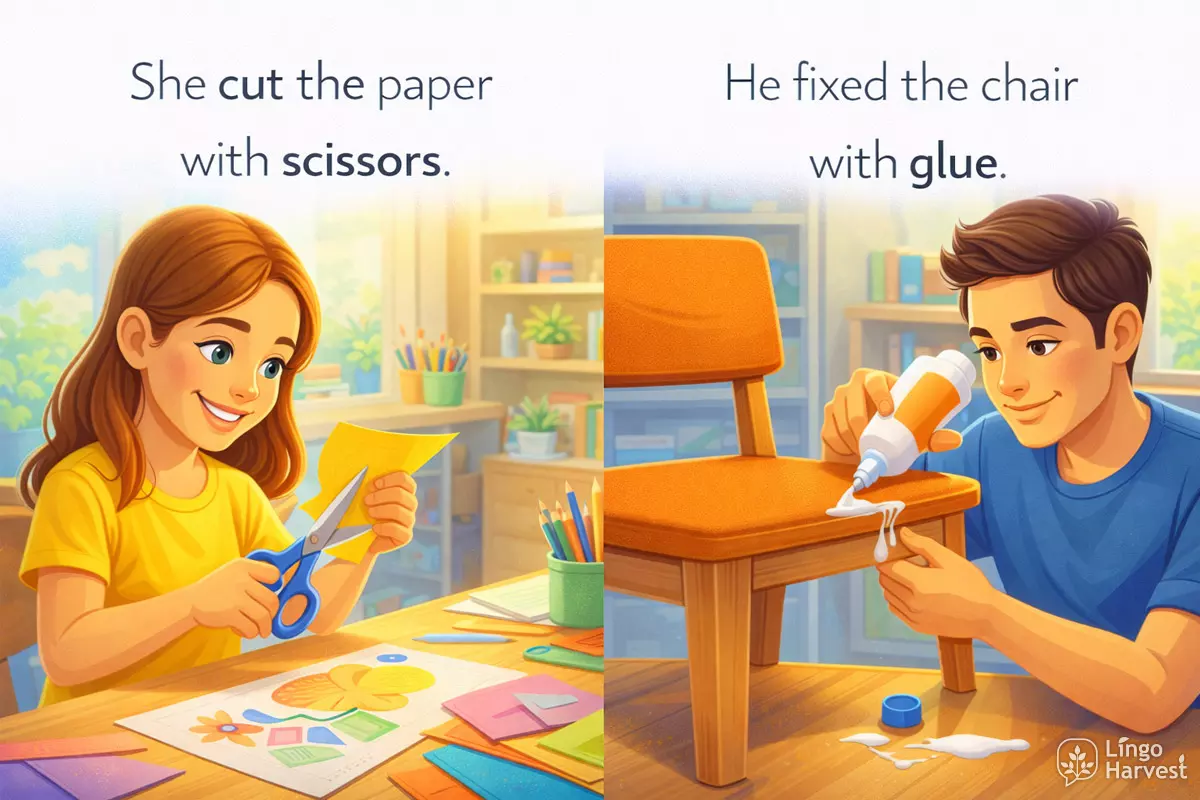
When describing how something is done, with introduces the object that enables or assists the action. This application is especially common in both spoken and written English, making it a core part of everyday communication. Here are some typical examples:
- She cut the paper with scissors.
- He fixed the chair with glue.
- The artist painted with a fine brush.
- They unlocked the door with a key.
- You can write with a pen or a pencil.
- The chef sliced the bread with a sharp knife.
- She measured the flour with a cup.
- The child drew on the wall with crayons.
- We stirred the soup with a wooden spoon.
- He hammered the nail with a rock.
- The dentist examined the tooth with a mirror.
- They communicated with sign language.
Patterns and typical sentence structure
The usual pattern is: Subject + verb + object + with + instrument/tool. Here, with introduces what was used to accomplish the action.
- She opened the can with a can opener.
- The window was cleaned with a cloth.
- He wrote the message with his left hand.
Instrument vs. agent: quick comparison
To clarify the difference between with (for instruments) and by (for agents), see the examples below:
| Action | Instrument/Tool (with) | Agent (by) |
|---|---|---|
| The cake was cut | with a knife | by the chef |
| The letter was written | with a pen | by Sarah |
| The picture was painted | with watercolors | by the artist |
| The door was unlocked | with a key | by the janitor |
| The window was broken | with a stone | by the children |
In summary, using with to specify the tool or method emphasizes how something is done, rather than who does it. This distinction is central to clear and precise English communication, especially when describing processes, actions, or instructions.
How by and with work in action descriptions
Understanding the difference between “by” and “with” is crucial when describing how actions are performed. These prepositions often clarify whether we’re talking about the person (or agent) performing the action, or the tool (or instrument) used. Choosing the right word helps accurately convey who or what is responsible for an action and how it was carried out.
“By”: Emphasizing the Agent
When we use “by,” we typically identify the doer of the action. This is common in passive sentences, where the focus is on the action itself rather than the subject. For example, “The cake was baked by Maria.” Here, “by Maria” tells us who performed the action. “By” can also be used for methods or means, but most often it pinpoints the responsible agent.
- The letter was written by Sam. ✅
- The painting was created by a famous artist.
- The project was completed by the team.
- The house was built by my grandfather.
- The decision was made by the committee.
“With”: Highlighting the Instrument
“With” usually introduces the tool, object, or means used to perform an action. It answers the question “using what?” rather than “by whom?” For instance, “She cut the bread with a knife.” In this case, “with a knife” shows what was used, not who did it.
- He opened the door with a key. ✅
- She wrote with a pen.
- The artist painted with watercolors.
- They fixed the machine with some tools.
- The child drew with crayons.
Comparison of Usage Patterns
To make the distinction clearer, here’s a structured comparison of how these prepositions function in typical action descriptions:
| Preposition | What it shows | Example |
|---|---|---|
| By | The agent (doer) of the action | The song was sung by the choir. |
| With | The instrument or tool used | The song was sung with passion. |
| By | Method or means (sometimes) | She traveled by train. |
| With | Accompaniment or manner | She traveled with her family. |
Key Takeaways for Action Descriptions
- Use “by” to indicate who performed the action.
- Use “with” to specify what was used to perform the action.
- “By” is essential in passive voice constructions to name the agent.
- “With” is used for instruments, tools, or company.
- Confusing these can lead to ambiguous or awkward sentences.
Grasping the distinction between these prepositions ensures your action descriptions are both clear and precise, making your communication more effective.
Using by with transport and travel phrases
When talking about how we travel or the means of transport, English usually uses "by" to indicate the method. This preposition helps specify the general way someone gets from one place to another, such as "by train," "by car," or "by bicycle." It's important to note that "by" is used for modes of transport without an article or possessive (not "by the bus," but "by bus").
Common patterns with "by" for transportation

"By" is most natural when you want to express the method of travel in a broad sense. Here are some typical phrases:
- by bus → We usually go to work by bus.
- by train → They travelled to Paris by train.
- by plane → She arrived in Canada by plane.
- by car → We drove to the beach by car.
- by taxi → He got to the airport by taxi.
- by bicycle → She goes to school by bicycle.
- by tram → We explored the city by tram.
- by subway → I commute by subway every day.
- by boat → They crossed the river by boat.
- by ferry → We travelled to the island by ferry.
- by motorcycle → He toured the country by motorcycle.
- by helicopter → They reached the mountain base by helicopter.
- by ship → The goods were transported by ship.
- by scooter → She goes around town by scooter.
- by metro → Many people travel by metro in big cities.
When not to use "by"
There are cases where "by" isn't appropriate. If you talk about a specific vehicle or add a possessive or article, use "in" or "on" instead:
- Correct: I came by bus.
- Incorrect: I came by the bus. ❌
- Correct: I came on the bus.
- Correct: We travelled by plane.
- Incorrect: We travelled by my car. ❌
- Correct: We travelled in my car.
Comparing "by" and "with" in travel contexts
"With" is not used for the means of transport itself, but might describe the company or objects brought along (e.g., "with my friends," "with luggage"). To clarify the difference, see the table below:
| Phrase with "by" | Phrase with "with" |
|---|---|
| by train | with my family |
| by taxi | with a suitcase |
| by boat | with a friend |
| by motorcycle | with a helmet |
| by plane | with a pet |
| by bus | with a ticket |
Summary
For modes of transport, "by" is the usual preposition, while "with" describes companions or items. Remember: use "by" for the method, and avoid articles or possessives with it. This small difference makes your English sound more natural and precise when discussing travel.
Typical confusion in learner writing and speech
Learners often mix up “by” and “with” when describing who does something versus what tool or means is used. This confusion leads to mistakes that can sound unnatural or even change the meaning. The root of these issues is understanding the difference between indicating the agent (the doer) and the instrument (the thing used).
Common mistake patterns
- Using “by” instead of “with” for instruments:
I opened the door by a key ❌ (should be with a key ✅) - Mixing up the agent and the tool:
The cake was made with Mary ❌ (should be by Mary ✅) - Overusing “by” for any means or method:
He wrote the letter by a pen ❌ (should be with a pen ✅) - Using “with” to mean the person who does the action:
The story was told with my grandfather ❌ (should be by my grandfather ✅)
Why these errors happen
Learners’ native languages might use only one preposition for both agent and instrument, or they may translate literally. Some also assume “by” always means “using,” and “with” always means “together,” leading to confusion.
Typical sentences learners get wrong
- The window was broken by a stone ❌ (should be: with a stone ✅)
- The song was sung with Anna ❌ (should be: by Anna ✅)
- The message was sent by email ✅ (correct for method, but can be confused with instrument)
- The picture was drawn by a pencil ❌ (should be: with a pencil ✅)
- The door was closed by the wind ✅ (correct, when the wind is the agent)
- The soup was eaten by a spoon ❌ (should be: with a spoon ✅)
- The house was built with John ❌ (should be: by John ✅)
- The answer was written by a blue pen ❌ (should be: with a blue pen ✅)
- The room was cleaned by a vacuum cleaner ❌ (should be: with a vacuum cleaner ✅)
- The book was read with my mother ❌ (should be: by my mother ✅)
Comparison of uses
| Preposition | Typical Role | Example (Correct) | Example (Incorrect) |
|---|---|---|---|
| by | Agent (the doer) | The cake was made by Anna. | The cake was made by a spoon. ❌ |
| with | Instrument (the tool) | The cake was made with a spoon. | The cake was made with Anna. ❌ |
| by | Means/method (sometimes correct) | The letter was sent by email. | The letter was sent by a pen. ❌ |
| with | Companion (not agent!) | I went to the park with Anna. | The song was sung with Anna. ❌ |
Quick tips to avoid confusion
- Use by for the person, animal, or force that acts.
- Use with for the object or tool used to do something.
- If you are talking about a means (like “by bus”), check if it is a method, not a tool.
- When in doubt, ask: “Who did it?” (use by), or “What was used?” (use with).
Practice: change active sentences to passive using by and with
Understanding how to transform active sentences into passive voice helps highlight the difference between agents (who does the action) and instruments (what is used to do it). When changing sentences, "by" introduces the person or thing performing the action, while "with" introduces the object or tool used. Below, you'll find practice activities and explanations to help you master these structures.
How to Decide: By or With?
- By is used for the agent — the person or thing that does the action.
- With is used for the instrument, tool, or means by which the action is done.
- Sometimes, both can appear in one passive sentence for clarity.
Example Transformations
- Active: The chef prepared the meal.
Passive: The meal was prepared by the chef. - Active: She opened the door with a key.
Passive: The door was opened with a key (agent is not mentioned). - Active: The artist painted the mural with a brush.
Passive: The mural was painted by the artist with a brush.
Structured Practice: Convert the Sentences
Change the following active sentences to passive. Decide if you need "by" (agent), "with" (instrument), or both.
- Tom fixed the car with a wrench.
- The wind broke the window.
- Maria wrote the letter with a blue pen.
- The gardener trimmed the bushes with electric shears.
- The teacher explained the lesson.
- They built the bridge with steel beams.
- Lightning started the fire.
- The cat caught the bird with its claws.
- The scientist measured the temperature with a thermometer.
- Someone stole the painting.
- He cleaned the floor with a mop.
- The manager signed the contract.
- She decorated the cake with icing.
- The mechanic repaired the engine with special tools.
- The author wrote the novel.
- They locked the door with a padlock.
- The children drew pictures with crayons.
- The company shipped the goods by truck.
- The nurse checked the pulse with a stethoscope.
- The artist sculpted the statue from marble.
Show answers
- The car was fixed by Tom with a wrench.
- The window was broken by the wind.
- The letter was written by Maria with a blue pen.
- The bushes were trimmed by the gardener with electric shears.
- The lesson was explained by the teacher.
- The bridge was built by them with steel beams.
- The fire was started by lightning.
- The bird was caught by the cat with its claws.
- The temperature was measured by the scientist with a thermometer.
- The painting was stolen (agent unknown or not mentioned).
- The floor was cleaned by him with a mop.
- The contract was signed by the manager.
- The cake was decorated by her with icing.
- The engine was repaired by the mechanic with special tools.
- The novel was written by the author.
- The door was locked by them with a padlock.
- Pictures were drawn by the children with crayons.
- The goods were shipped by the company by truck.
- The pulse was checked by the nurse with a stethoscope.
- The statue was sculpted by the artist from marble.
Summary Table: Passive Voice with By and With
| Active Sentence | Passive (by: agent) | Passive (with: instrument) |
|---|---|---|
| John cut the bread with a knife. | The bread was cut by John. | The bread was cut with a knife. |
| The decorator painted the wall with a roller. | The wall was painted by the decorator. | The wall was painted with a roller. |
| The engineer measured the distance with a tape. | The distance was measured by the engineer. | The distance was measured with a tape. |
| The boy broke the window with a stone. | The window was broken by the boy. | The window was broken with a stone. |
| The chef made the soup with fresh vegetables. | The soup was made by the chef. | The soup was made with fresh vegetables. |
By practicing these changes, you can better distinguish when to use "by" for agents and "with" for instruments, making your passive constructions more precise and natural.