Like vs As: Comparing Roles and Usage Differences in English

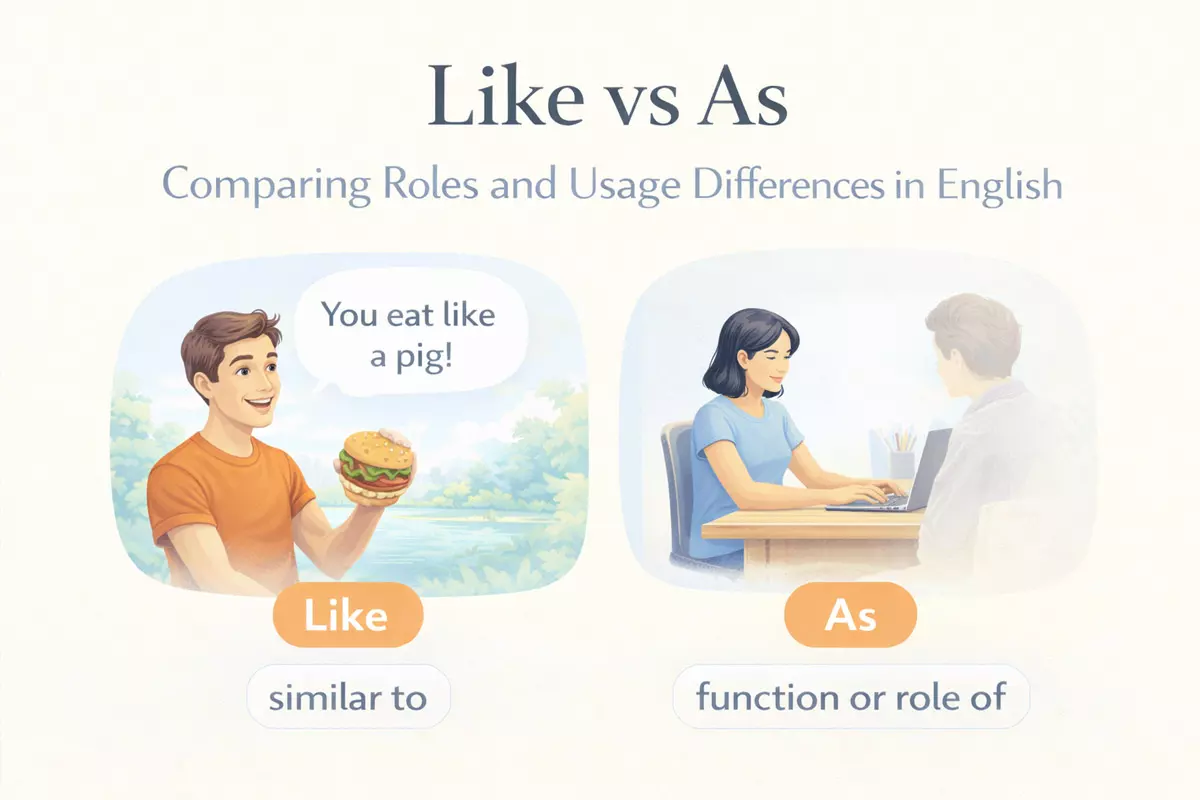 The article details how like and as differ when expressing similarity or role, outlines key grammar rules, and lists common fixed phrases.
English learners frequently struggle to choose between two small yet important words that have distinct functions in sentences. Mastering the correct usage of these similar terms is essential for clear and accurate communication. By learning the differences and practicing their proper application, you can express your ideas more precisely and minimize common errors that may confuse your listeners or readers. This attention to detail not only improves your language skills but also boosts your confidence when using English in various situations.
Core difference between similarity and role
Understanding how “like” and “as” function in English depends on recognizing whether you’re expressing a resemblance or describing a specific function or position. While both words compare things, they serve distinct purposes in sentences.
When you use “like”, you’re drawing a comparison between two things that are not the same, but share similar qualities. It’s about showing resemblance or likeness. For example, “She sings like a professional” means her singing is similar to that of a professional, but she isn’t actually one.
On the other hand, “as” is used to indicate the actual role, function, or capacity in which someone or something is acting. It describes the real position or job. For instance, “She works as a teacher” means teaching is truly her profession, not just a comparison.
Usage patterns: resemblance vs. function
- Like is common with nouns and pronouns for comparisons: “He runs like the wind.”
- As often introduces clauses or refers to real roles: “Do as I say.” / “She acted as leader.”
- “Like” never means “in the role of.”
- “As” is rarely used for simple similarity.
- “Like” is informal in some structures; “as” is preferred in formal writing for functions.
Quick comparison table
| Usage | Example | Meaning |
|---|---|---|
| “like” (showing similarity) | He swims like a fish. | He swims very well (similar to a fish). |
| “as” (showing role/capacity) | He works as a chef. | His job is chef (real position). |
| “like” + noun | She looks like her mother. | There is a resemblance. |
| “as” + clause | Do as you’re told. | Follow instructions (actual way). |
| Incorrect: “He works like a teacher” | ❌ (unless he isn’t really a teacher) | Only use “like” if it’s not his real job. |
Typical mistakes to avoid
- Using “like” when describing someone’s real profession or function.
- Using “as” for basic comparisons of appearance or manner.
- Confusing role with resemblance, especially in formal writing.
To sum up, “like” draws parallels based on similarity, while “as” defines true roles or functions. Choosing the right word helps make your meaning clear and precise in English.
Grammar rule: as before clauses vs like before nouns
Understanding when to use “as” and when to use “like” can help make your English sound more natural and precise. The main distinction lies in what follows each word. “As” typically introduces a clause—a group of words containing a subject and verb. In contrast, “like” is used before a noun, pronoun, or noun phrase, not a full clause.
“As” for Clauses
Use “as” when what follows could stand as a complete sentence on its own. This is common when you want to compare actions, situations, or jobs in the same way something else is done. For example:
- He sings as she does. (full clause: “she does”)
- Do it as we discussed. (clause: “we discussed”)
- She works as her mother did. (clause: “her mother did”)
“Like” for Nouns and Pronouns
“Like” should be used when you’re comparing something to a noun or pronoun, not a full clause. It sets up a simple comparison, often to show similarity in appearance, behavior, or quality. Examples include:
- He runs like a cheetah. (noun: “a cheetah”)
- She sings like her sister. (noun: “her sister”)
- The house looks like a castle. (noun: “a castle”)
Common Mistakes and Tips
People sometimes use “like” before a clause in informal speech, but in formal writing, this is considered incorrect. For clarity, remember:
- ✅ Correct: He did it as I expected. (clause)
- ❌ Incorrect: He did it like I expected.
Summary Table: “As” vs “Like” Usage
| Form | When to Use |
|---|---|
| as + subject + verb (clause) | To compare actions, jobs, or situations using a full clause Example: “She dances as he does.” |
| like + noun/pronoun/noun phrase | To compare directly to a person, thing, or quality (no verb) Example: “He eats like a child.” |
| as + noun (in job titles or roles) | To describe someone’s role or function Example: “She works as a teacher.” |
| like + prepositional phrase | To show similarity with more detail Example: “He talks like his father at meetings.” |
Quick Reference: Usage Patterns
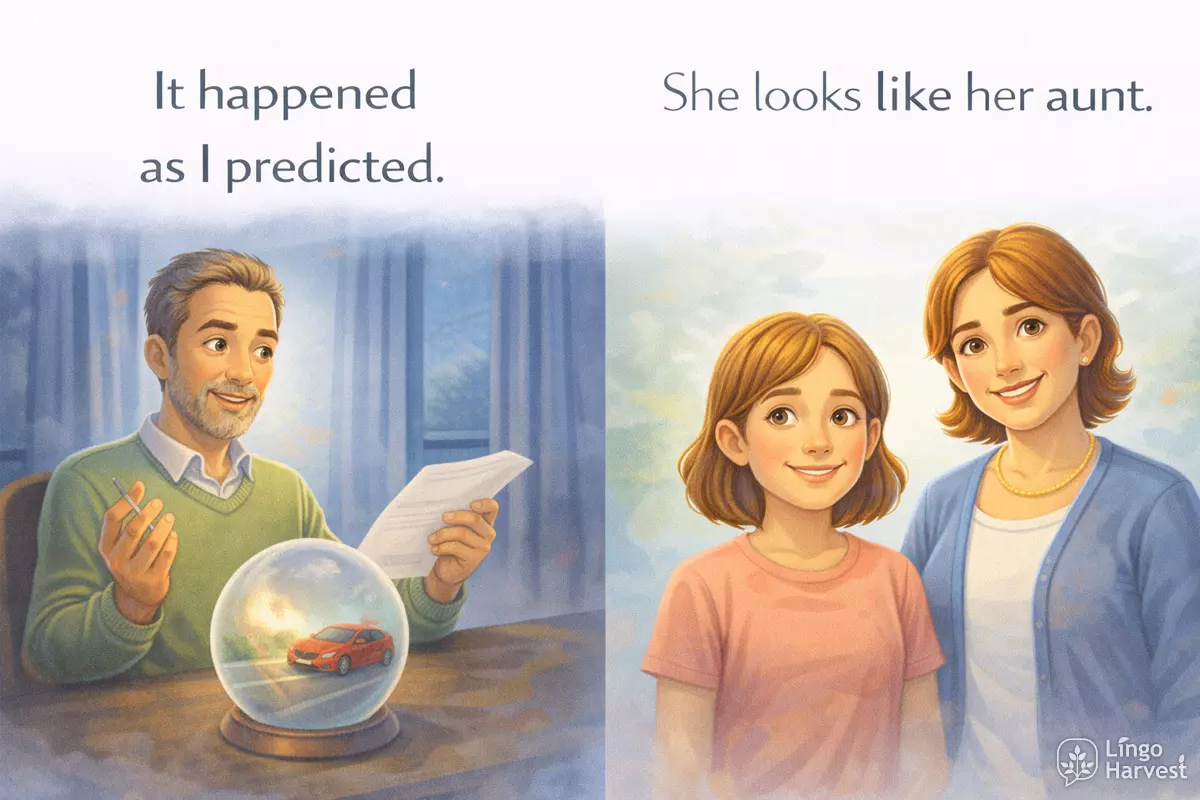
Here are more examples to help clarify the difference:
- It happened as I predicted. → (clause)
- She looks like her aunt. → (noun)
- Do it as we agreed. → (clause)
- He fought like a lion. → (noun)
- They acted as professionals do. → (clause)
- She smiled like a movie star. → (noun)
- He works as a manager. → (role/job)
- It sounds like a plan. → (noun phrase)
- Finish the task as instructed. → (clause)
- They move like dancers. → (noun)
Mastering this difference will make your comparisons clearer and your English more accurate.
Common fixed phrases with like and as
Many everyday expressions in English rely on set phrases that use "like" and "as" in particular ways. Understanding these can help you sound more fluent and avoid confusion, since their meaning is often idiomatic or non-literal.
Frequently used expressions with "like"
"Like" is common in similes and comparisons, but it also appears in fixed expressions that don’t always follow strict grammar rules. Here are some widely used phrases:
- Like clockwork (very regularly or predictably)
- Like father, like son (children resemble their parents)
- Like a fish out of water (feeling uncomfortable or out of place)
- Like a bull in a china shop (clumsy or careless in a delicate situation)
- Like wildfire (spreading very quickly)
- Like water off a duck’s back (not affected by criticism or insults)
- Like pulling teeth (very difficult or unpleasant)
- Like there’s no tomorrow (with great energy or urgency)
- Like the back of my hand (very familiar)
- Like a broken record (repeating the same thing over and over)
- Like a house on fire (getting along very well or very quickly)
Common idioms and patterns with "as"
"As" is often used in fixed comparisons or to describe roles, qualities, or conditions. Many set phrases use a specific structure:
- As soon as (immediately when)
- As far as I know (to the best of my knowledge)
- As well as (in addition to)
- As long as (provided that / for the duration)
- As a rule (generally, usually)
- As if / as though (suggesting something appears to be the case)
- As good as (almost or practically)
- As much as (to the same degree)
- As for (regarding, concerning)
- As a matter of fact (actually, in fact)
- As usual (in the normal way)
- As a result (therefore, consequently)
Comparing usage in set expressions
Sometimes, the choice between "like" and "as" changes the meaning or grammatical structure. Here are a few examples that highlight the difference:
| Phrase with "like" | Phrase with "as" |
|---|---|
| He acts like a manager. (He behaves similarly, but isn’t a manager.) |
He acts as a manager. (He performs the role of a manager.) |
| It looks like rain. (It appears that it might rain.) |
As is often the case... (Describing a typical situation.) |
| Sing like a bird. (Sing in a similar way to a bird.) |
As you wish. (Do as you desire.) |
| He eats like a horse. (He eats a lot.) |
As always. (In the usual way.) |
These fixed forms are worth learning as whole units, since their structure and meaning don’t always follow simple rules. Practice using them in conversation to build natural fluency.
Register differences in spoken and written English
When comparing "like" and "as," the way these words are used can shift considerably depending on whether communication is informal or formal, and whether it is spoken or written. Context and register play a big role in determining which is more appropriate.
Common choices in conversation
In everyday speech, "like" often substitutes for "as" or "as if," especially in informal registers. This is typical in casual dialogue, where strict adherence to grammatical rules is less important. Some examples you might hear include:
- It looks like it’s going to rain. (instead of "as if")
- Do it like I showed you. (instead of "as I showed you")
- She sings like a professional. (comparison)
- He acted like he didn’t care. (meaning "as if")
- They worked like crazy. (informal expression)
- Just do it like this. (instructional, casual)
- I feel like I’m forgetting something. (meaning "as if")
- Talk to him like you would to a friend. (simile)
- It sounds like a good idea. (impression or assumption)
- He looked at me like I was crazy. (informal narrative)
Patterns in formal and written English
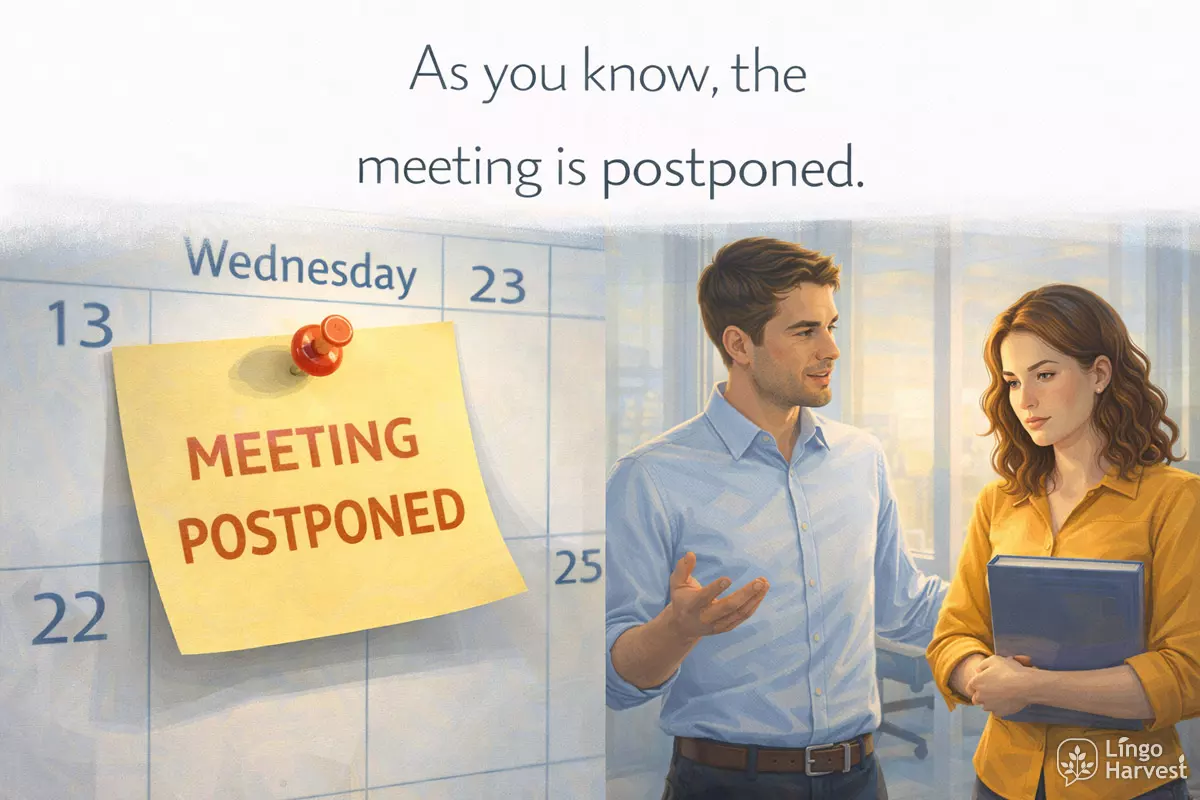
For more formal or academic writing, "as" is generally preferred when introducing clauses, especially after verbs and prepositions. Using "like" in these contexts is often considered nonstandard. "As" is also used for roles and functions:
- She works as a teacher. (role or job)
- Do it as I showed you. (manner, introducing a clause)
- As you know, the meeting is postponed. (introducing a clause)
- He acted as if nothing had happened. (hypothetical)
- She spoke as a representative of the company. (capacity or role)
- As mentioned earlier, this is important. (referring back in text)
- He was employed as a consultant. (function/job)
- As far as I can tell, it’s correct. (set phrase)
- She did it as requested. (following instructions)
- As is often the case, he was late. (typical pattern)
Quick comparison: informality vs. formality
| Spoken/Informal Usage | Written/Formal Usage |
|---|---|
| He looks like he needs help. ✅ | He looks as if he needs help. ✅ |
| Do it like I told you. ✅ | Do it as I told you. ✅ |
| I feel like I’m getting sick. ✅ | I feel as if I’m getting sick. ✅ |
| She works like a teacher. ❌ (incorrect for role) | She works as a teacher. ✅ |
| It happened like I expected. ❌ (nonstandard) | It happened as I expected. ✅ |
Summary points
- In informal contexts, "like" is flexible and often replaces "as" or "as if" in speech.
- Formal writing values precision; "as" is required for roles, clauses, and comparisons involving actions.
- Using "like" for roles ("She works like a teacher") is nonstandard in writing.
- Native speakers often mix these forms in speech, but written standards remain stricter.
Typical mistakes with as a vs like a
Many English learners confuse “as a” and “like a” because both can introduce comparisons or roles, but their usage rules differ. Mixing them up can result in awkward or incorrect sentences, especially when describing jobs, functions, or making similes.
Common Confusion Points
- Using “like a” when describing a real role or job: Incorrect: She works like a teacher. ❌ Correct: She works as a teacher. ✅
- Using “as a” for similarity instead of actual identity: Incorrect: He runs as a cheetah. ❌ Correct: He runs like a cheetah. ✅
- Replacing “as a” with “like a” in formal writing: Incorrect: I acted like a spokesperson. ❌ Correct: I acted as a spokesperson. ✅
- Forgetting that “like a” is used for comparisons, not functions or jobs.
- Using “as a” for metaphorical comparisons, which makes the sentence sound unnatural.
Quick Comparison Table
| Expression | Correct Usage Example | When to Use |
|---|---|---|
| as a | She works as a doctor. | Describing real jobs, roles, or official capacities |
| like a | He sings like a professional. | Making comparisons, showing similarity |
| as a | I acted as a guide. | Temporary or actual function/role |
| like a | She eats like a bird. | Metaphorical or figurative comparison |
Examples of Mistakes and Corrections
- He works like a manager. ❌ → He works as a manager. ✅
- She dances as a ballerina. ❌ → She dances like a ballerina. ✅
- I spoke like a representative. ❌ → I spoke as a representative. ✅
- They acted like referees. ❌ → They acted as referees. ✅
- He runs as a rabbit. ❌ → He runs like a rabbit. ✅
- She works as a machine. ❌ → She works like a machine. ✅
- He serves like a waiter. ❌ → He serves as a waiter. ✅
- She teaches like a professor (if she is a professor). ❌ → She teaches as a professor. ✅
- I acted like a judge (if you performed the official role). ❌ → I acted as a judge. ✅
- He sings as an angel. ❌ → He sings like an angel. ✅
Tips to Avoid These Errors
- Use “as a” for actual roles, jobs, or identities.
- Use “like a” for comparisons or to describe similarities.
- Double-check if you mean a literal role (choose “as a”) or a way of doing something (choose “like a”).
- If you can replace the phrase with “in the role of,” use “as a.”
- If you can replace it with “similar to,” use “like a.”
By keeping these patterns and guidelines in mind, you can avoid the most common slip-ups and communicate your meaning more clearly.
Practice: correct and improve comparison sentences
Understanding how to use "like" and "as" accurately helps you express comparisons more clearly. In this section, you'll work with common mistakes and see how to improve sentences for better clarity and correctness. The following exercises focus on identifying errors and rewriting sentences to match standard English usage.
Spot and Fix the Errors
Review each sentence below. Decide if "like" or "as" is used correctly, and rewrite the sentence if needed.
- He works like a doctor.
- She sings as a professional singer.
- They acted like they didn’t care.
- We should do it as you suggested.
- He talks as his father does.
- It looks as rain.
- She runs like the wind.
- Use this tool like I showed you.
- He did it as a joke.
- The teacher explained it like a scientist.
Show answers
- ❌ He works like a doctor. → He works as a doctor.
- ❌ She sings as a professional singer. → She sings like a professional singer.
- ✅ They acted like they didn’t care.
- ✅ We should do it as you suggested.
- ✅ He talks as his father does.
- ❌ It looks as rain. → It looks like rain.
- ✅ She runs like the wind.
- ❌ Use this tool like I showed you. → Use this tool as I showed you.
- ✅ He did it as a joke.
- ✅ The teacher explained it like a scientist.
Common Patterns with "Like" vs "As"
Below is a structured overview of typical sentence patterns. Note when each word is appropriate:
| Pattern | Example Sentence |
|---|---|
| as + noun (job/role) | She works as a nurse. |
| like + noun (comparison) | He swims like a fish. |
| as + subject + verb | Do it as I told you. |
| like + pronoun/noun + verb | He looks like his father. |
| as + prepositional phrase | As in the past, we met at noon. |
| like + situation/condition | It feels like summer. |
Rewrite for Precision
Try rewriting these sentences to make them clear and grammatically correct:
- He acted as his brother.
- She looks as her mother.
- They used the box as a table.
- He sings like a professional.
- Do it like I do.
- She works as a manager.
- He behaves like a child sometimes.
- Use this room as an office.
- She talks like her teacher.
- Follow the instructions like the example shows.
Show answers
- He acted like his brother.
- She looks like her mother.
- They used the box as a table.
- He sings like a professional.
- Do it as I do.
- She works as a manager.
- He behaves like a child sometimes.
- Use this room as an office.
- She talks like her teacher.
- Follow the instructions as the example shows.
Practicing these distinctions will help you communicate more precisely and avoid common pitfalls when making comparisons in English.