About vs On: Clear Guide to Topic-Based Preposition Choice in English

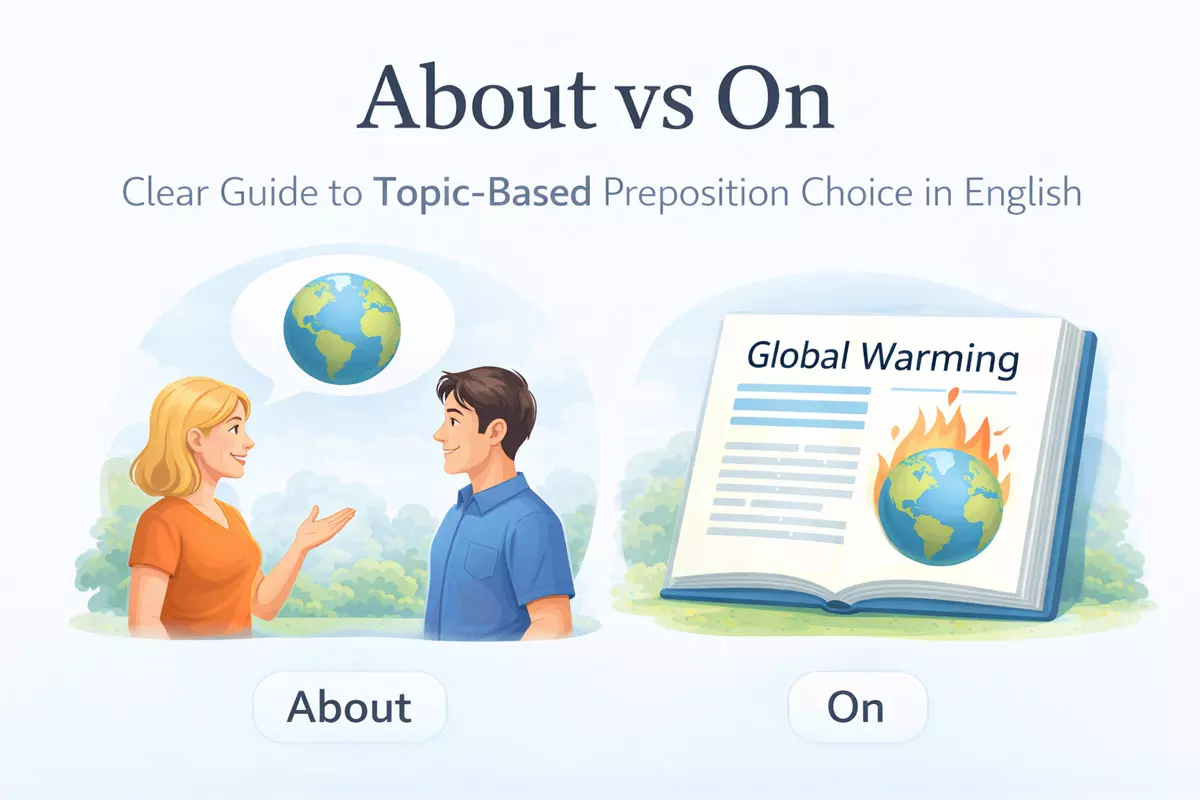 The article explains when to use about or on, showing how about introduces a general topic while on signals a focused subject. It covers usage with common verbs, academic versus casual language, real examples, and practical exercises.
Choosing the right preposition in English can be confusing, especially when several options seem possible. However, by paying close attention to the context and learning the specific uses of each preposition, you can improve both your accuracy and confidence in communication. Practice, exposure to real examples, and careful observation of how prepositions function in different sentences will gradually make the process easier. With time, you will be able to express your ideas more clearly and effectively.
When about suggests a general topic
The preposition about is often used to introduce a broad theme rather than a narrow, specific subject. When you say something is "about" a topic, you’re usually referring to its general area or main idea, rather than focusing on precise details or technical aspects.
For example, if a book is described as "about history," it likely covers multiple historical themes, events, or periods, not just a single event or figure. This usage signals that the discussion, content, or explanation is not limited to one precise aspect but instead encompasses a wider scope.
Typical uses of "about" for general topics
- Conversations: "We talked about travel."
- Books and articles: "She wrote a book about gardening."
- Questions: "Can I ask you about your experience?"
- Lectures: "Today's lecture is about climate change."
- Documentaries: "The film is about wildlife conservation."
- Advice: "Let me give you some tips about studying."
- Interviews: "He was interviewed about his career."
- Stories: "This story is about hope and resilience."
- Reports: "The report is about market trends."
- Podcasts: "Their podcast is about personal finance."
- Meetings: "The meeting is about project updates."
- Surveys: "The survey is about customer satisfaction."
- Essays: "My essay is about the importance of exercise."
- Movies: "The movie is about friendship."
How "about" differs from "on"
While "about" covers a topic in a general way, "on" often implies a more focused or technical approach. For instance, "a lecture on quantum physics" is likely to be more specialized than "a talk about science." If you want to emphasize that the subject matter is broad, "about" is your best choice.
Choosing between these prepositions can subtly change how your audience perceives the scope of your topic, so use "about" when you want to highlight general coverage or an overview rather than specific details.
When on suggests a focused or formal subject
In English, the preposition "on" often signals that the topic is being discussed in a concentrated or more academic way. This usage is common in titles, presentations, academic writing, and situations where the subject matter is treated with a level of seriousness or depth. Choosing "on" instead of "about" can make your statement sound more precise or scholarly.
Academic and Professional Contexts
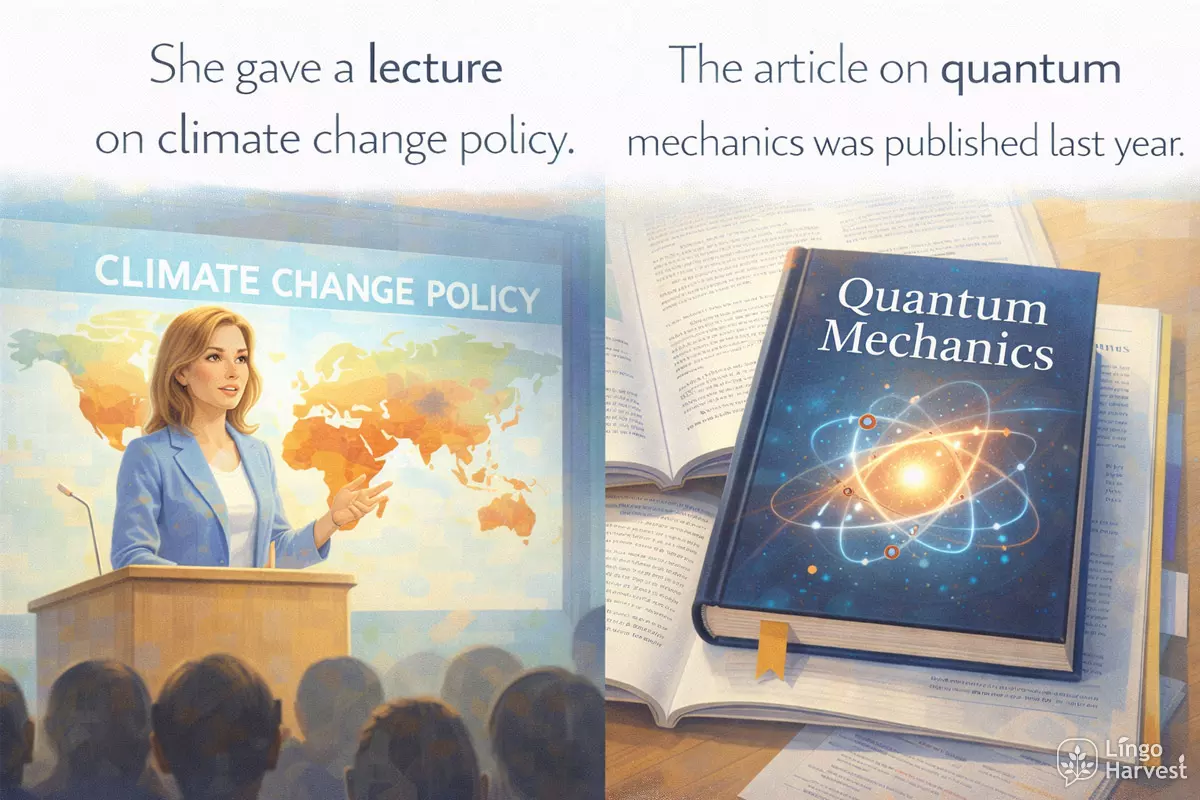
Writers and speakers frequently select "on" when naming lectures, essays, or articles that deal with a specific theme or issue. This choice gives the impression of a structured, in-depth examination rather than a casual overview.
- She gave a lecture on climate change policy.
- The article on quantum mechanics was published last year.
- He wrote a report on urban development strategies.
- There was a workshop on time management skills.
- The seminar on digital marketing attracted many professionals.
- Her thesis on medieval literature received high praise.
- The conference on artificial intelligence is next month.
- We had a discussion on ethical business practices.
- The documentary on ocean pollution was eye-opening.
- He delivered a speech on leadership in education.
Comparing "on" and "about" in Formality
The choice between "on" and "about" can subtly shift the tone. "About" is more conversational and broad, while "on" is typically reserved for situations demanding specificity or authority.
| Situation | More Formal (On) | Less Formal (About) |
|---|---|---|
| Academic presentation | Presentation on renewable energy | Talk about renewable energy |
| Written report | Report on urban transport | Write-up about city buses |
| Research paper | Paper on social media trends | Essay about Facebook |
| Lecture title | Lecture on genetic engineering | Talk about genes |
Key Takeaways
- Use "on" for focused or specialized subjects, especially in academic or formal settings.
- Titles and headings often favor "on" for clarity and emphasis.
- "On" can make your work sound more authoritative and structured.
- Switch to "about" for informal, conversational, or generalized statements.
This distinction helps you match your language to the context, ensuring your message fits the situation and audience.
Using about and on with talk, write, read, think
Understanding the difference between "about" and "on" with verbs like "talk," "write," "read," and "think" helps make your English more precise. Both prepositions connect your verb to a topic, but they don’t always mean exactly the same thing. Let’s look at how each one is used and how your choice can affect the meaning or formality of a sentence.
General Differences in Meaning
"About" is the more common preposition and is used for general topics or when discussing something in a broad way. "On" tends to sound a bit more formal or academic and is often used when the subject matter is specific, detailed, or when referring to the title or focus of a piece of writing.
Patterns and Examples with Common Verbs
- Talk about your day, the weather, a problem, your plans
- Talk on a subject (often for lectures: "She talked on climate change")
- Write about your experiences, a book, your family
- Write on a topic (often for essays or reports: "He wrote on modern architecture")
- Read about history, other cultures, famous people
- Read on a topic (sometimes means "continue reading": "Read on to find out more")
- Think about your future, a question, what to do next
- Think on (less common, more formal or old-fashioned: "Think on your mistakes")
Comparing Usage: Table of Typical Patterns
| Verb + about | Verb + on | Typical Context/Example |
|---|---|---|
| talk about | talk on | General conversation vs. formal lecture “Let’s talk about your ideas.” “He gave a talk on robotics.” |
| write about | write on | Personal stories vs. academic topics “She writes about travel.” “He wrote a paper on genetics.” |
| read about | read on | Learning in general vs. specific research “I read about whales.” “I read on the subject of marine biology.” |
| think about | think on | Everyday reflection vs. formal advice “Think about your answer.” “Think on this matter carefully.” |
Quick Tips
- Use about for informal, everyday topics.
- Choose on when discussing academic, official, or specific subjects.
- Some verbs strongly prefer one preposition: "think about" is much more common than "think on."
- Switching between "about" and "on" can subtly change the tone or focus of your message.
In summary, selecting between "about" and "on" with these verbs depends on how formal or focused you want to sound. Both can be correct, but context and nuance matter.
Differences in academic vs casual language
When choosing between "about" and "on" to introduce topics, the context—whether formal or informal—can strongly influence which preposition sounds natural. Academic English tends to favor precision and formality, often preferring "on" for paper titles, research, and lectures. Everyday conversation, by contrast, leans toward "about," which feels more relaxed and general.
Academic English: Formal Precision
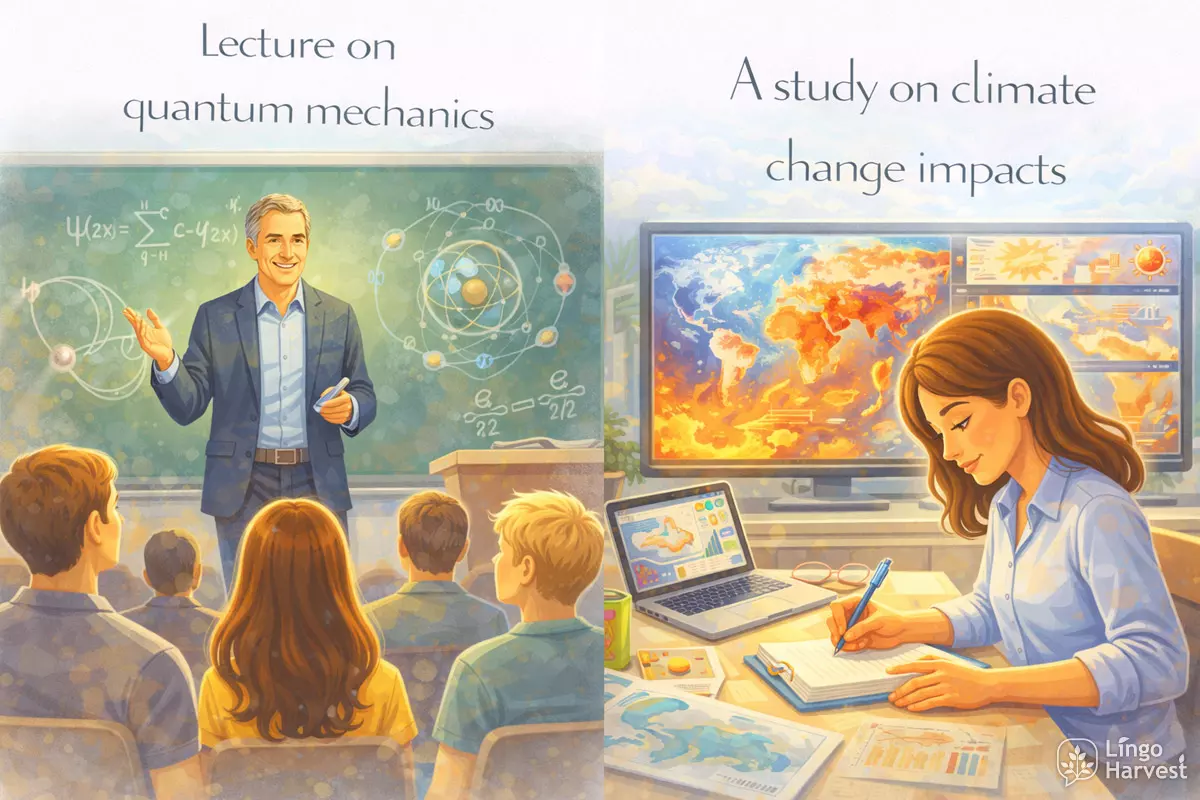
In scholarly settings, "on" is commonly used to signal a focused, in-depth treatment of a subject. For example:
- A lecture on quantum mechanics
- A study on climate change impacts
- An article on Renaissance art
- A conference on medical ethics
- A report on economic trends
Here, "on" conveys a direct, specific engagement with the topic, which fits academic expectations.
Casual English: Everyday Use
In informal speech and writing, "about" is the go-to choice for introducing subjects in a more general or conversational way. Examples include:
- Let’s talk about your weekend
- I read a book about space travel
- We had a discussion about our plans
- They’re chatting about movies
- She’s curious about the new app
"About" here suggests a broader, less formal approach—perfect for friendly exchanges.
Quick Comparison Table
| Academic/Formal Context | Casual/Informal Context |
|---|---|
| A paper on Shakespeare’s tragedies | A conversation about Shakespeare |
| A seminar on artificial intelligence | Talking about AI |
| A report on pollution levels | Chatting about pollution |
| A thesis on migration patterns | Stories about moving to a new city |
| A lecture on ancient history | Talking about the past |
Summary Points
- "On" is more formal, direct, and common in academic writing and professional presentations.
- "About" is flexible, informal, and fits everyday conversation.
- Choosing the right preposition helps match your language to the setting and audience.
Understanding these distinctions can help you sound more natural and appropriate—whether you’re writing a research paper or just chatting with friends.
Examples from presentations, emails and articles
Choosing between "about" and "on" when introducing topics can change the tone and clarity of communication. In professional and academic settings, both prepositions appear frequently, but their usage depends on context and the level of specificity required. Below you'll find a range of authentic sample sentences and patterns as they typically appear in talks, workplace correspondence, and published writing.
Common patterns in spoken and written communication
- Today's meeting is about our quarterly goals.
- The workshop on digital marketing starts at 10 a.m.
- I have a question about your last email.
- The article on climate change was very informative.
- Please send me the report on last month's sales.
- Her presentation is about effective teamwork.
- Let’s talk about project deadlines.
- He gave a lecture on renewable energy sources.
- I’d like some feedback on my proposal.
- This email is about tomorrow’s schedule.
- They published a study on workplace productivity.
- Our discussion about the budget was productive.
- She wrote a memo on new company policies.
- Let’s focus on the main issue.
- Do you have any comments about the attached file?
- The seminar on artificial intelligence was sold out.
- I’m writing about your recent request.
- The talk on leadership skills was inspiring.
- Please brief us on the current situation.
- She is concerned about the deadline.
Comparison: "about" vs "on" in context
The following table shows how each preposition shifts the focus or formality of topic statements in professional English. Notice that "about" is often broader or more conversational, while "on" is typically more specific or formal.
| Phrase with "about" | Phrase with "on" | Typical context |
|---|---|---|
| I'm writing about your application. | Report on your application status. | Email correspondence, formal updates |
| Let's talk about marketing plans. | Presentation on marketing strategy. | Meetings, presentations, internal memos |
| Discussion about budget cuts. | Seminar on financial management. | Roundtable talks, academic events |
| Questions about the new policy? | Paper on company policy changes. | Q&A, research articles |
| Concerned about the results? | Lecture on interpreting results. | Emails, training sessions |
Summary tips for choosing the right preposition
- Use about for general topics, feelings, or informal exchanges.
- Use on for formal topics, titles, or when emphasizing expertise or focus.
- Check the context: presentations and articles often prefer "on"; conversations and emails often use "about."
By observing these real-world examples, you can better tailor your language to fit the context, audience, and degree of formality required in English communication.
Practice: choose about or on in real-life scenarios
When using English in daily life, choosing between “about” and “on” depends on what you want to express: general subject versus specific focus. Let’s look at practical exercises and real contexts to strengthen your sense for the right preposition.
Quick Test: Which Preposition Fits?
For each sentence, decide if “about” or “on” is the better choice:
- We had a long discussion ___ climate change.
- She gave a lecture ___ modern architecture.
- This book is ___ the history of jazz.
- I watched a documentary ___ whales.
- Can you give me some advice ___ this problem?
- The article ___ page 12 covers the new law.
- He wrote a report ___ the company’s finances.
- They argued ___ who should be in charge.
- The podcast episode is ___ time management.
- We need information ___ the new schedule.
Show answers
- about
- on
- about
- about
- about
- on
- on
- about
- on
- about
Common Real-World Expressions: “About” vs. “On”
- Ask about plans
- Read about a celebrity
- Write an essay on climate policy
- Give a talk on mental health
- Complain about service
- Report on quarterly results
- Learn about a new topic
- Present findings on pollution
- Talk about your experience
- Focus on details
- Enquire about prices
- Comment on a post
- Worry about the future
- Work on a project
- Debate about a topic (less formal; “debate on” is also possible for formal contexts)
When to Use “About” vs. “On”: Structured Scenarios
| Scenario | Typical Preposition | Example Sentence |
|---|---|---|
| General conversation topic | about | We talked about our holidays. |
| Academic lecture or report | on | She gave a lecture on genetics. |
| Searching for information | about | I need some information about the event. |
| Publishing or presenting findings | on | The scientist published a paper on cell biology. |
| Giving advice or opinions | about | He asked for advice about his job. |
| Focusing on a narrow area | on | Let’s focus on the main issue. |
Mini-Quiz: Correct or Incorrect?
Decide if the preposition is correct (✅) or incorrect (❌). If incorrect, what would you use?
- He wrote an article about renewable energy.
- She gave a speech about the environment.
- I read a report on the city’s traffic problems.
- We had a meeting on our next project.
- Can you tell me on your experience?
- They published a study on climate change.
- He talked about his plans for the future.
- She wrote a book on modern architecture.
- We discussed about the issue for hours.
- The professor lectured on ancient history.
- I need advice on this matter.
- He spoke on his childhood memories.
Show answers
- ✅ Correct
- ✅ Correct
- ✅ Correct
- ✅ Correct
- ❌ Incorrect – should be “about your experience”
- ✅ Correct
- ✅ Correct
- ✅ Correct
- ❌ Incorrect – should be “discussed the issue” or “discussed the issue” (no preposition)
- ✅ Correct
- ✅ Correct
- ❌ Incorrect – should be “about his childhood memories”
Practicing with real examples and scenarios will help you internalize the difference between “about” and “on,” making your English sound more natural and precise.