Near vs Next to vs Close to: Understanding Distance Prepositions Easily

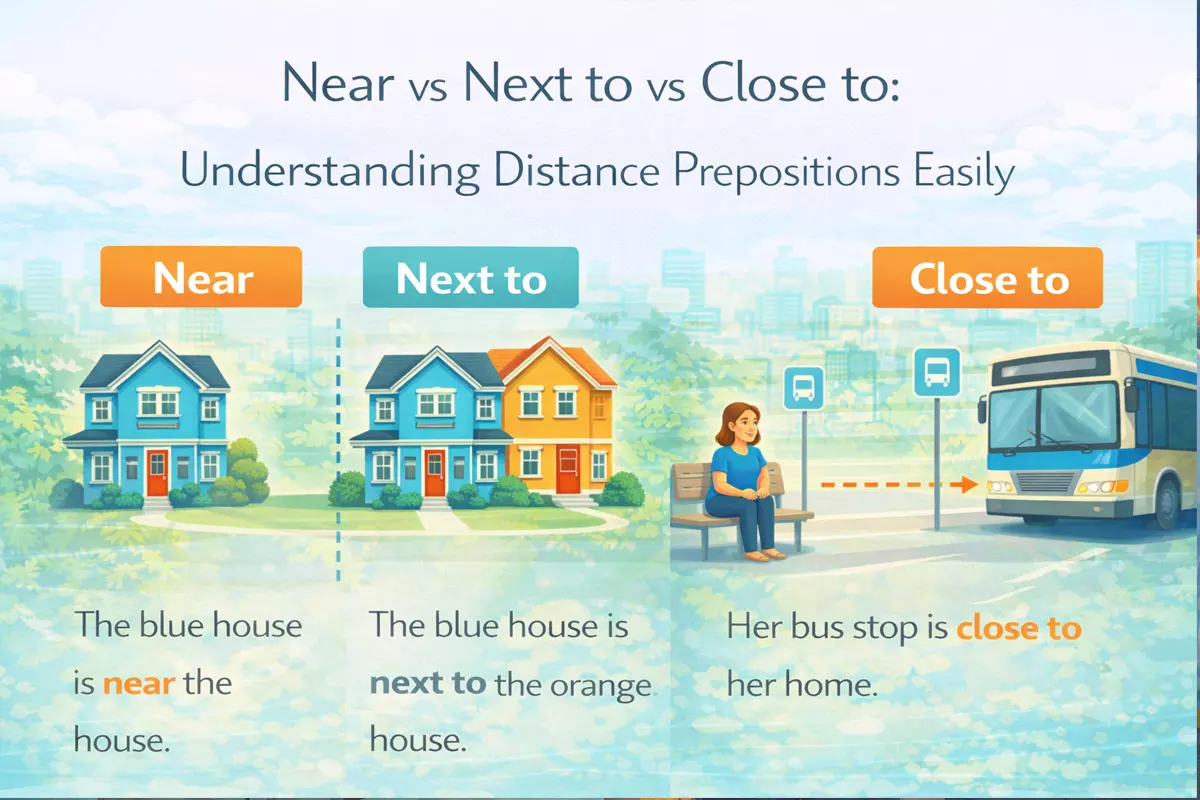 The article explains how near shows general closeness, next to means exact adjacency, and close to allows flexible distance. It covers common phrases, usage in directions and descriptions, and includes practice describing rooms or maps.
Understanding how to express physical proximity in English is essential for clear and precise communication. Words like near, close to, next to, beside, and adjacent all describe spatial relationships but carry slightly different meanings. For example, next to and beside usually mean something is immediately at the side of another object, while near and close to suggest a short distance without necessarily being directly alongside. Using the right term helps you convey exactly how things are positioned relative to each other.
How near expresses general closeness
"Near" is commonly used to indicate that something is generally close but not necessarily right beside another object or place. Unlike "next to," which implies immediate adjacency, "near" suggests a flexible, undefined distance—close enough to be relevant, but with some space in between. This makes "near" suitable for both physical and abstract contexts, such as locations, relationships, or even time.
Flexible use of "near" in sentences
The preposition "near" can describe proximity in a way that doesn't specify exact measurements. It is often chosen when the speaker wants to express that two objects or places are within a convenient or noticeable distance of each other, without emphasizing direct contact.
- The library is near the park.
- They live near the city center.
- There’s a bus stop near my house.
- My office is near the river.
- We sat near the window.
- Her birthday is near mine.
- He stood near the entrance.
- The school is near a supermarket.
- She works near the airport.
- The hotel is near the station.
- Our seats are near the stage.
- The restaurant is near the cinema.
General characteristics of "near"
- Implies closeness, but not touching.
- Distance is relative, not fixed.
- Can refer to time or relationships, e.g., "near the end" or "near to someone emotionally."
- Works with both physical and abstract nouns.
Comparing "near" with related prepositions
| Preposition | Typical Meaning | Example |
|---|---|---|
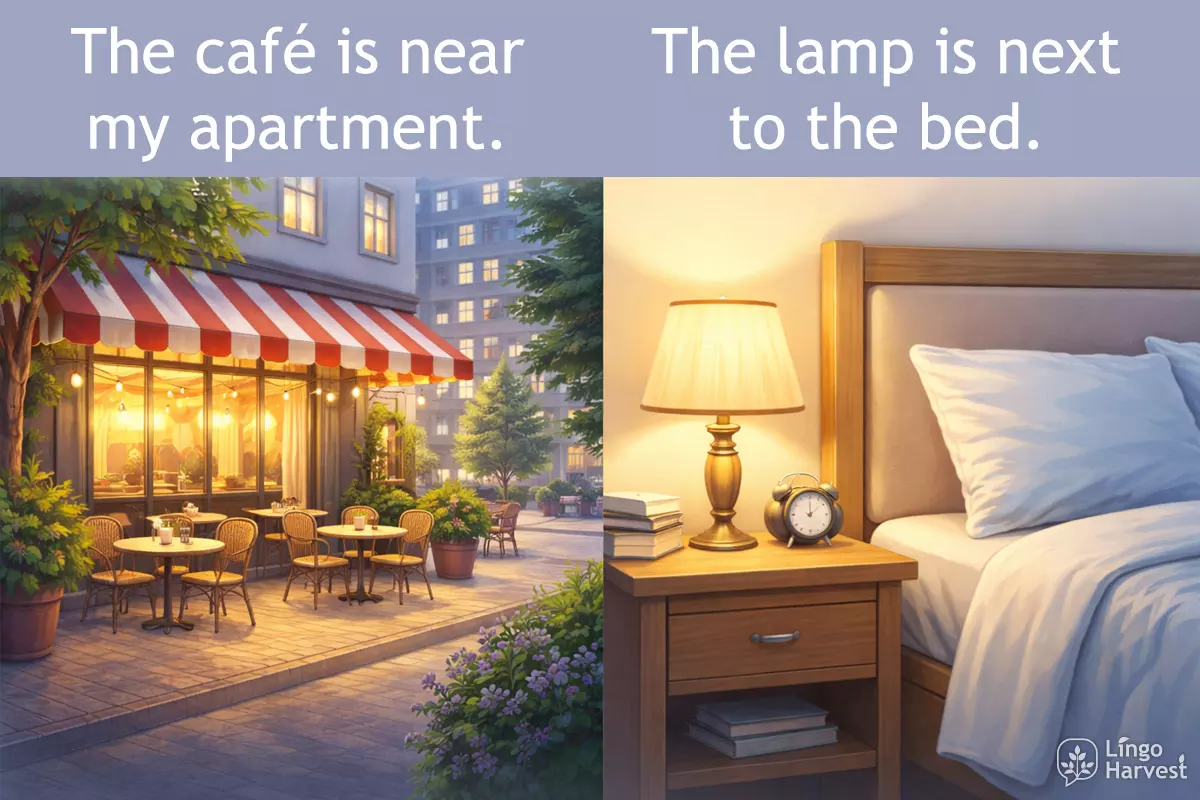
| Near | General proximity; not necessarily touching | The café is near my apartment. |
| Next to | Immediately beside; no space in between | The lamp is next to the bed. |
| Close to | Almost as general as "near," but can suggest a smaller distance | The school is close to the hospital. |
| By | Very close, often used with places or objects | She sat by the door. |
In summary, "near" is a versatile word for expressing that two things are in the same area or vicinity, without specifying exactly how close. Use it when you want to communicate general closeness, but not strict adjacency.
Exact adjacency meaning of next to
When English speakers use "next to," they’re usually talking about two things that are immediately beside one another, with nothing in between. This preposition expresses the idea of true adjacency—think of objects that are touching or directly aligned side by side. For example, if a chair is "next to" a table, it means there is no gap or other object separating them.
How "next to" differs from similar prepositions
While "near" and "close to" indicate general proximity, "next to" specifically means that two things are directly adjacent. There’s a clear difference in precision:
- Next to: No space between; direct contact or immediate proximity.
- Near/Close to: Some distance may exist, but the objects are in the same general area.
Common scenarios for using "next to"
You’ll often hear "next to" used in everyday situations where placement is important, such as:
- Seating arrangements ("She sat next to me on the bus.")
- Furniture placement ("The lamp is next to the sofa.")
- Buildings or rooms ("The pharmacy is next to the post office.")
- Line order ("He stood next to his friend in line.")
- Tables in a restaurant ("Our table is next to the window.")
- Objects on a desk ("The book is next to the computer.")
- Parking spots ("My car is parked next to yours.")
- Photos or illustrations ("The caption is next to the picture.")
- Numbers in a sequence ("Two comes next to one.")
- Houses on a street ("They live next to us.")
Visualizing adjacency: "next to" in context
Let’s compare "next to" with other distance prepositions to clarify its unique meaning:
| Preposition | Example & Description |
|---|---|
| Next to | The printer is next to the computer. (They are touching or immediately side by side.) ✅ |
| Near | The printer is near the computer. (They are in the same area, but not necessarily touching.) |
| Close to | The printer is close to the computer. (A small distance apart, but not necessarily adjacent.) |
| Beside | The printer is beside the computer. (Very similar to "next to," but can sometimes suggest a bit more flexibility in position.) |
Key takeaways
Using "next to" signals that two objects are in direct contact or immediate alignment. This is the most precise choice when you want to emphasize that no other item or space comes between them. In contrast, "near" and "close to" do not require this level of proximity. If you need to describe exact adjacency, "next to" is usually your best option.
Flexible distance meaning of close to
When English speakers use "close to," they’re usually talking about relative proximity, but the actual distance can vary depending on context. Unlike "next to," which suggests immediate adjacency, "close to" covers a wider range. This phrase is often used when something isn’t far away, but not necessarily touching or directly beside another object or place.
How context changes the sense of "close to"
The interpretation of "close to" depends on what you’re describing. For example, in a small town, saying “the school is close to my house” might mean a five-minute walk. In a big city, it could mean several blocks away. The phrase adapts to the speaker’s expectations and the setting.
- Walking distance: “The park is close to the library.” (Maybe a 10-minute walk)
- Driving distance: “The airport is close to the city center.” (Could be a 20-minute drive)
- Emotional or abstract proximity: “We’ve grown close to each other.” (Describes relationships, not physical space)
- Comparative statements: “This answer is closer to correct.” (About accuracy, not distance)
Examples of "close to" in different scenarios
- “My friend lives close to the station.”
- “The coffee shop is close to my office.”
- “The museum is close to the river.”
- “We parked close to the entrance.”
- “The bus stop is close to my apartment.”
- “The hotel is close to the beach.”
- “The bakery is close to the main road.”
- “Our seats were close to the stage.”
- “The supermarket is close to the gym.”
- “His office is close to mine.”
Comparison: "close to" vs. "near" and "next to"
| Expression | Typical Meaning |
|---|---|
| Close to | Flexible proximity; not far, but not always adjacent |
| Near | Similar to "close to," but often used for general vicinity |
| Next to | Directly beside; no space between |
In summary, "close to" is versatile and adapts to different distances. It’s often used when you want to express that something is conveniently accessible, but not necessarily right beside another object. Always consider the context and the speaker’s perspective to understand exactly how near something is meant to be.
Typical phrases with places, people and objects
When talking about distance or location, English speakers use certain prepositions in predictable patterns. Knowing these common combinations will make your speech more natural and your meaning clearer. Below, you’ll find practical examples and typical structures for using "near," "next to," and "close to" with places, people, and things.
Common patterns and everyday examples

- The library is near the park.
- My desk is next to the window.
- The school is close to my house.
- She sat next to me during the meeting.
- There’s a coffee shop near the station.
- The post office is close to the supermarket.
- He lives next to his best friend.
- The restaurant is near the river.
- My keys are close to the phone.
- The cat sleeps next to the radiator.
- Our hotel is near the city center.
- There’s a playground close to our apartment.
- She parked her car next to mine.
- The bus stop is near the museum.
- He stood close to the door.
- The lamp is next to the bed.
- They live near each other.
- Put the chair close to the table.
- The bank is next to the grocery store.
- My friend’s house is near the beach.
Comparing usage with places, people, and objects
The table below shows how these prepositions typically combine with different nouns. This makes it easier to recognize patterns and choose the right preposition for your context.
| Preposition | Common with Places | Common with People/Objects |
|---|---|---|
| near | near the station, near the lake, near the school | near my friend, near the sofa, near the keys |
| next to | next to the bank, next to the cinema, next to the entrance | next to me, next to the lamp, next to my bag |
| close to | close to downtown, close to the airport, close to work | close to my parents, close to the computer, close to the edge |
Tips for natural use
- “Next to” usually means immediately beside, with nothing in between.
- “Near” suggests a short distance.
- “Close to” also suggests a short distance, but is often more specific than “near.”
- All three can be used with both people and things.
- “Next to” always implies side-by-side position.
- Practising these combinations will help you sound more fluent.
- They help avoid mistakes when describing the position of people, places, or objects in English.
Using these prepositions in directions and descriptions
Clarity in giving directions or describing locations often depends on choosing the right preposition. Words like “near,” “next to,” and “close to” all relate to distance but signal slightly different spatial relationships. Understanding these can help you communicate more precisely, whether you’re helping someone find a building, talking about your favorite café, or describing your neighborhood.
How these prepositions change meaning
“Near” and “close to” both suggest something is not far away, but not necessarily immediately adjacent. “Next to,” on the other hand, means two things are directly beside each other, with nothing in between. When you want to tell someone exactly where something is, picking the right word matters.
- The pharmacy is next to the supermarket. (Directly beside, no other building between)
- The park is near the school. (A short walk, but not touching)
- Is your apartment close to the subway station? (Within a convenient distance, but not necessarily adjacent)
- Our office is next to the post office. (Immediately neighboring)
- The coffee shop is near the river. (In the same area, but not right on the riverbank)
- There’s a bakery close to my house. (Within easy reach)
- His desk is next to mine. (Side by side)
- The hotel is near the city center. (Not far, but not in the center)
- We sat next to each other at the concert. (Immediately adjacent seats)
- The museum is close to the main square. (Very short distance)
- The playground is near the library. (In the vicinity)
- Her car was parked next to mine. (Directly beside)
- There’s a grocery store close to the bus stop. (Conveniently located)
- The school is near my grandmother’s house. (Within the same neighborhood)
- My best friend lives close to me. (Short distance)
- The dog sat next to his owner. (Direct contact or right beside)
Quick comparison of “near,” “next to,” and “close to”
| Preposition | Typical Use | Example Sentence | Level of Proximity |
|---|---|---|---|
| Near | General proximity, not touching | The café is near the cinema. | → Short distance |
| Next to | Directly beside, no gap | She sat next to her friend. | ✅ Immediate adjacency |
| Close to | Very short distance, but not necessarily adjoining | The bank is close to the market. | → Very nearby |
Tips for giving directions
When helping someone find a location, use “next to” for places that are directly beside each other, and “near” or “close to” for locations within a short walking distance. This distinction helps avoid confusion and makes your instructions more effective. If you’re unsure, “near” and “close to” are safer for general proximity, while “next to” works best for immediate neighbors.
Practice: describe a room or map with the three options
Understanding how to use "near", "next to", and "close to" is easier with practical examples. Try describing a familiar space—like your bedroom, classroom, or a simple map—by choosing the most natural preposition for each relationship. Notice how each word suggests a different sense of distance or position.
Sample Room Description
Imagine a living room with several pieces of furniture. Here are some possible ways to describe their locations using the three prepositions:
- The sofa is next to the coffee table.
- The lamp is close to the window.
- The bookshelf is near the door.
- A plant is next to the TV stand.
- The armchair is close to the fireplace.
- The rug is near the center of the room.
- The remote control is next to the sofa.
- The painting is close to the ceiling.
- The clock is near the entrance.
- The cushions are next to each other on the couch.
Practice Task: Describing a Map
Look at the following descriptions of places in a town. Choose "near", "next to", or "close to" for each blank.
- The post office is __________ the supermarket.
- The library is __________ the city park.
- The bakery is __________ the corner of Main Street.
- The bank is __________ the pharmacy.
- The school is __________ the museum and the cinema.
- The train station is __________ the river.
- The coffee shop is __________ my apartment.
- The bus stop is __________ the hospital.
- The university is __________ the city centre.
- The restaurant is __________ our office.
Show answers
- next to
- close to
- near
- next to
- between
- near
- close to
- next to
- near
- close to
Quick Comparison of Usage
Here's a summary table to help you remember the typical use of each preposition:
| Preposition | Typical Use | Example Sentence |
|---|---|---|
| next to | Directly beside, no other object in between | The chair is next to the desk. |
| close to | Very short distance; almost touching, but not always immediately adjacent | The window is close to the bed. |
| near | General proximity; not far, but not necessarily direct neighbors | There’s a café near the station. |
Try making your own sentences about a familiar place using each option. Focus on the actual distance or relationship, and you’ll quickly feel more confident choosing the right word in context.