Around vs About: Movement, Approximation and Meaning Differences

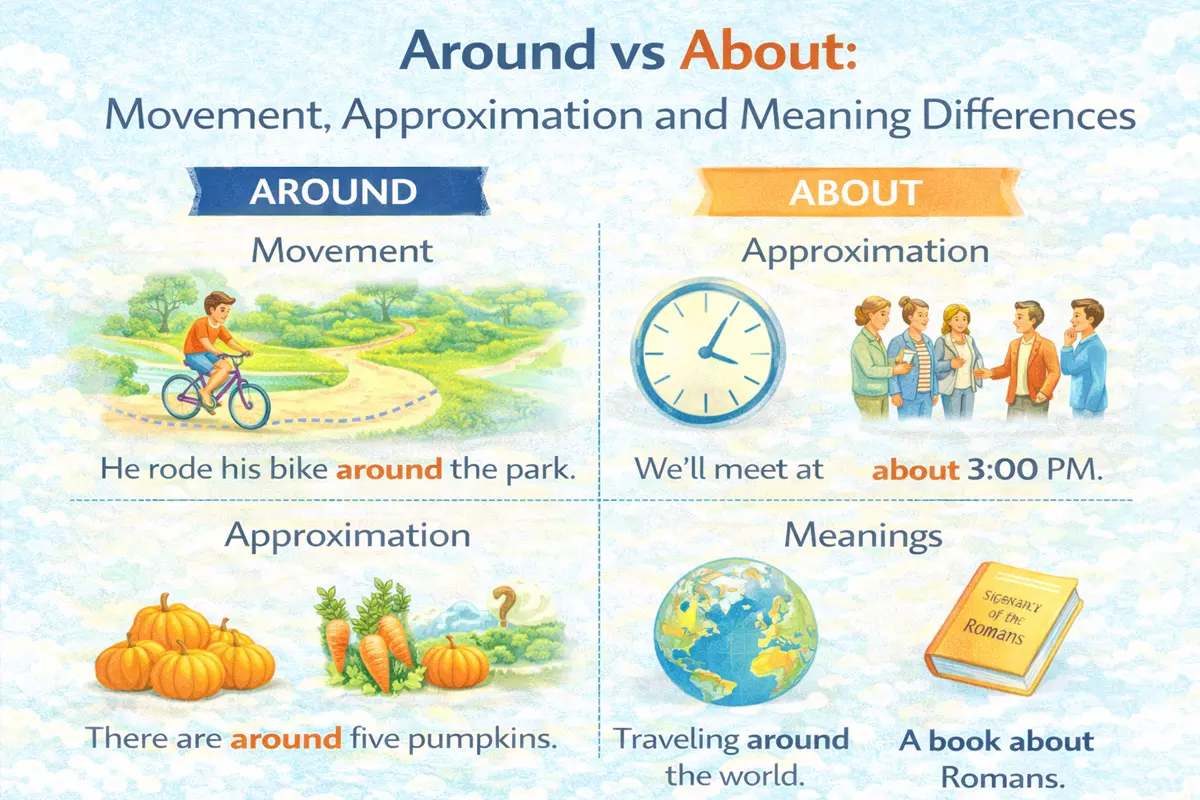 Here we how around expresses movement in space, about indicates approximate numbers or time, and discusses regional and style differences. It also reviews fixed expressions, common learner mistakes, and provides practice correcting around and about.
Have you ever noticed how we use words like "nearby" to describe someone's location and "approximately" to estimate numbers, even though both convey a sense of closeness or vagueness? These subtle differences in word choice can significantly impact the meaning of what we're saying, especially when discussing where something is or making rough calculations. Understanding these nuances helps us communicate more precisely and ensures that our listeners interpret our messages as we intend.
Movement meaning of around in space
When we use the word around in the context of physical space, it often describes movement that circles, surrounds, or follows the boundary of something. This spatial sense is distinct from more abstract uses, like approximation. For example, saying "The children ran around the playground" means they moved following the edge or perimeter of the playground, not just anywhere in the area.
Common patterns with "around" for spatial movement
- Walking around a building
- Driving around the city
- Running around the track
- Swimming around the island
- Moving around the table
- Circling around a statue
- Strolling around the park
- Looking around a room
- Traveling around the world
- Skating around the rink
- Turning around a corner
- Marching around the square
- Flying around the globe
- Going around obstacles
- Escaping around the fence
- Wandering around the neighborhood
How "around" differs from "about" in spatial movement
In most modern English, "about" is rarely used for actual movement in physical space. Instead, "around" is the preferred term to indicate motion that follows a route, edge, or boundary. For example, "She walked about the garden" is technically possible but sounds old-fashioned or literary, while "She walked around the garden" is natural and common.
Prepositions in action
To illustrate the difference in how these prepositions work in spatial contexts, here's a comparison of typical usage:
| Phrase | Meaning & Nuance |
|---|---|
| Walk around the park | Follow the path or edge of the park, possibly making a circuit. |
| Look around the room | Turn your head or move to see different parts of the room; covering the area visually. |
| Drive around the city | Travel through various areas of the city, often with no fixed route. |
| Move about the house | Wander or go from place to place within the house (rare in modern usage). |
In summary, around is the standard choice for expressing motion that encircles, covers, or follows the boundary of a place or object, making it key for describing spatial movement in English.
Approximate number and time uses of about
The preposition "about" is commonly used when we want to estimate or give an imprecise figure for quantities, distances, or periods of time. Rather than giving an exact number, "about" signals that the information is close to the actual value, but not exact. This makes it a useful tool in both casual conversation and more formal writing, especially when precision isn't possible or necessary.
Typical number and amount patterns

When referring to quantities, "about" is placed before the number or amount. Here are some examples:
- about 20 people attended the meeting
- She earns about $50,000 a year
- There are about 100 pages in this book
- We walked about five miles
- He weighs about 80 kilograms
- It costs about ten dollars
- About half the class was absent
- The package weighs about two pounds
- They have about three hours left
- There are about a dozen eggs in the fridge
- The solution contains about 15% salt
- About 30% of students passed the test
Time expressions with "about"
"About" is also frequently used to express approximate times or durations. Some common structures include:
- The train arrives at about 7 p.m.
- It takes about 30 minutes to get there
- She left about an hour ago
- We’ll be ready in about ten minutes
- The meeting lasted about two hours
- I’ll call you at about noon
- We met about three weeks ago
- It happened about a year back
- He’s been waiting about half an hour
- They’ll finish about tomorrow afternoon
Comparing "about" with other approximators
"About" is not the only word used for approximation, but it is among the most neutral and widely used. Here’s a comparison of several common approximators in English:
| Approximator | Typical Use & Example |
|---|---|
| about | General estimation. About 40 people came. |
| around | Similar to "about," often interchangeable. Around 6 o’clock. |
| approximately | More formal or scientific contexts. Approximately 5.3 liters. |
| roughly | Suggests a less precise estimate. Roughly 200 students. |
| nearly | Indicates just under a specific amount. Nearly two hours. |
Summary
Using "about" before numbers and times helps speakers indicate that a figure is close but not definite. This makes conversations clearer and prevents misunderstandings when exact details are unavailable or unnecessary. The flexibility and frequency of "about" ensure its place as a key part of everyday English when expressing estimates.
Regional preferences and style differences
English speakers from different parts of the world often choose “around” or “about” in ways that reflect their local habits. In North America, “around” is much more common for both physical movement and rough estimates, while speakers in the UK, Ireland, Australia, and New Zealand tend to prefer “about” for approximations and general references. This variation isn’t only about geography—it also extends to formality and context.
Common usage patterns
- American English: “around” for both movement and approximation (e.g., “He walked around the block” and “It costs around $10”).
- British English: “about” for approximation (“It’s about five miles away”), “round” for movement (“He went round the corner”).
- Australian English: “about” is standard for estimates, but “around” is growing in use among younger speakers.
- Irish English: “about” dominates for rough numbers, but “round” may appear in casual speech.
Style and register differences
Formal writing tends to favor “about” for approximations. “Around” is more informal and conversational, especially in American English. Some speakers find “around” less precise when used for numbers or time, while “about” is neutral and fits academic or professional contexts.
Examples of regional variation
Here are some sample sentences showing how different varieties of English might use these terms:
- US: “Let’s meet around noon.”
- UK: “Let’s meet about midday.”
- US: “There were around twenty people at the party.”
- UK: “There were about twenty people at the party.”
- UK/IE: “He drove round the town.”
- US: “He drove around the town.”
- AU: “It should take about an hour.”
- US: “It should take around an hour.”
- IE: “There were about fifty students.”
- US: “There were around fifty students.”
Comparison of “around” and “about” in different regions
| Region | Preferred term for approximation | Preferred term for movement |
|---|---|---|
| United States | around | around |
| United Kingdom | about | round |
| Australia | about (increasing “around”) | around/round (mixed) |
| Ireland | about | round |
| Canada | around/about (both common) | around |
Summary
In short, local dialects and formality influence whether “around” or “about” is chosen. For approximations, “about” is more universal in formal English, but “around” is favored in North America, especially in casual settings. Movement-related uses (“walked around/round the park”) show even more regional variety, with “round” remaining strong in the UK and Ireland. Understanding these preferences helps avoid confusion and makes your English sound more natural in different contexts.
Fixed expressions using around and about
Many common English phrases and idioms use "around" or "about" in ways that go beyond their literal meanings. These set phrases often have distinct meanings that can't always be guessed from the words alone. Understanding how these prepositions appear in fixed expressions can help you sound more natural and avoid confusion.
Typical expressions with "around"
" Around" often conveys movement, informality, or the idea of something being nearby or loosely connected. Here are some frequent collocations and idiomatic uses:
- Look around – to explore or inspect a place.
- Hang around – to stay in a place without purpose.
- Mess around – to waste time or behave playfully.
- Get around – to travel to different places or to avoid something.
- Turn around – to change direction or situation.
- Come around – to regain consciousness or to change opinion.
- Be around – to be present or available.
- Fool around – to behave in a silly or playful way.
- Go around – to circulate or to behave in a certain way.
- Shop around – to compare prices or options before deciding.
Common phrases with "about"
"About" is frequently used to introduce topics or indicate approximation, but it also appears in idioms and set phrases:
- Think about – to consider or reflect on something.
- Care about – to feel concern or interest.
- Go about – to begin or continue doing something.
- Bring about – to cause something to happen.
- Set about – to start doing something with determination.
- Be about to – to be on the point of doing something.
- What about…? – to ask for someone’s opinion or suggest an alternative.
- Just about – almost or nearly.
- Go on about – to talk at length, often annoyingly.
- How about…? – to make a suggestion.
Comparing usage in set phrases
Some expressions might seem similar but have different meanings depending on which preposition is used. See the comparison below:
| Expression with "around" | Expression with "about" |
|---|---|
| Look around (explore the surroundings) | Look about (rare, old-fashioned; also means look around) |
| Go around (visit different places or spread, e.g. "a rumor goes around") | Go about (proceed with an activity, e.g. "go about your business") |
| Hang around (stay somewhere without purpose) | Be about (be present, e.g. "Is John about?") |
| Come around (change opinion or recover) | Bring about (cause to happen) |
Grasping these set phrases helps you avoid literal translation errors and makes your English sound more fluent and idiomatic. Often, the choice between "around" and "about" in these expressions is fixed and cannot be swapped without changing or losing the intended meaning.
Common errors in learner speech and writing
Learners often confuse "around" and "about" because both words can relate to movement or approximation, but their usage differs depending on context. Mixing them up can lead to awkward or unclear sentences, especially in both spoken and written English.
Misuse in Describing Movement
A frequent mistake is using "about" when describing physical movement or position, such as "walk about the park" instead of "walk around the park." "Around" is used for circular or surrounding motion, while "about" is not standard in these cases.
Confusion in Expressing Approximate Quantities
Another common error is choosing "around" when "about" is more natural for approximation. For instance, "There were around 30 people" is correct, but sometimes learners overuse "around" or switch them inappropriately.
Overgeneralizing One Preposition
Some learners pick one form and use it everywhere, regardless of context. This results in sentences like "Tell me around your experience" instead of "Tell me about your experience."
Typical Example Errors
- He ran about the track. ❌ (Should be: He ran around the track.)
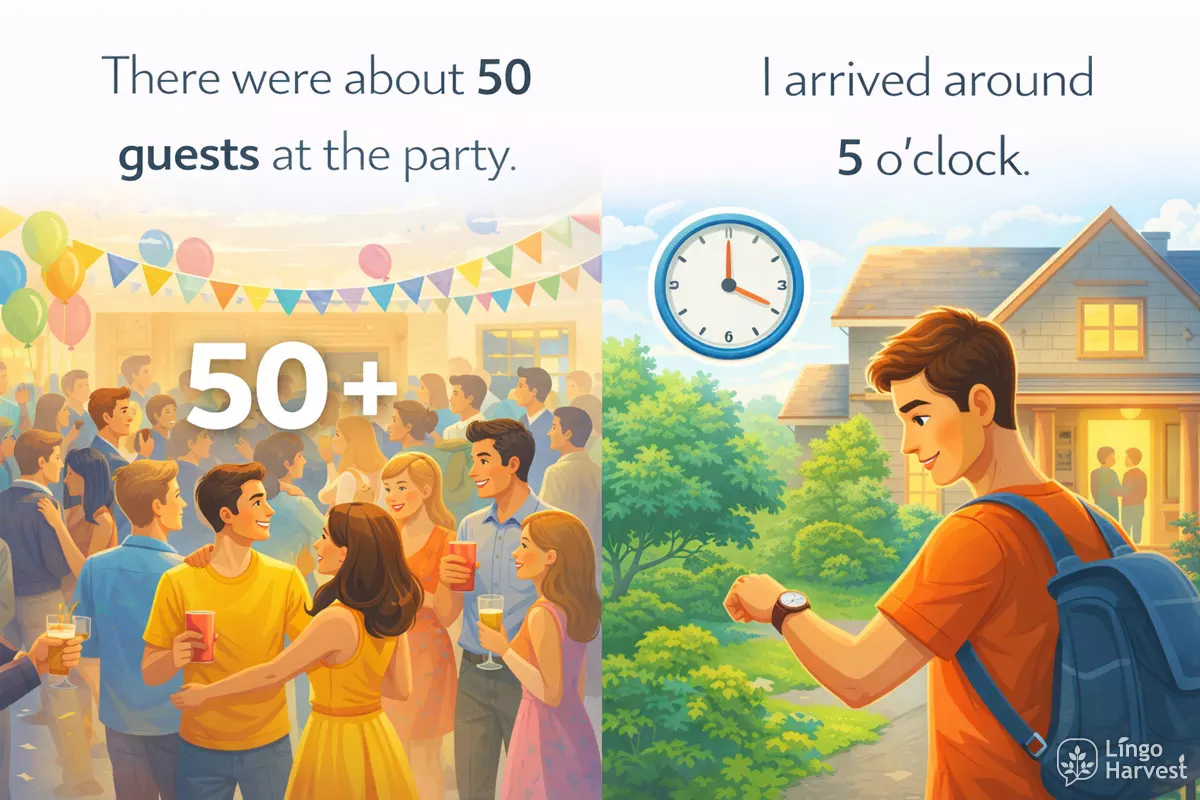
- There were about 50 guests at the party. ✅ (Correct usage)
- We talked around our plans. ❌ (Should be: We talked about our plans.)
- The children are playing about the house. ❌ (Should be: The children are playing around the house.)
- I arrived around 5 o’clock. ✅ (Correct usage)
- She looked about the room for her keys. ✅ (Correct for searching in various directions)
- Can you tell me around the project? ❌ (Should be: Can you tell me about the project?)
- We walked about the city. ❌ (Should be: We walked around the city.)
- There are around ten apples left. ✅
- He was wandering about. ✅ (Correct for aimless movement)
Quick Comparison of Usage
| When to use "around" | When to use "about" |
|---|---|
| Describing circular or surrounding movement: • She walked around the park. • The earth orbits around the sun. |
Talking about topics, or giving information: • Tell me about your trip. • We spoke about the problem. |
| Stating approximate numbers (informal): • There were around 50 people. |
Stating approximate numbers (neutral/formal): • About 100 guests attended. |
| Movement from place to place without a clear direction: • He moved around the house. |
Movement without a specific path (used less for physical space): • He wandered about (aimless movement). |
| Indicating position surrounding something: • People gathered around the table. |
Talking about general ideas: • The book is about history. |
Summary Tips
To avoid mistakes, remember: use "around" for movement in a circle or surrounding something, and "about" for topics, information, or approximate numbers (especially in formal contexts). Checking example sentences can help reinforce correct usage.
Practice: correct misuse of around and about in examples
Many learners confuse “around” and “about”, especially when talking about location, movement, or approximation. Below, you can practice distinguishing when to use each word correctly. Review the sentences and decide which word fits best in context. This will help you avoid common mistakes and improve your understanding of subtle differences.
Choose the Correct Word
For each sentence, select either “around” or “about” to complete the meaning accurately. Focus on whether the sentence describes movement, a general subject, or an approximate amount.
- We walked ___ the park for an hour.
- There were ___ twenty people at the meeting.
- Can you tell me ___ your trip?
- The cat ran ___ the house, chasing a toy.
- He looked ___ the room but couldn’t find his keys.
- I have ___ five dollars in my wallet.
- Let’s walk ___ the block before dinner.
- They talked ___ politics all night.
- She lives somewhere ___ here.
- He moved the chairs ___ the table.
- Tell me ___ your weekend plans.
- The kids are running ___ the playground.
- The concert starts at ___ 8 o’clock.
- I saw him walking ___ the city center yesterday.
- The book is ___ history and science.
Show answers
- around
- about
- about
- around
- around
- about
- around
- about
- around
- around
- about
- around
- about
- around
- about
Common Mistakes: “Around” vs. “About”
Here are frequent sentences where these words are misused. Identify what’s wrong and mentally correct them.
- I have around five minutes to spare.
- Let’s talk around your project.
- She walked about the room nervously.
- There were about 100 people in the hall.
- They traveled about Europe last summer.
- He complained around the noise all night.
- They discussed around the new policy changes.
- The children ran around the playground for an hour.
- We spent about three weeks in Italy.
- There were around twenty shops in the mall.
Show answers
- Correct.
- Should be: Let’s talk about your project.
- Should be: She walked around the room nervously.
- Correct.
- Should be: They traveled around Europe last summer.
- Should be: He complained about the noise all night.
- Should be: They discussed about the new policy changes.
- Correct.
- Correct.
- Correct.
Quick Reference: Typical Uses
| Context | Use “around” | Use “about” |
|---|---|---|
| Movement/location | We walked around the lake. | (Not used for movement) |
| Approximate numbers/time | We arrived around 9 PM. | There were about 30 people. |
| Topic/subject | (Not used for topic) | Let’s talk about your ideas. |
| General location | Is anyone around? | (Not typical) |
Practicing with real sentences will help you naturally choose the right word, whether you’re describing movement, approximation, or conversation topics.