Beyond vs Past: Limits, Boundaries and Usage Differences in English

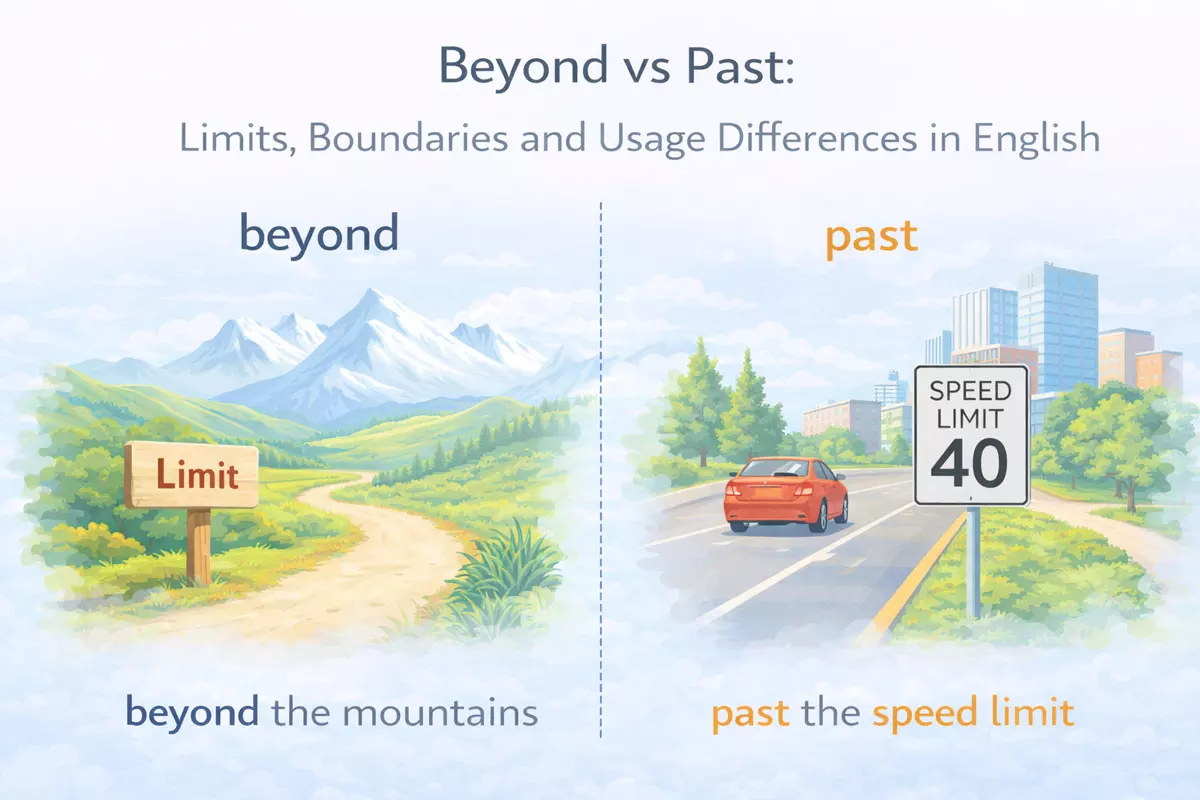 This article explains how beyond and past are used to express limits, movement, and abstract ideas like ability or belief. It covers typical collocations, context-based usage, and offers practice rewriting sentences using these words.
English prepositions can be challenging, particularly when distinguishing between words such as beyond and past. Both terms relate to boundaries or limits, but they are used differently depending on context. Beyond often suggests something farther away or outside a certain limit, while past generally refers to movement from one side of a point to the other. Developing an understanding of these subtle differences is important for achieving clear and accurate communication in English.
Limit and boundary meanings of beyond
When we use "beyond" in English, it often suggests something exceeding a certain edge, line, or conceptual barrier—whether physical, emotional, or even abstract. The word naturally carries the idea of surpassing, moving further than a set point, or existing outside an established limit.
How "beyond" expresses limits and boundaries
"Beyond" is commonly used to indicate that something is outside the scope of what is normal, expected, or physically present. This can refer to tangible boundaries, such as a fence or horizon, as well as intangible ones, like understanding, patience, or imagination. Here are some typical scenarios:
- Physical space: "The valley lies beyond the mountains."
- Ability: "This task is beyond my skill level."
- Understanding: "The concept is beyond me."
- Time: "We cannot plan beyond next year."
- Limits of tolerance: "His behavior was beyond acceptable."
- Imagination: "The universe is beyond our wildest dreams."
- Legal or moral boundaries: "That action is beyond the law."
- Age or stage: "Children under five are not allowed beyond this point."
- Expectations: "Her generosity is beyond words."
- Geographical: "The river flows beyond the border."
- Measurement: "Temperatures soared beyond 40°C."
- Comparison: "This cake is beyond compare."
- Endurance: "He worked beyond exhaustion."
- Reach or access: "The treasure lies beyond our grasp."
- Belief: "The story was beyond belief."
Comparison: "Beyond" vs. "Past" in expressing boundaries

While both "beyond" and "past" can relate to crossing limits, "beyond" emphasizes surpassing a boundary, often with a sense of being outside or apart from it, whereas "past" usually marks movement after a point in time or space. The nuances can affect which word fits best in a sentence.
| Usage | "Beyond" | "Past" |
|---|---|---|
| Physical boundary | "The forest lies beyond the river." | "He walked past the river." |
| Abstract limit | "Beyond the limits of science." | "Past his prime." |
| Ability/Comprehension | "The math was beyond her understanding." | ❌ (Not typically used) |
| Time | "Don’t stay beyond midnight." | "It’s past midnight." |
Summary
To sum up, "beyond" often marks a point where something is no longer included, accessible, or understandable, emphasizing a sense of separation from a defined edge or limit. This quality distinguishes it from similar prepositions, making it useful for highlighting both literal and figurative boundaries.
Movement and distance meanings of past
When talking about physical space or movement, "past" commonly indicates going by or beyond a reference point. It emphasizes the action of moving so that something is left behind, either in space or in time. This is especially useful for describing routes, directions, or the position of objects in relation to each other.
How "past" is used for movement
The preposition "past" often appears when describing travel or motion. It marks the point after which the movement continues, making it clear that the subject has gone by a specific place or object. For example:
- She walked past the bakery.
- The car drove past the school.
- We ran past the finish line.
- He cycled past the park gates.
- The train sped past the station.
- I hurried past the crowd.
- They sailed past the lighthouse.
- A dog ran past us on the street.
- She slipped past the guards unnoticed.
- The parade marched past our house.
Distance and position with "past"
"Past" also helps specify a location relative to another point, especially when giving directions or describing where something is situated. In these contexts, it means "beyond" or "on the far side of" a landmark:
- The pharmacy is just past the intersection.
- Keep going straight, and the library is past the post office.
- The bus stop is past the traffic lights.
- Our house is two blocks past the bridge.
- There’s a café past the museum on your left.
- The playground is past the sports field.
- The shop is past the river, near the old mill.
- Walk past the fountain and turn right.
- The office is past the second set of doors.
- The station is just past the roundabout.
Comparing "past" with similar words
While "past" and "beyond" can both suggest movement over a boundary, their nuances differ. "Past" focuses on the act of going by or the point immediately after. "Beyond" often implies a greater or more indefinite distance. For instance, "She walked past the gate" means she went just by the gate; "She walked beyond the gate" suggests she continued to a further point.
| Expression | Typical Use | Example |
|---|---|---|
| past | Movement by a specific point or landmark | He drove past the cinema. |
| beyond | Movement to a point further away, often indefinite | The road continues beyond the village. |
| over | Movement above and across | The cat jumped over the fence. |
| through | Movement inside and out the other side | She walked through the tunnel. |
Understanding how "past" signals direction and position helps clarify routes and spatial relationships in English. Whether you’re giving directions or describing where something happened, using "past" accurately can make your meaning much clearer.
Abstract uses in ability, understanding and belief
When discussing the words "beyond" and "past," their abstract meanings often come into play in contexts related to what someone can do, know, or accept as true. Both terms are used not just for physical limits, but also to express boundaries of skill, comprehension, or conviction.
Ability: Expressing What Is Possible or Impossible
"Beyond" and "past" commonly signal that something cannot be achieved or is out of reach for a person or thing. For example, "The math problem was beyond me" means it was too difficult to solve. In contrast, "This job is past his abilities" suggests the required skills are greater than what he has. Both phrases indicate a limit, but "beyond" often feels more absolute or conceptual, while "past" can imply a more measurable or practical threshold.
- "The challenge was beyond her strength." ❌
- "This task is past my patience." ❌
- "His recovery is beyond expectation." ✅
- "The project went past our initial goals." →
Understanding: Limits of Comprehension
In terms of grasping ideas, "beyond" is frequently used to show that something is too complex or alien to be understood. "Past," on the other hand, is less common in this sense but can appear in fixed phrases.
- "Quantum mechanics is beyond most people's understanding."
- "It's past me why he left so suddenly."
- "The concept was beyond his grasp."
- "Her explanation went past what I could follow."
Belief: Boundaries of Acceptance
When it comes to belief, "beyond" often marks something as unbelievable or outside what can be accepted as true. "Past" is rarer here, but may appear in idiomatic expressions.
- "The story was beyond belief."
- "It's past believing that he could be so careless."
- "Her generosity is beyond compare."
- "That excuse is past convincing anyone."
Comparing Abstract Uses
| Function | Typical with "beyond" | Typical with "past" |
|---|---|---|
| Expressing inability | "beyond my ability," "beyond repair" | "past his skills," "past saving" |
| Describing incomprehension | "beyond understanding," "beyond logic" | "past my comprehension" |
| Stating disbelief | "beyond belief," "beyond imagination" | "past convincing," "past believing" |
| Setting expectations | "beyond expectation" | "past the point of caring" |
The abstract usage of "beyond" emphasizes a sense of surpassing or exceeding a limit, often in a way that feels insurmountable or absolute. "Past" can convey a similar idea, but is sometimes more grounded in practical or emotional limits. Both words help speakers clarify not just physical, but also mental and emotional boundaries in English.
Common collocations with beyond and past
Understanding how "beyond" and "past" pair with other words reveals their typical contexts and shades of meaning. Both terms frequently appear in set phrases or fixed expressions, but their combinations highlight their differences: "beyond" often relates to limits or surpassing expectations, while "past" is more commonly linked to movement, time, or stages.
Typical expressions with "beyond"
"Beyond" tends to suggest something further than a point, limit, or expectation. It's used for both physical and abstract boundaries. Here are some standard pairings:
- beyond belief – incredible, hard to accept as true
- beyond repair – unable to be fixed
- beyond recognition – changed so much that it is unrecognizable
- beyond doubt – certain, unquestionable
- beyond control – impossible to manage or restrain
- beyond imagination – difficult or impossible to imagine
- beyond comprehension – impossible to understand
- beyond compare – better than anything else
- beyond expectation – more than anticipated
- beyond reach – inaccessible, unattainable
- beyond the horizon – figuratively or literally further than can be seen
- beyond the scope – outside the range or limits
Frequent combinations with "past"
"Past" most commonly refers to movement (literal or figurative) or time. It often indicates something that has finished or been surpassed.
- past midnight/noon – after a certain time
- past experience – previous events or knowledge
- past his/her prime – no longer at the best age or condition
- past due – overdue
- past the point of – beyond a particular stage or moment
- past recovery – unable to recover
- past history – events that have already happened
- past the age of – older than a specific age
- past caring – so tired or upset that one no longer cares
- past your bedtime – later than the usual time for sleep
- past the deadline – after the final time allowed
Side-by-side comparison of common patterns
| With "beyond" | With "past" |
|---|---|
| beyond belief | past experience |
| beyond repair | past due |
| beyond control | past the point of |
| beyond recognition | past his/her prime |
| beyond compare | past recovery |
Recognizing these frequent pairings will help you use "beyond" and "past" more naturally in both speech and writing. While some combinations are fixed, others allow for flexibility depending on context. Consider the nuance each word brings to a phrase—whether it’s about surpassing a boundary or simply moving forward in time or space.
How context decides which word sounds natural
Grasping the difference between "beyond" and "past" often comes down to the situation, not just dictionary definitions. These words both relate to limits or boundaries, but their natural use depends on what you want to express—physical movement, abstract limits, or even time.
Physical vs. Abstract Boundaries

In everyday speech, "past" is usually chosen for movement from one place to another or when referring to time. "Beyond," on the other hand, often suggests crossing a limit—sometimes literal, but often more abstract or metaphorical. Context clues in the sentence help listeners or readers decide which sounds right.
- "He walked past the store." → Movement along a path
- "Her skills go beyond the basics." → Exceeding a level or standard
- "It's past midnight." → Reference to time
- "This is beyond my understanding." → Exceeding mental or conceptual limits
- "We drove past the city limits." → Physical location
- "The problem is beyond repair." → Irreversible state
- "He looked past her mistakes." → Overlooking issues
- "Beyond the mountain lies a valley." → Something further away (often more poetic or descriptive)
- "It's past the deadline." → Time limit exceeded
- "Her generosity is beyond compare." → Superlative, abstract quality
Subtle Nuances in Usage
The choice between "beyond" and "past" can subtly change the meaning of a sentence. For example, "past" tends to be more neutral, while "beyond" often adds an emotional or evaluative layer—implying something is not just farther, but outside the usual scope.
| Situation | Preferred Word & Reason |
|---|---|
| Physical movement (walking/driving) | "Past" – Describes moving by or along something |
| Time reference | "Past" – Refers to moments after a point in time |
| Exceeding a limit or level | "Beyond" – Implies surpassing a boundary (literal or figurative) |
| Describing something outside possibility or understanding | "Beyond" – Suggests something unattainable or incomprehensible |
| Comparisons or superlatives | "Beyond" – Emphasizes uniqueness or extremity |
Listening for Collocations
Certain words naturally "collocate" (pair up) with "past" or "beyond." Native speakers rely on these patterns, which develop through exposure and practice. For example, "past experience," "past the point," "beyond belief," and "beyond hope" are all fixed expressions where swapping the word would sound odd or ungrammatical. Understanding these subtle cues and patterns helps ensure your choice fits smoothly in conversation or writing, making your English sound more natural and precise.
Practice: rewrite sentences using beyond or past correctly
Understanding when to use "beyond" and "past" can help clarify meaning and avoid common mistakes. Below, you'll find practice exercises where you need to choose the correct word for each sentence. Think about whether the sentence is talking about physical distance, time, a limit, or an abstract boundary.
Rewrite the sentences with the correct word
For each item, decide whether "beyond" or "past" fits best. Rewrite the sentence, replacing the incorrect or missing word.
- We drove ______ the old church and turned left.
- Her patience goes ______ what I expected.
- It’s already ______ midnight, so let’s go home.
- This idea is ______ my understanding.
- He walked ______ the store without noticing me.
- The discussion went ______ the original topic.
- The deadline is ______ due, but the report isn’t finished.
- Our house is just ______ the river.
- The technology used here is ______ anything we’ve seen before.
- She looked ______ the window, lost in thought.
- His skills are ______ those of his classmates.
- The bank is just ______ the post office.
- Some jokes go ______ good taste.
- We worked ______ sunset to finish the job.
- He ran ______ the finish line and kept going.
Tips for choosing between "beyond" and "past"
- Past is often used for physical locations (“walk past the school”), times (“past midnight”), or when something has moved by a point.
- Beyond is used for limits, boundaries, or things outside what is expected or possible (“beyond my understanding”, “beyond the horizon”).
- Some sentences may seem possible with both, but usually one sounds more natural or accurate.
Show answers
- We drove past the old church and turned left.
- Her patience goes beyond what I expected.
- It’s already past midnight, so let’s go home.
- This idea is beyond my understanding.
- He walked past the store without noticing me.
- The discussion went beyond the original topic.
- The deadline is past due, but the report isn’t finished.
- Our house is just beyond the river.
- The technology used here is beyond anything we’ve seen before.
- She looked past the window, lost in thought.
- His skills are beyond those of his classmates.
- The bank is just past the post office.
- Some jokes go beyond good taste.
- We worked past sunset to finish the job.
- He ran past the finish line and kept going.