Prepositions of Degree: up to, at least, no more than and Usage Rules

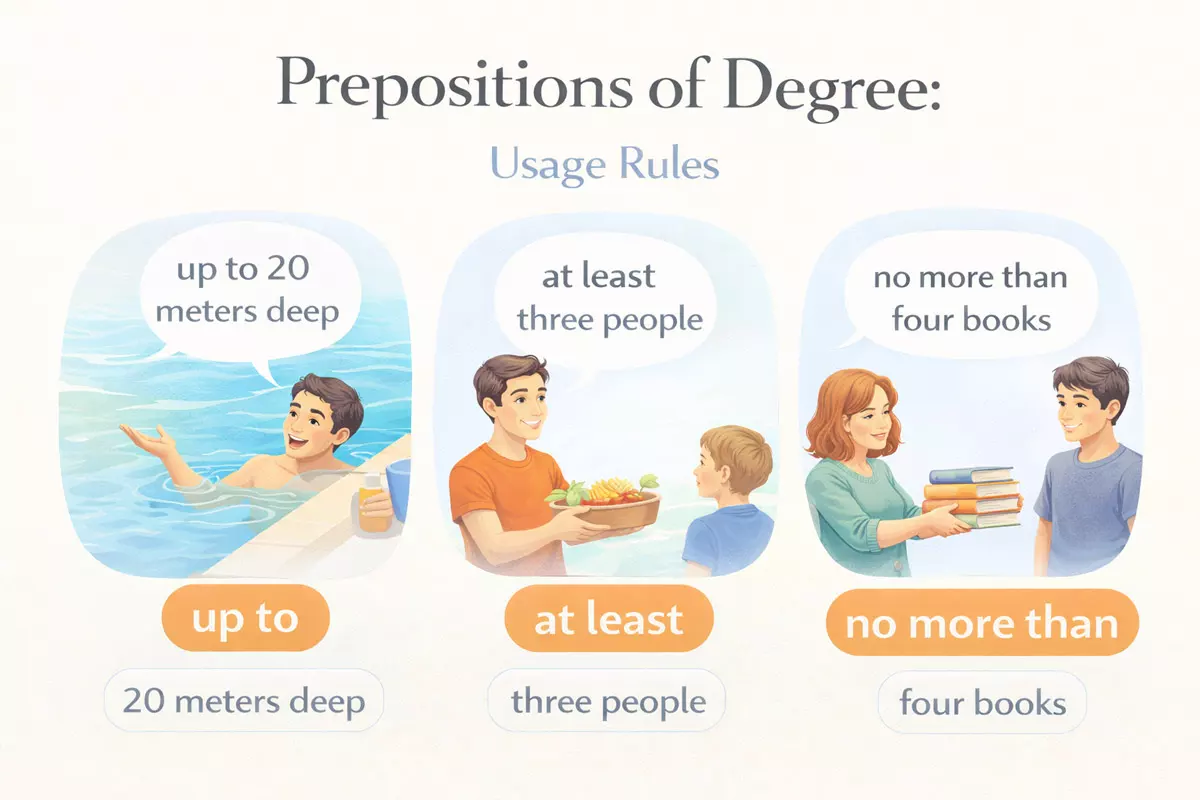 The article explains how prepositions of degree set limits and ranges, compares phrases like up to, at least, and no more than, shows how to use them with numbers, discusses polite versus strict use, points out common mistakes, and provides practice exercises.
- How prepositions of degree express limits and ranges
- Differences between up to, at least and no more than
- Combining degree prepositions with numbers and quantities
- Polite softening vs strict limits in real communication
- Common mistakes with double or conflicting limits
- Practice exercises with real-life degree expressions
Grasping how to use expressions that indicate extent or limitation—like those referring to minimums, maximums, and ranges—is crucial for clear and effective communication in English. These phrases allow you to express ideas with accuracy, ensuring that your audience understands exactly what you mean. By mastering such language, you enhance both your writing and speaking skills, making your statements more precise and your intentions easier to interpret in various contexts.
How prepositions of degree express limits and ranges
Prepositions like "up to," "at least," and "no more than" help us define boundaries in statements about quantity, frequency, or extent. They allow speakers to indicate the highest possible value, the minimum required, or to set clear restrictions. These expressions are essential for accuracy, whether you are discussing prices, ages, time, or amounts.
Setting upper and lower boundaries
"Up to" is often used to express a maximum limit, showing that something does not exceed a certain amount. In contrast, "at least" signals a minimum threshold, while "no more than" restricts the upper range. These forms communicate expectations and rules with precision.
- Up to: There can be a maximum, but not more. (e.g., "You may bring up to three guests.")
- At least: There is a required minimum. (e.g., "You must be at least 18 years old.")
- No more than: The amount or number must not be exceeded. (e.g., "No more than five people are allowed.")
Comparing prepositions of degree

To clarify how these terms differ in practical use, consider the following structured overview:
| Expression | Indicated Range | Example Sentence |
|---|---|---|
| Up to | From zero/minimum to the stated maximum | You can save up to $50 on this offer. |
| At least | The stated minimum and above | Applicants must have at least three years of experience. |
| No more than | Any amount not exceeding the limit | No more than 20 students may participate. |
| No less than | The value stated or higher | Spend no less than 30 minutes on this task. |
Common contexts for usage
These prepositions appear in daily life, rules, and instructions. Here are some typical scenarios:
- Age restrictions: "Children must be at least 12 years old."
- Purchase limits: "Buy up to two items per customer."
- Time requirements: "Stay for no less than one hour."
- Weight or size limits: "Baggage must weigh no more than 23 kg."
- Participation numbers: "No more than four teams may enter."
- Financial amounts: "You can withdraw up to $500 per day."
- Minimum standards: "Projects should include at least five sources."
- Attendance: "At least 10 people must be present for the meeting to start."
- Speed or quantity: "Drive at no more than 50 km/h."
- Duration: "The warranty covers you for up to two years."
By using these prepositional phrases, speakers and writers can make their meaning clear and avoid misunderstandings about what is allowed, required, or possible.
Differences between up to, at least and no more than
When discussing quantities or limits, English speakers use “up to,” “at least,” and “no more than” for different nuances. Each expression sets a boundary, but the kind of boundary and the expectation it creates are not the same.
Meaning and Usage Overview
- Up to sets a maximum limit, indicating the highest possible value but not necessarily reaching it.
- At least establishes a minimum threshold, meaning the number or amount will not be lower than the specified figure.
- No more than also defines an upper limit, but with a stronger sense of restriction — the amount will not exceed the stated value.
Comparative Examples
To make the distinctions clear, here are typical scenarios where these prepositions of degree appear:
- “You can bring up to three guests.” (Three is the maximum; bringing fewer is fine.)
- “There must be at least five participants.” (Five is the minimum; more are allowed.)
- “Submit no more than two pages.” (Two is the strict upper limit; one or two pages only.)
- “Stay here for at least 30 minutes.” (Don’t leave before 30 minutes have passed.)
- “Spend up to $50.” (You may spend any amount not exceeding $50.)
- “You may eat no more than one dessert.” (One dessert is the absolute maximum.)
- “Read at least two chapters.” (Two is the minimum; more is acceptable.)
- “The discount applies up to 10 items.” (Maximum of 10 items can be discounted.)
- “Stay no more than one hour.” (Do not exceed an hour.)
- “Invite at least ten people.” (Ten or more are required.)
Summary Table: Key Distinctions
| Expression | What it Indicates | Example |
|---|---|---|
| Up to | Maximum possible amount; not more than | “You may take up to five days off.” |
| At least | Minimum required amount; not less than | “Bring at least $20.” |
| No more than | Strict upper limit; never exceeding | “No more than four entries per person.” |
Practical Usage Tips
- Up to is often used to express flexibility or a possible range, without a strict requirement to reach the upper boundary.
- At least signals a baseline that must be met or surpassed; it is useful in instructions or requirements.
- No more than has a limiting, sometimes restrictive tone, and is common in rules, applications, or policies.
- Understanding these subtle variations helps convey instructions, offers, and requirements more clearly in both casual and formal English.
Combining degree prepositions with numbers and quantities
Using prepositions such as up to, at least, and no more than with numbers and measurable amounts allows us to express limitations, minimums, and maximums clearly. These expressions help specify exact or approximate values, set expectations, or define boundaries in both formal and everyday communication.
Common patterns and usage
Degree prepositions frequently appear before numbers, percentages, prices, ages, and other measurable quantities. Here are some typical ways they are used:
- Up to + number: indicates a maximum limit.
Example: Up to 30 people can attend. - At least + number: shows a minimum requirement.
Example: You must be at least 18 years old. - No more than + number: sets an upper boundary.
Example: No more than five items per customer. - Over + number: means more than a certain quantity.
Example: Over 50% of respondents agreed. - Less than + number: indicates a quantity below the stated figure.
Example: Less than 100 calories per serving. - Exactly + number: specifies a precise figure.
Example: Exactly 12 students passed. - Between + number and number: sets a range.
Example: Between 5 and 10 minutes. - About / approximately + number: gives an estimate.
Example: About 200 kilometers away. - No less than + number: emphasizes a minimum.
Example: No less than $500 will be accepted. - At most + number: highlights an upper limit.
Example: At most three attempts allowed.
Comparing prepositions in context
The nuance of each preposition changes the meaning of a sentence. For example, "Up to 10 people" allows any number from zero to ten, while "At least 10 people" means ten or more.
| Expression | Meaning / Example |
|---|---|
| Up to 30 minutes | Any time from 0 to 30 minutes (The maximum allowed is 30) |
| At least 30 minutes | 30 minutes or more (The minimum required is 30) |
| No more than 30 minutes | 30 minutes or less (The upper limit is 30) |
| More than 30 minutes | Over 30 minutes (Exceeds 30) |
| Less than 30 minutes | Under 30 minutes (Does not reach 30) |
Tips for clear communication
- Always pair the preposition directly with the number or quantity for clarity.
- Be mindful of context: “at least” and “no more than” can change the tone or requirements of instructions.
- Use these structures in rules, guidelines, offers, and reports to avoid misunderstanding.
By mastering how to combine these prepositions with numbers, you can express limits, requirements, or estimates precisely and naturally in English.
Polite softening vs strict limits in real communication
Understanding how prepositions of degree like up to, at least, and no more than function in everyday exchanges can help you express boundaries with either flexibility or firmness. In natural conversation, speakers often choose softer or more exact phrases depending on whether they want to leave room for negotiation or set a non-negotiable rule.
Softening boundaries: creating flexibility
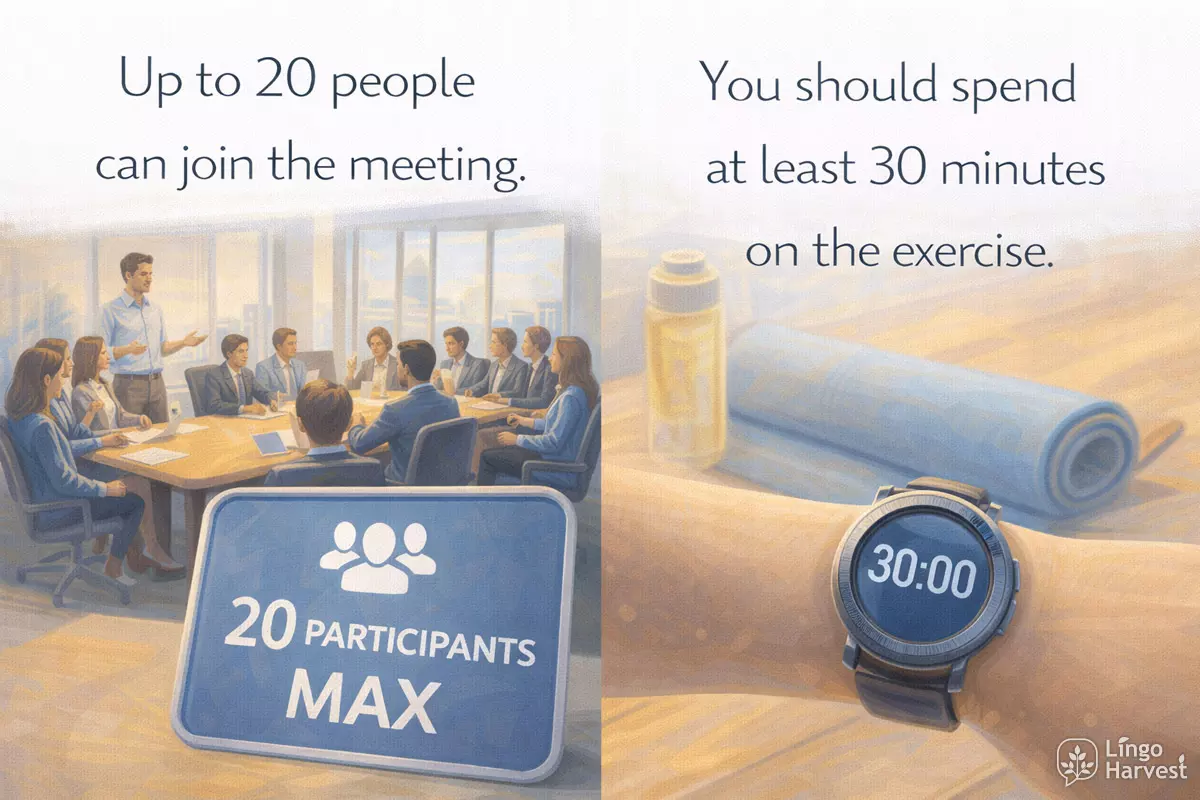
When you want to sound accommodating or avoid coming across as too rigid, you might select language that suggests an upper or lower limit without closing off options. For example, up to and at least allow for flexibility and encourage a positive tone.
- Up to 20 people can join the meeting. (Maximum, but fewer is fine.)
- You should spend at least 30 minutes on the exercise. (30 minutes is the minimum, but more is welcome.)
- Please submit up to three examples. (Three is the cap, but fewer are acceptable.)
- We need at least two volunteers. (More than two is better, but two is the minimum.)
- Stay for at least an hour if you can. (Longer stays are encouraged.)
Enforcing strict boundaries: making limits clear
When there's no room for negotiation or you must set firm rules, certain prepositions signal a fixed boundary. No more than or no less than state the limit clearly, leaving less space for interpretation.
- Bring no more than two guests. (Two is the absolute maximum.)
- You can take no less than 15 minutes for a break. (15 minutes is the shortest allowed.)
- The report should be no more than 500 words. (Anything above 500 is unacceptable.)
- You must be no less than 18 years old to enter. (Under 18 is not allowed.)
- Submit no more than one application per person. (Multiple applications are not accepted.)
Comparing softening and strictness in context
| Flexible/Persuasive | Strict/Non-negotiable |
|---|---|
| “You can order up to five items.” (You may order fewer.) |
“You may order no more than five items.” (Five is the hard limit.) |
| “Stay at least until 6 PM.” (Later is fine.) |
“You must not leave before 6 PM.” (Leaving earlier is not allowed.) |
| “We need at least three people.” (More is better.) |
“We require exactly three people.” (No more, no less.) |
| “Please donate at least $5.” (More is appreciated.) |
“Do not donate more than $5.” ($5 is the maximum allowed.) |
Choosing between these expressions depends on your intention—whether you want to encourage, suggest, or strictly control. Recognizing the subtle nuances helps you communicate more naturally and appropriately in both formal and informal situations.
Common mistakes with double or conflicting limits
When using prepositions like up to, at least, and no more than, it's surprisingly easy to create confusing or contradictory statements. These expressions set boundaries, but combining them without care can muddle your meaning or even make your sentence logically impossible.
Why double limits cause confusion
Trying to express both a minimum and a maximum in one phrase often leads to awkward or unclear language. For instance, saying “at least up to 10 people” mixes a lower and upper limit into one phrase, which can puzzle the listener. Each preposition is designed to indicate either a floor or a ceiling—not both at once.
Examples of conflicting or redundant usage
- “You can have up to at least five cookies.” ❌ (Contradicts: is five the minimum or maximum?)
- “No more than at least 100 applicants will be considered.” ❌ (Unclear which boundary applies)
- “At least up to 3 hours of study is required.” ❌ (Redundant: just say “at least 3 hours” or “up to 3 hours”)
- “There are no more than a minimum of 20 seats.” ❌ (Impossible: ‘no more than’ sets a max, ‘minimum’ sets a floor)
- “You need to wait up to at least 10 minutes.” ❌ (Confusing: how long is the wait?)
- “You must spend at least no more than $50.” ❌ (Logically inconsistent)
- “Applicants should be at least under 30 years old.” ❌ (Mixes minimum and maximum in a single phrase)
- “Stay here for up to a minimum of two hours.” ❌ (Contradictory limits)
- “No more than at least 12 people may enter.” ❌ (Which is it—minimum or maximum?)
- “You can eat at least up to two slices of cake.” ❌ (Unnecessarily combines both limits)
How to avoid errors with degree prepositions
- Choose either a minimum (at least) or maximum (up to, no more than), not both, unless you clearly state a range.
- When setting both boundaries, use a clear range: “between 5 and 10,” or “at least 5, but no more than 10.”
- Avoid stacking limit phrases together in one expression.
- Check that your sentence’s logic matches your intended meaning.
- When in doubt, rephrase for clarity—simplicity usually works best.
Clear vs. unclear expressions: A comparison
| Unclear/Incorrect | Clear/Correct |
|---|---|
| You can take up to at least 3 days off. | You can take up to 3 days off. → or: You must take at least 3 days off. |
| No more than at least $100 is allowed. | No more than $100 is allowed. → or: At least $100 is required. |
| At least up to 8 guests may attend. | Up to 8 guests may attend. → or: At least 8 guests must attend. |
| Applicants must be no more than at least 18 years old. | Applicants must be at least 18 years old. → or: No more than 18 years old. |
By separating minimum and maximum ideas or using clear range language, you avoid ambiguity and make your meaning easy to understand. Always double-check sentences containing limits to ensure they’re precise and not self-contradictory.
Practice exercises with real-life degree expressions
Understanding how to use prepositions of degree in everyday communication is essential for clarity and accuracy. The following tasks will help you apply "up to", "at least", and "no more than" in practical, real-world contexts. Try each exercise to reinforce your grasp of these expressions.
Fill in the blanks
Choose the correct preposition to complete each sentence: "up to", "at least", or "no more than".
- We need _______ five volunteers for the event, but more would be helpful.
- You should eat _______ three servings of vegetables every day for good health.
- There were _______ 20 people in the room; it wasn't crowded at all.
- The package will arrive in _______ seven days, depending on the shipping method.
- Applicants must be _______ 18 years old to qualify for the program.
- The discount is valid for _______ two items per customer.
- Please submit the form _______ Friday to be considered.
- The meeting will last _______ one hour.
- You can invite _______ ten guests to the party.
- The task should take _______ 15 minutes to complete.
Show answers
- at least
- at least
- no more than
- up to
- at least
- no more than
- by
- up to
- up to
- no more than
Choose the best option
Select the most appropriate phrase to complete each statement.
- The conference room can hold _______ 50 people. (A) no more than (B) at least (C) up to
- She wants to spend _______ $30 on a birthday gift. (A) at least (B) up to (C) no more than
- You should wait _______ two hours for a response. (A) no more than (B) up to (C) at least
- To pass the test, you need _______ 60% correct answers. (A) at least (B) no more than (C) up to
- The event will last _______ three hours. (A) up to (B) at least (C) no more than
- Participants may bring _______ two guests. (A) at least (B) no more than (C) up to
- The software supports _______ 10 users at the same time. (A) at least (B) up to (C) no more than
- Please submit the report in _______ five days. (A) at least (B) up to (C) no more than
- You must be _______ 21 years old to enter the club. (A) no more than (B) at least (C) up to
- The package weighs _______ 5 kg. (A) at least (B) no more than (C) up to
Show answers
- C) up to
- B) up to
- A) no more than
- A) at least
- A) up to
- B) no more than
- B) up to
- B) up to
- B) at least
- B) no more than
Common real-life scenarios
Here are some practical examples of degree expressions in action. Review each to see how these phrases fit into daily situations:
- Discount available for purchases of at least $100.
- Children up to age 12 can enter for free.
- Please submit your assignment in no more than 300 words.
- This medicine should be taken at least twice a day.
- The elevator can carry up to 10 people.
- Stay in the waiting area for no more than 15 minutes.
- Applicants must have at least two years of experience.
- Orders will be delivered in up to 5 business days.
- Use no more than one teaspoon of salt in the recipe.
- Membership is open to people at least 21 years old.
Comparing the expressions
To help you distinguish between these commonly confused prepositions, review the table below:
| Expression | Typical Meaning |
|---|---|
| up to | A maximum limit; not more than a specified amount |
| at least | A minimum requirement; not less than a stated amount |
| no more than | An upper boundary; equal to or less than a specified value |
Short writing challenge
Write two original sentences for each expression ("up to", "at least", "no more than") describing something about your daily routine or plans.
Show answers
- Examples for "up to": I can work up to eight hours today. The store is open up to 9 PM.
- Examples for "at least": I need at least seven hours of sleep. We should bring at least one bottle of water.
- Examples for "no more than": Please spend no more than 20 minutes on this task. The dog should eat no more than two cups of food.