Prepositions of Source and Origin: from, out of, made of / from / with

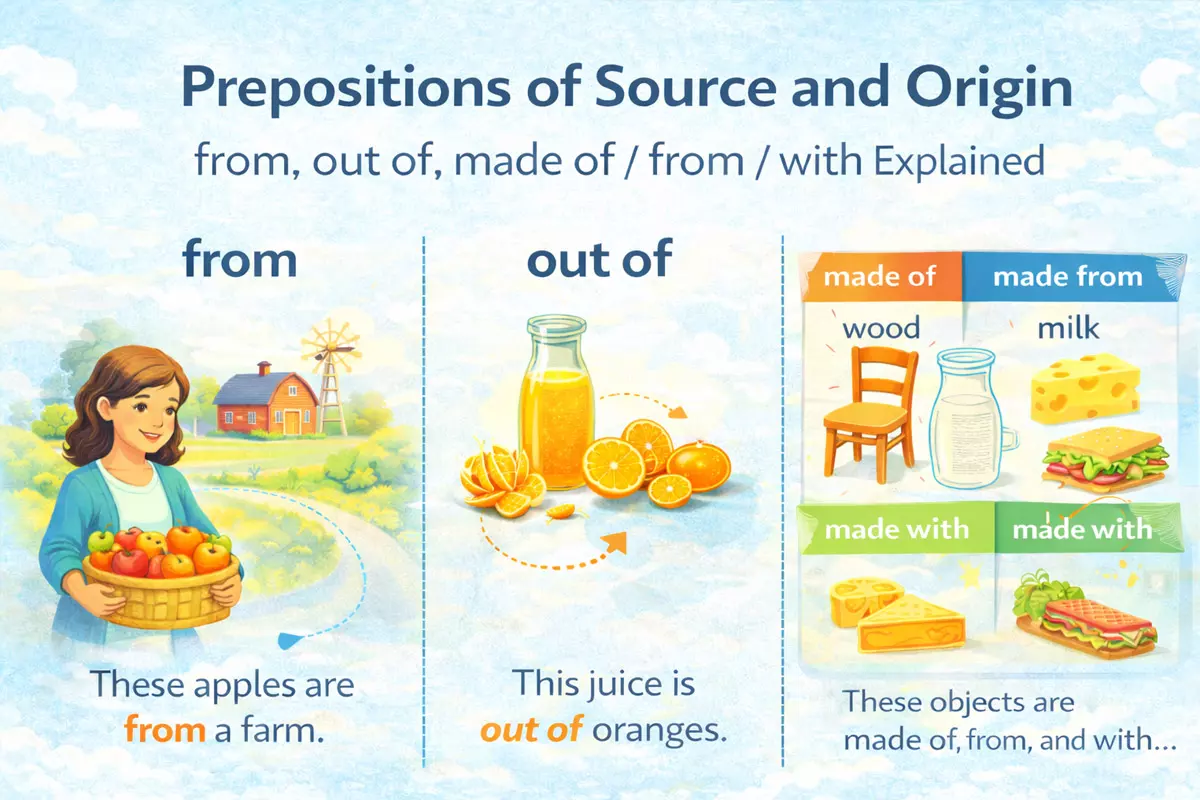 Here we the basic meaning of from, how out of is used for material and origin, and the differences between made of, made from, and made with. It also gives real examples and practice for describing products, food, and materials accurately.
Have you ever wondered how to express where something starts or what it is made from in English? Knowing the words and phrases that indicate source, material, and origin can help you clearly describe the background, composition, or beginnings of objects and ideas in everyday conversation. For example, saying a painting is made of oil on canvas shows its material, while mentioning that a recipe comes from Italy highlights its origin. Mastering these terms not only improves your communication but also makes your descriptions more engaging and precise.
Basic source meaning of from
The word "from" is most commonly used in English to show the starting point or origin of something. This preposition helps to indicate where something begins, comes, or is taken. Whether you’re talking about physical places, points in time, materials, or sources of information, "from" helps clarify the origin or starting location.
Physical and Abstract Origins
In its most literal sense, "from" tells us about the physical place where something starts or the point of departure. For example, "She walked from the park to her house" shows the park as the starting location. But "from" also covers more abstract ideas, like time ("from Monday to Friday") or origin ("from a good family").
- She comes from Canada.
- They moved here from another city.
- The train departs from platform 4.
- I learned this from my teacher.
- He recovered from his illness.
- The smell comes from the kitchen.
- This tradition comes from ancient times.
- The letter is from my friend.
- The noise came from outside.
- She borrowed the book from the library.
- The view from the hill is beautiful.
- We are open from 9 am to 6 pm.
- He is different from his brother.
- The story was translated from French.
- She graduated from university last year.
- Remove the pan from the heat.
- The painting was stolen from the museum.
- The cake is made from flour, eggs, and sugar.
Source vs. Destination
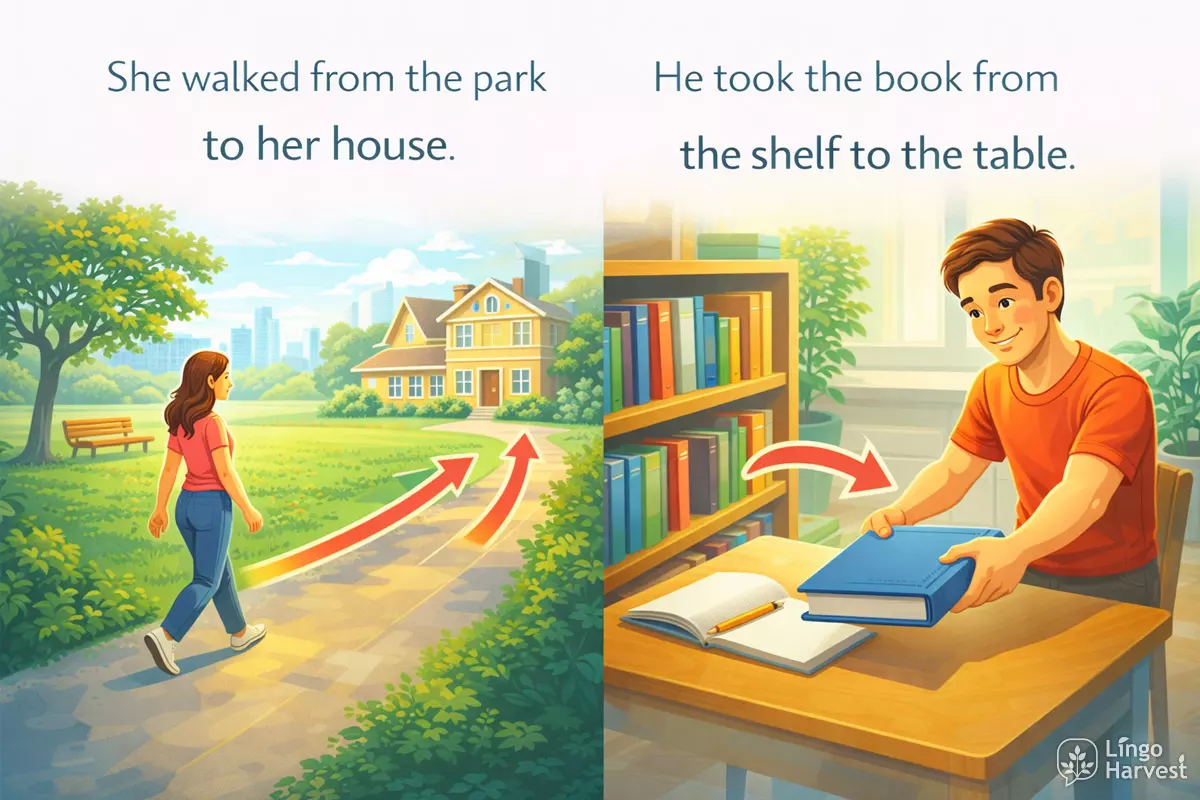
"From" always focuses on the starting point, not the endpoint. It works in contrast to prepositions like "to" or "into," which indicate where something is going.
| Example | Source (from) vs. Destination (to) |
|---|---|
| She walked from the park to her house. | park = source, house = destination |
| He took the book from the shelf to the table. | shelf = source, table = destination |
| Messages from friends to you. | friends = source, you = destination |
| The train departs from London to Manchester. | London = source, Manchester = destination |
Summary
In summary, "from" is essential for expressing where something begins, both in a literal and figurative sense. It connects the idea of origin to a wide range of contexts, including locations, times, people, and even materials. Understanding this core use helps you form clearer and more precise sentences in English.
Out of for material and origin
When we talk about how something is made or where it comes from, "out of" is a useful preposition. It often highlights the transformation from raw material to finished product, or emphasizes the surprising or unusual nature of the source. This differs from "made of" or "made from," which are also used for materials, but have slightly different nuances.
Using "out of" to describe materials
"Out of" is commonly chosen when the material has undergone a change, or when the original form is no longer recognizable in the result. For example, "The sculpture was crafted out of scrap metal." Here, the focus is on the transformation from scrap into art.
- The artist built a table out of old doors.
- They made a costume out of cardboard boxes.
- She created jewelry out of bottle caps.
- A boat constructed out of plastic bottles.
- The chef made a dessert out of leftover bread.
- He fashioned a lamp out of a glass jar.
- The children designed masks out of paper plates.
- Furniture out of pallets is popular in DIY projects.
- He built a shed out of reclaimed wood.
- The model was assembled out of LEGO bricks.
Comparing "out of" with other prepositions of material and origin
While "out of" emphasizes transformation or creativity, "made of" usually suggests the material is still evident (e.g., "a ring made of gold"), and "made from" is used when the material has been changed into something new (e.g., "cheese made from milk").
| Preposition | Typical Use & Example |
|---|---|
| out of | Emphasizes transformation or unexpected material. They built a raft out of barrels. |
| made of | Material is obvious and unchanged. This chair is made of wood. |
| made from | Material has been processed or changed. Wine is made from grapes. |
| made with | Highlights an ingredient or component, not the main material. Bread made with seeds. |
When to choose "out of"
Use "out of" when you want to stress the process of creating something from often surprising, recycled, or transformed materials. It is especially common in informal speech, creative contexts, and when describing crafts or inventions.
Differences between made of, made from and made with
Understanding how to use "made of", "made from", and "made with" correctly helps you express what something consists of, how it was created, and what ingredients or materials are involved. Each phrase carries a slightly different nuance, depending on the process and the visibility of the original material.
Made of
Use "made of" when the material is still recognizable in the final product. The original substance remains visible or clear after the process. For example:
- The table is made of wood.
- This ring is made of gold.
- The bottle is made of glass.
- Her dress is made of silk.
- The chair is made of metal.
- The statue is made of stone.
- The fence is made of iron.
- The floor is made of marble.
- The box is made of cardboard.
- The bridge is made of concrete.
Made from
"Made from" is used when the original material has been transformed and is no longer easily recognizable. The process changes the material’s form or nature. For instance:
- Paper is made from trees.
- Wine is made from grapes.
- Cheese is made from milk.
- Plastic is made from oil.
- Bread is made from flour and water.
- Yogurt is made from milk and bacteria cultures.
- Chocolate is made from cocoa beans.
- Paper bags are made from recycled paper.
- Soap is made from fats and lye.
- Biofuel is made from plant waste.
Made with
Choose "made with" to highlight one or more ingredients or components used in making something, especially when talking about food, drinks, or products with multiple parts. For example:
- This cake is made with almonds.
- The soup is made with fresh vegetables.
- The salad is made with olive oil.
- The dish is made with rice and beans.
- The smoothie is made with bananas and yogurt.
- The sauce is made with tomatoes and garlic.
- The pizza is made with cheese and mushrooms.
- The sandwich is made with wholegrain bread.
- The drink is made with lemon and mint.
- The dessert is made with chocolate and cream.
| Expression | Usage & Example | Original Material Visible? |
|---|---|---|
| made of | Material stays the same; can see the material The bench is made of stone. |
✅ Yes |
| made from | Material is transformed; original not obvious Butter is made from cream. |
❌ No |
| made with | Focus on ingredients/components used Pasta is made with eggs and flour. |
Partly/Varies |
Quick Reference List
- Chair made of plastic
- Vase made of clay
- Juice made from oranges
- Yogurt made from milk
- Bread made with whole wheat flour
- Pizza made with fresh basil
- Shirt made of cotton
- Beer made from barley
- Stew made with potatoes and carrots
- Envelope made from recycled paper
- Jar made of glass
- Cheesecake made with cream cheese
- Soap made from vegetable oils
Choosing the right expression depends on how much the original material has changed and what you wish to emphasize: the main material, the transformation, or the included ingredients.
Describing products, food and materials accurately
Communicating what something is made from, where it comes from, or how it is constructed often relies on choosing the right prepositions and phrases. English uses a variety of expressions—such as from, out of, made of, made from, and made with—to specify origins, ingredients, and materials. Knowing when and how to use these options helps you paint a clear picture of objects, foods, and manufactured goods.
Common prepositions for describing origin and composition
- From: Used to indicate the place of origin or source.
Example: "Wine from France" - Out of: Describes transformation or what has been used to create something, often emphasizing change.
Example: "A sculpture out of scrap metal" - Made of: Used when the material is still recognizable in the final product.
Example: "A table made of wood" - Made from: Used when the original material is transformed and no longer looks the same.
Example: "Paper made from trees" - Made with: Highlights particular ingredients or components, especially in recipes or food items.
Example: "Cake made with almonds"
Expanded examples for clarity
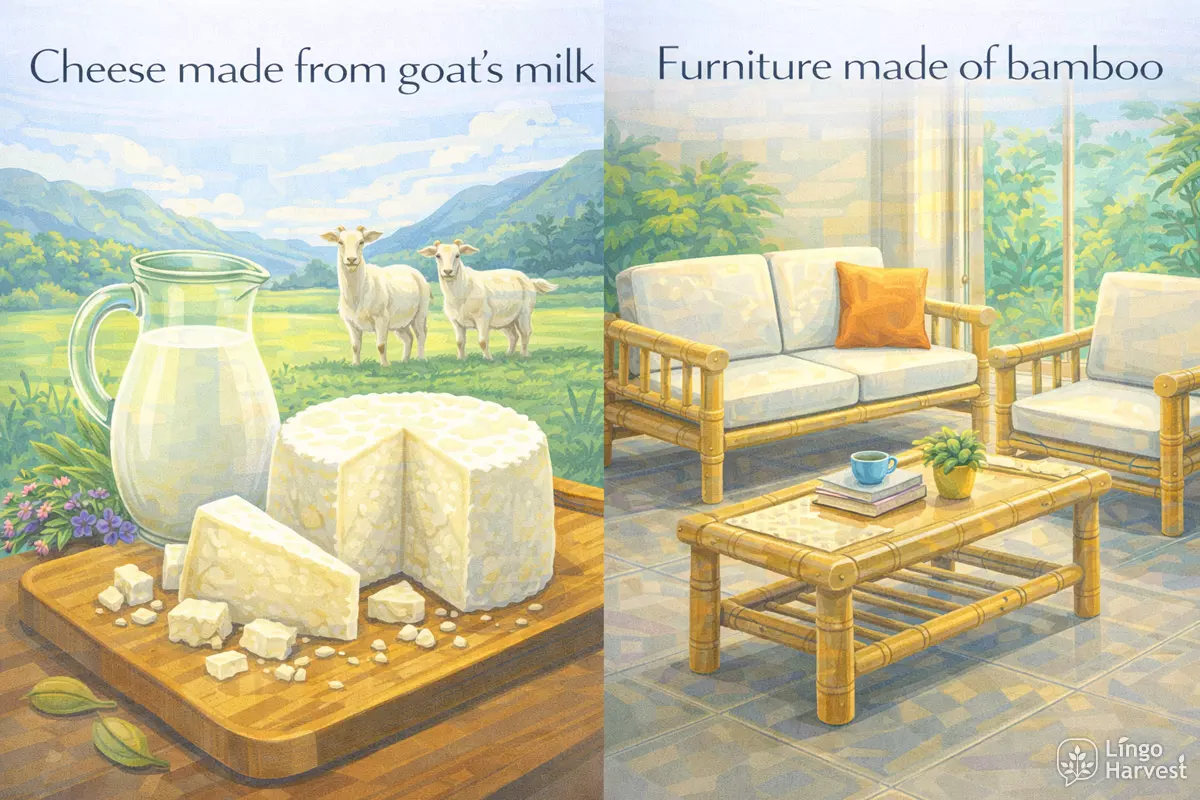
- Cheese made from goat's milk
- Furniture made of bamboo
- Pasta made with eggs
- Jewelry out of recycled glass
- Olive oil from Spain
- Soup made with fresh herbs
- Statue made of bronze
- Chocolate from Belgium
- Sweater made from wool
- Basket made out of straw
- Desk made of metal
- Wine made from grapes
- Jacket made with down feathers
- Cookies made with chocolate chips
- Perfume from natural oils
- Floor made of marble
- Vase out of clay
- Salad made with avocado
Choosing between "made of," "made from," and "made with"
| Expression | When to use | Example |
|---|---|---|
| made of | The material is visible and unchanged in appearance | A chair made of plastic |
| made from | The material is transformed; not obviously visible | Cheese made from milk |
| made with | Focus on key ingredients or components, often in food | Bread made with whole grains |
| out of | Emphasizes creation, often from unusual or recycled materials | Art made out of bottle caps |
By selecting the right prepositions, you can specify not only the source or material but also highlight the process or transformation involved. This helps listeners or readers understand exactly what a product is, how it was made, and where its components come from.
Examples from packaging, menus and instructions
When you look at product labels, restaurant menus, or user guides, you'll often see prepositions like from, out of, made of, made from, and made with used in various ways. These expressions help specify the source, ingredients, or origin of an item, and understanding them can make daily English much clearer.
Common phrases found on food packaging
- Made from 100% recycled materials
- Contains ingredients sourced from local farms
- Packaged in a box made of cardboard
- Produced out of organic wheat
- Made with real fruit juice
- Imported from Italy
- Made with non-GMO soy
- Crafted from handpicked grapes
- Free from artificial colors
- Extracted out of natural herbs
- Chocolate made with cocoa butter
- Bottle made of glass
How menus use prepositions of origin and ingredients
- Soup made from fresh tomatoes
- Pasta with sauce made of basil and olive oil
- Salad with cheese made from goat’s milk
- Dessert made with nuts
- Juice pressed out of ripe oranges
- Tea imported from India
- Bread baked with whole grains
- Coffee made from Arabica beans
Instructions and manuals: Indicating materials and components
- Table made of solid oak
- Handle made from stainless steel
- Cover made with waterproof fabric
- Frame constructed out of aluminum
- Parts sourced from Germany
- Panel made from recycled plastic
Comparing "made of", "made from", and "made with"
| Expression | Typical Use | Example Phrase |
|---|---|---|
| made of | Describes the material you can still see or feel in the final product | Bottle made of glass |
| made from | Focuses on transformation; the original material changes its form | Cheese made from milk |
| made with | Used for listing ingredients or components, not always the main one | Bread made with seeds |
These patterns appear everywhere in daily life, providing useful clues about where something comes from or what it’s constructed or prepared with. Noticing these prepositions can help you better understand packaging, food descriptions, and assembly instructions, and improve your own usage in English.
Practice: improve sentences describing origin and material
Understanding how to describe where something comes from or what it's made of is key to clear, natural English. Below you'll find exercises and tips for using "from," "out of," "made of," "made from," and "made with" to accurately express origin and material. Review the examples, then try the practice tasks to sharpen your skills.
Common mistakes and how to fix them
- Incorrect: This chair is made from wood.
Correct: This chair is made of wood. - Incorrect: The cake is made of eggs, flour, and sugar.
Correct: The cake is made with eggs, flour, and sugar. - Incorrect: She comes out of France.
Correct: She comes from France. - Incorrect: The statue is made with marble.
Correct: The statue is made of marble.
Improve the sentences
Rewrite the following sentences so they use the correct preposition or phrase to show origin or material:
- The vase is made from glass.
- These shoes are made with leather.
- The bread is made of flour and water.
- She is out of Spain.
- The clock was made from wood.
- My shirt is made with cotton.
- This soup is made of mushrooms and cream.
- Wine comes out of grapes.
- The sculpture is made with bronze.
- Chocolate is made of cocoa beans.
Show answers
- The vase is made of glass.
- These shoes are made of leather.
- The bread is made from flour and water.
- She is from Spain.
- The clock was made of wood.
- My shirt is made of cotton.
- This soup is made with mushrooms and cream.
- Wine comes from grapes.
- The sculpture is made of bronze.
- Chocolate is made from cocoa beans.
Patterns for expressing origin and material
Here are some useful patterns for describing what things are made of or where they come from:
- made of + material (when the material is visible and unchanged): "The table is made of wood."
- made from + material (when the material has been transformed): "Paper is made from trees."
- made with + ingredients (often for food): "This salad is made with tomatoes and lettuce."
- from + place of origin: "He is from Canada."
- out of + material (informal, often for something unusual): "She built a model out of matchsticks."
Comparison of prepositions for material and origin
| Phrase | Typical Use |
|---|---|
| made of | Material is unchanged and visible (wood, stone, metal, glass) |
| made from | Material has changed form (milk into cheese, trees into paper) |
| made with | Lists ingredients or components, especially for food |
| from | Describes place of origin (countries, cities, sources) |
| out of | Often emphasizes creativity or unusual materials |
Try it yourself: choose the best preposition
Fill in the blank with "of," "from," "with," or "out of":
- The bridge is made ____ steel.
- Cheese is made ____ milk.
- This dish is made ____ rice and vegetables.
- The artist built a sculpture ____ old car parts.
- He comes ____ Brazil.
- The table is made ____ wood.
- Wine is made ____ grapes.
- The cake is made ____ flour, eggs, and sugar.
- This bag is made ____ leather.
- The drink is made ____ fresh oranges.
Show answers
- of
- from
- with
- out of
- from
- of
- from
- with
- of
- with
Pay attention to the context and the nature of the material or origin when choosing the right preposition. With practice, your sentences will sound more natural and accurate.